
Why Embrace Adaptive Teams: HR Leader’s 2026 Guide

TL;DR:
- Adaptive teams are flexible groups that regularly reshape their structure, roles, and leadership to meet business demands. They outperform traditional teams in outcomes like engagement, innovation, and retention by emphasizing psychological safety and distributed decision-making. Building such teams requires leadership to shift from command to enablement, focusing on cultural change before adopting agile practices.
Adaptive teams are dynamic groups that continuously reshape their structure, roles, and leadership in response to changing business demands. Understanding why embrace adaptive teams matters is the starting point for any HR or business leader serious about reducing turnover and building real organizational resilience. 70% of technology leaders now rate adaptability as more critical to success than technical skills. That number signals a fundamental shift in how high-performing organizations think about talent. Companies like Atlassian and Novo Nordisk have built competitive advantage not on fixed org charts, but on teams that flex, learn, and reconfigure faster than their markets change.
Why embrace adaptive teams over traditional structures
Adaptive teams, known in organizational research as dynamic team models, outperform traditional fixed-role structures on nearly every measurable outcome. The core reason is simple: rigid teams are built for a world that no longer exists. 44% of worker skills are expected to change within five years. That means the team you build today around today’s skill sets will be structurally misaligned by 2030 without a deliberate mechanism for evolution.
The benefits of adaptive teams extend well beyond agility. Employees in flexible team environments report higher engagement because their work matches their actual strengths and energy patterns, not just their job title. Retention improves because people feel seen and utilized correctly. Innovation accelerates because cross-functional exposure creates the kind of cognitive friction that generates new ideas. These are not soft outcomes. They are measurable, and they compound over time.
Agility beats raw ability in modern success, according to organizational psychologist Adam Grant. The speed of learning and unlearning matters more than what someone already knows. Adaptive teams are the structural vehicle for making that principle operational across your workforce.
What makes teams adaptable? core traits that drive performance
The most effective adaptive teams share four defining characteristics that separate them from teams simply labeled “agile” on a slide deck.
- Structural fluidity: High-performing teams oscillate between flat and hierarchical structures depending on task complexity and time pressure. Teams that stay rigidly flat or permanently hierarchical underperform. The ability to shift modes is the differentiator, not the mode itself.
- Psychological safety: Members must feel safe enough to challenge assumptions, admit uncertainty, and experiment without fear of punishment. Without this foundation, no structural change produces real adaptability.
- Distributed decision-making: Authority flows to whoever holds the most relevant knowledge for a given decision, not to whoever holds the highest title. This speeds up execution and builds accountability at every level.
- Continuous sensing: Adaptive teams incorporate ongoing feedback loops and environmental scanning to stay aligned with shifting conditions. Transparency is not optional here. It is the operating system.
Cross-functionality is equally critical. When team members understand adjacent roles and disciplines, handoffs shrink, blind spots disappear, and problem-solving accelerates. Outcome accountability ties it together: adaptive teams are measured by what they deliver, not how closely they followed a process.
Pro Tip: Before redesigning your team structure, map the decision types your team makes weekly. Identify which decisions require speed and which require depth. That map tells you when to go flat and when hierarchy actually serves performance.

How do adaptive teams reduce turnover and improve workforce agility?
The connection between adaptive team structures and employee retention is direct and well-documented. Here is how the mechanism works in practice:
- Adaptability accelerates learning. When team members rotate across functions and take on evolving responsibilities, they grow faster. Growth is one of the top drivers of employee engagement and the primary reason high performers stay.
- Flexible talent models cut hiring delays. Flexible teams can reduce hiring time from 88 days to just days by using pre-vetted specialists on demand. That speed reduces the burnout that comes from understaffed teams carrying excess workload.
- Better communication reduces disengagement. Adaptive teams build strong feedback loops by design. Employees who receive regular, honest feedback are far less likely to disengage quietly before eventually leaving.
- Enabling leadership builds trust. Moving from commanding to enabling leadership is the single most important leadership shift for supporting adaptive teams. Managers who enable rather than control create the psychological safety that keeps people committed.
⚡️ The importance of flexible teams shows up most clearly in retention data. When people are placed in roles that match their personality and working style, not just their skills, they stay longer and perform better. This is exactly the insight behind organizational agility in HR: structural flexibility and people intelligence work together, not separately.
Traditional teams vs. adaptive teams: what the data shows
The differences between traditional and adaptive team models are structural, financial, and cultural. This comparison helps clarify what you are actually choosing between.
| Feature | Traditional Teams | Adaptive Teams |
|---|---|---|
| Role design | Fixed, defined by job title | Fluid, defined by work outcomes |
| Leadership style | Command and control | Enabling and distributed |
| Decision-making | Top-down hierarchy | Distributed to knowledge holders |
| Hiring approach | Permanent headcount growth | Mix of core staff and on-demand specialists |
| Response to change | Slow, requires restructuring | Fast, built into operating model |
| Innovation capacity | Limited by siloed functions | High, driven by cross-functional exposure |
| Turnover risk | Higher due to role mismatch | Lower due to fit-based placement |
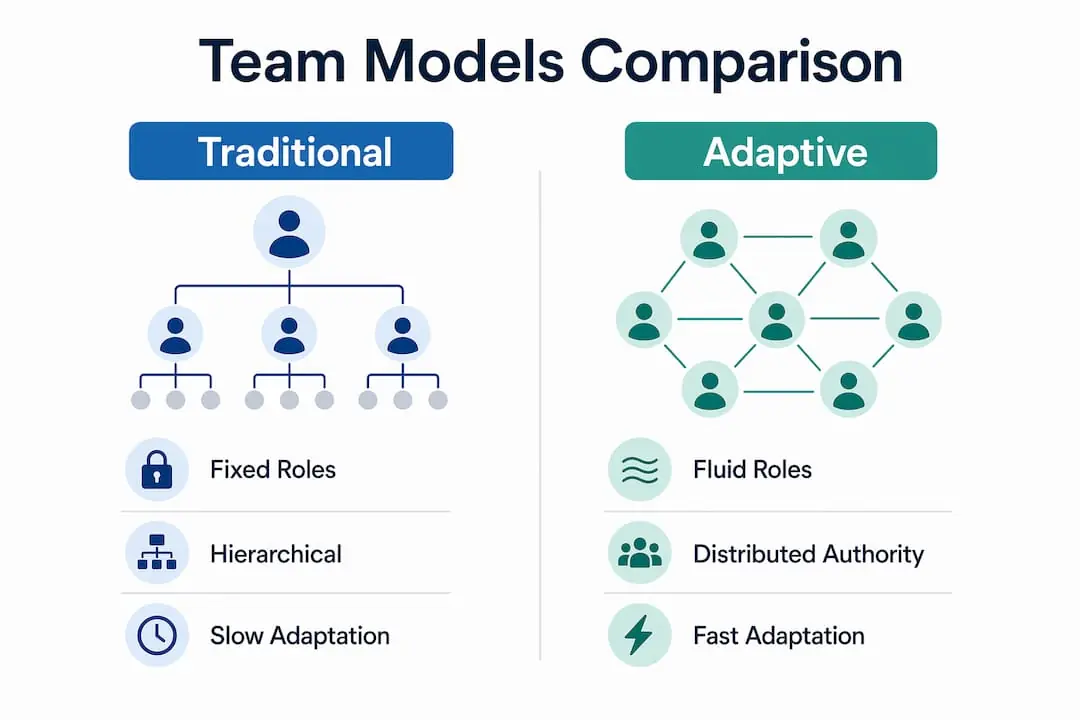
Companies building teams around work outcomes rather than fixed roles see measurably higher speed and quality in project delivery. This shifts focus from personnel management to capability deployment. The financial implication is significant: flexible teams decouple capabilities from permanent payroll commitments, reducing overhead while maintaining execution capacity.
Startups like those in the Y Combinator portfolio have long operated this way by necessity. What is new is that established enterprises, including global firms in financial services and healthcare, are now adopting the same model deliberately. The advantages of dynamic teams are no longer a startup luxury. They are a competitive requirement.
How to build adaptive teams: practical steps for HR leaders
Building genuinely adaptive teams requires more than renaming your Scrum ceremonies. The foundation must come before the operating model. Here is how to get it right:
- Start with work clarity, not role clarity. Define what outcomes need to be achieved before you define who should achieve them. Talent profiling that maps personality to work requirements, not just skills to job descriptions, produces far better team configurations.
- Build psychological safety deliberately. Run structured retrospectives. Reward people who surface problems early. Make it safe to say “I don’t know.” Organizations that skip this cultural foundation and jump straight to Agile frameworks consistently fail to realize adaptive benefits.
- Develop enabling leadership at every level. Train managers to distribute authority, not hoard it. Paradoxical leadership that balances performance demands with psychological safety fuels both experimentation and high performance. This is a learnable skill, not a personality trait.
- Integrate flexible talent strategically. Identify which capabilities your core team needs permanently and which can be accessed on demand. This reduces excess capacity costs and keeps the team lean and responsive.
- Embed continuous learning as a team practice. Schedule regular skill reviews, cross-training sessions, and external sensing activities. Adaptive teams do not wait for annual performance reviews to identify capability gaps.
The workforce structure upgrade most leaders need is not a new org chart. It is a new operating philosophy: people placed in the right context, with the right authority, and the right support to grow.
Pro Tip: Avoid the trap of superficial Agile adoption. Renaming your manager a “Scrum Master” without changing how decisions get made or how psychological safety is built produces frustration, not agility. Prioritize culture and leadership transformation first, then layer in the process.
Key takeaways
Adaptive teams outperform traditional structures because they align people to work outcomes, distribute authority intelligently, and build the psychological safety that keeps talent engaged and retained.
| Point | Details |
|---|---|
| Adaptability beats technical skill | 70% of tech leaders prioritize adaptability over expertise, making team flexibility a strategic asset. |
| Structure must flex with context | High-performing teams shift between flat and hierarchical modes based on task demands, not ideology. |
| Culture precedes operating model | Psychological safety and distributed decision-making must exist before Agile frameworks deliver results. |
| Flexible talent reduces turnover risk | Outcome-based roles and on-demand specialists cut hiring delays and reduce burnout from understaffing. |
| Enabling leadership is the multiplier | Shifting from command to enabling leadership is the single highest-leverage change for adaptive team success. |
The shift most leaders are not ready to make
I have worked with dozens of HR leaders and business founders who genuinely want adaptive teams. They read the research, they attend the workshops, and they come back energized. Then six months later, the org chart looks exactly the same. The reason is almost always the same too: the leaders themselves have not changed how they lead.
Building adaptive teams is not primarily a structural challenge. It is a leadership identity challenge. Moving from commanding to enabling means giving up the feeling of control that most leaders were promoted for demonstrating. That is uncomfortable. It requires trusting people you have not fully tested yet, in situations where the outcome is uncertain.
What I have seen work is starting small and making the shift visible. Pick one team, one project, one quarter. Distribute real authority. Build in real feedback loops. Measure what happens. The data almost always supports continuing. But you have to be willing to run the experiment without guaranteeing the outcome in advance.
The other pitfall I see consistently is confusing personality fit with skills fit. Skills can be learned. Personality determines how someone processes ambiguity, responds to feedback, and collaborates under pressure. Those are the variables that predict whether someone thrives in an adaptive team or burns out in one. That is why tools like Sparkly, which assess personality as the primary variable, produce more reliable team configurations than skills-based assessments alone. You can teach someone a new framework. You cannot teach them a new nervous system.
The long-term competitive advantage of adaptive teams is real. But it requires leaders who are willing to model the adaptability they are asking of their teams.
— Mikk
How Sparkly helps you build smarter adaptive teams
Adaptive teams succeed when people are placed in contexts that match who they actually are, not just what they have done before. Sparkly is built on exactly that principle. ⚡️
Sparkly merges psychometric assessments, Human Design, AI analysis, and human judgment to produce higher-probability insights about personality, role fit, and team dynamics. Unlike tools that assess skills, Sparkly focuses on the traits that predict how someone will perform in a fluid, high-accountability environment. HR leaders use Sparkly to redesign jobs around personality strengths, identify team members ready for expanded roles, and reduce the costly mismatch that drives turnover. If you are serious about building teams that adapt and retain talent, explore how SaaS transforms employee potential and see how Sparkly fits into your people strategy. You can also review personality-focused assessment strategies to get started with a practical framework today.
FAQ
What are adaptive teams in organizational management?
Adaptive teams are dynamic groups that shift their structure, roles, and leadership style in response to changing business conditions. They prioritize outcomes over fixed job titles and distribute decision-making authority based on knowledge, not hierarchy.
Why do adaptive teams reduce employee turnover?
Adaptive teams reduce turnover by placing people in roles that match their personality and working style, not just their skills. Better fit reduces disengagement, burnout, and the quiet quitting that precedes most voluntary exits.
How do adaptive teams differ from agile teams?
Agile is a specific methodology with defined ceremonies and roles. Adaptive teams are a broader organizational model that may use Agile practices but prioritizes cultural foundations like psychological safety and enabling leadership over any single framework.
What is the biggest mistake when building adaptive teams?
The most common mistake is adopting Agile processes without first building the cultural and leadership foundation. Organizations that skip psychological safety and distributed decision-making consistently fail to realize the benefits of adaptive team models.
How do you assess whether someone fits an adaptive team?
Personality-based assessment is more predictive than skills testing for adaptive team fit. Tools that evaluate how someone processes ambiguity, responds to feedback, and collaborates under pressure, like those offered by Sparkly, provide stronger signals for team agility decisions than resume-based screening alone.