The Role of AI in Employee Assessment in 2026

TL;DR:
- AI in employee assessment is revolutionizing HR by enhancing decision quality and providing better data, not just automation. Its adoption accelerates rapidly, supporting continuous feedback, bias detection, and predictive analytics while requiring responsible governance. To succeed, HR teams must focus on clear objectives, data quality, transparent communication, and integrating AI as a synthesis tool with human oversight.
The role of AI in employee assessment has shifted from experimental curiosity to a genuine competitive advantage for HR leaders who understand how to use it well. The problem is that most conversations about AI in HR still start in the wrong place. They focus on automation and speed when the real story is about better human decisions, not fewer of them. Traditional assessments have always carried blind spots: recency bias in manager reviews, inconsistency across teams, and feedback that arrives months after it could have changed anything. AI does not remove those problems on its own. But in the right hands, it gives you far better data to work with.
Table of Contents
- Key Takeaways
- The role of AI in employee assessment today
- How AI augments human judgment in assessment
- Benefits and challenges of AI-enabled assessment
- Practical steps for HR leaders to implement AI assessment
- Future trends in AI-powered assessment
- My take on AI and human judgment in assessment
- See how Sparkly approaches smarter assessment 💡
- FAQ
Key Takeaways
| Point | Details |
|---|---|
| AI adoption is accelerating fast | HR AI use jumped from 26% in 2024 to 43% in 2025, making governance skills urgent for HR teams. |
| AI augments, never replaces, human judgment | The best systems produce draft narratives and alerts, but final decisions must stay with managers. |
| Bias risks shift, not disappear | AI can introduce new scoring gaps by gender and race that require continuous model validation. |
| Personality insight drives better fit | Assessing who someone is, not just what they know, predicts role success far more reliably. |
| Governance determines outcomes | Transparency, explainability, and mandatory human review separate responsible AI use from risky shortcuts. |
The role of AI in employee assessment today
The numbers tell a clear story. AI adoption in HR grew from 26% in 2024 to 43% in 2025, a 17-point jump that makes this one of the fastest-adopted enterprise technologies in recent memory. That kind of growth rarely happens without pressure behind it, and in this case, the pressure is real: organizations need more feedback cycles, faster calibration, and better data than any single manager can realistically provide. ⚡️
AI is being applied across three broad functions in assessment right now. First, automation of repetitive tasks like compiling feedback surveys, flagging overdue reviews, and scheduling check-ins. Second, data synthesis, where systems pull together manager notes, peer comments, and performance metrics into a single coherent view. Third, prediction, where machine learning models identify employees at risk of disengagement or who may be ready for advancement before a manager would naturally notice.
The operational payoff is real too. AI saves an average of 4 hours per employee per review cycle. For an organization running mid-year and year-end reviews across 500 employees, that is 4,000 hours returned to strategic work. Organizations using AI-driven workforce intelligence report nearly 25% improvement in performance outcomes, which makes the business case hard to ignore.
Key capabilities showing up in modern systems include:
- Automated review drafts that managers edit rather than write from scratch
- Continuous feedback aggregation across peer, manager, and self-assessment inputs
- Turnover risk scoring based on engagement signals and performance trends
- Skills gap analysis that surfaces development needs before they become retention problems
How AI augments human judgment in assessment
The most useful mental model here is AI as a synthesis engine, not a decision-maker. The best implementations produce editable narrative drafts, surface coaching prompts, and alert managers to patterns they may have missed. The manager still owns the conversation and the outcome.

Here is what that looks like in practice. A manager working with an AI-enabled performance tool no longer starts a review cycle with a blank page. The system has already pulled together six months of project completion data, peer feedback themes, attendance patterns, and goal progress. Natural language processing (NLP) converts that raw data into a structured draft narrative. The manager’s job becomes editing and personalizing, not gathering and writing. That shift alone meaningfully reduces the cognitive load that causes rushed or inconsistent reviews.
AI-powered performance systems transform evaluations from episodic events into continuous, evidence-led coaching. Instead of one high-stakes conversation per year, managers get real-time prompts: “Alex has completed three cross-functional projects this quarter. Consider discussing a stretch assignment.” That kind of timely coaching prompt is something most managers would generate on their own if they had the time and the data. AI gives them both.
On the bias mitigation side, AI tools can flag calibration issues across teams. If one manager consistently rates their team two points higher than peers across comparable roles, the system surfaces that pattern before the data feeds into compensation decisions. It does not eliminate bias, but it makes the bias visible, which is the first condition for addressing it.
Pro Tip: When evaluating any AI assessment tool, ask the vendor specifically how it flags rating calibration gaps across managers. If they cannot show you that feature with a live example, the tool is not yet mature enough for fair performance use.
Predictive analytics add another dimension. Machine learning models trained on historical data can identify employees whose behavioral patterns resemble those of high-performers who left within 18 months. That is not a termination signal. It is an early warning to have a development conversation before the person updates their resume. You can read more about how this applies earlier in the talent lifecycle in this overview of the impact of AI on recruitment.
Benefits and challenges of AI-enabled assessment
📈 The upside of AI in employee assessment is real and documented. When you anchor feedback in observable behaviors rather than subjective impressions, AI democratizes the process in ways that benefit employees who do not have strong informal relationships with their managers. The quieter, more introverted performer who delivers excellent work but does not self-promote gets a fairer shot when the system is tracking output, not personality.
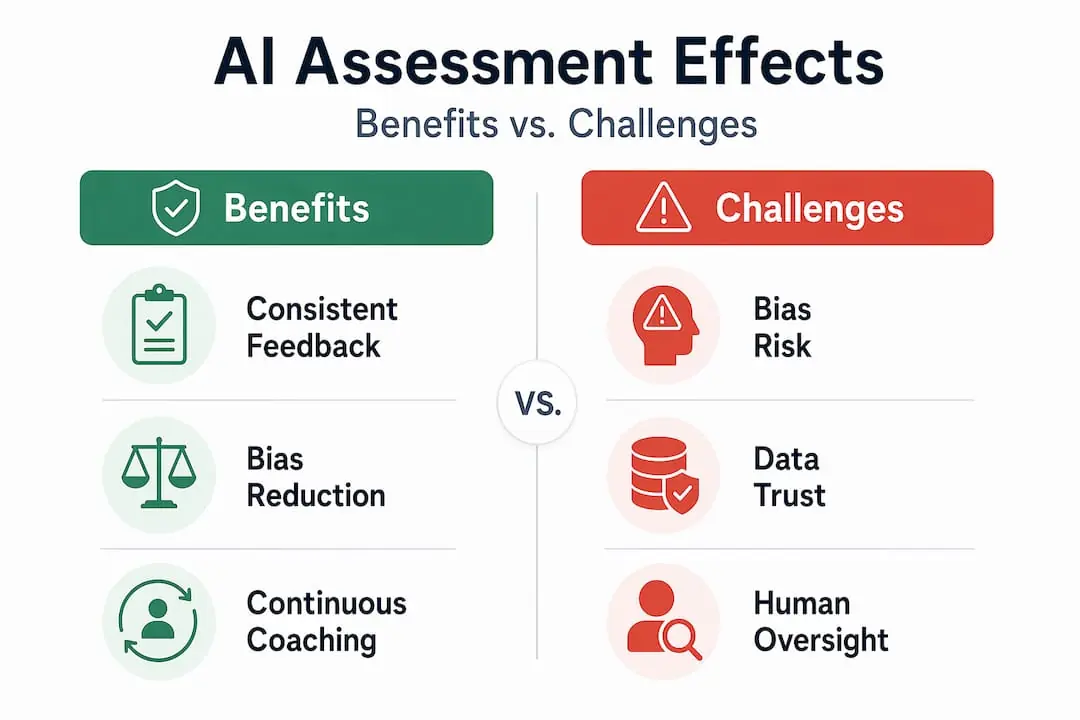
| Benefit | Challenge |
|---|---|
| More consistent feedback across teams | Risk of AI perpetuating or shifting existing bias patterns |
| Reduced time per review cycle | Employee distrust around surveillance and data use |
| Real-time coaching prompts for managers | Lack of explainability in algorithmic scoring |
| Personalized development recommendations | Over-reliance on metrics that miss context |
| Earlier identification of flight risk | Legal and compliance exposure without proper governance |
The challenges deserve the same directness. AI tools can produce different scores for women and minorities compared to human recruiters. That finding from field experiments on AI assessment is not a reason to avoid AI. It is a reason to audit your models continuously and never let an AI score stand without human review.
The trust issue is equally serious. 59% of workers believe AI may exacerbate bias rather than reduce it. That perception gap between what HR leaders intend and what employees experience can erode engagement faster than a bad manager. Transparent communication about what data the system uses, what it does not, and who makes final decisions is not optional. It is the price of trust.
“The question is not whether AI will be part of performance management. It already is. The question is whether your organization is governing it well enough to make it a net positive for the people it assesses.”
Practical steps for HR leaders to implement AI assessment
Moving from interest to implementation requires a clear sequence. Here is what the research and real-world pilots consistently show works:
-
Define a specific objective first. Do not implement AI for assessment broadly. Choose one problem: reducing bias in calibration, increasing feedback frequency, or cutting review drafting time. A focused objective gives you a measurable outcome and keeps the pilot manageable.
-
Audit your data sources before you touch any tool. AI systems are only as fair as the data they learn from. If your historical performance data contains rating gaps by gender, tenure, or team, the model will learn those patterns. Clean data governance comes before vendor selection.
-
Run a structured pilot with defined KPIs. Choose two or three teams, set baseline metrics (feedback frequency, calibration variance, review completion rates), and measure the change after one full cycle. Include manager satisfaction and employee perception in your KPIs, not just efficiency metrics.
-
Train managers on interpretation, not just operation. Managers need to understand that an AI turnover risk score is a conversation starter, not a verdict. Without that framing, you will get either blind trust in the algorithm or blanket skepticism toward it.
-
Communicate to employees before you launch. Explain what data feeds the system, what decisions humans still make, and how employees can question an assessment. Transparent AI governance including audits and explainable models is increasingly expected by regulators and employees alike.
Pro Tip: Schedule a quarterly model review with whoever manages your AI vendor relationship. Ask for demographic breakdown data on assessment scores every cycle. If the vendor is not providing that routinely, make it a contract requirement.
For HR leaders exploring the full range of assessment types that pair well with AI-assisted evaluation, the guide on types of HR assessments is worth bookmarking.
Future trends in AI-powered assessment
The next evolution is already visible in leading organizations. Static, annual snapshots are giving way to continuous, real-time capability mapping. Think of it less like a report card and more like a live dashboard that updates as work gets done.
AI analytics enable personalized learning pathways by linking feedback directly to competency models and skills inventories. Instead of generic development plans, employees receive targeted recommendations based on their actual behavioral patterns and the specific gaps their role requires. That shift from generic to precise is where AI adds the most visible value to individual careers.
The most exciting frontier is mobility forecasting. AI systems are beginning to predict not just who might leave, but who is ready to move into an adjacent role they have never held. That kind of internal talent intelligence reduces the cost and risk of external hiring while creating visible growth paths for high-potential employees.
| Emerging capability | Expected impact |
|---|---|
| Continuous real-time feedback loops | Replaces annual review dependency with ongoing coaching |
| Skills trajectory modeling | Forecasts readiness for role transitions before employees self-identify |
| Bias-aware assessment design | Reduces demographic scoring gaps through model auditing |
| Integrated learning recommendations | Connects performance data directly to development content |
One underappreciated shift is the move toward personality-centered assessment in AI models. Skills can be taught. Personality, working style, and cognitive preferences are far more stable predictors of fit and satisfaction. The organizations getting the most from AI in talent evaluation are those that feed personality and behavioral data into their models alongside performance metrics.
My take on AI and human judgment in assessment
I have seen HR leaders make two opposite mistakes with AI assessment tools. The first is treating the algorithm as the authority, letting scores drive decisions without question. The second is using AI outputs as decoration, running the process but ignoring the data when it challenges a manager’s existing view. Neither approach works.
What I have learned from working across organizations at different stages of AI adoption is that the technology itself is rarely the obstacle. The obstacle is a culture that has not decided what AI is actually for. If AI is there to confirm gut feelings, you are wasting the investment. If it is there to surface information a manager could not realistically gather alone, and then a human makes the final call with full accountability, you get better outcomes.
The piece most HR leaders underinvest in is the personality layer. Skills on a resume tell you what someone has done. Personality data tells you how they will perform in this role, with this team, under this kind of pressure. That combination of human insight and AI synthesis is where the real signal lives.
Transparency is not a nice-to-have either. Every employee assessed by an AI-informed process deserves to know what data shaped that assessment and who had final say. When you build that trust, AI becomes a tool that employees welcome rather than fear. And that changes everything about how performance conversations actually go.
— Mikk
See how Sparkly approaches smarter assessment 💡
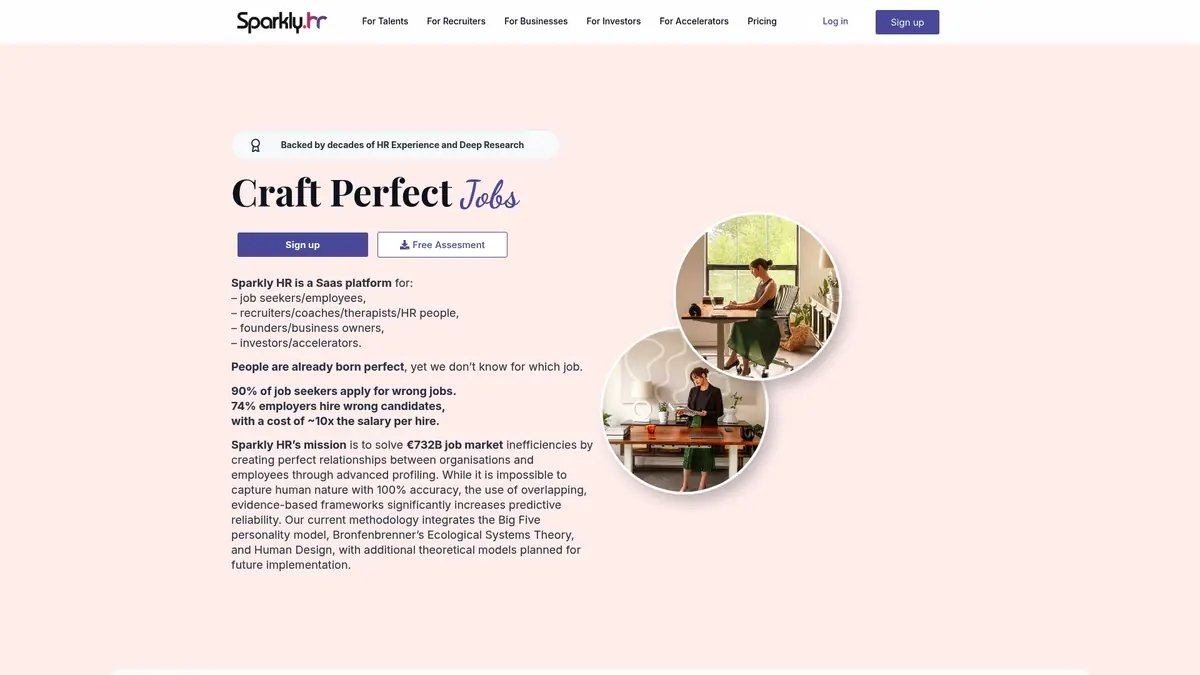
Sparkly was built on a premise most assessment tools ignore: people are not wrong, they are often just placed in the wrong roles. Where most platforms focus on skills and performance history, Sparkly goes deeper by prioritizing personality, behavioral patterns, and role fit as the primary signals for assessment.
Sparkly merges four data sources that are individually unreliable: human judgment, AI analysis, psychometric assessments, and Human Design. Together, they produce higher-probability insights that HR teams can actually use in interviews and team design decisions. The result is a clearer picture of who someone really is and where they will thrive.
If you are building or refining your organization’s assessment approach, explore how SaaS platforms are transforming HR potential and compare the top talent evaluation platforms for 2026 to find the right fit for your team.
FAQ
What is the role of AI in employee assessment?
AI supports employee assessment by automating data collection, generating draft review narratives, flagging calibration gaps, and predicting turnover risk. It augments human judgment rather than replacing it, with final decisions remaining with managers.
How does AI improve employee evaluation fairness?
AI anchors feedback in observable behaviors and flags rating inconsistencies across teams, which reduces the impact of recency bias and subjective impressions. However, AI models must be continuously audited, as they can introduce new scoring gaps by gender or race.
How much time does AI save in performance reviews?
AI-assisted performance management saves an average of 4 hours per employee per review cycle, primarily by automating draft generation and data compilation tasks.
What are the biggest risks of using AI for employee assessment?
The main risks are algorithmic bias, employee distrust around data surveillance, and over-reliance on metrics without human context. Transparent governance, explainable models, and mandatory human review at every decision point are the most effective safeguards.
How should HR leaders start implementing AI in assessments?
Start with a single focused objective, audit your existing performance data for bias before selecting a tool, and run a small pilot with defined KPIs. Train managers to interpret AI outputs critically and communicate to employees exactly how the system works before launch.