
Talent Profiling Step by Step: Your 2026 HR Guide

TL;DR:
- Most organizations lose valuable employees because they misplace talent rather than hire poorly. Talent profiling offers a structured, repeatable method for understanding individual capabilities and optimizing role fit. Regularly updating and calibrating profiles ensures better hiring, development, and retention outcomes, reducing turnover costs.
Most organizations lose good people not because they hired wrong, but because they placed people wrong. Talent profiling step by step gives HR professionals and business leaders a repeatable method to understand who they have, what those people are genuinely capable of, and where they will thrive. Without a structured approach, you are left guessing. The result? Mismatched roles, disengaged teams, and turnover costs that quietly drain the business. A well-structured profiling process improves hiring quality, reduces time-to-fill, and cuts turnover costs significantly. This guide walks you through every stage.
Table of Contents
- Key Takeaways
- Talent profiling step by step: what it means and what you need
- Steps 1 to 3: the preparation phase
- Steps 4 to 6: execution, calibration, and frameworks
- Steps 7 to 8: verification and continuous improvement
- Common mistakes that undermine talent profiling
- My perspective on what actually makes this work
- How Sparkly accelerates your talent profiling process
- FAQ
Key Takeaways
| Point | Details |
|---|---|
| Start with clear scope | Profile a small, high-impact group first to avoid resource strain and keep the process manageable. |
| Separate must-haves from nice-to-haves | Limit critical criteria to 3 to 5 items so your talent pool stays realistic and searches stay focused. |
| Calibrate before you categorize | Run evaluator alignment sessions before sorting people into talent frameworks to reduce bias and rating drift. |
| Turn profiles into plans | Every completed talent profile should feed directly into an individualized development or succession plan. |
| Refine continuously | Revisit profiles after key milestones like 90-day reviews to sharpen accuracy and stay current. |
Talent profiling step by step: what it means and what you need
Talent profiling is the structured process of capturing what makes an individual effective in a given role, team, and organizational context. It goes beyond skills on a resume. A complete profile includes competencies, behavioral patterns, performance data, and personality traits that predict how someone will actually show up under pressure, in collaboration, and during change.
Before you start collecting data, you need a few things in place:
- Role frameworks that define what success looks like in each position you are profiling
- Assessment tools covering personality, cognitive style, and values (not just skills checklists)
- Performance data from reviews, output metrics, and project history
- Peer and manager feedback gathered through structured formats, not casual impressions
- A defined business goal the profiling process is meant to support, whether that is succession planning, restructuring, or improving a specific team’s output
The talent identification process becomes genuinely useful only when it connects to a real decision. Profiling for its own sake creates paperwork. Profiling tied to a promotion cycle, a team redesign, or a hiring need creates clarity. Tech platforms such as applicant tracking systems and skills intelligence tools increase accuracy by mapping talent data to job requirements in real time.
| Data Source | What It Reveals |
|---|---|
| Psychometric assessments | Personality traits, energy patterns, working style preferences |
| Performance reviews | Output consistency, goal achievement, behavior under pressure |
| Peer feedback | Collaboration style, team impact, interpersonal patterns |
| Manager observations | Role fit signals, growth trajectory, adaptability |
| Self-assessments | Self-awareness, development priorities, motivation drivers |
Steps 1 to 3: the preparation phase
The most common reason talent profiling fails is not poor execution. It is poor preparation. If you start collecting data before you know what you are looking for or who you are profiling, you will end up with a mountain of information and no way to use it.
Here is how to set the foundation correctly:
-
Define your scope. Choose one or two key groups or roles to profile first. Limiting initial profiling to a few groups on a biannual cadence prevents overwhelm and keeps quality high. A team of 10 senior engineers or a group of middle managers is a workable starting point.
-
Identify your must-haves. Separating must-haves from nice-to-haves shortens searches and keeps profiling realistic. Aim for 3 to 5 non-negotiable success criteria per role. These might include things like high tolerance for ambiguity, ability to influence without authority, or a specific cognitive style. Nice-to-haves go on a secondary list and do not drive decisions.
-
Assign evaluator roles. Decide who is responsible for what. HR typically owns the process design and data consolidation. Direct managers contribute behavioral observations. Skip-level leaders add strategic context. Peers contribute collaboration data. Each evaluator needs a defined lane and a structured format to contribute.
Pro Tip: Build a one-page brief for each evaluator before the process begins. It should explain what the profile is for, what they are expected to contribute, and what “good data” looks like. Vague input is almost always the result of vague instructions.
Structured talent assessment with clear roles and timelines reduces inefficiencies and creates consistency across your entire process. Spend real time here. Steps 1 to 3 are where most of the value gets built or lost.
Steps 4 to 6: execution, calibration, and frameworks
Now you collect, align, and sort. This phase is where most organizations rush, and where the most meaningful decisions get made.

Gathering multi-source data
Do not rely on a single input. A manager’s impression of someone is shaped by their own biases, working style, and relationship history. Grounding decisions in multi-source data including peer recognition and explicit category definitions is what separates a reliable talent profile from a manager’s opinion. Pull together performance review data, structured peer feedback, assessment results, and any relevant output metrics simultaneously.
Sparkly takes this a step further by merging four typically unreliable data sources: human observation, AI analysis, psychometric assessments, and Human Design frameworks. The goal is not any single source but the convergence point across all of them, which produces higher-probability insights about role fit, team dynamics, and individual potential.
Running calibration meetings
Before you sort anyone into a talent framework, you need evaluators to align on what the categories actually mean. Calibration sessions surface rating discrepancies and give managers a chance to present their evidence before decisions are locked in.
A calibration meeting is not a debate about who is better. It is a structured review where each evaluator presents their data, discrepancies are surfaced, and the group agrees on placement based on evidence, not consensus. This step is a practical safeguard against inconsistent ratings. Without it, one tough-grading manager and one generous one will place equivalent employees in completely different talent tiers.
Pro Tip: Set a rule before calibration begins: every placement must be supported by at least two independent data points. This stops the loudest voice in the room from driving decisions.
Using a talent framework
The 9-box grid is the most widely used talent categorization tool, plotting employees across two axes: current performance and future potential. Other frameworks focus on role readiness, succession pipeline depth, or team dynamics fit. The right framework depends on what decision you are trying to make.
| Framework | Best Used For |
|---|---|
| 9-box grid | Succession planning and leadership pipeline visibility |
| Skills matrix | Identifying technical gaps across a team |
| Role-fit scoring | Restructuring and redeployment decisions |
| Personality mapping | Team dynamics, communication style alignment |
Skills-based hiring frameworks use structured assessments to reduce bias and create continuously improving talent data. The same logic applies internally. Whatever framework you choose, document your definitions clearly so everyone is sorting against the same standard. ⚡️
Steps 7 to 8: verification and continuous improvement
A talent profile that does not lead to action is just a document. Steps 7 and 8 are where profiling generates real return on investment.
-
Create individualized development plans. Each employee’s profile should feed directly into a plan that addresses skill gaps, reskilling priorities, or readiness for a stretch role. These plans should be specific. “Improve communication” is not a plan. “Present quarterly results to the leadership team by Q3 and complete one facilitation training by June” is.
-
Communicate findings carefully. Ongoing communication and feedback prevent morale damage when talent review outcomes are shared. Managers should discuss individual learnings and development paths without sharing comparative rankings. Telling someone they are in the “high potential” box is fine. Telling them they scored lower than a peer is not, and it rarely helps.
-
Track growth against the profile. Set a 90-day checkpoint after any major profile-driven decision, whether that is a role change, a promotion, or a new development plan. Check whether the predicted behaviors and strengths are showing up as expected.
-
Refine the profiles regularly. Profile accuracy compounds when you update must-have criteria based on what you observe after placements and role changes. Review every active profile at a minimum once every six months and after every major organizational shift.
The talent development steps work best as a cycle, not a one-time project. Each iteration makes your profiling criteria sharper, your placements more accurate, and your team stronger.
Common mistakes that undermine talent profiling
Even well-intentioned profiling efforts can go sideways. Here are the traps to watch for:
-
Overloading the must-have list. When everything is critical, nothing is. More than five must-haves in a single profile almost always reflects unclear thinking about what the role actually requires. Cut ruthlessly.
-
Relying on manager intuition alone. One person’s gut feeling is not a talent profile. Subjective consensus without multi-source evidence produces decisions that feel confident and land badly.
-
Profiling without a follow-up mechanism. If there is no process to turn profile data into development plans, the entire effort produces no change. Build the follow-up into the project plan before you start collecting data.
-
Running profiles too infrequently or too often. Annual-only reviews miss critical changes. Monthly reviews create administrative drag. Biannual reviews with 90-day checkpoints hit the right balance for most organizations.
Pro Tip: Train your evaluators before every profiling cycle, not just the first time. Rating frameworks drift over time. A 30-minute refresh before each round costs almost nothing and significantly improves calibration quality.
My perspective on what actually makes this work
I’ve seen organizations spend months building elaborate talent profiles and end up with data nobody uses. I’ve also seen lean, focused profiling processes produce genuine succession pipelines and measurable drops in turnover within a year. The difference is almost never the sophistication of the tool. It is operational usability.
What I’ve learned is this: the more complex your profiling framework, the less likely it is to survive contact with a busy quarter. The best talent profiling guide I can offer you is a simple one. Start with one group. Define three to five behaviors that actually predict success in that role. Gather data from at least three sources. Calibrate before you categorize. Then act on what you find.
The organizations I’ve worked with that treat talent profiling as a living process rather than an annual event are the ones that build genuine competitive advantage from it. Profiles that get updated, challenged, and refined based on real outcomes are worth ten times more than perfect profiles that sit in a shared folder untouched.
The other thing I feel strongly about is the role of personality in this process. Skills can be learned. Personality is far more durable. Designing roles and teams around who people fundamentally are, rather than what credentials they happen to hold, is where the real leverage lives.
— Mikk
How Sparkly accelerates your talent profiling process
If you are building out a talent profiling process and want data you can actually trust, Sparkly was designed for exactly this problem.
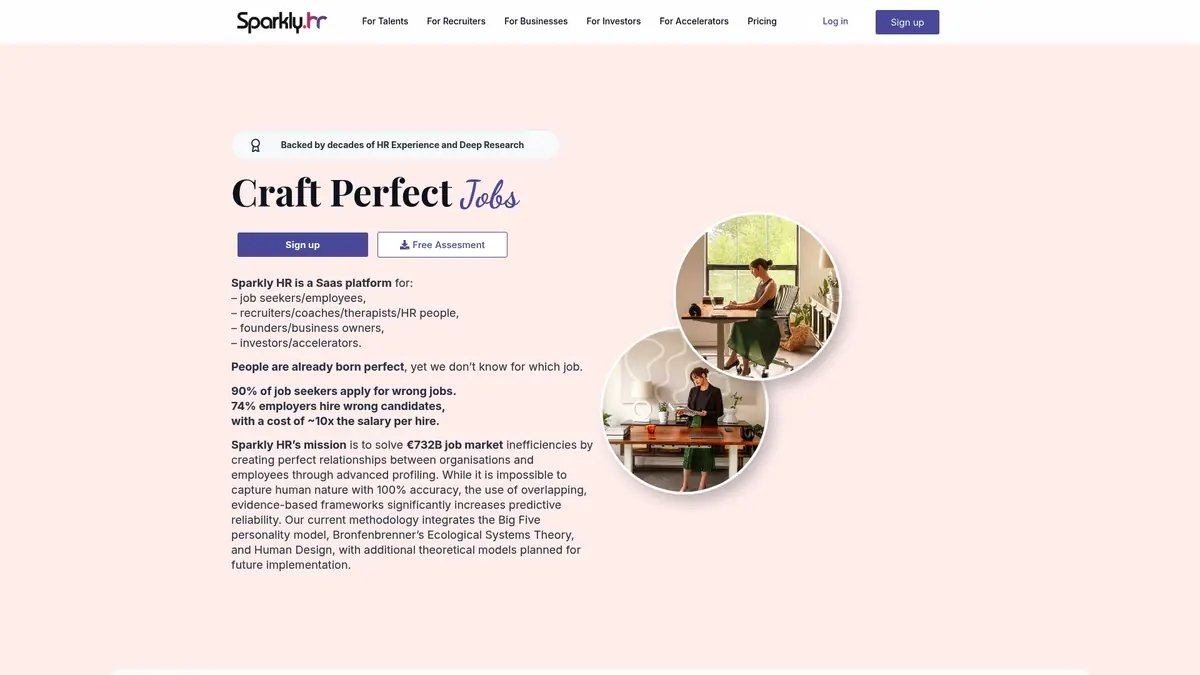
Sparkly merges four data sources that are each unreliable on their own: human observation, AI analysis, psychometric assessments, and Human Design frameworks. Together, they produce higher-probability insights that HR professionals can use directly in interviews, development conversations, and placement decisions. The platform focuses on personality first, because personality shapes how someone performs in any given environment far more than their current skill set does. You can explore how SaaS transforms employee potential or browse the top talent evaluation tools to see how Sparkly compares. If you are ready to move from gut feeling to evidence, Sparkly gives you a structured, repeatable way to get there.
FAQ
What is talent profiling and why does it matter?
Talent profiling is the structured process of capturing an individual’s competencies, behavioral patterns, personality traits, and performance data to determine how well they fit a role or team. It matters because mismatched placements drive turnover and productivity loss more than most organizations realize.
How many steps are in a talent profiling process?
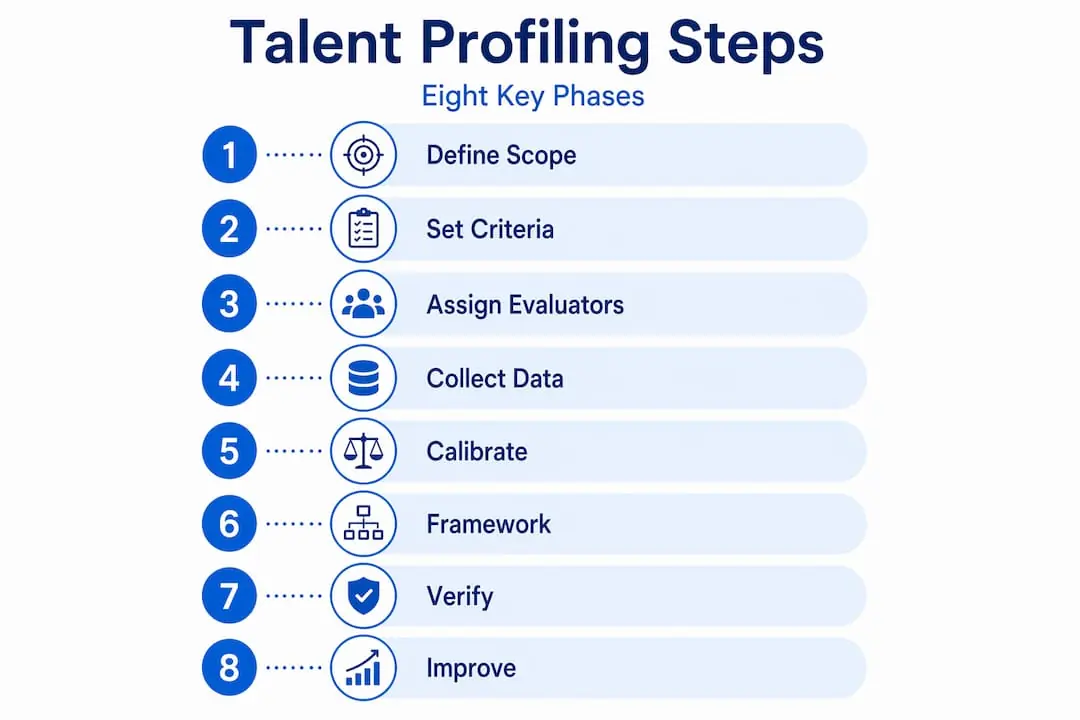
A complete talent profiling process typically involves eight steps: defining scope, setting criteria, assigning evaluators, gathering multi-source data, running calibration sessions, applying a talent framework, creating development plans, and refining profiles continuously.
How do you avoid bias in talent reviews?
Bias is reduced by calibrating evaluators before categorizing anyone and requiring every placement to be supported by at least two independent data points rather than a single manager’s impression.
How often should talent profiles be updated?
Most organizations benefit from a biannual review cycle with 90-day checkpoints after major placement or development decisions, and a full profile refresh at least once every six months.
What is the difference between must-have and nice-to-have criteria in a talent profile?
Must-haves are the three to five non-negotiable behaviors or traits that predict success in a specific role. Nice-to-haves are desirable but not decisive. Keeping this distinction clear keeps your talent pool realistic and your decisions focused.