
What Is Organizational Design? A 2026 Guide for Managers

TL;DR:
- Organizational design involves intentionally aligning a company’s structure, processes, and incentives with strategic goals beyond just creating an org chart. It encompasses decision-making, work flow, and accountability, especially critical during growth or strategic shifts to maintain performance and agility. Effective design relies on understanding informal networks, cultural adaptation, and continuous assessment to ensure the system functions cohesively and adapts over time.
Organizational design is defined as the intentional, holistic blueprinting of a company’s structure, processes, people, and technology to align with strategic goals. It goes far beyond drawing an org chart. When you design an organization deliberately, you are deciding how decisions get made, how work flows between teams, how accountability is distributed, and how the entire system responds when strategy shifts. For managers and executives, understanding organizational design is the difference between a company that executes well and one that constantly fights internal friction. ⚡️
What is organizational design and why does it matter?
Organizational design is the formal discipline of structuring how an organization operates as a system. The term is often confused with “restructuring,” but the two are not the same. Restructuring typically means moving boxes on a chart. Organizational design means rethinking how the entire system, including roles, decision rights, workflows, and incentives, works together to produce results.

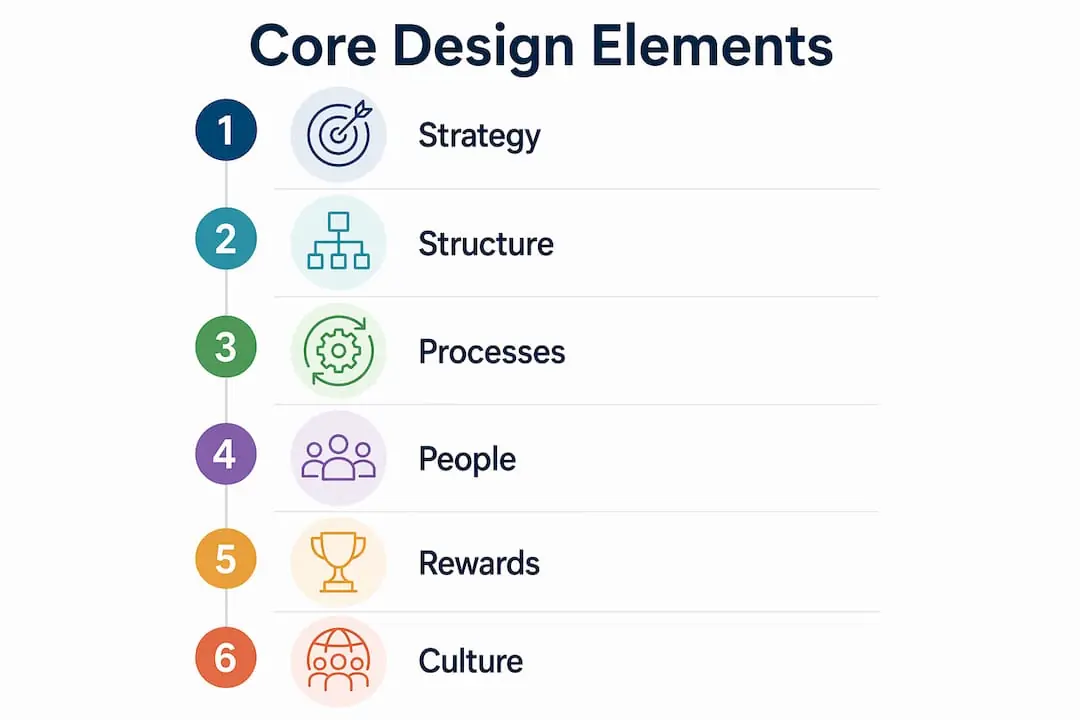
Effective organizational design involves five to seven core elements: strategy, structure, processes, people, and rewards and metrics. These elements are interdependent. Change one without adjusting the others, and you create misalignment. For example, a company can adopt a flat structure but still reward managers for hoarding information, which kills the very collaboration the flat structure was meant to create.
The importance of organizational design becomes clearest during periods of growth, merger, or strategic pivot. A company scaling from 50 to 500 employees cannot operate on the same informal coordination mechanisms it used at startup. Without deliberate design, communication breaks down, accountability blurs, and talented people leave because they cannot see where they fit. This is the core reason organizational design belongs on every executive’s agenda, not just in HR.
What are the core elements of organizational design?
The most practical framework for understanding the elements of organizational design is the Four Cs model developed by Professor John Joseph at UC Irvine’s Paul Merage School of Business. The Four Cs framework covers Configuration, Control, Channelization, and Coordination. Each element addresses a distinct dimension of how an organization functions.
- Configuration refers to the formal structure: how roles, teams, and reporting lines are arranged. This is the element most people think of when they hear “org chart.”
- Control covers the mechanisms that govern behavior: performance metrics, incentives, approval processes, and accountability structures.
- Channelization describes how information and resources flow through the organization, including communication channels, knowledge management systems, and decision pipelines.
- Coordination addresses how different parts of the organization work together, through cross-functional teams, shared goals, or lateral integration mechanisms.
| Element | Role in organizational design |
|---|---|
| Strategy | Sets the direction all other elements must support |
| Structure | Defines reporting lines, teams, and role groupings |
| Processes | Governs how work gets done and decisions get made |
| People | Matches talent, personality, and capability to roles |
| Rewards and metrics | Reinforces the behaviors the design requires |
The critical insight here is that organizational design influences informal networks, culture, and the social fabric of a company. Changes ripple beyond formal structures. A new reporting line does not just change who someone reports to. It changes who they talk to, whose priorities they absorb, and how they think about their own contribution.
Pro Tip: Before redesigning any element, map how information currently flows informally. The informal network often reveals where real decisions are made, and that is where your redesign needs to focus first.
How do traditional and modern organizational design models differ?
Traditional hierarchical models excel at control and consistency. They work well in stable environments where tasks are predictable and compliance matters more than speed. The military, large manufacturing firms, and regulated financial institutions have used hierarchical structures effectively for decades. The tradeoff is clear: traditional hierarchical models limit speed and adaptation compared to agile, autonomous team-based approaches.
Modern organizational design models move in the opposite direction. Modern organizations are shifting from traditional hierarchies to skills-informed, adaptive models that flatten decision-making to improve speed, responsiveness, and capability intelligence. In practice, this means:
- Pushing decision rights closer to the work, not up the chain
- Replacing annual performance reviews with continuous feedback loops
- Using real-time capability data to match people to tasks dynamically
- Building cross-functional squads that own outcomes end to end
AI is accelerating this shift significantly. Companies like Google, Spotify, and Amazon have each experimented with models that use data to inform role design and team composition rather than relying on tenure or title. The result is a design philosophy where the organization adapts continuously rather than waiting for a formal restructuring cycle every three to five years.
The practical difference for you as a manager is this: a traditional model asks “who is in charge?” A modern adaptive model asks “who has the best information and capability to make this decision right now?” That is a fundamentally different operating logic, and it requires a fundamentally different design.
Pro Tip: If your organization is moving toward a flatter model, start by piloting decision habits in one team before rolling out company-wide. Delegation without clear guardrails creates confusion, not speed.
Why organizational design matters for performance and culture
The benefits of effective organizational design show up directly in employee engagement, operational efficiency, and the organization’s ability to absorb change. When design is poor, the symptoms are predictable: slow decisions, duplicated work, unclear accountability, and high turnover among high performers. When design is strong, people know what they own, how to get resources, and how their work connects to strategy.
Organizational change often fails due to misunderstanding how people experience change rather than poor strategy. This is a critical point. Most transformation efforts invest heavily in new processes and structures but underinvest in helping people understand what the change means for them personally. The result is a beautiful new org chart that nobody actually follows.
“The user experience is not the problem. Permission is.” This insight from Forbes Business Council captures the real barrier to effective organizational design: cultural resistance and the absence of institutional permission to behave differently.
Cultural resistance is often the main barrier to effective organizational design, not technical processes. You can redesign every workflow and reporting line, but if managers are still rewarded for controlling information and protecting headcount, the new design will not take hold. The incentive structure must match the intended behavior. This is why the rewards and metrics element of organizational design is not a nice-to-have. It is the enforcement mechanism for everything else.
Organizations with strong design also show greater change-readiness. When roles are clear, decision rights are distributed appropriately, and people are placed in positions that match their strengths, the organization can absorb disruption without losing momentum. That agility is a direct product of deliberate design, not luck.
How managers can apply organizational design principles
Applying the principles of organizational design starts with an honest diagnosis. Before you redesign anything, you need to understand where the current design is creating friction. Here is a practical sequence:
- Map decision flows. Identify the ten most common decisions in your team or division. For each one, note who makes it, who needs to be consulted, and how long it takes. Bottlenecks here reveal structural misalignments.
- Audit role clarity. Ask each team member to write down their top three accountabilities. Compare their answers with the formal job description. Gaps between the two are design failures, not performance failures.
- Assess incentive alignment. Check whether your reward and recognition systems reinforce the behaviors your design requires. If you want collaboration but only reward individual output, your design is working against itself.
- Pilot new decision habits. Successful tech companies reduce escalations by piloting decision habits, clear delegation guardrails, and instrumentation to detect bottlenecks early. Start with one team, define explicit decision rules, and measure escalation rates before and after.
- Keep structure close to the work. High-performing organizational models keep decision rights close to operational assets and centralize only when scale or expertise demands it. Centralize sparingly and with a clear rationale.
The most common mistake executives make is treating organizational design as a one-time project. Design is an ongoing practice. As strategy evolves, as new capabilities emerge, and as the workforce changes, the design must adapt. Building a regular design review into your operating calendar, at least annually, prevents the slow drift toward misalignment that eventually requires a painful restructuring.
Leaders often confuse redesign with restructuring. Real success depends on changing decision-making behaviors and granting institutional permission for adaptation. That means explicitly telling your team what they are now allowed to decide without escalating, and then holding that boundary consistently.
Pro Tip: When redesigning roles, assess personality fit alongside skills. Skills can be learned. Personality determines how someone naturally approaches problems, collaborates, and handles ambiguity. Placing people in roles that match their personality reduces friction and accelerates performance. Sparkly’s personality-based hiring approach is built on exactly this principle.
Key takeaways
Organizational design succeeds when structure, decision rights, incentives, and people placement work as a unified system aligned to strategy, not as separate initiatives managed in isolation.
| Point | Details |
|---|---|
| Design is a system, not a chart | All five elements (strategy, structure, processes, people, rewards) must align or the design fails. |
| Modern models push decisions down | Adaptive organizations place decision rights close to the work to improve speed and accountability. |
| Culture and permission matter most | Structural changes without institutional permission to behave differently produce no lasting results. |
| Diagnosis before redesign | Map decision flows and audit role clarity before changing any reporting lines or processes. |
| Design is continuous | Build a regular design review into your operating calendar to prevent strategic drift. |
My honest take on why most redesigns fall short
I have seen organizations invest months in redesign work, produce detailed new org charts, run leadership alignment sessions, and then watch nothing actually change six months later. The reason is almost always the same. The redesign addressed the formal structure but left the informal system untouched.
The informal system is where real organizational life happens. It is the Slack channels that bypass the official communication hierarchy. It is the senior manager who still gets called for every decision even though the new design says otherwise. It is the performance review that still rewards individual heroics over team outcomes. Until you address those informal dynamics, the new design exists only on paper.
What I find most underappreciated is the role of personality in organizational design. Most design frameworks focus on roles, processes, and structures. Very few ask whether the people in those roles are actually wired for what the design requires of them. A decentralized model that pushes decision rights down only works if the people receiving those rights are comfortable with ambiguity and autonomous decision-making. Not everyone is, and that is not a flaw. It is a design consideration.
The organizations I have seen get this right treat people placement as part of the design process, not an afterthought. They ask not just “what does this role require?” but “what kind of person thrives in this role given how our organization actually operates?” That question changes everything about how you hire, develop, and restructure.
— Mikk
How Sparkly supports your organizational design work
Redesigning your organization is only as good as your understanding of the people inside it. Sparkly is a people-intelligence platform built specifically for this challenge. It combines psychometric assessments, Human Design data, AI analysis, and human judgment to give HR leaders and executives a clearer picture of role fit, team dynamics, and change-readiness before they make structural decisions.
When you are redesigning teams or shifting responsibilities, Sparkly helps you move beyond gut feeling. Its talent optimization tools show you which people are likely to thrive in new roles, where personality mismatches are creating friction, and how to restructure around actual strengths rather than assumptions. For executives managing complex organizational change, that kind of people intelligence is not optional. It is the foundation of a design that actually holds. Explore how Sparkly supports HR transformation at every stage of your redesign.
FAQ
What is organizational design in simple terms?
Organizational design is the process of structuring a company’s roles, processes, decision rights, and incentives to support its strategy. It goes beyond org charts to address how the entire system operates as a whole.
What are the main elements of organizational design?
The core elements are strategy, structure, processes, people, and rewards and metrics. These five elements must work together. Changing one without adjusting the others typically creates new misalignments.
How does organizational design differ from organizational structure?
Organizational structure is one component of organizational design, specifically how roles and reporting lines are arranged. Organizational design is the broader system that includes structure plus processes, decision rights, incentives, and people placement.
Why do most organizational redesigns fail?
Most redesigns fail because they change formal structures without addressing informal behaviors, incentive systems, or decision-making habits. Real redesign success requires granting institutional permission for new behaviors, not just drawing new reporting lines.
How often should an organization review its design?
At minimum, organizations should conduct a design review annually or whenever strategy shifts significantly. Treating design as a continuous practice prevents the gradual drift toward misalignment that eventually forces a costly restructuring.