
What Is Team Agility? A Guide for Managers

TL;DR:
- Team agility involves organizational capabilities focused on adaptability, cross-functional collaboration, and continuous value delivery.
- It is measured through flow metrics like predictability and requires sustained leadership commitment, context-appropriate methods, and quality practices.
Most managers assume team agility is about running Scrum ceremonies or using a Kanban board. Install the process, hold the standups, and you’re agile. That assumption is expensive. What is team agility, really? It’s a broader organizational capability centered on adaptability, cross-functional collaboration, and continuous value delivery. It’s the difference between a team that follows an agile script and a team that actually responds well when conditions change. This guide cuts through the noise and gives you a clear, practical understanding of what team agility means, how to measure it, and how to build it.
Table of Contents
- Key Takeaways
- What is team agility in the SAFe framework
- Core principles that drive real team agility
- Measuring team agility with flow metrics
- Common pitfalls when building team agility
- How to improve team agility as a manager
- My take on what team agility actually requires
- How Sparkly helps you build truly agile teams ⚡️
- FAQ
Key Takeaways
| Point | Details |
|---|---|
| Team agility goes beyond ceremonies | Scrum and Kanban enable agility but do not create it on their own. |
| Cross-functional teams are the foundation | Teams of 5 to 11 members with end-to-end delivery skills are the basic unit of team agility. |
| Flow metrics beat velocity alone | Measuring flow time, load, and predictability reveals bottlenecks that sprint velocity hides. |
| Cadence creates real adaptability | A fixed Program Increment rhythm aligns teams and preserves predictability under change. |
| Personality fit shapes team dynamics | Putting the right people in the right roles, not just the right skills, determines how agile a team actually becomes. |
What is team agility in the SAFe framework
The clearest team agility definition comes from the Scaled Agile Framework. SAFe describes team agility as the people-and-process dimension of Team and Technical Agility, built around cross-functional, self-managing Agile Teams that deliver value through Scrum, Kanban, or hybrid lean-agile methods within Agile Release Trains.
That definition carries a lot of meaning. A few things stand out:
- Cross-functional. Agile teams include everyone needed to define, build, test, and deploy, without waiting on external dependencies for routine work.
- Self-managing. Teams have the authority and accountability to plan their own work and adapt when priorities shift.
- Continuous value delivery. Team agility is measured by outcomes, not activity. Ceremonies are a means, not the goal.
- Agile Release Trains (ARTs). ARTs consist of 50 to 125 people organized around a value stream. Individual team agility scales through this structure, not despite it.
The distinction between local team agility and agility at scale is worth understanding early. A single team running Scrum well is a starting point. True organizational impact happens when multiple teams coordinate through an ART, sharing a cadence, synchronized planning, and aligned goals. One without the other leaves potential on the table.
Pro Tip: Don’t evaluate your team’s agility by looking at their process adoption. Ask instead: how quickly can this team respond to a significant change in priorities without losing delivery quality? That answer tells you far more.
What is agile methodology in this context? Think of it as the broader umbrella of values and principles from the Agile Manifesto. Team agility is the practical, team-level expression of those principles, applied through specific practices and structures. Agile methodology gives you the “why.” Team agility gives you the “how” at the team level.
Core principles that drive real team agility
Understanding the team agility definition is step one. Building it requires committing to specific agile teamwork principles. Here are the ones that matter most:
- Ownership of iterative value delivery. Teams own their work from planning through deployment. This accountability, not just task assignment, is what drives speed and quality.
- Built-in quality. Continuous delivery pipelines enable teams to release from daily to monthly, but only when quality is embedded in the process, not bolted on at the end.
- Inspect and Adapt. At the end of every Program Increment, teams hold structured retrospectives to identify what’s slowing them down and make concrete adjustments. This is the engine of continuous improvement.
- Shared purpose across functions. Cross-functional teams of 5 to 11 people perform better when they share a clear mission, not just a shared backlog.
- Flexible method selection. True team agility comes from empowering teams to choose the mix of Scrum, Kanban, or hybrid approaches that fits their work context, not from mandating one framework universally.
- Leadership and coaching. Managers who protect team focus, remove blockers, and invest in psychological safety create the conditions where agility grows. Teams don’t self-organize in a vacuum.
Pro Tip: If your team’s retrospectives only produce process tweaks, they’ve stopped being improvement sessions and become compliance rituals. Push for structural changes and watch what happens to engagement and output.
The role of coaching here cannot be overstated. Sustaining team agility requires leadership commitment to cadence, continuous improvement, and investing in technical health as part of organizational culture. That’s not a one-time initiative. It’s an ongoing responsibility.
Measuring team agility with flow metrics
Many teams rely on velocity to gauge how well they’re performing. Velocity has value, but it also hides problems. A team can have a consistent velocity while drowning in technical debt, bottlenecked by cross-team dependencies, or delivering features nobody actually needs.

SAFe introduces six flow metrics that give a more complete picture:
| Flow Metric | What It Measures |
|---|---|
| Flow velocity | Number of work items completed per period |
| Flow time | Time from work item start to delivery |
| Flow load | Amount of work in progress at any moment |
| Flow efficiency | Ratio of active work time to total flow time |
| Flow distribution | Balance of work types across the system |
| Flow predictability | Ratio of planned to actual business value delivered per PI |
Flow predictability is arguably the most telling metric. It tells you whether your team delivers what it commits to, which is the practical test of real team agility practices working in production.
Why does this matter more than velocity? Velocity alone masks bottlenecks, technical debt, and context-switching impacts. Flow metrics surface systemic constraints. A high flow load, for example, signals too much work in progress, which predicts slowdowns before they show up in sprint reviews.
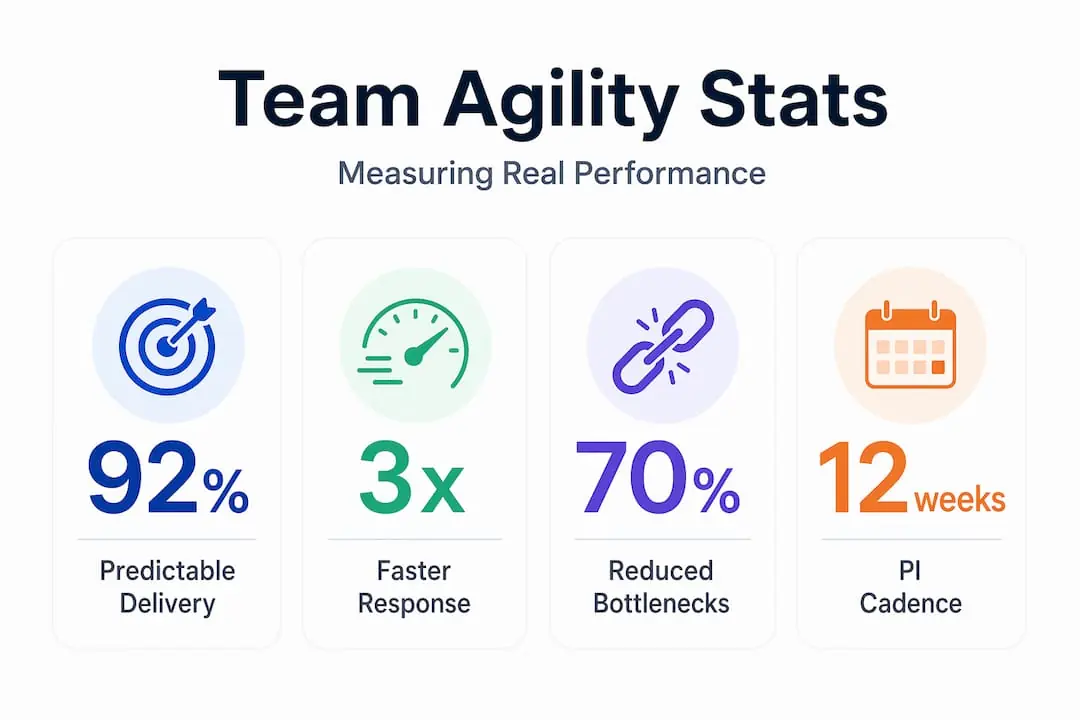
Program Increment (PI) cadence ties all of this together. A fixed 8 to 12-week PI rhythm creates a shared planning and measurement heartbeat across teams. It gives everyone a synchronized point to align, assess, and adjust. Fixed PI cadence underpins the ability of teams to adapt quickly while maintaining predictability. Without that cadence, you get drift: teams move at different speeds, dependencies become invisible until they become crises, and your agility metrics tell inconsistent stories.
Common pitfalls when building team agility
Organizations that struggle to build genuine team agility often share the same failure patterns. Recognizing them early saves significant time and credibility.
- Confusing ceremonies with agility. Daily standups and sprint reviews are useful structures. They are not agility. PI Planning is the heartbeat of coordination across teams, but skipping the thinking behind it and going through the motions produces theater, not results.
- Scaling coordination failures. Coordination, not ceremonies, is the primary scaling failure. When teams don’t surface cross-team dependencies during PI Planning, those dependencies become surprises mid-increment that derail delivery.
- Overrelying on velocity. Overreliance on velocity leads teams to local optimization, ignoring system-level delays or overloaded work in progress. You end up rewarding the wrong behavior.
- Inconsistent leadership commitment. Agility requires sustained focus. Leaders who greenlight transformation, then shift priorities or ignore cadence commitments, undercut the entire effort. Teams notice immediately.
- Accumulating technical debt. Fragile architecture slows everything down. Teams that skip quality practices to hit sprint velocity numbers eventually become the teams that can’t deliver anything reliably.
Pro Tip: When evaluating your team’s agility, look at the gap between what gets committed in PI Planning and what actually ships. A widening gap is a signal that coordination, not capability, is the real problem.
The solution to most of these pitfalls isn’t a new tool or a different framework. It’s building shared norms, collaboration routines, and quality practices over time, with consistent mentoring and leadership involvement. Team agility is a capability, and capabilities take sustained investment.
How to improve team agility as a manager
Knowing the principles is one thing. Translating them into daily management decisions is where team agility actually happens. Here’s a practical sequence:
- Form genuinely cross-functional teams. Map every skill needed to deliver a product increment end to end, then build your teams to include those skills. If your team regularly needs external handoffs for routine work, it’s not yet cross-functional.
- Give teams real authority. Assign accountability for outcomes, not just tasks. Let teams decide how to organize their work within agreed constraints. Self-management is not optional in an agile team setup.
- Implement a hybrid Scrum and Kanban model where it fits. Some teams do better with sprint cadences. Others manage steady-state operational work better through a flow-based Kanban approach. Match the method to the work, not the other way around.
- Embed quality from the start. Build automated testing, code reviews, and Definition of Done standards into your process before a single feature ships. Retrofitting quality is far more expensive than building it in.
- Connect your teams through ART structures and PI Planning. Multi-team alignment requires a deliberate structure. Use PI Planning to surface and manage cross-team dependencies before they become blockers. It’s one of the highest-leverage activities a manager can invest time in.
- Measure flow, not just velocity. Track flow time, load, and predictability regularly. Use that data to drive your Inspect and Adapt sessions with concrete evidence rather than anecdotes.
- Invest in coaching and a continuous improvement culture. Sponsor regular retrospectives. Bring in external coaches when teams are stuck. The teams that improve fastest are the ones with leaders who treat learning as a priority, not a luxury.
One often-overlooked dimension: the right people in the right roles makes all of this significantly easier. You can explore how talent selection methods influence team composition and long-term agility. Getting the fit right from the start reduces the friction that slows agile teams down.
My take on what team agility actually requires
I’ve seen a lot of organizations celebrate their “agile transformation” after installing Scrum ceremonies and renaming project managers as product owners. Two years later, they’re frustrated that nothing has really changed. The teams are busier, the backlogs are longer, and the delivery pace is still unpredictable.
Here’s what I’ve found to be true: agility is not a destination you reach by implementing a framework. It’s a capability your team either has or doesn’t, and it shows up under pressure. When a major market shift happens, or a critical feature needs to pivot mid-increment, does your team adapt clearly and quickly? Or does it stall, waiting for escalation and direction?
What I’ve learned is that the teams with real agility are the ones where leadership has consistently done three things. They’ve protected the cadence even when it was inconvenient. They’ve invested in psychological safety so people surface problems early instead of hiding them. And they’ve treated quality and technical health as non-negotiable, not as something to defer when velocity pressure hits.
The personality and working style fit of your team members matter more than most managers realize. Two people can have identical skills and produce completely different outcomes depending on how their natural working styles interact under stress. That’s not a small detail. It’s the kind of thing that determines whether your retrospectives generate genuine improvement or polite conversation.
Team agility is a capability journey. It compounds over time when you feed it correctly, and it erodes quickly when you stop paying attention. The managers who build the most agile teams aren’t the ones who know the most SAFe terminology. They’re the ones who stay committed to the rhythm, the people, and the quality. Long term, that’s the whole game.
— Mikk
How Sparkly helps you build truly agile teams ⚡️
Building team agility starts with getting the right people in the right roles, and that’s exactly where most organizations leave value on the table. Sparkly goes beyond CVs and skills assessments to analyze personality, cognitive fit, team dynamics, and change-readiness. Because skills can be learned. How someone naturally thinks, collaborates, and responds to uncertainty cannot be easily changed.
Sparkly merges psychometric data, Human Design, AI analysis, and human judgment to generate higher-probability insights that HR leaders and managers can actually use. You get clarity on role fit, burnout risk, and team composition before problems surface, not after.
If you’re serious about improving your team’s agility from the ground up, start with how you assess and place people. Explore how SaaS tools transform employee potential and learn how better talent assessments improve team dynamics in practice. Sparkly gives you the data to make those decisions with confidence.
FAQ
What is the team agility definition in simple terms?
Team agility is the ability of a cross-functional, self-organizing team to deliver continuous value, adapt to change quickly, and improve its processes over time. It goes beyond following agile ceremonies to encompass ownership, quality practices, and coordinated delivery.
How does team agility differ from traditional teams?
Team agility vs traditional teams comes down to structure and authority. Traditional teams are typically organized by function, rely on hierarchical decision-making, and hand work off across departments. Agile teams include all the skills needed for end-to-end delivery and self-manage their work within agreed constraints.
What are the key benefits of team agility?
The benefits of team agility include faster response to market changes, more predictable delivery through flow metrics and cadence, reduced dependency bottlenecks, and higher team engagement through ownership and continuous improvement.
What are some team agility examples in practice?
A software development team running two-week sprints with a shared Definition of Done, participating in PI Planning with five other teams, and tracking flow predictability across increments is a practical team agility example. The key indicator is that they adapt their plan when conditions change without losing delivery quality.
How do you measure whether your team has real agility?
Use SAFe’s flow metrics, particularly flow predictability, which measures the ratio of planned to actual business value delivered per Program Increment. A consistent, high flow predictability score is one of the strongest signals that team agility practices are working at the system level.