
Why Upgrade Workforce Structure for Business Growth

TL;DR:
- Redesigning workforce structure focuses on optimizing decision rights, roles, and workflows to boost productivity and resilience.
- Effective restructuring considers behavioral alignment, clear accountability, and human-centered change to ensure lasting success.
Most business leaders hear “workforce restructuring” and immediately picture layoffs, budget cuts, and damage control. That framing is not just limiting. It’s actively costly. Understanding why upgrade workforce structure decisions actually drive productivity, retention, and long-term resilience changes how you lead. The companies pulling ahead right now are not the ones trimming headcount. They’re the ones redesigning how work flows, where decisions get made, and which people sit in which roles. This article gives you the evidence and the framework to do the same. ⚡️
Table of Contents
- Key Takeaways
- Why upgrade workforce structure: the core signals
- The human side of workforce redesign
- AI’s role in reshaping workforce structure
- Legal, operational, and cultural risk
- Practical steps to upgrade workforce structure
- My perspective on getting restructuring right
- How Sparkly helps you upgrade smarter
- FAQ
Key Takeaways
| Point | Details |
|---|---|
| Structural issues signal upgrade time | Accountability diffusion, slow decision velocity, and talent ceilings are three clear signs your structure has outgrown your ambitions. |
| Human-centric redesign outperforms | Companies that integrate behavioral science into workforce changes outperform peers by 15% in total shareholder return. |
| AI reshapes roles, not just headcount | Automation frees over 600 hours of repetitive work per employee annually, creating space to redesign roles rather than simply eliminate them. |
| Legal risk is real and avoidable | Poor documentation and inconsistent criteria are the top causes of legal exposure during restructuring. |
| Structure without decision rights fails | Changing the org chart without realigning accountability perpetuates the same bottlenecks in a new shape. |
Why upgrade workforce structure: the core signals
Workforce structure is not just your org chart. It is the sum of how roles are defined, how decisions get made, who owns what outcomes, and how teams are grouped. When any one of these elements falls out of sync with where your business is heading, performance degrades quietly before it collapses loudly.
Three specific signals tell you it’s time to act. The first is accountability diffusion, which is when multiple people share ownership of an outcome but nobody truly owns it. Deadlines slip, problems get passed around, and post-mortems are inconclusive. The second is velocity decay: your organization takes longer to make decisions than it used to, not because problems got harder but because the structure creates friction. The third is a talent ceiling, where your best people have no meaningful path forward inside the current shape of the organization and start leaving.
These aren’t soft feelings. Less than 25% of organizational restructurings achieve their intended outcomes because leaders restructure without first diagnosing which signal they are actually responding to. They change the shape of the org chart and call it done. Two quarters later, the same problems resurface wearing a different name.
There is also a less obvious cost worth flagging. Misaligned workforce structure narrows ambition, slows internal mobility, and lowers engagement even when short-term performance stays stable. People read structure as a signal about what is valued and who is trusted. A flat structure that buries experienced contributors signals one thing. A bloated hierarchy that separates decision makers from ground-level reality signals another.
Pro Tip: Before committing to any structural change, write down which specific signal you are addressing. If you cannot name it clearly, you are not ready to restructure yet.
The human side of workforce redesign
Here is where most restructuring efforts lose the plot. Leaders focus on boxes and lines and miss the people actually doing the work. A human-centric transformation approach that applies behavioral science delivers 15% higher total shareholder returns compared to purely operational fixes. That is not a marginal gain. That is the difference between a restructuring that sticks and one that creates a second, more expensive restructuring 18 months later.
The four pillars that BCG research identifies as central to this approach are worth understanding:
- Leader enablement: Senior leaders must model the new behaviors first. If the org chart changes but leadership patterns don’t, teams revert to the old structure psychologically even while sitting in new reporting lines.
- People engagement: Employees who understand the why behind structural changes cooperate faster and resist less. Thorough, honest communication is not a soft nicety. It’s a performance lever.
- Executional certainty: Clarity about who decides what, by when, and with which inputs removes the ambiguity that tanks post-restructuring productivity.
- Culture shaping: Leadership behavior and cultural diagnostics must be part of the redesign, not an afterthought. New structures embed into culture through rituals, recognition, and daily decisions.
“Structural change without behavioral change is just rearranged furniture. The room still functions the same way.” 📈
Managing change fatigue is equally important. When teams go through structural shifts frequently without clear rationale, trust erodes and discretionary effort drops. The antidote is involving employees and frontline managers in the redesign process, even in limited ways, so the change feels like something happening with them rather than to them. You can find practical methods for this in Sparkly’s guide on reducing turnover through agility.
AI’s role in reshaping workforce structure

Artificial intelligence is not a reason to reduce headcount. It is a reason to reconfigure where human judgment gets applied. The average office worker spends over 600 hours annually on repetitive administrative tasks. Automating those tasks does not eliminate the need for people. It frees people to take on work that requires contextual reasoning, relationship management, and judgment under uncertainty.
The strategic approach to AI-driven workforce redesign follows a sequence:
- Inventory repetitive tasks across teams and map which are candidates for automation based on rule-dependency and volume.
- Identify which roles shift rather than disappear. A financial analyst who spent 60% of their time on report generation now spends that time on interpretation and recommendation.
- Create rotation programs that move engineers, product managers, and operations staff through AI-enabled workflows. Skill diffusion through rotation reduces dependency on a handful of AI experts and builds organizational resilience.
- Design new roles that didn’t exist before: AI integration leads, output quality reviewers, governance specialists who audit model outputs for bias and accuracy.
- Preserve human judgment layers in every automated workflow. AI transitions that succeed are the ones that keep humans responsible for oversight, relationships, and edge cases.
The risk of treating AI adoption as a cost-cutting opportunity is significant. Teams that lose institutional knowledge through premature headcount reduction often rebuild it expensively six to eighteen months later, usually by rehiring the same people as contractors at higher rates.
Pro Tip: Use a skill gap assessment matrix to evaluate each affected role across three axes: current proficiency, future demand, and retraining feasibility. This gives you a defensible, data-informed basis for redeployment decisions.
Legal, operational, and cultural risk
Restructuring is not just an organizational design question. It carries legal, financial, and cultural weight that leaders often underestimate until they’re already in it.
| Risk Category | What Goes Wrong | How to Mitigate |
|---|---|---|
| Legal exposure | Inconsistent selection criteria and poor documentation | Standardize criteria; document every decision with clear rationale |
| Productivity disruption | 33% productivity drop for six months post-restructure | Phase changes; communicate timelines clearly |
| Cultural damage | Trust erosion from opaque or rushed decisions | Involve managers early; explain reasoning at every level |
| Decision right gaps | New structure inherits old bottlenecks | Redesign accountability alongside org chart |
On the legal side, workforce restructuring invites scrutiny around documentation consistency, jurisdictional compliance, and fairness in how affected employees are selected. The most common mistakes are applying selection criteria inconsistently across similar roles and failing to document the business rationale clearly enough to withstand review.
The cultural layer deserves equal attention. When you change structure without diagnosing the existing culture, you often discover that the culture simply absorbs the new org chart and continues operating by the old informal rules. Leadership behavior is the single most powerful signal about whether the new structure is real. If leaders revert to their old communication patterns and decision habits within weeks of a restructure, teams read that as permission to do the same.
Key actions to protect stability during a structural change:
- Define decision rights explicitly for every new role before the change goes live
- Communicate changes in layers: executives first, then managers, then individual contributors
- Run a cultural diagnostic before and after to track whether the intended shifts are landing
- Build a 90-day post-restructure review into the plan before you launch
Practical steps to upgrade workforce structure
Knowing the reasons to change workforce structure is necessary but insufficient. You also need a repeatable process to translate diagnosis into action.
Start with the three-signal test: can you clearly identify accountability diffusion, velocity decay, or a talent ceiling as the trigger for this change? If yes, proceed. If not, spend more time diagnosing before spending organizational capital on a restructuring that may not solve the right problem.
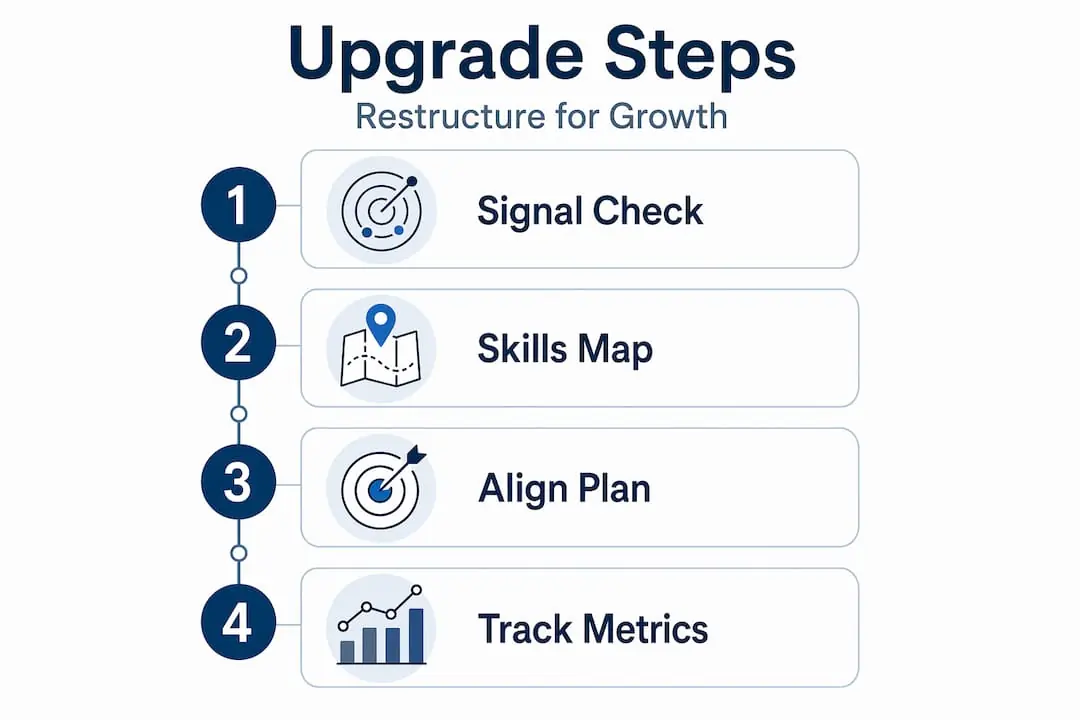
Next, conduct a task and skills inventory. Map what every team actually does at the task level, not the job description level. This reveals where roles have drifted from their design intent and where skill concentrations create fragility. Tools like personality-based assessments can surface who is naturally suited to redesigned roles, which reduces placement error and speeds adoption.
The third step is to align your automation plan, retraining commitments, and phased redeployment timeline into a single roadmap. Skill gap matrices help you identify who can be retrained quickly, who needs longer runway, and who may need to transition out of the organization. Being honest at this stage is what protects both people and business performance later.
Finally, build measurement into the plan from day one. Productivity recovery time, decision velocity improvement, retention rates in restructured teams, and manager confidence scores are all concrete signals that tell you whether the upgrade is working. Without them, you’re flying without instruments. 💡
Pro Tip: Internal talent shifts, done with data, can cut turnover by 53%. Build redeployment pathways before you post external job listings.
My perspective on getting restructuring right
I’ve watched organizations rush into structural changes because a consultant delivered a compelling slide deck or because a competitor reorganized and suddenly everyone felt pressure to respond. The result is almost always the same: a restructuring that changes the chart but not the behavior, and a workforce that becomes more cynical and less trusting with each iteration.
What I’ve learned is that the most expensive restructuring is the one you do twice. The first one fails not because the design was wrong, but because no one mapped decision rights. The new structure inherited the old accountability fog and the dysfunction continued under a new name.
The organizations that get this right start with people intelligence, not organizational theory. They ask: who in this organization actually makes decisions well, regardless of title? Who carries knowledge that won’t survive a reorganization? Where are people placed in roles that work against their natural strengths? These are personality and cognitive questions, not skills questions. Skills can be learned. Misaligned wiring is much harder to fix after the fact.
The importance of workforce upgrades is real, but the upgrade has to start with an honest, data-informed picture of your people, not just your processes. That’s where Sparkly’s approach of assessing personality first, before skills, changes what’s possible. You stop placing people in the least-bad available role and start designing roles around where they’ll actually thrive.
— Mikk
How Sparkly helps you upgrade smarter
Restructuring decisions made without people intelligence are guesses dressed up as strategy. Sparkly changes that by going beyond resumes and skills inventories to assess personality, cognitive patterns, values, and team dynamics together. The platform merges inputs from psychometric assessments, Human Design, AI analysis, and human observation into computed insights that HR leaders can actually use.
Whether you’re navigating a full organizational redesign, identifying internal redeployment candidates, or trying to reduce the burnout risk in high-change teams, Sparkly gives you a clearer picture before you move anyone. Explore how SaaS-powered people intelligence can turn your next restructuring into a genuine upgrade, or see how employee fit assessments help you cut turnover costs while placing people where they perform best. 📈
FAQ
Why upgrade workforce structure instead of just hiring more people?
Hiring into a broken structure amplifies existing problems rather than solving them. Workforce upgrades address the root causes of inefficiency, accountability gaps, and role misalignment that additional headcount alone cannot fix.
Is workforce restructuring necessary if performance metrics look stable?
Yes. Misaligned structure can suppress engagement and narrow ambition even when short-term metrics appear healthy. By the time performance visibly drops, the structural problem is typically well advanced.
What are the main benefits of workforce restructuring?
The core benefits of workforce restructuring include faster decision making, clearer accountability, better role-person fit, improved retention, and greater organizational resilience during periods of change.
How do you reduce legal risk during a workforce upgrade?
Standardize your selection criteria, document the business rationale for every decision, and verify compliance with jurisdictional obligations before implementing changes. Inconsistent documentation is the most common trigger for legal exposure.
How long does it take to see results after upgrading workforce structure?
Most organizations experience a productivity dip of around 33% for approximately six months post-restructure. Measuring recovery time against a defined baseline is the most reliable way to track whether the upgrade is working.