
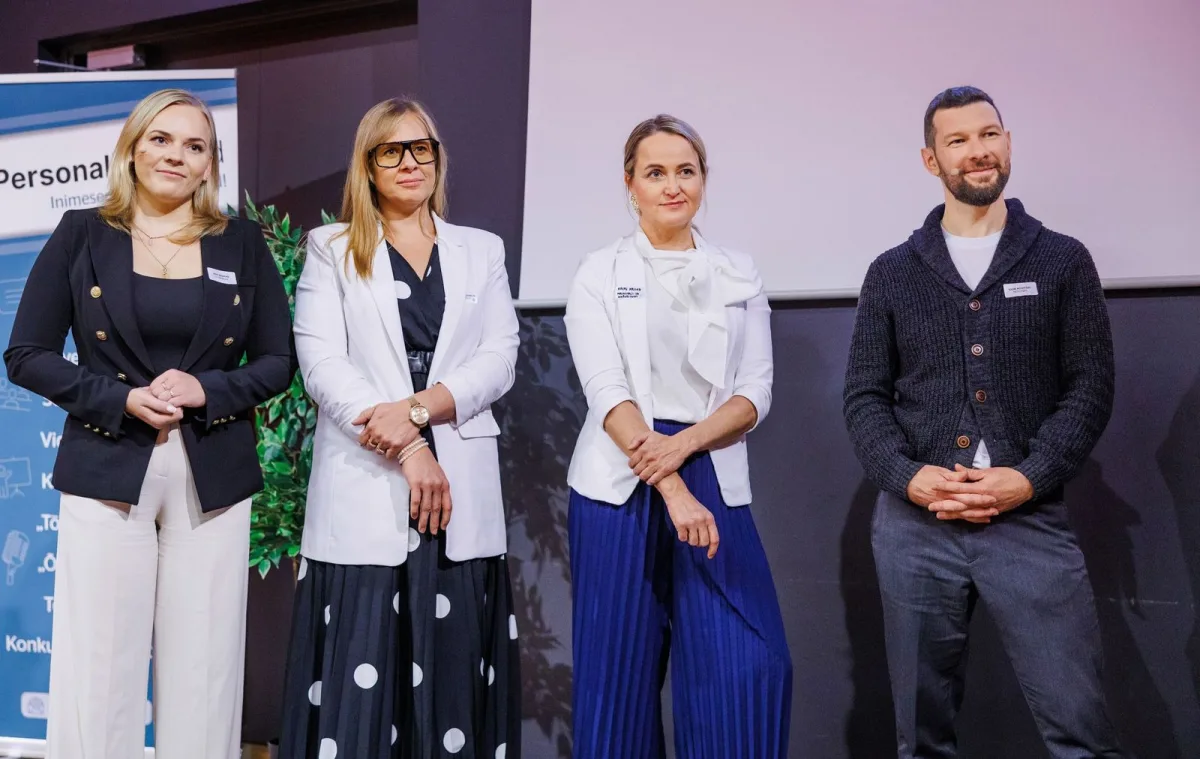
On 13 October 2026, Äripäev and Personaliuudised held Talent Hunt, a conference that brought recruitment work directly before an audience.
Helen Roots and Mirell Soasepp, together with their team, had taken on an exceptionally bold plan. Jaanika Tammekänd, Helena Ojala, Kersti Vannas, Hanno Ahonen, Renita Käsper, Monna-Maria Lõbus, Erik Rüütel, Charlie Ferguson and many others helped make the day possible.
As the head of Sparkly.HR, I had the opportunity to take part in the preparations, serve on the jury and speak at the event. It was an honour to be involved in preparing it.
Four recruiters — Anu Saukas, Marion Rakaselg, Kairi Kriisa and Igor Novitski — made phone calls on stage to people they had never met, conducted interviews and searched for candidates suited to the tasks they were given. They did all this under the watchful eyes of more than a hundred fellow recruiters. A four-member jury also observed their work.
At any moment, something unexpected could happen. A candidate might not answer. A conversation could head in another direction. Crucial information might remain out of reach. And your colleagues would see it all.
Accepting a challenge like that takes professional confidence and personal courage. All four deserved admiration.
We learned as jurors, too.
I am not a professional recruiter, and I have no formal education in the field. As an entrepreneur, I have had to find a couple of hundred employees over the years, but that does not mean I know the ideal recruitment process. I have, however, gained experience building software systems, owning businesses, investing and mentoring.
That made it especially valuable to work alongside Jaanika Tammekänd, Helena Ojala and Kersti Vannas.
We discussed our observations together, although each of us presented them in our own name. I took more of the role of a critical questioner, while the others highlighted strengths and successes. This let us show different sides of the same activity.
We did not rank the recruiters. We tried to help the audience notice details that can be missed in a fast conversation: what was asked, what a conclusion was based on and what further information would have been useful.
All four had a distinctive approach. They made contact differently, guided interviews differently and explained their choices differently. Judging them all against one style would have been unfair.
Their ability to absorb information quickly was particularly impressive. They had to understand a company and a role, present both convincingly to a candidate and assess the candidate's fit. For some tasks they had only minutes to prepare; for others, a little longer. Time pressure was deliberately part of the challenge.
And they rose to it.
Why is there still so much dissatisfaction with recruitment outcomes?
During the breaks, conversations continued about questions that concern recruiters, HR managers and business leaders alike.
I also brought figures into those discussions that are worth revisiting: 87% of employees reportedly willing to change jobs, a figure associated with CV-Online surveys, and the claim that roughly three quarters, or 74%, of employers have been dissatisfied with people they hired.
These indicators mean different things. Willingness to change jobs does not automatically mean dissatisfaction, and an experience of a poor hire does not mean that three quarters of all hires fail. Both figures do, however, prompt us to ask how well the person, the work and the working environment fit together.
We also discussed the possible cost of a failed hire: an amount equal to 4–20 times an employee's salary, depending on the role, the region and which costs are included. When making this comparison, the pay period must also be specified: a monthly salary and an annual salary produce entirely different orders of magnitude.
Training, colleagues' time, lost output, another recruitment process and the effect on the team add up to a substantial cost in any case.
Renita Käsper gave a strong overview of international developments in recruitment and the questions that now need answers. My presentation focused on how to give recruiters more meaningful analytical information and improve the quality of decisions.
Do we begin recruitment too late?
In my view, before writing a job advertisement we should clarify:
- which tasks the person will actually perform;
- what outcomes we expect from them;
- the rhythm, workload and responsibility of the role;
- who they will work with on the team;
- who their direct manager is and how that person leads;
- the company's values and working environment;
- whether all these tasks should even belong to one person.
Only then can we describe the role and give the recruiter a basis for comparing candidates.
Without that groundwork, we may find many likeable and capable candidates who are still not right for this particular job or team. If we hire them, everyone eventually loses.
And then it looks as though the recruiter did a poor job.
Yet recruiters are often caught between two sides. They are expected to find the right person, but the input from the hiring manager is incomplete. Responsibility is passed on without the information needed to carry it.
On the other side is a candidate who may not know exactly which work and environment suit them. A strong presentation and a pleasant conversation can create a good impression, but they do not yet give a complete picture of fit.
This is where I see an opportunity for Sparkly: to help describe the work, the person and the team so that recruiters can use more comparable information alongside their experience and ask more precise questions.
Sometimes the fit problem is already written into the job advertisement.
As of October 2026, Sparkly's own analysis of job advertisements covered nearly 10,000 active vacancies in Estonia. Under the model we used, most of them targeted two different personality profiles at once. Advertisements combining expectations from three profiles were approximately half as common as those targeting two profiles.
That is a result of Sparkly's analysis, and its meaning depends on the model and how the profiles are defined. It does not prove that a person cannot perform tasks of different kinds. It does raise the question of whether the expectations combined in one role support each other or work against each other.
If we seek one person for very different ways of working at once, it is worth reviewing the design of the role and the distribution of tasks within the team before recruiting.
Otherwise, we may hire inefficiency into the organisation and expect the new employee to solve it through personal effort.
Team dynamics depend on tasks as well. People may get along well, but if work and responsibility are poorly distributed, good relationships alone may not produce good collaboration or results.
Talent Hunt gave us much more to think about than one conference day could hold.
It let us see professionals' real working methods, learn from their different approaches and discuss how to improve the recruitment brief and the decisions that follow.
Thank you to the Äripäev and Personaliuudised teams. Thank you to Helen Roots and Mirell Soasepp for having the courage to create a format where so many details could have gone differently, yet the day ran smoothly.
Thank you to Jaanika Tammekänd, Helena Ojala and Kersti Vannas for the thoughtful work together on the jury; to Hanno Ahonen for guiding the day; and to Renita Käsper for opening up important questions. Thank you to all the speakers, candidates and everyone who contributed to organising the event.
My deepest respect goes to the four recruiters who let us observe their work so closely.
For me, 13 October 2026 was a historic day for recruitment in Estonia. It was an honour to be part of it. I very much hope a worthy follow-up will come.
Mikk Orglaan, Sparkly.hr CEO