
Why measure employee engagement? Boost retention and morale

TL;DR:
- Employee disengagement is costly and often overlooked because organizations rely on outdated annual surveys that miss real-time signals. Regular pulse surveys and strategic action based on engagement data improve retention, productivity, and organizational resilience. Leadership that treats engagement as a accountability tool and acts promptly fosters genuine trust and continuous improvement.
Employee disengagement is one of the most expensive problems your organization may not be tracking closely enough. When team members feel disconnected from their work, the ripple effects touch everything from productivity and morale to your bottom line. Yet many organizations still rely on once-a-year surveys, collecting data that’s outdated before the ink dries. The truth is, annual engagement surveys may be missing the real-time signals that indicate when your best people are about to walk out the door. This guide covers why measuring engagement matters, how to do it well, and how to turn data into action. ⚡️
Table of Contents
- Understanding employee engagement: Why it matters
- The measurable benefits: How engagement drives retention and performance
- How (and how often) to measure engagement for real results
- Translating engagement data into meaningful action
- Why most engagement measurement falls short—and what to do instead
- Connect your engagement strategy to smarter HR solutions
- Frequently asked questions
Key Takeaways
| Point | Details |
|---|---|
| Measuring engagement cuts turnover | Tracking engagement trends helps HR proactively address issues that lead to costly employee turnover. |
| Move beyond annual surveys | Strategic engagement measurement involves frequent check-ins and timely action, not just yearly reports. |
| Data drives practical change | Engagement metrics are only valuable when translated into targeted, organization-wide improvements. |
| Act on results transparently | Sharing findings and next steps with employees boosts participation and trust. |
| HR tech accelerates success | Specialized SaaS and assessment tools streamline engagement strategies and boost retention. |
Understanding employee engagement: Why it matters
Employee engagement is not the same as job satisfaction. A satisfied employee might show up, complete tasks, and go home without ever feeling genuinely invested in the team’s success. An engaged employee cares about outcomes, volunteers ideas, supports colleagues, and brings energy to challenges. That distinction matters enormously for HR leaders trying to build resilient, high-performing cultures.
Here’s what engagement actually captures:
- Emotional commitment: Does the employee feel a sense of purpose in their role?
- Discretionary effort: Are they willing to go beyond what’s required?
- Alignment with company goals: Do they understand how their work connects to broader outcomes?
- Intention to stay: Do they see a future for themselves within your organization?
These dimensions are measurable, and when tracked consistently, they give you a far richer picture than annual satisfaction scores ever could. Leading expert HR insights increasingly confirm that engagement is a leading indicator of performance, not just a trailing metric.
“The key issue is not only measurement frequency but ensuring timely, actionable insights without creating survey fatigue or ‘tick-box’ behavior.” — Are Annual Engagement Surveys Obsolete?
This is where many organizations go wrong. They treat engagement surveys as a compliance activity rather than a strategic tool. The survey goes out, results come in, leadership reviews a report, and then… not much changes. Employees notice that pattern quickly, and participation rates drop year after year. Use an employee engagement checklist to ensure your approach actually connects measurement to meaningful outcomes.
The business case for engagement is well established. Organizations with highly engaged workforces consistently outperform competitors in productivity, customer satisfaction, and profitability. When engagement drops, absenteeism rises, collaboration suffers, and turnover spikes. For medium and large companies, the financial cost of replacing even one mid-level employee can run between 50% and 200% of that person’s annual salary. Multiply that across a workforce and the stakes become undeniably clear.

The measurable benefits: How engagement drives retention and performance
With engagement defined, it’s crucial to see what tangible results measurement can deliver for your organization. The benefits are not theoretical. They show up in your quarterly reports, your exit interview data, and your ability to attract top candidates.
The numbers behind engagement:
| Metric | Low engagement impact | High engagement impact |
|---|---|---|
| Employee turnover | Up to 43% higher | Significantly reduced |
| Productivity loss | Billions annually | Measurably improved output |
| Absenteeism | 37% higher | Reduced sick days |
| Customer ratings | Below average | Consistently higher |
| Profitability | Lower margins | Up to 23% higher profits |
These figures aren’t just interesting. They represent real money, real talent lost, and real missed opportunities for growth. Organizations that reduce employee turnover through proactive engagement measurement protect their investment in people and build stronger institutional knowledge.
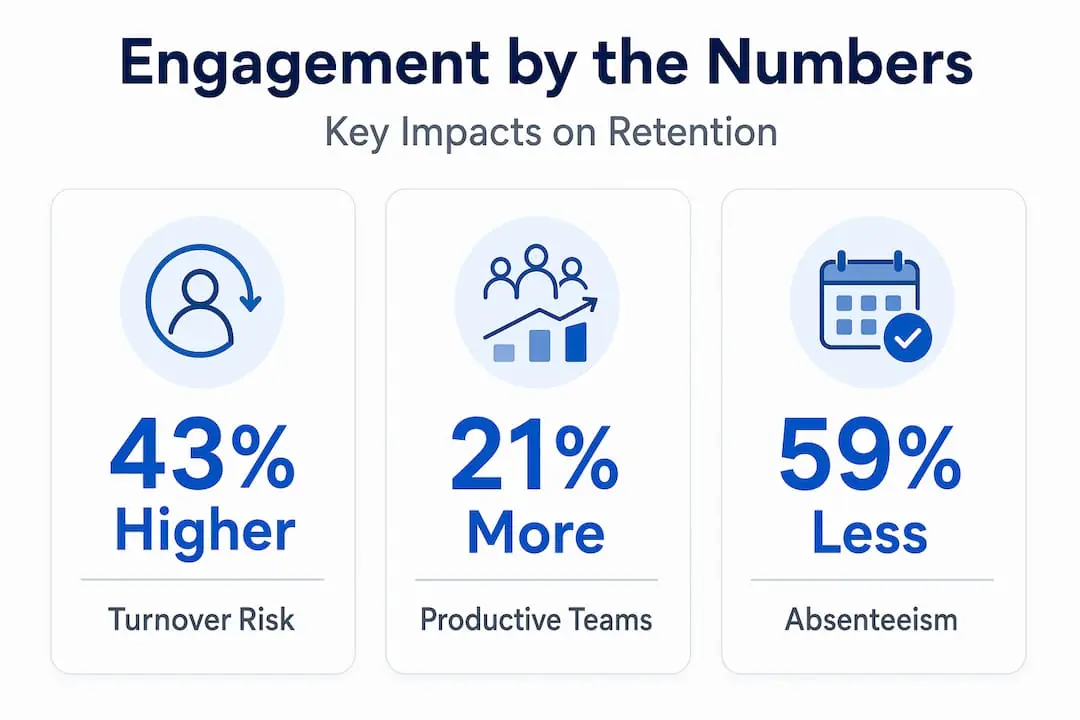
📈 Engagement measurement helps HR spot trouble early. When a team’s pulse score dips two months in a row, that’s a signal, not a coincidence. Acting on that data quickly, before a top performer hands in their notice, is infinitely more cost-effective than any recruitment campaign.
One of the most underappreciated benefits of frequent engagement measurement is what it reveals about role fit. When engagement data is paired with a potential checklist, HR can identify whether disengagement stems from poor skill alignment, unclear expectations, or a mismatch between personality and role demands. That level of insight transforms engagement data from a symptom tracker into a genuine strategic asset.
Pro Tip: Don’t use engagement results to rank teams against each other. Use them to understand what conditions help specific groups thrive, then replicate those conditions across your organization.
Consider a mid-sized tech firm with 600 employees. After implementing monthly pulse surveys, their HR team noticed that engineers in one department consistently rated “sense of purpose” significantly lower than peers. Rather than assuming performance issues, they dug into role design. They discovered the team was handling repetitive maintenance tasks with little visibility into how their work connected to product outcomes. A simple change in how work was communicated and structured produced a meaningful jump in that team’s engagement scores within 90 days. No new hires, no restructuring. Just smarter use of data.
How (and how often) to measure engagement for real results
Given the real-world impact, it’s vital to measure the right way, finding the right cadence and tools to maximize actionable insights. The debate between annual surveys and more frequent check-ins has been ongoing for years, and the evidence is tilting decisively in one direction.
Annual vs. pulse surveys: A quick comparison
| Factor | Annual surveys | Pulse surveys |
|---|---|---|
| Frequency | Once per year | Weekly, monthly, or quarterly |
| Response rates | Often declining | Typically higher with brevity |
| Actionability | Delayed | Near real-time |
| Survey fatigue risk | Lower frequency but longer | Higher if poorly designed |
| Depth of insight | High with good design | Moderate but trending |
The annual survey vs. pulse debate really comes down to one question: how quickly does your organization need to respond? For most medium to large companies, the answer is “faster than once a year.”
Here’s a step-by-step approach that works in practice:
- Define what you’re measuring. Set clear dimensions: belonging, purpose, manager effectiveness, workload fairness, growth opportunities. Don’t just ask if people are “happy.”
- Choose your cadence strategically. A quarterly deep survey plus monthly three-question pulse checks gives you both breadth and speed.
- Ensure anonymity. Employees need to trust the process. Guarantee confidentiality or participation will be low and data will be skewed.
- Analyze by team and role type. Company-wide averages hide the real patterns. Segment your results by department, tenure, and role level.
- Act visibly and quickly. Use employee surveys for turnover as decision-making tools, not just reporting tools.
- Close the loop publicly. Tell employees what you heard, what you’re going to do about it, and when they can expect to see change.
Pro Tip: The fastest way to kill participation is to survey employees and then go silent. Even a brief “here’s what we learned and here’s what we’re doing” email dramatically improves future response rates and builds credibility for the process.
For organizations managing multiple teams across locations, HR team management tools can automate survey distribution, segment results, and track progress over time without adding administrative burden. The goal is sustainable measurement, not a one-time event. Leading consulting engagement metrics frameworks also recommend integrating engagement data with performance management cycles for richer, more actionable intelligence.
💡 One often-overlooked element: how you phrase questions shapes the data you get. “Do you feel supported by your manager?” produces very different results than “In the past two weeks, did your manager check in on your workload?” Behavioral, specific questions generate more honest and useful responses.
Translating engagement data into meaningful action
A robust measurement framework only delivers value if paired with decisive, meaningful follow-through. Data sitting in a dashboard changes nothing. What matters is what your HR team and managers do with the information.
Here’s what high-impact organizations do differently:
- They act within a defined window. Results from a pulse survey trigger a team-level conversation within two weeks, not two quarters.
- They distinguish between systemic and local issues. A company-wide drop in “clarity of direction” calls for executive communication changes. A drop in one team’s “trust in leadership” calls for a different, more targeted response.
- They redesign roles, not just processes. When engagement data consistently flags that people feel underutilized or mismatched to their responsibilities, that’s a role design problem. Understanding talent mapping advantages helps HR identify where people’s natural strengths and personalities are being wasted.
- They reward honest feedback. If employees who share critical feedback face any kind of subtle pushback, the culture of trust collapses. Psychological safety is the foundation for honest engagement data.
- They track change over time. Engagement isn’t a single score. It’s a trend. Improving scores across six months of consistent interventions tells a powerful story about what’s working.
The measurement frequency debate ultimately resolves to this: how you use the data matters far more than how often you collect it. Organizations that measure quarterly but act decisively outperform those who measure monthly but file reports and move on.
Pro Tip: Transparency in sharing results is not just good practice, it’s a strategic advantage. When employees see their feedback reflected in real decisions, participation climbs, trust deepens, and the data you collect next time becomes even more accurate and useful.
Effective action also means looking beyond surface-level fixes. If your data shows that employees feel stuck in their growth, the answer isn’t another training catalog. It’s a genuine conversation about development pathways, role evolution, and how their personality and strengths align with future opportunities within your organization.
Why most engagement measurement falls short—and what to do instead
Here’s an uncomfortable truth: most engagement programs are designed to make HR look productive, not to make employees feel genuinely heard. The playbook usually goes like this. Roll out a survey in November. Present a slide deck in January. Create a working group that meets twice and then dissolves. Repeat next year with slightly different questions.
That cycle is not just ineffective. It actively erodes trust. Employees who participate in surveys and see no change become more disengaged, not less. The act of measuring without acting can actually accelerate the problem it was meant to solve.
The conventional focus on survey methodology, the choice of Likert scale versus Net Promoter Score, the number of questions, the benchmarking tool, misses the point entirely. Methodology matters far less than organizational will. Do leaders genuinely want to hear difficult truths? Are managers equipped to have honest conversations with their teams after results come in? Is HR positioned as a strategic partner with the authority to recommend real changes?
The organizations that see measurable improvements in retention and morale share one trait: they treat engagement data as a leadership accountability tool, not an HR reporting exercise. When a team’s engagement score drops, the manager is asked what they plan to do. When that same score improves, the manager is recognized. That shift, from measurement as observation to measurement as accountability, is what separates symbolic programs from ones that actually move the needle.
Another hard lesson: personality fit matters as much as job design. Skills can be trained. But if someone’s natural behavioral tendencies put them in conflict with their role’s demands every single day, no amount of surveying will fix that. Use your engagement checklist insights as a starting point, but pair them with deeper personality-based assessments to understand why disengagement is happening, not just that it’s happening.
Connect your engagement strategy to smarter HR solutions
Measuring engagement well is only half the equation. The other half is building the infrastructure to act on what you learn quickly and effectively.
At Sparkly, we believe the best engagement strategies are built on knowing your people deeply, not just statistically. Our SaaS HR solutions combine personality assessment, Human Design data, psychometric tools, and AI to give HR teams a richer, higher-probability view of what each employee needs to thrive. Explore our talent optimization guide to see how personality-first insights can help you redesign roles and shift team members into positions where engagement naturally follows. And when you’re ready to put your data to work at a team level, our talent allocation tools make it simple to match people to the work that suits them best.
Frequently asked questions
What is the main goal of measuring employee engagement?
The main goal is to identify what drives employee satisfaction and loyalty so HR can proactively reduce turnover and improve team morale. Done well, it transforms engagement measurement from a reporting activity into a genuine retention strategy.
How often should companies measure engagement?
Most experts now recommend blending annual deep-dive surveys with frequent short pulse checks to maintain real-time awareness of team sentiment without overwhelming employees. The right cadence depends on your organization’s size, pace of change, and capacity to act on results.
What’s the risk of only measuring engagement once per year?
Annual-only measurement approaches frequently miss early warning signs of disengagement, leaving HR teams reacting to problems like turnover spikes rather than preventing them. They can also reinforce a culture where surveys feel like formalities rather than genuine opportunities for employees to be heard.
How can HR ensure engagement results lead to real change?
Share results transparently with employees and managers, assign clear ownership for follow-up actions, and communicate progress updates on a regular cadence to demonstrate that feedback creates visible impact. Closing the feedback loop is the single most important driver of future participation and trust.