
Why employee surveys are your best tool to cut turnover

TL;DR:
- Employee surveys act as early signals of disengagement, enabling HR teams to address issues before resignations occur.
- Most surveys fail due to lack of leadership commitment and meaningful follow-up, which erodes employee trust and participation.
- Pairing survey data with personality assessments offers personalized insights that significantly improve retention and organizational resilience.
Most HR teams treat exit interviews like a post-mortem. By the time an employee is sitting across from you explaining why they’re leaving, the decision was made weeks or even months ago. The real opportunity to intervene has already passed. Employee surveys flip that script entirely. When designed and deployed thoughtfully, they act as a live radar system for disengagement, giving your HR team the early signals needed to act before a resignation letter lands on your desk. This article breaks down how to use employee surveys strategically, what makes them fail, and how pairing survey data with personality insights can dramatically improve your retention numbers.
Table of Contents
- Why employee surveys matter for retention
- Diagnosing disengagement: The power of timely surveys
- Making surveys work: Action, accountability, and communication
- Enhancing retention with personality-focused assessments
- What most HR teams get wrong about employee surveys
- Take your retention strategy further with advanced HR tools
- Frequently asked questions
Key Takeaways
| Point | Details |
|---|---|
| Surveys reveal warning signs | Regular employee surveys help HR catch disengagement before it leads to turnover. |
| Action drives trust | Acting on survey results and communicating outcomes builds lasting survey participation and credibility. |
| Combine with personality data | Pairing surveys with personality assessments creates smarter, more personalized retention strategies. |
| Avoid survey fatigue | Limit frequency and always share survey impact to keep feedback honest and participation high. |
Why employee surveys matter for retention
Turnover is expensive. Replacing a single employee can cost anywhere from 50% to 200% of their annual salary when you factor in recruiting, onboarding, lost productivity, and the institutional knowledge that walks out the door with them. For companies with 20 or more employees experiencing high turnover, these costs compound fast and quietly. The financial drain rarely appears in a single line item, which makes it easy to underestimate.
Here’s the problem with relying on exit interviews: they surface information that is already past its usefulness. Employees who have made up their minds are rarely candid anyway. They soften feedback to preserve references and relationships. You end up with vague responses about “seeking new opportunities” rather than the real reasons, which usually relate to manager behavior, lack of recognition, or feeling stuck in a role that no longer fits.
Employee surveys change the dynamic entirely. Early warning signals surface through survey data long before a resignation becomes inevitable. That’s the core value: you get actionable intelligence while you still have time to act on it. When connected to a strong employee engagement checklist, surveys become a structured, forward-looking retention system.
“Employee surveys help retention by surfacing early warning signals of disengagement and letting HR address issues before they lead to costly turnover.” — ASE Online
Signs that surveys commonly reveal before employees begin openly considering leaving include:
- Declining engagement scores over two or more consecutive survey cycles
- Negative open-ended feedback about management, workload fairness, or career growth
- Slipping motivation scores, especially in teams that once ranked highly
- Low response rates themselves, which often signal distrust or apathy
- Mismatch between role expectations and day-to-day reality, often uncovered in job satisfaction questions
Pairing these survey signals with employee retention strategies gives HR teams a clear, evidence-based starting point for action. Surveys do not just identify unhappy employees. They identify which problems need solving and where in the organization those problems live.
It’s also worth noting how surveys connect to better hiring decisions downstream. When you understand what drives disengagement in your current workforce, you can improve recruitment success factors to bring in candidates who are a stronger long-term fit from day one.
Diagnosing disengagement: The power of timely surveys
Knowing that surveys matter is one thing. Knowing how to design and deploy them for maximum diagnostic value is where most HR teams struggle. The format and timing of your surveys determine the quality of data you receive.
Pulse surveys, typically 5 to 10 questions sent monthly or bi-monthly, are particularly powerful for fast feedback loops. Unlike annual engagement surveys that capture a single moment in time, pulse surveys reveal trends. A team’s engagement score dropping across three consecutive months tells a very different story than one bad month that follows a stressful product launch.

Here’s a snapshot of the key metrics HR teams should track through survey cycles:
| Metric | Healthy benchmark | Concern threshold | Action trigger |
|---|---|---|---|
| Survey response rate | Above 75% | 60% to 74% | Below 60% |
| Engagement score trend | Stable or rising | Slight decline over 2 cycles | Declining for 3+ cycles |
| Intention-to-leave rate | Under 10% | 10% to 20% | Above 20% |
| Manager satisfaction score | Above 7/10 | 5 to 6.9/10 | Below 5/10 |
| Role clarity score | Above 70% positive | 55% to 69% positive | Below 55% positive |
The table above is not just a reference guide. It’s a trigger system. When a metric crosses into the “action trigger” zone, your team should have a pre-built response protocol ready to go. Waiting until the next survey cycle to address a crisis-level drop is where HR teams lose the most ground.
Using HR team management tools that visualize these trends in real time accelerates the diagnostic process significantly. You stop spending hours in spreadsheets and start spending time on actual conversations with team leads and employees.
The diagnostic phase also benefits from quality question design. Open-ended questions generate rich qualitative insight, but they are harder to act on quickly. Closed questions with numeric scales generate trend data but can miss nuance. The best surveys blend both, using closed questions for benchmarking and one or two open-ended questions per cycle to capture what the numbers can’t say. Pairing this approach with recruiting best practices ensures that lessons learned from current team data inform smarter future hiring.
Pro Tip: Avoid analysis paralysis. When survey data comes in, resist the urge to address every issue simultaneously. Identify the top two or three themes with the highest impact and assign clear ownership. Progress on a few fronts builds more trust than scattered, shallow responses across many areas.
Making surveys work: Action, accountability, and communication
Here’s the uncomfortable truth about employee surveys: running them without acting on results is worse than not running them at all. Employees who complete surveys and then see nothing change become deeply cynical. That cynicism poisons future survey participation and, more importantly, their overall trust in leadership.
Surveys paired with visible action and closed-loop communication drive retention. Without that combination, survey fatigue sets in and disengagement accelerates. Here’s how the outcomes compare:
| Scenario | Employee trust | Survey participation | Retention impact |
|---|---|---|---|
| Survey with clear action and follow-up communication | High | Increases over time | Positive, measurable |
| Survey with partial follow-up and vague updates | Moderate | Stays flat or declines slightly | Neutral to slightly positive |
| Survey with no visible action taken | Low | Drops significantly | Neutral to negative |
| No surveys at all | Uncertain | N/A | Reactive, no early warning |
The pattern is clear. Action and communication are not optional extras. They are the engine that makes surveys work. HR teams that run surveys without the follow-through are essentially asking employees to invest time and emotional honesty with no return.
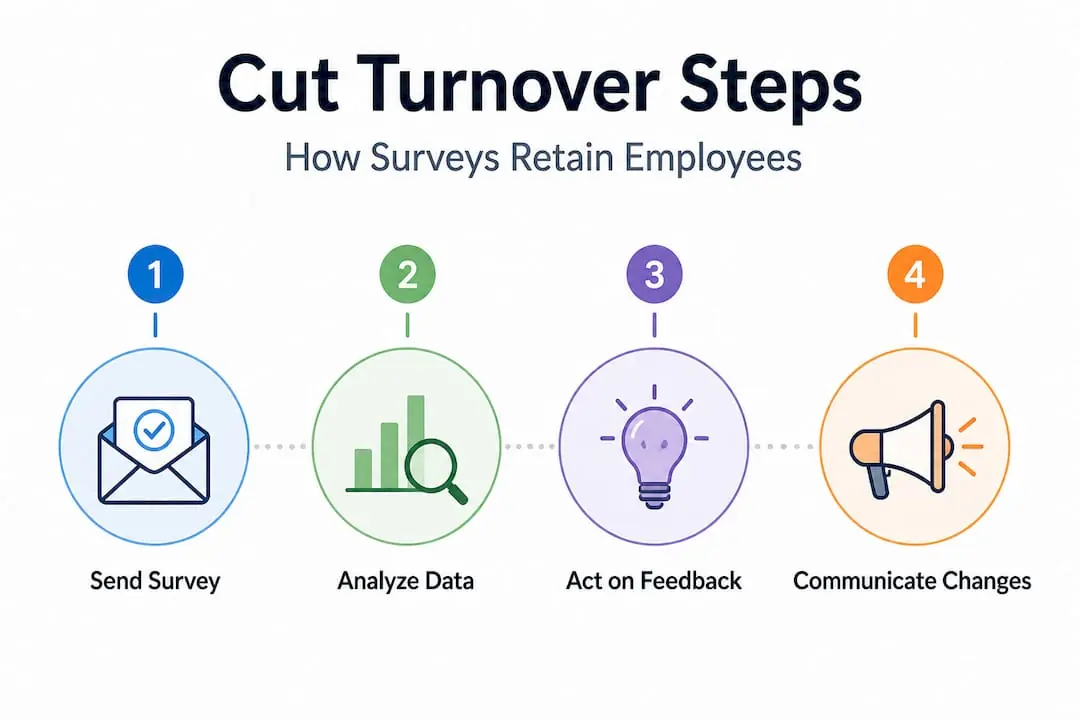
Here are the steps every HR team should take after each survey cycle:
- Analyze results within 5 to 7 business days of survey close. Delays dilute the relevance of the findings.
- Share a transparent summary with all employees, including the overall themes, not just the positive ones.
- Identify two to three priority areas and assign specific owners and timelines for each.
- Communicate the action plan clearly, using team meetings, email summaries, or a shared HR dashboard.
- Follow up at the next survey cycle with a specific update on what changed and what is still in progress.
This process is not complicated, but it requires discipline. HR SaaS platforms can automate parts of the communication loop, ensuring that survey results and action updates are distributed without relying entirely on HR bandwidth.
Pro Tip: Always clarify the purpose of a survey before you send it. Employees should know what you’re asking, why you’re asking it, and specifically how their feedback will influence decisions. A single sentence of context at the top of a survey dramatically improves response quality and candor. Reviewing hiring process best practices can also help you connect these communication habits to how candidates experience your organization from the very beginning.
The leadership hiring best practices conversation also connects here, because managers are often the single biggest factor in whether survey action actually reaches employees on the ground.
Enhancing retention with personality-focused assessments
Survey data tells you that people are disengaged. Personality assessments help explain why they are disengaged and what to do about it at an individual level. The combination is where the real retention lift happens.
Consider a scenario where your latest pulse survey reveals that engagement scores in your operations team have dropped 15 points over six weeks. The data tells you something is wrong. But is it the role design? The team dynamics? A mismatch between individual strengths and current responsibilities? Survey data alone cannot tell you. Personality data can.
Companies using regular engagement surveys paired with personality data see up to 30% lower turnover, because they can intervene at the individual level, not just the organizational level. 📈 That is the difference between a policy change and a genuine conversation about fit and motivation.
Personality-focused assessments inform retention in several specific ways:
- Coaching personalization: Knowing whether an employee is driven by autonomy, recognition, or collaboration allows managers to tailor their support and communication style.
- Role redesign: When a personality profile reveals that someone is mismatched with their current responsibilities, you can restructure the role to better suit their natural working style rather than losing them entirely.
- Team-fit matching: Survey dissatisfaction sometimes reflects team conflict rather than job dissatisfaction. Personality data helps identify friction points and restructure team compositions before relationships deteriorate.
- Turnover risk prediction: Combining intention-to-leave survey scores with personality data creates a far more accurate risk profile than either source alone.
At Sparkly, we assess personality first, because skills can be learned but personality cannot be trained away. We merge four distinct data sources: human judgment, AI analysis, psychometric assessments, and Human Design to extract higher probability insights for HR teams. That multi-source approach reduces the blind spots that any single tool carries. Explore the full landscape of HR assessment types and use the employee potential checklist to see how personality-informed surveys fit into a broader retention strategy.
Pairing survey insights with personality data also gives HR a stronger foundation for talent networking best practices, helping you build teams that are intrinsically more resilient and engaged over time.
What most HR teams get wrong about employee surveys
We’ve worked with enough HR teams to notice a consistent pattern: surveys get launched with enthusiasm and then quietly abandoned when results are uncomfortable or when action feels too complex to organize.
The honest reality is that most survey programs fail not because of poor question design or wrong frequency. They fail because of a lack of leadership commitment. When senior management does not visibly champion the survey process and demonstrate that feedback influences decisions, the entire effort becomes performative. Employees see through it quickly.
There’s also a tendency to treat the survey tool itself as the solution. It’s not. The tool is the mechanism. The culture of accountability is the actual lever. We’ve seen organizations with sophisticated survey platforms generating rich, beautifully visualized data do absolutely nothing with it for months, while a smaller company with a basic Google Form creates genuine change simply because leaders review results publicly every quarter and hold themselves accountable to the outcomes.
Another overlooked mistake is surveying too broadly without enough depth. Asking 40 questions annually generates data overload. By the time HR finishes analyzing it, the moment for intervention has passed. Focused, frequent, shorter surveys with fast follow-up cycles consistently outperform comprehensive annual surveys in terms of actual retention impact.
The employee potential evaluation guide reinforces this point clearly: understanding your people deeply requires ongoing engagement, not periodic snapshot surveys. When employees see no change after speaking up honestly, their candor disappears from future surveys. And once that trust is gone, it takes significant effort to rebuild. The format of your survey matters far less than what you do the morning after results come in. 💡
Take your retention strategy further with advanced HR tools
If this article has made one thing clear, it’s that surveys are only powerful when they’re connected to action, context, and deeper insight about your people. Reading engagement scores without understanding the personalities behind them leaves significant retention opportunity on the table.
Sparkly’s assessment platform is built exactly for this moment. We help HR teams move from raw survey data to personalized, personality-informed retention strategies. Our personality-focused assessment strategies give you the deeper “why” behind your survey results, so you can redesign roles, realign teams, and have better development conversations. Use our employee fit assessment guide to understand how fit at the personality level drives long-term retention. And if you’re ready to explore how SaaS HR transformation can operationalize all of this at scale, Sparkly is the place to start. ⚡️
Frequently asked questions
How often should we run employee surveys to maximize retention?
Quarterly engagement surveys are the baseline minimum, with monthly pulse surveys being the ideal setup for catching early signs of disengagement and enabling timely corrective action.
What makes employees take surveys seriously?
Employees engage consistently when they see visible results from past feedback and receive clear, upfront communication about what the survey is for and how their input will shape real decisions, as research confirms.
How do personality-based assessments work with survey data?
Personality assessments provide the deeper context that survey scores alone cannot reveal, enabling HR to build personalized retention plans that match individual team members’ natural strengths, motivators, and working styles rather than applying blanket policies.
Can too many surveys drive employees away?
Yes, survey fatigue grows rapidly when organizations collect feedback without acting on it or explaining how responses influenced any decisions, making employees feel their input is pointless.