How to Leverage Human Design in HR for Better Teams

TL;DR:
- Human Design categorizes individuals into four energy types with unique decision-making strategies, serving as an HR communication tool.
- It should be applied post-hire for team development and role alignment rather than as a screening method to avoid legal risks.
- Integrating Human Design through mapping, workshops, and pilot programs can enhance team dynamics, meeting effectiveness, and performance, especially when combined with data-driven tools.
Leveraging Human Design in HR is the practice of using individual energy profiles and decision-making strategies to optimize communication, team design, and performance alignment across your organization. The system, developed by Ra Uru Hu in 1987, categorizes people into four Types: Generators, Projectors, Manifestors, and Reflectors, each with distinct energy outputs and decision-making patterns. As an HR professional or business leader, you can apply these profiles as an alignment framework, not a personality label, to reduce friction, improve engagement, and build teams that actually work well together. Tools like MyBodyGraph.com and frameworks from Satori Synergy show how this translates into real HR practice. âš¡ï¸
How to leverage Human Design in HR: the core framework
Human Design is a synthesis of astrology, the I Ching, Kabbalah, and quantum physics that produces a “BodyGraph†chart based on birth date, time, and location. The four Types define how people interact with energy and make decisions, and this is where HR relevance begins. Strategy and Authority function as a built-in GPS for decision-making, guiding how each person initiates, responds, waits, or reflects before committing to choices.
Here is a quick breakdown of the four Types and their workplace energy dynamics:
- Generators and Manifesting Generators (roughly 70% of the population): Sustain energy through work they find satisfying. They thrive in operational, execution-focused roles and respond best to direct questions rather than open-ended mandates.
- Projectors (roughly 20%): Natural guides and systems thinkers. They work best in advisory or leadership roles but burn out quickly in high-output, always-on environments.
- Manifestors (roughly 9%): Initiators who work in bursts. They need autonomy and resist micromanagement. Pair them with roles that require launching new ideas or breaking through obstacles.
- Reflectors (roughly 1%): Highly sensitive to group dynamics. They are excellent culture barometers but need longer decision cycles, ideally 28 days, before committing to major changes.
Forbes notes that Human Design lacks strong peer-reviewed evidence for improving HR outcomes causally. This means you should treat it as a culture and communication lens, not a diagnostic tool, and measure results internally rather than assuming evidence-based effects. That distinction matters enormously for legal and ethical compliance.
How to use Human Design insights in hiring and team building
The most important rule for using Human Design in recruitment: candidates cannot be screened by birth time or energetic Type. Doing so creates legal exposure under anti-discrimination laws in virtually every jurisdiction. Human Design belongs behind the scenes, used to map team dynamics after hiring decisions are made through standard, validated processes.
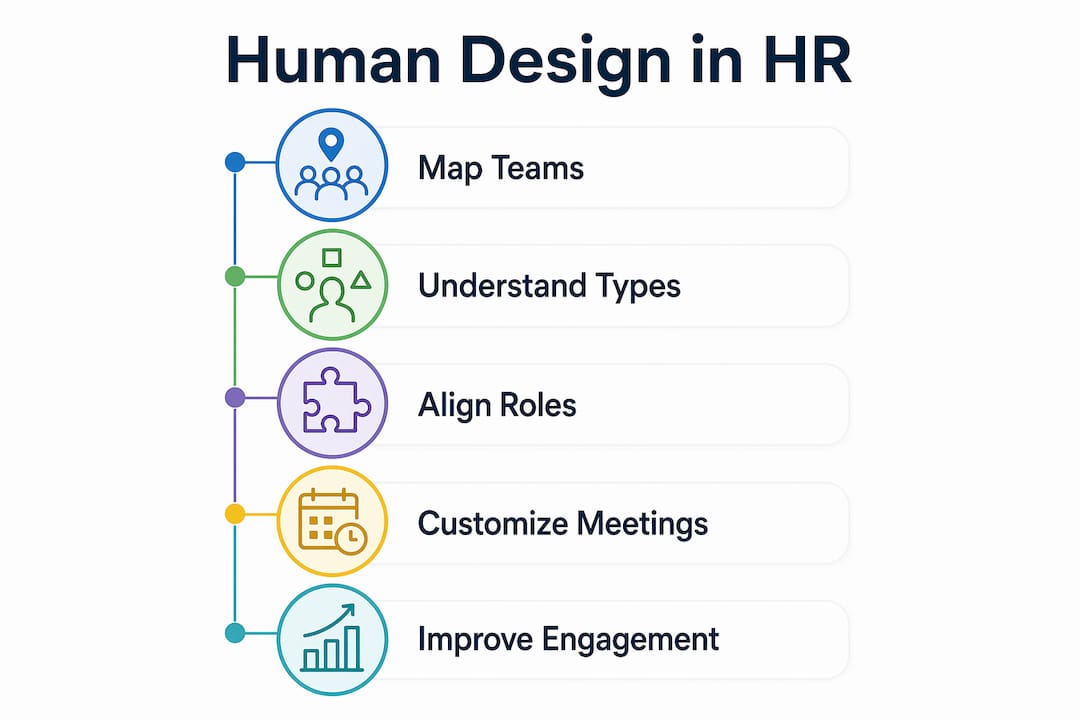
Here is a practical four-step approach for integrating Human Design into team building:
- Map your existing team first. Collect BodyGraph charts for current team members using MyBodyGraph.com. Identify energy gaps, for example, a team of all Generators with no Projector guidance, or a leadership group with no Manifestors to drive initiation.
- Define role requirements by energy output. Before posting a new role, clarify whether it demands sustained operational energy (Generator fit), advisory capacity (Projector fit), or autonomous initiation (Manifestor fit). Use this to sharpen your job description language, not to filter candidates.
- Bring in a Human Design consultant for team workshops. Team workshops create a shared language for decision ownership and communication norms, reducing leadership bottlenecks and increasing individual accountability.
- Run a 30-day pilot. A decision-making pilot based on Human Design authority and strategy concepts helps teams turn abstract alignment ideas into measurable behavior change. Track meeting friction, escalation rates, and self-reported clarity before and after.
Pro Tip: When building complementary teams, prioritize energetic diversity over Type uniformity. A team of all Projectors will generate brilliant strategy but struggle to execute. A team of all Generators will execute relentlessly but may lack the guidance to course-correct. Mix intentionally.
Efficient team dynamics require mapping individuals and their interactions to avoid energy imbalances and bottlenecks. Human Design gives you a structured vocabulary for doing exactly that.

Applying Human Design to performance management and development
Traditional Performance Improvement Plans (PIPs) often fail because they treat underperformance as a skills deficit when the real issue is misalignment. Satori Synergy’s framework reframes PIPs as alignment plans that account for energy patterns and decision-making styles, creating feedback that is specific and human rather than punitive.
Here is how this works in practice:
- Translate feedback through the alignment layer. Instead of telling a Projector to “be more proactive,†recognize that Projectors are designed to wait for recognition and invitation before acting. Reframe the feedback: “We want to invite your input more deliberately. When would you like us to ask?â€
- Adjust output expectations by energy type. Generators sustain consistent output. Manifestors work in bursts followed by rest. Holding a Manifestor to a Generator’s output rhythm creates friction and resentment. Build performance metrics that reflect natural work patterns.
- Use defined centers for coaching focus. A person with an undefined Will Center (ego) is not lazy. They are not designed to sustain willpower-driven commitments over time. Coaching them toward role structures with built-in recovery time is more effective than motivational pressure.
“Human Design’s strategic value is more about coaching managers on decision ownership and communication than labeling individuals.†— Human Design Strategy & Authority Explained
Layering Human Design atop existing HR processes as an “alignment translation layer†is the most sustainable implementation model. You are not replacing your performance framework. You are adding a lens that helps managers ask better questions and give more precise feedback. For a broader view of how soft skills assessment fits into development conversations, this context is directly relevant.
Integrating Human Design into leadership, meetings, and workplace culture
Meeting design is where Human Design delivers some of its most immediate, practical returns. Research from Rev Human Design shows that tailoring meeting lengths and agenda styles to Type profiles reduces friction and burnout. The logic is straightforward: Projectors and Reflectors deplete faster in high-stimulation group settings, while Generators can sustain longer collaborative sessions.
| Type | Ideal meeting format | Decision timing |
|---|---|---|
| Generator | Longer collaborative sessions, open discussion | Responds in the moment to direct questions |
| Projector | Short, focused briefings with clear invitation | Needs time to observe before advising |
| Manifestor | Asynchronous updates, minimal check-ins | Decides independently, then informs |
| Reflector | Small group or one-on-one conversations | Requires up to 28 days for major decisions |
Leadership role alignment is the second major application. Delegating based on defined centers, for example, assigning someone with a defined Throat Center to external communication roles, creates natural fit rather than forced performance. Human Design leadership guidance specifically recommends customizing meeting cadence to profiles to improve flow and reduce cognitive overload.
Pro Tip: Start with leadership team BodyGraphs before rolling Human Design out company-wide. When leaders understand their own Types and Authorities, they model the framework authentically, which dramatically increases adoption rates among their teams.
Embedding Human Design into culture also means building psychological safety around it. Employees resist new frameworks when they feel evaluated or labeled. Frame Human Design as a tool for self-understanding and team communication, not as a management assessment. Human-centered design thinking provides a validated structure for this: ideate, prototype, test, and iterate. Use that cycle to introduce Human Design concepts gradually and measure impact at each stage.
Common challenges and ethical considerations in HR adoption
Applying Human Design in HR comes with real risks if you move too fast or too carelessly. Here are the critical guardrails:
- Never use Type or birth data in hiring decisions. This creates legal exposure under employment discrimination law. Human Design belongs in post-hire team development, not candidate screening.
- Avoid personality labeling. Telling someone “you’re a Projector, so you can’t handle this role†is both inaccurate and harmful. Human Design describes tendencies, not ceilings.
- Manage resistance with transparency. Employees resist new frameworks when they face uncertainty. Psychological safety and clear communication about voluntary adoption are critical for successful rollout.
- Measure your results. Because Human Design lacks strong causal evidence in peer-reviewed literature, your internal data becomes your evidence base. Track engagement scores, meeting satisfaction, and turnover rates before and after implementation.
- Combine with validated tools. Human Design works best alongside established frameworks like psychometric assessments, 360-degree feedback, and structured workplace assessments. It adds a layer of nuance, not a replacement for rigor.
The organizations that get the most from Human Design treat it as one input among many, not as the definitive answer. That measured approach also protects you legally and builds employee trust over time.
Key takeaways
Human Design works in HR as an alignment and communication framework, not a predictive tool, and its value depends entirely on how thoughtfully you integrate it with existing, validated HR practices.
| Point | Details |
|---|---|
| Use it behind the scenes | Apply Human Design to team mapping and development, never to candidate screening or hiring decisions. |
| Match energy to role design | Align role requirements with energy output patterns before writing job descriptions or restructuring teams. |
| Reframe performance conversations | Translate PIPs into alignment plans that account for decision-making styles and natural energy rhythms. |
| Tailor meetings by Type | Adjust meeting length, format, and decision timelines to reduce burnout and improve participation quality. |
| Measure internal impact | Track engagement, friction, and turnover data before and after adoption to build your own evidence base. |
Why I think Human Design deserves a serious seat at the HR table
I have spent years watching organizations invest heavily in skills-based hiring and competency frameworks, only to see talented people leave within 18 months because the role never fit how they actually think and work. Human Design does not solve every people problem, and I would never claim it does. What it does is give managers a vocabulary for conversations that most HR frameworks completely miss: how does this person make decisions? What kind of environment drains them? When are they at their best?
The honest limitation is that Human Design is not scientifically validated in the way that Big Five personality assessments or cognitive ability tests are. You cannot cite a meta-analysis to your CFO. What you can do is run a 90-day pilot with one team, measure the before-and-after on meeting satisfaction and escalation rates, and let the internal data make the case. That is how I would approach it, and that is how I have seen it work in practice.
The deeper opportunity is cultural. When a team shares a language for decision ownership, when a Projector knows their manager will invite their input rather than expecting them to push forward uninvited, trust builds faster. That trust is what reduces turnover. It is not the BodyGraph chart itself. It is the quality of attention the chart prompts.
My advice: do not position Human Design as a spiritual practice inside your organization. Position it as a communication and alignment tool. Pair it with data-driven platforms that assess personality, values, and role fit with higher statistical confidence. That combination is where the real return lives.
— Mikk
How Sparkly helps you go further with people intelligence
Human Design gives you a powerful lens for alignment, but it works best when combined with data that goes beyond a single framework. Sparkly is built for exactly that.
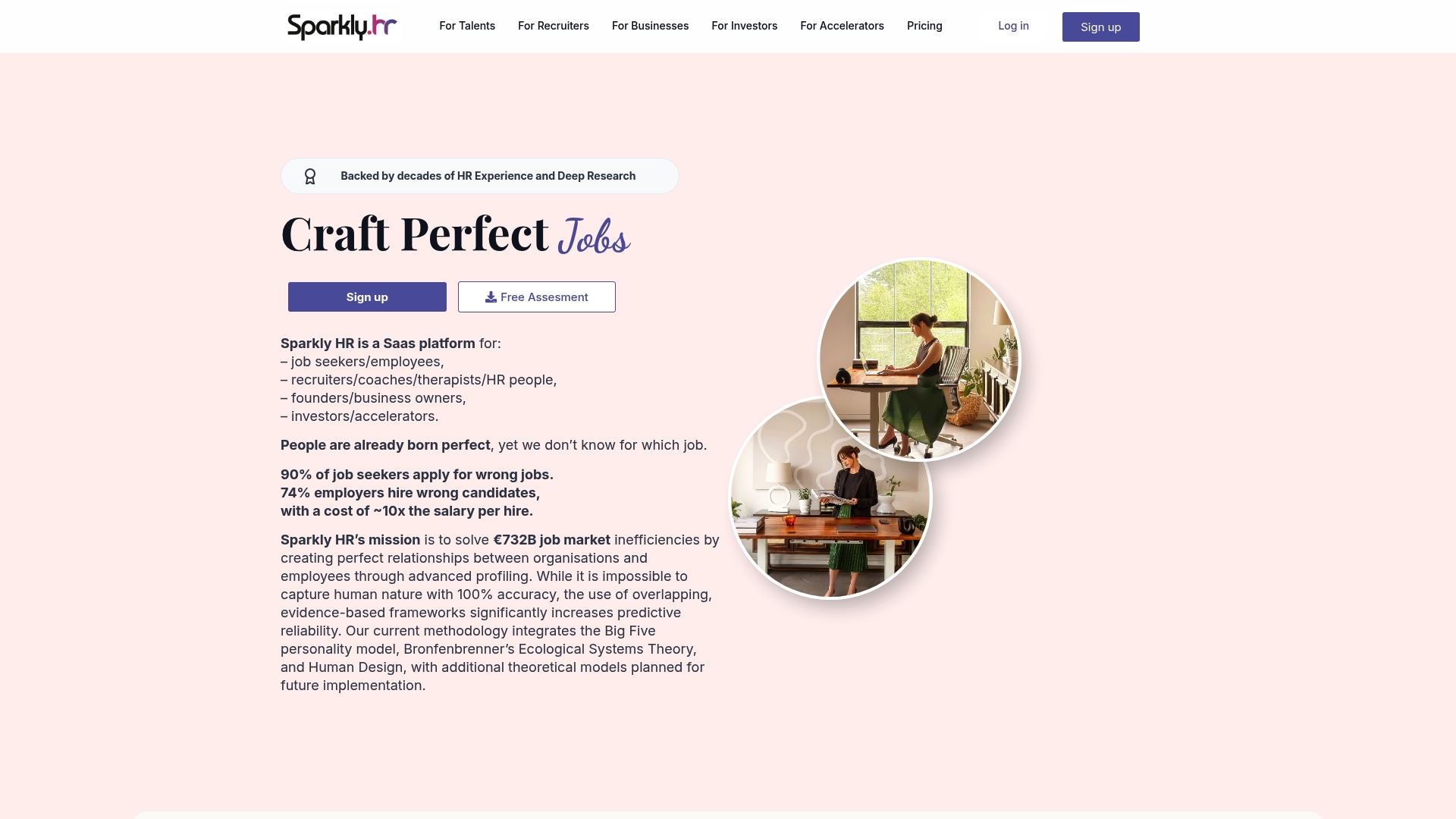
Sparkly merges human judgment, AI analysis, psychometric assessments, and Human Design into a single platform that produces higher-confidence insights for HR decisions. The focus is personality over skills, because skills can be learned but misalignment costs you time, money, and people. Whether you are redesigning roles, building teams, or preparing for a hiring cycle, Sparkly gives you the employee potential insights you need to make decisions you can stand behind. Explore how Sparkly can complement your Human Design practice and turn alignment into a measurable advantage.
FAQ
What is Human Design in the context of HR?
Human Design is a system that categorizes individuals into four energy Types with distinct decision-making strategies, used in HR as an alignment and communication framework to improve team dynamics and reduce friction.
Can you use Human Design as a hiring tool?
No. Screening candidates by birth time or energetic Type creates legal exposure under anti-discrimination law. Human Design belongs in post-hire team development and performance coaching, not candidate selection.
How does Human Design improve employee engagement?
By aligning role expectations, meeting formats, and feedback styles to individual energy patterns, Human Design reduces the mismatch between how people work best and what the job demands of them, which directly reduces burnout and disengagement.
How do you implement Human Design in the workplace?
Start by mapping existing team BodyGraphs using a tool like MyBodyGraph.com, run a 30-day decision-making pilot with one team, and measure engagement and friction metrics before and after to build an internal evidence base.
How does Sparkly use Human Design in its platform?
Sparkly combines Human Design with psychometric assessments, AI analysis, and human judgment to produce higher-probability personality insights that HR teams can use in interviews, role design, and team restructuring decisions.