The Role of Soft Skills Assessment in Workforce Success

TL;DR:
- Most hiring failures are caused by soft skills gaps, not technical incompetence, yet assessments focus mainly on credentials. Implementing continuous, multi-method soft skills evaluations with AI support improves retention, performance, and team resilience significantly. Organizations should prioritize role-specific soft skills development, triangulate feedback sources, and integrate assessment data into ongoing talent decisions.
Most hiring decisions feel confident right up until they fail. 89% of hiring failures trace back to soft skills gaps, not technical incompetence. Yet most organizations still screen primarily for credentials and technical ability, leaving the interpersonal, emotional, and adaptive qualities that actually drive performance largely unmeasured. The role of soft skills assessment is no longer a nice-to-have in HR strategy. It’s the factor separating high-performing teams from expensive turnover cycles. This article breaks down what effective soft skills evaluation looks like, why it matters more than ever, and how you can build it into your hiring and development process right now.
Table of Contents
- Key takeaways
- Why soft skills define organizational performance
- How to assess soft skills that actually matter
- Impact on employee retention and team resilience
- Building an effective soft skills assessment program
- My honest take on where organizations go wrong
- See your people more clearly with Sparkly
- FAQ
Key takeaways
| Point | Details |
|---|---|
| Soft skills drive hiring outcomes | 89% of bad hires stem from soft skills gaps, not technical shortfalls. |
| Assessment must go beyond interviews | Behavioral simulations and 360-degree feedback outperform traditional interview questions for reliable data. |
| Continuous evaluation beats one-time testing | Ongoing soft skills development tied to specific feedback cycles improves retention and resilience. |
| AI amplifies assessment accuracy | Organizations using AI-powered tools report up to 50% higher retention and 75% faster screening. |
| Focus beats breadth in development | Targeting three key soft skills gaps per development cycle produces measurable behavior change. |
Why soft skills define organizational performance
Here’s the uncomfortable reality most business leaders already sense but rarely act on. Technical skills get people hired. Soft skills determine whether they stay, grow, and bring others along with them. The importance of soft skills is not a talking point. It is a structural business issue.
The core soft skills that matter across roles include:
- Communication: The ability to convey ideas clearly, listen actively, and adapt messaging to different audiences. Employers rank communication the #1 skill heading into 2026.
- Emotional intelligence: Research shows it predicts 58% of job success and correlates with a $29,000 annual salary premium over technically equivalent peers.
- Adaptability: The speed at which employees reframe challenges, absorb change, and shift priorities without losing effectiveness.
- Collaboration: The willingness and skill to build trust, share credit, and navigate disagreement productively.
- Critical thinking: The ability to evaluate information objectively and make sound decisions under uncertainty.
What makes these skills strategically important is their multiplier effect. Teams led by high-EQ leaders see a 25% productivity increase compared to teams where emotional intelligence is absent at the leadership level. That’s not a marginal gain. That’s a structural performance advantage.
One misconception worth addressing directly: soft skills are not simply traits you either have or don’t have. They are developable. But unlike technical skills, they require a different kind of development. You cannot teach emotional intelligence from a slide deck. Soft skills assessment should focus on identifying existing aptitudes that can be strengthened, not cataloging deficiencies to fix. That distinction changes your entire approach to development.
How to assess soft skills that actually matter
The gap between knowing soft skills matter and actually measuring them well is where most organizations lose traction. Here is a practical look at the methods available and where each delivers real value.
| Assessment Method | Strengths | Limitations |
|---|---|---|
| Traditional interview questions | Quick, low cost, familiar format | Highly subjective, easy to rehearse, low predictive validity |
| Behavioral interview questions | Evidence-based, past behavior predicts future actions | Still prone to interviewer bias and candidate storytelling |
| Simulation and role-play exercises | Reveals real-time behavior under realistic conditions | Time-intensive, requires trained evaluators |
| 360-degree feedback | Multi-source view reduces individual bias | Requires psychological safety and honest respondents |
| AI-powered assessments | Scales evaluation, reduces unconscious bias, flags patterns | Needs quality data inputs and thoughtful calibration |
| Self-assessments | Raises self-awareness, low cost | Unreliable alone due to the Dunning-Kruger effect |
The core problem with relying on abstract interview questions is that candidates answer what they think you want to hear, not what they would actually do. Behavioral simulations place candidates in real-world scenarios where their responses reveal actual communication style, conflict management instincts, and decision-making patterns. That is where you find the data that matters.
Self-assessment is particularly tricky. People who are weakest in a skill often rate themselves most highly in it. The Dunning-Kruger effect is not a fringe phenomenon in HR. It is a daily reality. Multi-source, 360-degree feedback corrects for this by triangulating perspectives from managers, peers, and direct reports. It’s not perfect, but it is far more calibrated than any single-source method.
Pro Tip: When designing a behavioral assessment, anchor each scenario to a specific role requirement. A sales rep scenario should test persuasion and resilience under rejection. A project manager scenario should reveal how they prioritize competing demands and communicate under pressure. Generic scenarios produce generic data.
AI-powered recruitment tools have added a new layer of precision to assessing interpersonal skills at scale. When implemented thoughtfully, they surface patterns across large candidate pools that human reviewers simply cannot process consistently. The key word is thoughtfully. AI is a data amplifier, and garbage inputs produce garbage outputs.
Impact on employee retention and team resilience
The business case for continuous soft skills evaluation is now backed by hard numbers. Organizations using AI-powered soft skills assessment tools report a 50% increase in employee retention and a 75% reduction in interview screening time. Those are not incremental gains. They represent a fundamental shift in how talent decisions get made.
Retention does not hinge on salary alone. Employees leave when they feel misunderstood, misplaced, or unsupported. Continuous soft skills evaluation creates a different kind of feedback loop:
- Managers gain a clearer picture of where each team member’s interpersonal strengths and growth edges actually lie.
- Employees receive specific, evidence-backed development guidance rather than vague performance reviews.
- Organizations can identify early signals of disengagement, friction, or burnout before a resignation lands on HR’s desk.
- Team composition decisions become data-informed rather than instinct-driven.
The soft skills in the workplace context has also shifted dramatically with hybrid and remote work. Soft skills like communication, accountability, and trust-building become primary performance differentiators when you remove physical co-location from the equation. A technically brilliant employee who cannot communicate asynchronously, build trust remotely, or self-manage without direct supervision creates real team drag.
Integrating soft skills assessment data into talent management means connecting evaluation outputs to actual development plans, career pathing, and promotion criteria. Organizations that do this well treat the assessment not as a gatekeeping event but as a continuous developmental tool that builds organizational resilience over time.

Building an effective soft skills assessment program
Getting the structure right matters more than getting the tools right. A poorly structured program using excellent tools still produces noise. Here is what high-functioning soft skills assessment programs have in common.
Start with role-specific criteria. Not all soft skills carry equal weight across roles. A customer success manager needs high empathy and conflict resolution skills. A data analyst needs critical thinking and clarity of communication. Build your assessment criteria to reflect the actual behavioral demands of each role, not a generic competency model applied uniformly across your organization.
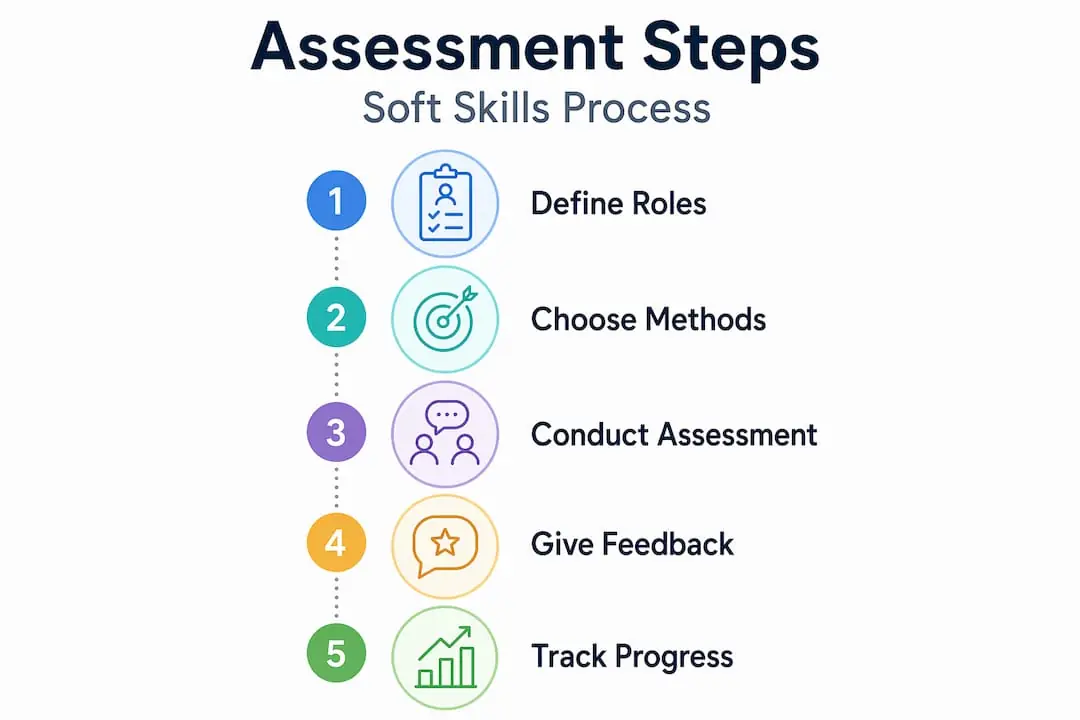
Use structured, multi-method evaluation. No single method is reliable enough to stand alone. Combine behavioral interview questions with simulation exercises and at least one form of multi-source feedback. This combination dramatically reduces the influence of any individual evaluator’s bias.
Focus development on three gaps at a time. Trying to develop every soft skill simultaneously produces shallow results across the board. Focusing on three critical gaps over a 60-to-90-day cycle produces meaningful, measurable behavior change. This is one of the most underused principles in soft skills development programs.
Pro Tip: After each assessment cycle, have managers sit with employees for a 30-minute feedback conversation focused exclusively on the top three development priorities. Skip the full competency review. Employees retain and act on focused, specific feedback far more effectively than comprehensive evaluations delivered once a year.
Connect assessment data to actual HR processes. The hiring process best practices that drive team alignment consistently involve feeding soft skills assessment outputs back into onboarding, performance reviews, and succession planning. Assessment data sitting in a spreadsheet nobody reads is not a program. It’s a filing exercise. Make the data live inside the decisions that actually shape your workforce.
My honest take on where organizations go wrong
I’ve worked with enough HR teams to see the same pattern repeat. Organizations invest in a soft skills assessment tool, run it during hiring, and then treat it as done. The irony is that the single biggest opportunity from soft skills evaluation is not in filtering candidates. It’s in developing the people you already have.
What I keep seeing is a near-total reliance on subjective methods that feel rigorous but aren’t. Managers rate people based on likability. Interview panels debate candidates based on gut feeling. Performance reviews recycle the same generic development themes year after year. Nobody wants to admit that the process is producing comfortable stories rather than accurate data.
The real shift happens when organizations stop treating soft skills evaluation as a compliance checkbox and start using it as a strategic development tool. That means assessing personality and behavioral tendencies at depth, not just surface-level competencies. It means triangulating across multiple sources. And it means acting on what the data shows, even when it challenges a manager’s preferred narrative about a team member.
I also think most organizations underestimate how much technology can help here. Not to replace human judgment, but to reduce the noise that human judgment produces at scale. When you merge psychometric data, behavioral signals, and structured feedback into a single picture, you get a much higher probability of seeing someone clearly. And seeing people clearly is where good people decisions start.
— Mikk
See your people more clearly with Sparkly
What we’ve covered here maps directly to what Sparkly was built to solve. Most assessment approaches rely on one or two data sources, each with their own blind spots. Sparkly merges psychometric data, AI analysis, and structured human feedback to produce people intelligence that HR teams can actually act on. 💡
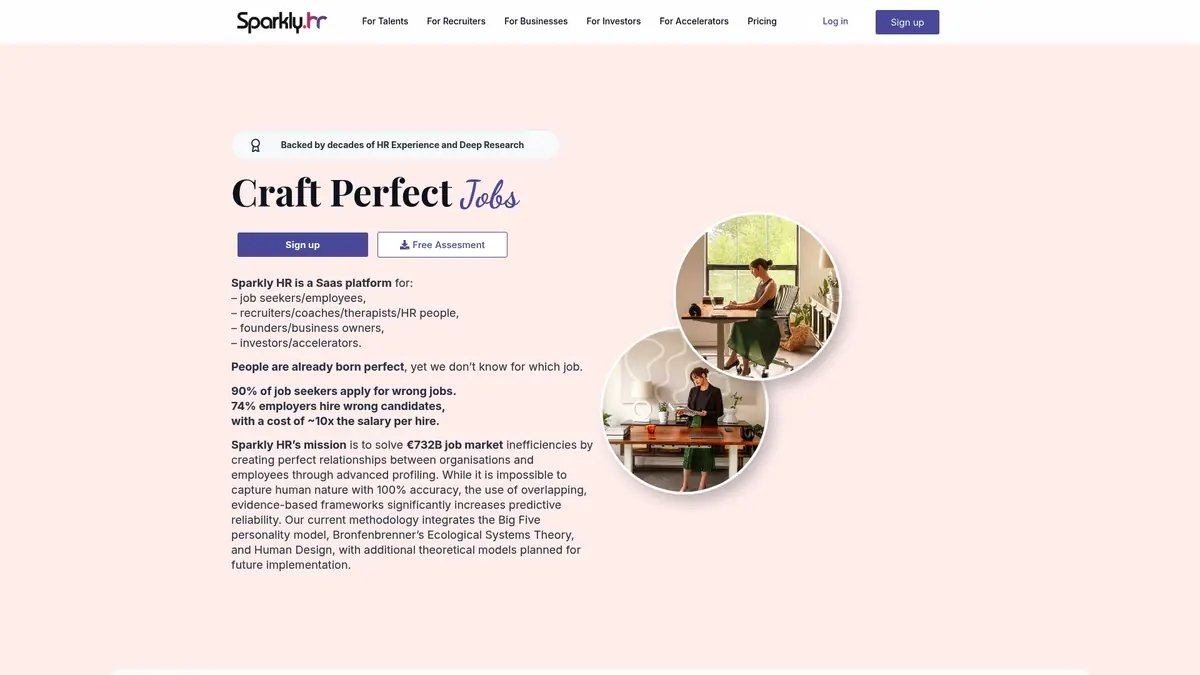
The platform helps you reduce hiring mismatch, identify where current employees are placed in the wrong roles or environments, and build development plans grounded in personality and behavioral data rather than guesswork. Whether you’re managing team dynamics, preparing for restructuring, or trying to cut costly turnover, Sparkly gives you the depth of insight that one-dimensional assessments simply can’t deliver. Explore the talent assessment strategies that improve team fit, or dive into the employee fit assessment guide built specifically for reducing turnover costs in 2026. Your people are not the problem. Misplacement is. 📈
FAQ
Why does soft skills assessment matter more than technical screening?
92% of hiring professionals prioritize soft skills equally or above technical ones because 89% of bad hires are caused by soft skills gaps. Technical skills can be trained. Personality and interpersonal tendencies are far harder to develop without targeted assessment.
What is the most reliable way to assess soft skills?
Multi-source 360-degree feedback combined with behavioral simulations produces the most reliable data. Self-assessments alone are unreliable due to the Dunning-Kruger effect, where low performers tend to overrate their own abilities.
How does soft skills assessment improve employee retention?
Organizations using AI-powered soft skills assessment tools see up to a 50% higher retention rate. Continuous evaluation allows managers to identify mismatch and disengagement early, enabling targeted development before employees reach the point of resignation.
How often should organizations assess soft skills?
Soft skills assessment should be a continuous process, not a one-time hiring filter. Quarterly feedback cycles tied to specific development goals produce better outcomes than annual reviews alone.
Which soft skills should HR prioritize in 2026?
Communication ranks as the top soft skill priority for 2026, followed closely by emotional intelligence, adaptability, and collaboration. Role-specific weighting matters: prioritize the skills most directly tied to performance in each function.