
The Future of Team Dynamics: A 2026 Guide for Leaders
TL;DR:
- Effective team coordination must evolve alongside AI and remote work to prevent slowing down overall performance.
- Structured rituals and explicit decision rights foster psychological safety and cross-cultural trust, enhancing cooperation.
The future of team dynamics is not what most managers expect. The old model — put smart people together, align on goals, and performance follows — is breaking down under the weight of AI adoption, remote work, and generational shifts in how people define meaningful work. What’s replacing it is more complex, more human, and frankly more exciting. This guide cuts through the noise to give you the research-backed strategies and practical frameworks you need to build teams that don’t just function well today but adapt and thrive as the world keeps moving. âš¡ï¸
Table of Contents
- Key takeaways
- The future of team dynamics and the AI coordination gap
- Psychological safety: structure matters more than sentiment
- Inclusive leadership and learning from failure
- Experience-based team design for remote environments
- Leader behaviors and employee well-being as a feedback loop
- My take: what the research won’t tell you directly
- How Sparkly helps you build better teams
- FAQ
Key takeaways
| Point | Details |
|---|---|
| AI creates a coordination gap | Individual speed increases with AI, but team coordination lags without deliberately redesigned workflows. |
| Psychological safety needs structure | Vague encouragement does not build safety. Specific rituals and team norms make the difference. |
| Experience beats communication volume | Pairing newcomers with experienced teammates outperforms increasing meeting frequency in remote teams. |
| Inclusive leadership drives innovation | Leaders who make failure visible and trackable unlock higher team innovation, especially with younger employees. |
| Well-being is a two-way signal | Employee well-being shapes how teams perceive their leaders, creating a feedback loop that managers must manage. |
The future of team dynamics and the AI coordination gap
Most leaders adopting AI in 2026 are solving the wrong problem. They are focused on individual speed, and that part is working. But 85% use AI while only 29% have embedded it meaningfully into team workflows. The result? Individuals move faster, but the team as a whole slows down because coordination has not kept pace.
This is what researchers are calling the “fragmentation tax.†When one person uses AI to produce outputs three times faster, but the handoff process, decision rights, and review cadences haven’t changed, the bottleneck just moves downstream. The team pays for individual speed gains with collective confusion.
The numbers are sobering. 55% of executives say AI is already widening performance gaps between their best and average teams, and 70% expect roles to become more collaborative, not more siloed, over the next three years. That means the teams winning with AI aren’t just using better tools. They are redesigning how they work together around those tools.
Here is what this looks like in practice:
- Audit your coordination cadences. If your team’s operating model was designed before AI entered workflows, it needs a redesign. Where are decisions made? Who needs to be in the loop and when? These questions are urgent now.
- Distribute AI fluency, not just access. Giving everyone a license is not enough. Teams need shared norms around when and how AI outputs are reviewed, challenged, and integrated.
- Redesign decision rights. Faster individual output means decisions arrive at managers faster too. Without clear decision authority, bottlenecks multiply even as individual productivity rises.
Pro Tip: Run a “coordination audit†with your team. Ask everyone to map the last three times they waited on a colleague or a decision. The patterns that emerge will tell you exactly where your operating model needs to change.
The teams that will lead in evolving team collaboration are not the ones with the most AI tools. They are the ones that treated coordination redesign as seriously as tool adoption.
Psychological safety: structure matters more than sentiment
There is broad agreement that psychological safety matters for team performance. What’s less understood is how to actually build it. And this is where most managers fall short.

Research published in 2025 confirms that psychological safety drives cooperation and team dynamic capabilities, with cooperation acting as the key mechanism that translates safety into performance. But the effect sizes vary significantly across cultures. In German teams, the safety-cooperation effect measured β=0.568, compared to β=0.365 in Brazilian teams. This is not a small difference. It means your approach to building safety in a cross-cultural team needs to be calibrated, not generic.
| Culture | Safety-cooperation effect (β) | Implication for managers |
|---|---|---|
| Germany | 0.568 | High sensitivity to structural fairness and clear norms |
| Brazil | 0.365 | Relationship-based trust plays a stronger role |
| Cross-cultural teams | Varies | Localized rituals outperform universal safety messaging |
The practical application here is specific. Vague encouragement like “we have an open-door policy†does not move the needle. What works is structured team norms: a standing question at every retrospective asking what team members are uncertain about, explicit protocols for surfacing disagreement, and regular reflection on decisions that didn’t go as planned.
Psychological safety is also not a static state. It erodes under stress and rebuilds through consistent behaviors over time. A team that felt safe in Q1 may not feel safe after a restructuring or a missed target in Q3. Leaders who treat safety as something to achieve once, rather than something to maintain actively, lose it quietly.
Pro Tip: Introduce a “learning question†ritual at your next team meeting. Ask: “What’s one assumption we’re making this week that we haven’t tested?†It signals safety without requiring anyone to explicitly declare their vulnerability.
For cultural compatibility considerations across international teams, the principles are consistent: specificity beats aspiration, and rituals beat rhetoric every time.
Inclusive leadership and learning from failure
Here is a finding that reframes how most leaders think about innovation: inclusive leadership improves team innovation not primarily through inclusion itself, but through its ability to create a culture where learning from failure is visible and trackable.
The research shows the pathway clearly. Inclusive leadership increases team members’ willingness to report, examine, and document failures. That documentation becomes a learning asset. And that learning asset drives innovation performance. The effect is strongest among new-generation employees, particularly those with a strong sense of career calling, who see failure learning as part of professional growth rather than something to hide.
This has direct implications for how you run your team:
- Make failure documentation routine, not punitive. A simple monthly “what didn’t work†log, shared across the team, normalizes failure as data rather than as evidence of incompetence.
- Recognize the learning behavior, not just the outcome. When someone surfaces a failed experiment, acknowledge the act of surfacing it. This reinforces the behavior you need.
- Connect failure learning to team goals explicitly. Younger employees especially respond when they can draw a direct line between a lesson learned and a better decision made. Show the before and after.
- Be transparent about your own failures as a leader. Research on inclusive leadership consistently shows that modeling vulnerability from the top accelerates psychological safety at every level of the team.
The nuance here matters for future leadership in teams. Inclusion without structure creates comfortable conversations but not better decisions. Inclusion with a built-in mechanism for learning from failure creates teams that adapt faster than their competitors.
Experience-based team design for remote environments
The impact of remote work on teams has produced one counterintuitive finding that every manager should know: more communication does not improve team performance. Experience does.
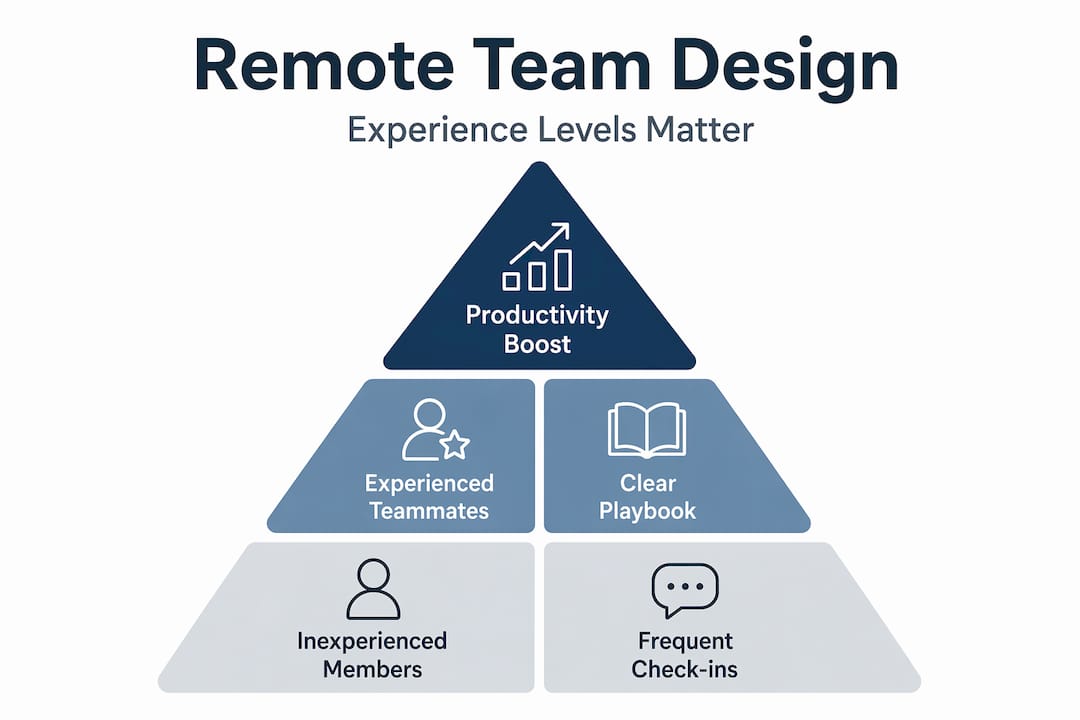
A study of remote workers in Japan found that assigning inexperienced employees to teams with experienced teammates boosted productivity by 26.2% for the shortest-tenure employees. Crucially, average team productivity and communication volume had no measurable effect on individual output. It was the experience of colleagues that moved the needle, not how often they talked.
The mechanism is straightforward. Experienced teammates reduce what researchers call “search costs.†Newcomers spend less time figuring out unwritten norms, debugging processes, and recovering from avoidable mistakes. They access institutional knowledge faster, which compounds over time into significantly higher output.
Here is how to apply this structurally:
- Pair intentionally. When onboarding a new team member remotely, assign them to a project where at least one experienced colleague is actively working, not just available for questions.
- Build asynchronous knowledge assets. Experience-based knowledge transfer scales further when encoded into playbooks, decision logs, and annotated templates that newcomers can access without a synchronous meeting.
- Audit your current team composition. Look at where your newest employees sit. Are they clustered together, or are they distributed across experienced teammates? The answer will tell you a lot about why some onboarding experiences are faster than others.
- Resist the reflex to add meetings. When remote team productivity drops, the instinct is to schedule more check-ins. The research suggests you’re better off investing that time in building better knowledge transfer structures instead.
Pro Tip: Create a “team playbook sprint†where your experienced team members document the top five things they wish they’d known in their first 90 days. This is one of the highest-return investments you can make in remote team productivity.
Leader behaviors and employee well-being as a feedback loop
Most leadership development models treat the relationship between leaders and employees as a one-way influence: leaders behave a certain way, employees respond. The research tells a more dynamic story.
A longitudinal study published in 2026 found that employee well-being predicts how team members perceive and rate their leader’s behaviors over time. Leader development, communication, and efficiency behaviors all correlated positively with employee well-being. But well-being did not predict future leadership behaviors. This points in one direction: the feedback loop runs through the employee.
The practical implications for managers are significant:
- Monitor well-being as a leading indicator. If your team’s well-being scores are dropping, your leadership effectiveness ratings will follow, even if you haven’t changed anything about how you lead.
- Invest in well-being before you need it. Teams with higher baseline well-being are more resilient to the disruptions of restructuring, AI transitions, and leadership changes.
- Use well-being data to check your blind spots. Leaders often believe they are communicating clearly and supporting development. Well-being data tells you whether the team is actually experiencing it that way.
- Align well-being initiatives with performance goals. This is not a soft HR initiative. The hiring process best practices that build team alignment from day one directly reduce the friction that depletes well-being over time.
Team dynamics in the workplace are not static systems to be optimized once. They are living feedback loops that require ongoing attention, real data, and a willingness to adapt.
My take: what the research won’t tell you directly
I’ve worked with enough teams navigating rapid change to know that the hardest part isn’t understanding these insights. It’s acting on them when everything is moving fast and results are due.
The most common mistake I see is managers investing heavily in AI tools and then wondering why the team still feels disconnected. Speed without coordination redesign doesn’t produce better team outcomes. It produces faster individual output and more team friction, and those two things feel very different from the outside.
What I’ve found genuinely moves the needle is specificity. Not “we value psychological safety†but “every retrospective ends with one person naming something they got wrong this week and what they learned.†Not “we encourage collaboration†but “every new hire is embedded with a senior teammate for the first 60 days, with shared project goals, not just mentoring calls.â€
The teams I’ve seen come out ahead in this environment are not the ones with the most tools or the biggest headcount. They are the ones where the leader understands that how people are placed, matched, and developed together is the actual competitive advantage. Everything else is table stakes.
— Mikk
How Sparkly helps you build better teams
Understanding the research is one thing. Having the data infrastructure to act on it consistently is another. Sparkly is built for exactly this gap.
Sparkly is a people-intelligence SaaS platform that turns personality, cognitive, and team-fit data into computed insights for role fit, task-person fit, team dynamics, and burnout risk. Unlike tools that focus on skills (which can be taught), Sparkly assesses personality first because personality predicts how someone will actually behave in a team, under pressure, and across cultures. If you want to improve team dynamics with more than gut feeling, Sparkly gives you the data layer to do it. Explore how SaaS-powered people intelligence translates research insights like these into decisions you can act on today.
FAQ
What is the biggest threat to future team dynamics?
The biggest threat is AI increasing individual speed without a corresponding redesign of team coordination. 55% of executives say AI is already widening performance gaps between teams that have adapted their operating models and those that haven’t.
How does psychological safety improve team performance?
Psychological safety enables open communication and risk-taking, which drives cooperation and team dynamic capabilities. Research shows the effect is stronger in some cultures than others, so structured rituals work better than general messaging.
Does remote work hurt team cohesion?
Not necessarily. The impact of remote work on teams depends heavily on team composition. Experienced teammates boost productivity by 26.2% for new remote employees, while communication volume alone has no measurable effect.
How can leaders use failure to drive innovation?
Inclusive leadership improves innovation by making failure learning visible and trackable, not just culturally acceptable. Documenting failures as a routine team practice is the mechanism, not simply encouraging openness.
How does employee well-being affect leadership perception?
Employee well-being predicts how team members rate their leader’s behaviors over time, not the other way around. This means leaders should treat team well-being as a leading indicator of their own effectiveness, not a lagging one.