Your Guide to Unbiased Recruitment: Strategies That Work

TL;DR:
- Unbiased recruitment evaluates candidates solely on job-relevant skills and qualifications using structured, fair processes. Structured interviews, with standardized questions and scoring, significantly reduce bias and enhance decision validity. Effective bias mitigation requires proactive assessment design, detailed documentation, and active AI governance aligned with legal standards.
Unbiased recruitment is the practice of evaluating every candidate solely on job-relevant skills, qualifications, and potential, removing personal or demographic factors from every hiring stage. In the industry, this is formalized as structured, equitable selection, and it sits at the intersection of legal compliance, organizational performance, and human fairness. The EEOC’s Uniform Guidelines on Employee Selection Procedures (UGESP) set the legal baseline in the US, while GOV.UK and Canada’s Public Service Commission offer detailed operational frameworks. This guide to unbiased recruitment gives HR professionals and business leaders a concrete, stage-by-stage system to reduce unconscious bias, improve candidate quality, and build hiring processes that hold up under scrutiny. ⚡️
What is a guide to unbiased recruitment and why does it matter?
Unbiased recruitment is not about ignoring differences. It is about making sure those differences never drive a hiring decision unless they are directly relevant to the job. The goal is a process where every candidate gets evaluated on the same criteria, in the same way, with the same information available to every decision-maker.
Fairness in hiring is achieved more through process design than through trying to train bias out of people. That insight changes everything about how you approach this problem. You cannot rely on good intentions. You need architecture: structured questions, standardized scoring, and documented decisions that can be reviewed and defended.
The business case is equally clear. Organizations that apply fair recruitment strategies consistently report better quality hires, lower turnover, and stronger team diversity. When your process is defensible, you also reduce litigation risk significantly. That is not a side benefit. For many HR leaders, it is the primary reason to act now.
How structured interviews reduce bias and improve fairness
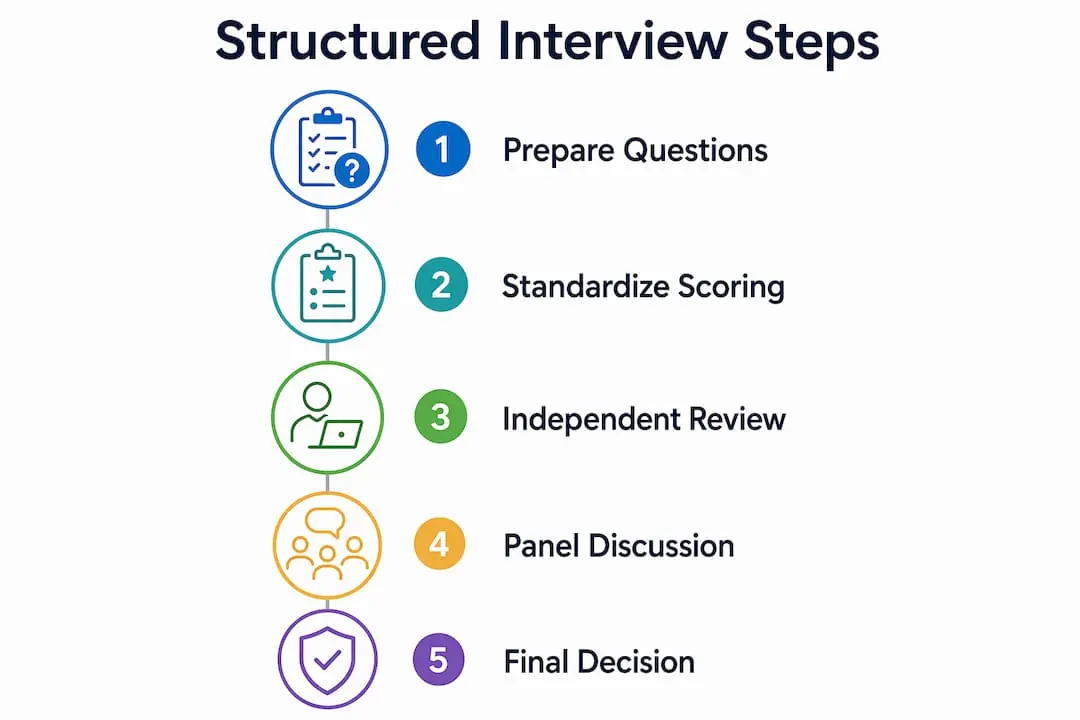
Structured interviewing is the single most effective tool in an unbiased recruiting workflow. The principle is straightforward: every candidate answers the same questions, in the same order, scored against the same predefined benchmarks. The result is a process where your decision reflects candidate performance, not interviewer preference.
GOV.UK recommends building interview panels with diverse members, specifically mixing gender and ethnicity, to reduce the risk of any one perspective dominating the evaluation. This matters because homogeneous panels tend to favor candidates who mirror their own backgrounds, often without realizing it. A diverse panel introduces natural checks on that tendency.
Here is what a structured interview process looks like in practice:
- Fixed question set: All candidates receive identical, job-relevant questions in the same sequence. No improvised follow-ups that only some candidates receive.
- Predefined benchmark answers: Before interviews begin, the panel agrees on what a strong, adequate, and weak answer looks like for each question. This removes post-hoc rationalization.
- Independent scoring: Each panelist scores responses individually before any group discussion takes place.
- Batch interviewing: Where possible, interview candidates for the same role in close succession to enable direct comparison.
- Documented rationale: Every score is recorded with a brief justification tied to the benchmark criteria.
Pro Tip: Score each candidate independently before the panel discusses results. Independent scoring before group discussion prevents dominant voices from cascading their bias across the panel, a phenomenon researchers call influence bias. Once one person shares a strong opinion, others unconsciously align with it.
Structured interviews also carry a measurable validity advantage. Structured interviews show a validity coefficient of approximately 0.51 compared to 0.38 for unstructured interviews. That gap translates directly into better hiring decisions and fewer costly mis-hires.
How to reduce bias in CV screening and early evaluation
CV screening is where unconscious bias strikes earliest and most invisibly. A candidate’s name, address, graduation year, or employment gap can trigger snap judgments before a single qualification is assessed. Fixing this stage requires both structural changes and ongoing vigilance.

Anonymizing CVs, removing names, photos, and other identifying details, can improve outcomes for underrepresented candidates. However, anonymization isn’t one-size-fits-all. If your organization runs targeted diversity campaigns, anonymization can actually work against those goals by removing the very information needed to track representation. Treat it as a design choice with interaction effects, not a universal fix.
| Tactic | What it addresses |
|---|---|
| Remove names and photos from CVs | Reduces gender and ethnicity bias at first review |
| Use years of experience instead of graduation dates | Accounts for career breaks and non-linear paths |
| Train hiring managers on bias patterns | Builds awareness of affinity bias and halo effects |
| Audit AI screening tool outputs regularly | Catches learned bias before it compounds |
| Apply consistent scoring criteria across all CVs | Prevents selective application of standards |
Training hiring managers is not optional. Awareness alone does not eliminate bias, but it does reduce the frequency of unchecked snap judgments. Pair training with structured scoring sheets so managers have a framework to anchor their evaluations.
AI-powered applicant tracking systems add another layer of risk. AI screening tools trained on historical hiring data risk reproducing gender and employment gap biases at scale. If your ATS was trained on data from a workforce that skewed male or lacked diversity, it will replicate those patterns unless you actively audit and adjust its outputs. Review AI tool performance against your Equality Act obligations and document every adjustment you make.
How to evaluate and mitigate bias across the full assessment process
Most organizations address bias reactively, after a complaint or a disparity surfaces. Bias mitigation requires proactive governance at the design and administration stages of every assessment, not just post-hoc reactions. Canada’s Public Service Commission formalizes this through its Mitigating Biases and Barriers Tool, which evaluates selection instruments before they are deployed.
The framework operates across six guiding principles:
- Awareness: Decision-makers understand the types of bias that affect each assessment stage, from planning through scoring.
- Accessibility: Assessment methods do not create unnecessary barriers for candidates with disabilities or non-standard backgrounds.
- Validity: Every selection tool measures what it claims to measure and is demonstrably relevant to the role.
- Standardization: All candidates experience the same process, administered in the same way.
- Transparency: Candidates understand how they will be evaluated and what criteria apply.
- Fairness: Outcomes are reviewed for disparate impact across demographic groups, and adjustments are documented.
“Mitigating bias requires evaluation at every stage, not just after problems arise.” — Canada’s Public Service Commission
Applying this framework means reviewing your job postings, application forms, screening tools, interview questions, and scoring rubrics before each hiring cycle. Document what you find and what you changed. That documentation is not bureaucratic overhead. It is your evidence trail if a hiring decision is ever challenged. The role of assessments in hiring extends well beyond the interview room, and the organizations that treat assessment design as a strategic function consistently outperform those that treat it as an afterthought.
What are the legal requirements for unbiased hiring?
Legal compliance in recruitment is not a separate track from fairness. The two are the same track. The EEOC’s Uniform Guidelines on Employee Selection Procedures (UGESP) require employers to validate any selection procedure that produces adverse impact against a protected group. Adverse impact is triggered when a protected group’s selection rate falls below four-fifths of the highest-selected group’s rate. That is the four-fifths rule, and it is the threshold that determines whether your process requires formal validity evidence.
Structured hiring processes are significantly easier to defend legally than unstructured ones because they generate documented, job-related criteria for every decision. When a candidate challenges a hiring outcome, your defense depends on your records. If your scoring sheets, benchmark answers, and panel notes are consistent and tied to job requirements, you have a defensible case. If your process was informal and undocumented, you do not.
| Process type | Validity coefficient | Legal defensibility |
|---|---|---|
| Structured interviews | ~0.51 | High: documented, standardized, job-relevant |
| Unstructured interviews | ~0.38 | Low: subjective, inconsistent, hard to defend |
Good intentions do not eliminate liability risk. Documented job-related criteria are what protect your organization when decisions are scrutinized. UK employers also operate under the Equality Act 2010, which requires reviewing automated tools for discriminatory impact. Canadian federal employers follow the Public Service Employment Act. Across all three jurisdictions, the pattern is the same: process documentation and job-relevance evidence are your legal foundation. Partnering with HR compliance specialists, such as those at Inclusive PEO, can help smaller organizations build that foundation without a full in-house legal team.
How to use AI responsibly in your unbiased recruiting workflow
AI tools in recruitment are neither inherently fair nor inherently biased. They reflect the data they were trained on and the governance structures around them. The NIST AI Risk Management Framework (AI RMF) provides the clearest governance standard available for organizations deploying AI in hiring contexts.
The NIST AI RMF requires organizations to define what “working right” means for each AI tool before deployment, then maintain continuous audit trails to verify that the tool performs as intended. AI governance and audit trails are not optional features. They are the mechanism by which liability is managed and transparency is maintained. Without them, you cannot demonstrate that your AI-assisted decisions were fair or job-relevant.
The practical risks are real. An AI screening tool trained on historical hiring data from a company that historically hired mostly men will score male-coded resumes higher, even if gender is not an explicit variable. The bias is embedded in proxies: word choice, career trajectory patterns, educational institutions. Catching this requires regular output audits comparing selection rates across demographic groups.
Pro Tip: Before deploying any AI screening tool, run it against a test dataset with known demographic composition and compare selection rates. If the tool produces disparate selection rates across gender or ethnicity, adjust the model or its weighting before it touches real candidates.
The role of AI in recruitment is most effective when it augments human judgment rather than replacing it. AI can surface patterns across large applicant pools that humans would miss. But the final evaluation of a candidate’s fit, personality, and potential still requires human interpretation, ideally supported by structured data from validated assessments. Staying current on recruitment technology trends helps HR leaders identify which tools have built-in governance features and which require additional oversight.
Key takeaways
Unbiased recruitment works when process design, legal compliance, and technology governance operate together as a system, not as separate initiatives.
| Point | Details |
|---|---|
| Structure beats intention | Structured interviews with predefined benchmarks outperform good intentions in reducing bias. |
| Screen CVs with design intent | Anonymization helps in some contexts but conflicts with targeted diversity programs; choose deliberately. |
| Audit before deployment | Evaluate every selection tool for bias before use, not after disparities appear. |
| Document everything | Consistent scoring records and documented criteria are your legal defense in any challenge. |
| Govern AI actively | AI tools require defined governance, audit trails, and regular output reviews to stay fair. |
Why process design is the real answer
I have worked with HR teams that genuinely believed their hiring was fair because their people were well-intentioned. That belief is the most dangerous one in recruitment. Bias does not require bad actors. It operates through unexamined processes, inconsistent questions, and undocumented decisions.
What I have found actually works is treating your hiring process the way an engineer treats a system: design it deliberately, test it against known failure modes, and audit it regularly. Structured interviews are not bureaucratic overhead. They are the mechanism that makes fairness reproducible. The same applies to CV screening, assessment design, and AI governance.
The organizations I have seen make the most progress on equitable hiring share one trait: they measure outcomes. They track selection rates by demographic group, review where candidates drop out of the funnel, and use that data to identify where their process is producing unintended results. You cannot fix what you do not measure.
My honest view is that personality-based assessment, done rigorously, is one of the most underused tools in fair recruitment. Skills can be learned. Personality, working style, and values alignment are far harder to develop after hire. When you assess those dimensions consistently and transparently, you give every candidate a fair shot based on who they actually are, not how well they perform in an unstructured conversation with someone who happens to like them.
— Mikk
How Sparkly helps you build a fairer hiring process
Sparkly is built for exactly this challenge. The platform merges psychometric assessments, Human Design data, AI analysis, and human judgment into a single decision-support layer that gives your hiring team higher-probability insights about candidate fit, personality, and role alignment.
Rather than relying on any single unreliable source, Sparkly computes insights from four data streams simultaneously, reducing the influence of individual bias on hiring outcomes. Every assessment is structured, documented, and tied to role-relevant criteria. Explore how Sparkly’s SaaS approach to people intelligence can support your unbiased hiring practices, from first screening through final selection. You can also review top talent evaluation tools to see how Sparkly compares against leading platforms in 2026.
FAQ
What is unbiased recruitment?
Unbiased recruitment is the practice of evaluating candidates solely on job-relevant qualifications and potential, using structured processes that remove demographic or personal factors from hiring decisions.
How do structured interviews reduce hiring bias?
Structured interviews use identical questions, predefined scoring benchmarks, and independent panel scoring to ensure every candidate is evaluated on the same criteria, reducing the influence of personal preference or unconscious bias.
What is the four-fifths rule in recruitment?
The four-fifths rule is an EEOC standard that triggers adverse impact review when a protected group’s selection rate falls below 80% of the highest-selected group’s rate, requiring employers to validate the job-relevance of their selection procedures.
Should you always anonymize CVs to reduce bias?
Not necessarily. Anonymizing CVs reduces gender and ethnicity bias at the screening stage, but it can conflict with targeted diversity campaigns. Treat anonymization as a deliberate design choice and check for interaction effects with your other DEI strategies.
How do you govern AI tools in recruitment to prevent bias?
Apply the NIST AI Risk Management Framework: define what fair performance looks like before deployment, maintain continuous audit trails, and regularly review selection rate outputs across demographic groups to catch and correct bias before it compounds.