
Talent selection methods guide: build stronger, lasting teams

TL;DR:
- High employee turnover damages team cohesion, reduces productivity, and reveals failed hiring processes that are too reliant on outdated tools. Implementing a diagnosis-driven, multi-method approach that integrates skills assessments, structured interviews, and AI tools improves long-term fit and reduces costs. Ensuring AI fairness and compliance through validation, documentation, and stakeholder engagement is essential for building a sustainable, high-performing workforce.
High employee turnover isn’t just expensive. It fractures team dynamics, stalls productivity, and signals something deeper is broken in how your organization selects people. The average cost of replacing a single employee can reach up to 200% of their annual salary, and mid-sized companies absorb that hit repeatedly when selection processes rely on gut instinct and outdated tools. This guide delivers a practical, research-backed roadmap to overhaul how you identify, assess, and choose talent. You’ll find specific methods, honest comparisons, and a step-by-step framework to build teams that actually stay and perform.
Table of Contents
- Diagnosing your current challenges
- Core talent selection methods explained
- How to innovate safely: balancing AI, compliance, and fairness
- Building your upgraded selection process: step-by-step
- Why most selection “innovations” don’t fix turnover—unless you do this first
- Bridge talent selection with better solutions
- Frequently asked questions
Key Takeaways
| Point | Details |
|---|---|
| Diagnose selection gaps | Identify weaknesses in your current hiring process, including lack of strategy or outdated methods. |
| Use multi-method approach | Combine structured interviews, skills-first assessments, and AI tools for best results. |
| Innovate with guardrails | Adopt new technology while ensuring compliance, fairness, and measurement. |
| Build process step-by-step | Overhaul your selection approach with clear objectives, piloting, and feedback loops. |
| Prioritize lasting fit | Focus on both skill and team alignment—not just new tools—to reduce turnover. |
Diagnosing your current challenges
Before you can fix your hiring process, you need to see it clearly. Most HR teams sense something is off but can’t pinpoint exactly where the breakdown happens. Is it sourcing? Screening? Decision-making? Or is it all three?
Common symptoms of ineffective talent selection:
- High churn within the first 90 days of employment
- Recurring “wrong fit” feedback from hiring managers after onboarding
- Long time-to-fill numbers that pressure teams to hire in a rush
- Over-reliance on resumes and credentials instead of demonstrated ability
- Fragmented tools that don’t communicate with each other, creating data blind spots
Mid-sized organizations often face a specific set of structural gaps. They’ve outgrown the informal, gut-driven approach of a small startup but haven’t yet built the systematic infrastructure of an enterprise HR function. That middle space is where the most costly mistakes happen.
Here’s a snapshot of where the industry stands right now:
| HR Metric | Industry Average | High-Performing Organizations |
|---|---|---|
| Time-to-fill (days) | 44 days | 18 days |
| First-year turnover rate | 32% | 12% |
| AI adoption in hiring | 59% | 80%+ |
| Formal AI strategy in place | 7% | 55%+ |
That last row is alarming. 59% of HR pros use AI in talent acquisition, but only 7% have a formal AI strategy. That gap between adoption and strategy is where risk lives. Tools without governance are not improvements. They’re liabilities.
Staying current with recruitment technology trends is important, but only when you also know which problems you’re solving. Start with diagnosis before you start shopping for solutions.
Core talent selection methods explained
Once you know where your process is falling short, you can make smarter choices about which methods to lean into and which to reconsider. Here’s an honest breakdown of the most common approaches being used in 2026.
The main selection methods and how they compare:
| Method | Primary Strength | Common Weakness | Best Use Case |
|---|---|---|---|
| Structured interviews | Consistency, legal defensibility | Time-intensive, interviewer bias possible | All roles, especially leadership |
| Skill assessments | Direct role-relevant measurement | Can miss personality fit and team dynamics | Technical or task-specific roles |
| AI-based screening | Speed, volume handling | Black-box risk, potential bias in training data | High-volume sourcing and initial screening |
| Personality assessments | Predicts behavioral tendencies | Often standalone, not integrated with other data | Team composition and culture fit |
| Situational judgment tests | Real-world problem-solving | Development and scoring cost | Complex or customer-facing roles |
Each method has a valid place in a well-designed process. The problem is most organizations pick one or two and treat them as sufficient. They’re not.
How to combine methods effectively:
- Start with a skills-first screen to filter by demonstrated ability, not just listed credentials.
- Follow with a structured interview to assess judgment and communication.
- Add a validated personality or behavioral assessment to predict team dynamics.
- Use AI tools for scheduling, note analysis, and pattern flagging, not for final decisions.
- Involve more than one stakeholder in the final scoring to reduce individual bias.
The skills-first approach deserves special attention. SHRM research confirms that skills-first framing speeds hiring and improves fit by mapping demonstrated skills directly to job needs. This method moves away from pedigree and toward evidence, which is especially valuable when you’re trying to reduce bias and expand your candidate pool.
One thing worth flagging: AI in recruitment is genuinely useful when applied to the right parts of the funnel. Automated screening of resumes, scheduling assistance, and sentiment analysis during video interviews are areas where AI adds speed without sacrificing quality. But placing AI in charge of final decisions, without human review and validated assessment to back it up, is where organizations run into trouble.

Pro Tip: Before adding any new selection tool, ask one question: “What specific decision does this improve, and how will we measure whether it worked?” If you can’t answer that, the tool isn’t ready to be deployed in your process.
Choosing the right evaluation SaaS tools means matching the tool’s strength to your most critical selection gap, not just adopting what’s trending.
How to innovate safely: balancing AI, compliance, and fairness
New tools are exciting. Automation promises speed. AI promises smarter decisions. But innovation without discipline creates new problems faster than it solves old ones.
“Innovation without guardrails can increase compliance and bias risk. Pair AI with validated assessment design and clear documentation to protect both candidates and your organization.” — McLean & Company
That quote should be on the wall of every HR team considering a major tech upgrade. The organizations that get this right treat fairness and documentation as foundational, not as afterthoughts.
Checklist for fair and defensible AI-assisted selection:
- Is the AI tool validated against adverse impact for your specific candidate population?
- Can you explain to a regulator or candidate how the tool reached its output?
- Are human reviewers making final calls, with AI serving in a supporting role?
- Is every assessment step documented with timestamps, scores, and rationale?
- Have you audited your data sources for historical bias that could contaminate AI training?
- Is your team trained to recognize and flag AI recommendations that feel off?
The legal landscape around AI in hiring is moving fast. Several U.S. states and cities now require employers to disclose when automated tools are used in hiring decisions. That AI and human qualification balance is not just an ethical consideration. It’s increasingly a legal one.
⚡️ Statistic to know: Only 7% of organizations using AI in hiring have a formal AI strategy in place. That means 93% are operating with significant governance gaps. Don’t be in that group.
Data-driven HR practices require more than just collecting data. They require knowing what questions the data is answering and whether those answers are fair and accurate. When you use talent optimization tools with that mindset, you build a process that’s both smarter and safer.
External compliance review is worth the investment. Bringing in an employment law specialist to audit your AI-assisted process once a year isn’t overhead. It’s insurance.
Building your upgraded selection process: step-by-step
You now understand the landscape. You know which methods exist, how they compare, and how to adopt innovation safely. Here’s how to put it all together in a process your team can actually use and trust.
Step 1: Define your actual pain points. Don’t start with tools. Start with your data. What is your current first-year turnover rate? Where in the funnel do candidates disengage? Which roles generate the most “wrong fit” complaints? This diagnostic phase should take one to two weeks and involve your hiring managers directly.
Step 2: Map the competencies each role truly needs. Go beyond job descriptions. For each open role, identify the core skills, behavioral tendencies, and team dynamics that predict success in your specific environment. A skills-first framework maps transferable skills to job needs, which leads to faster time-to-fill and better placement outcomes.
Step 3: Design a multi-method selection sequence. No single method is enough. Combine a skills screen, a structured interview with scored rubrics, and a behavioral or personality assessment. Layer AI into scheduling and note-taking, not into scoring. Document every step.
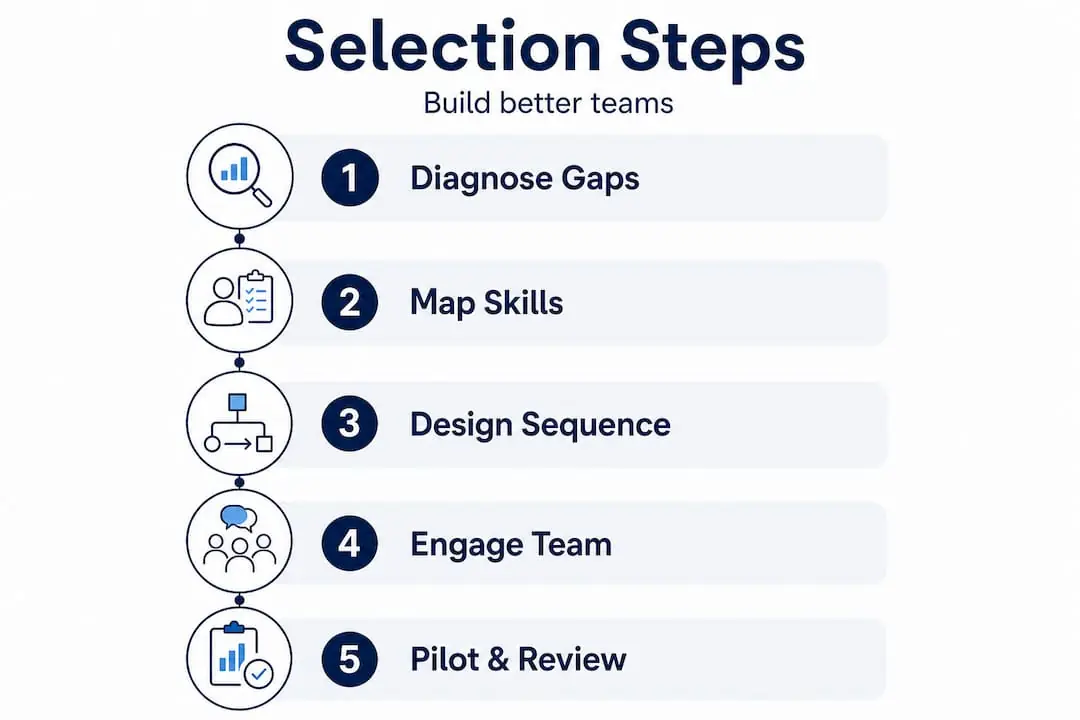
Step 4: Engage your stakeholders before you launch. Get hiring managers, team leads, and even top performers involved in reviewing the new process. Their buy-in is not optional. If your process changes but the people running it don’t understand or trust it, compliance drops and bias creeps back in.
Step 5: Run a pilot with one role or team. Resist the urge to overhaul everything at once. Pick a high-turnover role and run it through your new process for one hiring cycle. Measure time-to-fill, quality of hire at 90 days, and hiring manager satisfaction.
Step 6: Measure, document, and refine. After the pilot, review what worked and what didn’t. Look at your recruitment success factors and compare them against baseline metrics. Adjust your rubrics, tools, or sequencing based on real outcomes, not intuition.
| Phase | Key Action | Success Metric |
|---|---|---|
| Diagnose | Audit turnover and fit data | Identified top 3 failure points |
| Design | Build multi-method process | Documented assessment sequence |
| Pilot | Run with one role | 90-day quality of hire score |
| Measure | Compare to baseline | Improvement in time-to-fill and retention |
| Scale | Roll out across teams | Consistent hiring manager satisfaction |
Using job redesign tools can also help here. Sometimes the selection problem isn’t just about who you’re hiring. It’s about whether the role itself is designed in a way that sets people up to succeed. Redesigning a role before posting it can dramatically change who applies and who fits.
Pro Tip: Track “quality of hire” at 30, 60, and 90 days after every new placement. Ask the hiring manager three questions: Is this person meeting performance expectations? Are they integrating well with the team? Would you hire them again? That feedback loop is one of the highest-value data sources you’ll ever build.
Why most selection “innovations” don’t fix turnover—unless you do this first
Here’s a perspective you won’t find in most vendor decks: technology does not fix a culture problem. And in our experience working with HR teams across mid-sized organizations, the root cause of persistent turnover is almost never the selection tool. It’s the absence of a shared, honest definition of what “good fit” actually means for your team.
Companies invest in AI screening platforms, video interview tools, and psychometric dashboards. Turnover numbers barely move. Why? Because the tool is collecting data that no one is aligned on how to interpret. A personality report sits in a folder. An AI score overrides a manager’s gut without anyone questioning whether the AI was trained on data that reflects the team you’re actually trying to build.
📈 High-performing teams are not the result of flashy tools. They’re the result of systematic feedback, consistent measurement, and a process where everyone involved in hiring agrees on what they’re looking for before the first candidate applies.
The uncomfortable truth is that most “selection innovations” are adopted to solve a speed problem, not a quality problem. Faster screening sounds great until you realize you’re just hiring the wrong people faster.
What actually works? Starting with personality, not skills. Skills can be learned. Behavioral tendencies and natural working styles are far more predictive of long-term fit. That’s why tools that assess personality across multiple data sources, rather than relying on a single test or a single human’s impression, produce more reliable signals. Combining human observation, AI pattern recognition, psychometric data, and frameworks like Human Design creates a richer, higher-probability picture of how someone will actually show up in your team.
💡 Tools are levers, not silver bullets. They amplify the quality of your process. If the process is broken, the tool makes it faster and still broken. Fix the process first, then choose the tools that serve it. Explore more of these perspectives on the Sparkly HR blog for ongoing insights on building teams that last.
The mindset shift that changes everything: stop trying to predict who will pass the job description. Start trying to predict who will thrive in your specific team, with your specific culture, doing work that genuinely matches how they’re wired to operate.
Bridge talent selection with better solutions
If this guide has surfaced real gaps in your current process, you’re already ahead of most teams still guessing their way through hiring cycles.
Sparkly is built for exactly this moment. We help mid-sized HR teams move beyond skill checklists and resume screening to assess what actually predicts long-term fit: personality, behavioral tendencies, and team dynamics, validated through a blend of human insight, AI analysis, psychometric tools, and Human Design frameworks. Whether you’re redesigning a role or rethinking how you evaluate candidates entirely, our platform gives you higher-probability data to make confident decisions. Explore SaaS in HR potential, review our top evaluation SaaS comparisons, or start with our fit assessment guide to cut turnover costs and build teams that genuinely last.
Frequently asked questions
What are the most effective methods for talent selection in 2026?
A blend of skills-first assessments, structured interviews, and AI-assisted screening enables faster and more accurate hiring decisions, especially when methods are combined rather than used in isolation.
How can I avoid bias when using AI for talent selection?
Always pair AI tools with validated assessments and thorough documentation. Pairing AI with validated assessment design reduces compliance and bias risk while keeping human reviewers in control of final decisions.
Why do so many companies see turnover even after investing in hiring technology?
Technology amplifies your process but doesn’t fix misalignment. Innovation without guardrails increases risk rather than reducing it, and without feedback loops and process alignment, even good tools produce inconsistent outcomes.
Are skills-first hiring practices really faster and more accurate?
Yes. SHRM confirms that skills-first hiring maps demonstrated skills to role requirements, which shortens time-to-fill and improves placement quality compared to credential-based screening.