
First comes the work a company needs done. Then come the people who might do it. Only after that should we look outside and ask how those people will work together.
We have studied and described people for centuries. Yet we often fail to understand someone even when they work beside us. In hiring, we treat a person as a list of technical skills and available working hours. We add another requirement to the job description, look at previous jobs on a CV and hope the right people recognise themselves in the advert.
Later, we discover that the person can perform the required task, but their strengths show up elsewhere. Or the work suits them, but the pace, values, management style or team dynamics do not. We then mistakenly call it a failed hire.
The mistake actually starts much earlier: we have not described the context of the work precisely enough. We do things as they have been done for decades, but that is not enough, because this approach was never right in the first place.
Hours are easy to measure. Value is much harder to understand.
One person may do only 2.5 hours of productive work a day, another 9.5. The average may be somewhere around four or five hours, but none of us is average. Four hours can create a great deal of meaningful value. Seven hours can create little, or a lot. An hour describes time, not the value created during it.
AI makes this contradiction sharper. With AI, we increasingly ask what result it produces. With people, we still count working hours. Yet value is created when someone notices the right problem, makes a necessary decision and helps others reach an outcome. That value is often created together with a team.
People have equal rights and deserve fair treatment. That does not mean their strengths, needs and contributions are identical. If we treat people as interchangeable units in the name of equality, we may fail to notice their different strengths. Fair treatment does not require us to assume that people are the same. In a sense, the pursuit of equality can become discriminatory if we treat a person as a unit instead of trying to understand and value their strengths.
First the work. Then the person.
Hiring should begin with the company’s real work, not with an advert.
- What work needs to get done in the company? What are the tasks, decisions, responsibilities and expected outcomes? What problem needs solving? A job title is not yet a description of the work.
- Who on the existing team could do it? If the workload is small, the right person may already be in the company. Do they have the capacity, time and interest? Perhaps they are doing tasks that hide their strengths. Before looking outside, understand what the people already there can do.
- If there is no internal solution, how can we bring in capability from outside? Some work can be outsourced. Other work needs a new employee. Only now does it make sense to compare candidates against the real needs of the work, rather than a generic image of a “good person.”
- How will people work together? A capable person works with a specific manager, colleagues, clients and suppliers. The dynamics between them are part of the fit. Similar people may compete or reinforce each other; different people may complement each other or experience constant friction.
We rely on gut feeling most at this fourth step. Yet analysis can help us look at much more: work pace, speed of decisions and execution, clarity of communication, conflict tolerance, value priorities, management style and overlap in strengths. If this information is not visible side by side, risks go unnoticed. A decision is made with the best intentions and a good feeling, but from an incomplete picture.
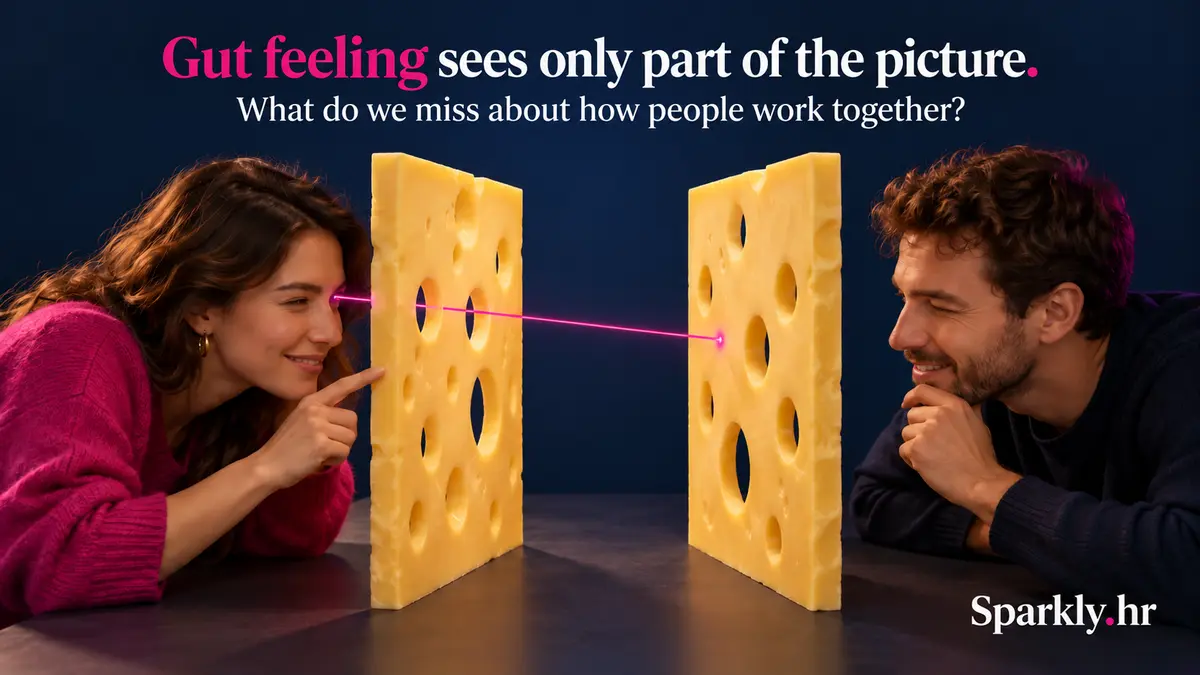
Two people are like two slices of Swiss cheese
Each person perceives the world a little differently. We have different sensitivities to situations, people, risks and opportunities. This gives each of us a unique view of the world. A person is not deficient simply because they do not notice what someone else notices. They are whole. But no one person can see the whole picture alone.
Imagine two slices of Swiss cheese, one behind the other. Each has holes, but they are not in exactly the same places. One person notices a customer’s unspoken need and overlooks a process risk. Another spots the risk quickly but misses an opportunity that seems obvious to the first. Together, they can cover each other’s blind spots. Where the holes overlap, part of the picture remains invisible to both. In a team, there is another blind spot: how other people relate to one another when I am not part of that relationship.
Gut feeling depends on what a person is able to perceive in the first place. Trying harder does not create a sensitivity someone does not have. It takes awareness, conversation and analysis, as well as a willingness to say: “I don’t perceive this, but it genuinely matters to the other person.” That is how we build a larger picture, of which each person’s intuition sees only a part. It helps explain why teams are always more complete than one person assisted by AI. Yes, AI can reduce gaps in execution, but it does not yet provide meaningful help with insight and vision.
If I am person 1, I can perceive my relationship with person 2 and my relationship with person 3. Biologically, I cannot perceive the dynamics of the relationship between persons 2 and 3. The same is true for a manager: they may feel a good fit with both employees and still fail to see what will happen when those two work together. Gut feeling gives us direct experience of the relationships we take part in; it does not automatically assemble a picture of every relationship in the team.
A profile on its own cannot provide that picture either. Profiles become meaningful when viewed in the context of the actual work and the connections between everyone involved. Analytics can bring to light relationships a manager has no direct intuition about.
A capable person can end up in the wrong environment
Some teams move quickly; others take time to weigh things up. If two people differ greatly in how they see the bigger picture and business opportunities, or in how quickly they gain insight and make decisions, both may be right and both may bring value to the team. Yet working together may consume a great deal of energy every day. The same applies to execution pace, communication clarity, sensitivity to conflict and a manager’s leadership style. People can bend themselves for a while, but constant adaptation has an emotional and cognitive cost.
When it comes to values, it is not enough to ask whether we use the same words. We need to understand what people actually mean by them, which values matter most to them and what they do when values collide. Sometimes people themselves cannot rank their preferences precisely until they face a concrete situation.
These questions can be explored before an interview, during it and before a probationary period begins. That makes it possible to understand early what needs to be discussed, instead of waiting for the first major conflict.
Fit can be explored. A person cannot be proven in advance.
Personality, values and working style affect collaboration, but people are not fixed profiles. They learn and adapt, and their behaviour depends on the situation. No assessment can promise that collaboration will definitely succeed or justify automatically excluding someone.
But before a probationary period, we can identify things to check: does the pace expected in the role suit the person’s way of working? Are responsibility and decision-making authority clear? How will disagreements be handled? Which tasks give the person energy, and which drain it? Discussing these questions early is less costly and more humane than finding a mismatch only after it has affected the whole team.
The impact of a poor hiring experiment does not stop with one person. It affects the manager, how colleagues divide their work, the time spent on onboarding and often the customers too. In my view, the cost of the consequences can grow to nearly 11 times as much because about eleven people or roles are affected. A smaller company may have fewer people, but each person often carries several roles.
We are all used to compensating for our weaknesses with our strengths. Sometimes we do it so well that we do not even notice how much effort goes into work that does not suit us. From the outside, the person looks conscientious and “excellent at being average.” That does not mean the person is average. It means their potential is being used in the wrong place.
Training has its place too. People can learn new skills and improve how they work together. But training cannot fix a poorly designed role. It makes little sense to develop someone only in a direction where every step requires them to work against their core strengths, if they could create far more value elsewhere.
“Is this the right person?” is the wrong question.
A better question is: In what work, with what responsibility and in what team can this person create the most value?
If a candidate is not right for one role, that does not mean they are the wrong employee. If today’s employee is not showing what they can do, they may not have been given the right work. And if two capable people cannot achieve results together, we should also look at how their work is divided and how they are managed. Some sources of conflict cannot be changed. Many situations, however, can be improved quickly with simple tools.
The recruiter and HR leader, working with the hiring manager, are not there simply to collect people who meet a list of requirements. Their job is to help build a team that solves the company’s real problems. Results can be measured in units, but people’s value is created through the combined effect of their contributions.
Sparkly helps make the work that needs doing visible first. Then the relevant tools can help find existing talent, place people in the right work and develop their potential. If the right person is not already in the company, that understanding can guide the search for new talent who fits the work, the existing team and the work environment. Analytics does not take away a manager’s gut feeling. It also shows them the places their intuition cannot reach.
Before the next job advert, ask:
- What work needs to get done? An overloaded part of someone’s job does not automatically mean a new employee is needed.
- Is the talent we need already working in the organisation? Perhaps there is no need to hire anyone new.
- What do we still not see about the team? Where is the “secret sauce” behind its success?