
Talent Development Steps for Engaged Tech Teams

Over half of American tech companies report losing valuable employees due to outdated development strategies. With the global demand for specialized skills at an all-time high, HR managers face pressure to keep top performers engaged and invested. This guide offers practical, data-driven methods for assessing workforce skills, identifying high-potential talent, and designing growth paths that address turnover while strengthening your team’s capabilities.
Table of Contents
- Step 1: Assess Current Roles and Workforce Skills
- Step 2: Identify High-Potential Talent and Gaps
- Step 3: Design Tailored Development Paths
- Step 4: Implement Targeted Training and Support
- Step 5: Measure Progress and Realign Strategies
Quick Summary
| Key Message | Explanation |
|---|---|
| 1. Assess Team Skills Systematically | Conduct a detailed skills inventory to understand current capabilities and identify areas needing development. |
| 2. Identify High-Potential Talent | Use a multi-dimensional assessment framework to pinpoint individuals capable of driving innovation within tech teams. |
| 3. Craft Personalized Development Paths | Create tailored growth plans for each employee that align individual goals with organizational objectives and emerging skill needs. |
| 4. Implement Targeted Training Programs | Develop a comprehensive learning ecosystem that includes varied training methods to close specific skill gaps effectively. |
| 5. Continuously Measure and Adjust Strategies | Establish robust metrics to evaluate talent development initiatives and remain adaptable to evolving business needs. |
Step 1: Assess Current Roles and Workforce Skills
Understanding your tech team’s current skill landscape is foundational to strategic talent development. By systematically evaluating existing capabilities, you can identify strengths, gaps, and opportunities for targeted workforce enhancement.
To effectively assess your team’s skills, start with a comprehensive skills inventory that goes beyond traditional job descriptions. Emerging workforce skill requirements demand a nuanced approach to talent mapping. Begin by conducting individual skill assessments through structured interviews, self evaluations, and performance data analysis. Create a detailed matrix that captures technical proficiencies, soft skills, and potential for growth across your tech teams.
Analyze the results against your organization’s strategic technology roadmap, paying special attention to emerging skill needs driven by digital transformation. Look for patterns that reveal where upskilling or reskilling might be most impactful. This data driven approach ensures your talent development efforts are precisely targeted and aligned with future business requirements.
Pro tip: Use anonymous skill surveys to encourage honest self reporting and gather more accurate insights about your team’s actual capabilities.
Step 2: Identify High-Potential Talent and Gaps
Identifying high-potential talent is a strategic process that goes beyond traditional performance evaluations. Your goal is to pinpoint individuals who demonstrate exceptional promise and have the capacity to drive significant innovation within your tech teams.

Begin by examining cognitive and emotional competencies that indicate high-potential talent. Look for employees who consistently show initiative, rapid learning abilities, adaptability, and a proactive approach to problem solving. Create a multi dimensional assessment framework that evaluates technical skills, leadership potential, innovation capacity, and cultural alignment. Use a combination of performance data, peer feedback, project outcomes, and structured skills assessments to build a comprehensive talent profile.
Pay special attention to identifying skill gaps that might hinder your team’s future capabilities. Analyze your current workforce against emerging technology trends and your organization’s strategic roadmap. This approach allows you to not only recognize top talent but also develop targeted development programs that address critical skill shortages and prepare your team for upcoming technological challenges.
Pro tip: Implement a 360-degree feedback mechanism that captures insights from multiple perspectives to create a more holistic view of potential talent.
Step 3: Design Tailored Development Paths
Crafting individualized development paths is crucial for nurturing talent and ensuring your tech team remains adaptive and motivated. Your objective is to create strategic growth trajectories that align individual aspirations with organizational objectives.
Personalized career development strategies require a nuanced approach that goes beyond generic training programs. Start by conducting individual deep dive sessions with each team member to understand their professional goals, strengths, and areas for improvement. Map out a comprehensive growth plan that includes technical skill enhancement, leadership training, cross functional exposure, and targeted learning experiences. Consider creating multiple development tracks that accommodate different career trajectories technical specialists, potential managers, and innovation leaders.
Ensure your development paths remain flexible and responsive to changing technological landscapes. Regularly reassess and adjust individual plans based on emerging skills, project performance, and evolving organizational needs. This dynamic approach demonstrates your commitment to employee growth and helps retain top talent by providing clear pathways for professional advancement.
Pro tip: Implement quarterly review checkpoints to validate and recalibrate individual development paths, ensuring they remain relevant and motivating.
Step 4: Implement Targeted Training and Support
Targeted training transforms potential into performance by providing precise skill development opportunities for your tech team. Your goal is to create a comprehensive learning ecosystem that addresses specific skill gaps and empowers employees to excel in their current and future roles.
Enterprise wide training programs require strategic design and execution. Begin by mapping individual skill requirements against organizational technology roadmaps. Develop a multi modal learning approach that includes online courses, hands on workshops, mentorship programs, and peer learning opportunities. Prioritize practical skill application by integrating training directly with real world project challenges. Create learning paths that are both flexible and mandatory ensuring team members can acquire cutting edge technical skills while maintaining their operational responsibilities.
Ensure your training support extends beyond traditional learning methods. Implement a continuous feedback mechanism that allows employees to provide input on training effectiveness and emerging skill needs. Allocate dedicated time and resources for learning allocating at least 10 percent of work hours for professional development activities. This approach demonstrates your commitment to employee growth and positions your organization as a forward thinking technology employer.
Pro tip: Develop a transparent skills tracking system that allows employees to visualize their learning progress and connect training achievements directly to career advancement opportunities.
Step 5: Measure Progress and Realign Strategies
Measuring talent development effectiveness requires a systematic and data driven approach that transforms insights into actionable strategies. Your objective is to create a robust feedback mechanism that continuously evaluates and refines your talent management initiatives.
Talent management evaluation practices demand comprehensive metrics beyond traditional performance indicators. Develop a multidimensional assessment framework that captures individual growth, team performance, skill acquisition rates, and strategic alignment. Utilize both quantitative metrics like training completion rates and skill proficiency scores and qualitative feedback through employee surveys and one on one discussions. Create a dashboard that tracks key performance indicators allowing real time monitoring of your talent development ecosystem.
Ensure your measurement strategies remain adaptive and responsive to organizational changes. Implement quarterly strategy review sessions where leadership and HR teams analyze performance data and make informed adjustments to talent development approaches. This iterative process demonstrates a commitment to continuous improvement and helps your organization stay agile in a rapidly evolving technological landscape.
Pro tip: Develop a standardized but flexible performance tracking template that allows for nuanced evaluation of individual and team potential beyond traditional numerical metrics.
The table below contrasts traditional and modern approaches to tech talent development:
| Factor | Traditional Approach | Modern Strategic Approach |
|---|---|---|
| Assessment | Standard reviews | Continuous, data-driven evaluation |
| Training | Generic programs | Personalized, flexible learning |
| Feedback | Annual appraisals | Ongoing, 360-degree feedback |
| Development | Linear career paths | Multiple, dynamic trajectories |
Here’s a summary of the key focus areas at each step of strategic tech talent development:
| Step | Main Objective | Key Action | Business Benefit |
|---|---|---|---|
| Assess Skills | Map current abilities | Detailed skills inventory | Informs targeted development |
| Identify Talent | Pinpoint strengths and gaps | High-potential and gap analysis | Drives innovation potential |
| Design Paths | Tailor advancement routes | Personalized growth plans | Boosts engagement and retention |
| Training & Support | Deliver relevant learning | Targeted training ecosystem | Accelerates capability building |
| Measure Progress | Track and refine strategy | Performance monitoring | Ensures future alignment |
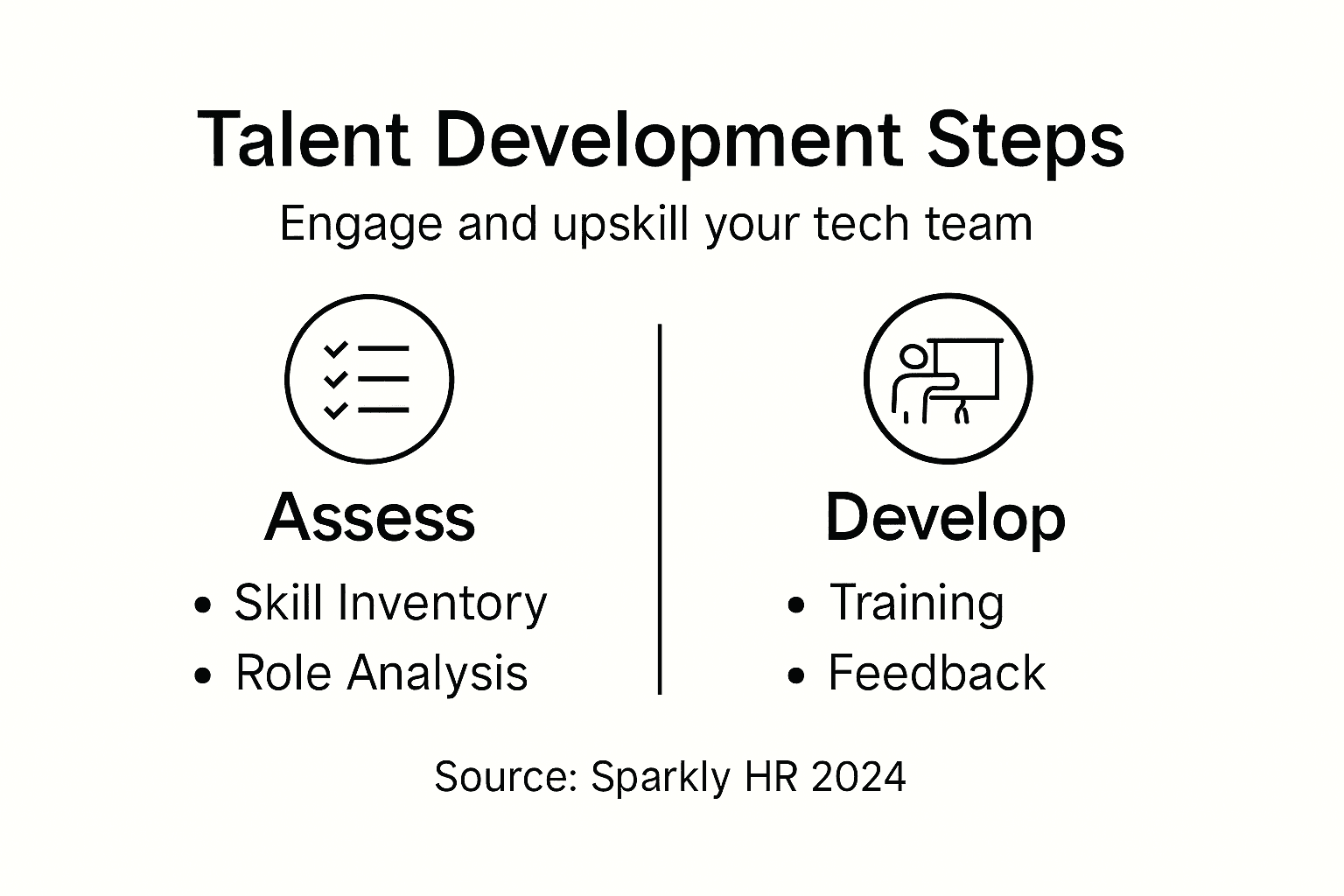
Unlock Your Tech Team’s Full Potential with Strategic Talent Development
Building an engaged and future-ready tech team means addressing complex challenges like skill gaps, high-potential talent identification, and personalized growth paths. This article highlights how deliberate assessment and targeted training are essential to stay ahead in fast-changing tech environments. If you want to transform these strategic steps into real workforce impact, you need tools that help you redesign jobs and shift your team’s strengths dynamically.
Discover how Uncategorized - Sparkly HR can help you implement continuous, data-driven evaluation and design flexible development paths tailored to each employee’s potential.
Empower your talent development strategy by leveraging our employee assessment SaaS platform that unlocks the full potential of current and future employees. Visit Sparkly HR today to start transforming your tech teams through smart workforce insights and innovative talent solutions.
Frequently Asked Questions
How can I assess my tech team’s current skills effectively?
Start by conducting a comprehensive skills inventory that includes individual skill assessments through structured interviews and self-evaluations. Create a matrix to capture technical proficiencies and soft skills, allowing you to identify strengths and gaps within 30 days.
What should I consider when identifying high-potential talent in my team?
Focus on cognitive and emotional competencies, such as initiative, adaptability, and problem-solving skills. Use a multi-dimensional assessment framework that combines performance data and peer feedback to create a detailed profile of high-potential individuals within 60 days.
How do I design personalized development paths for my tech team members?
Conduct individual sessions to understand each team member’s professional goals and strengths. Map out tailored growth plans that align their aspirations with organizational objectives, ensuring multiple tracks for career progression can be established in about 30 days.
What effective training methods should I implement for targeted skill development?
Develop a multi-modal learning approach that includes online courses, workshops, and mentorship programs. Prioritize practical skill application by integrating training directly with real-world challenges, and allocate specific time for learning activities, such as 10% of work hours per month.
How can I measure the effectiveness of my talent development initiatives?
Create a dashboard to monitor key performance indicators related to individual growth and skill acquisition rates. Implement quarterly review sessions to analyze this data, allowing you to refine your talent management strategies continuously and ensure alignment with business goals.
What is the importance of continuous feedback in talent development?
Continuous feedback fosters open communication and allows for real-time adjustments in training and development strategies. By implementing a 360-degree feedback mechanism, you can gather insights from various perspectives, leading to improved talent development outcomes.