How to Assess Employee Fit for Tech Teams Effectively

High turnover can leave HR managers in tech firms questioning how to build stronger teams in a shifting environment. The challenge lies in moving beyond technical resumes to identify the right mix of traits for lasting retention. By focusing on personality assessments that highlight cognitive flexibility, emotional intelligence, and collaborative potential, managers unlock deeper insights into team compatibility, laying the groundwork for smarter recruitment and sustained performance.
Table of Contents
- Step 1: Define Key Traits For Ideal Team Members
- Step 2: Prepare Multi-Source Assessment Tools
- Step 3: Conduct Personality-Driven Evaluation Sessions
- Step 4: Interpret Insights For Actionable Team Changes
- Step 5: Validate Fit Through Ongoing Performance Tracking
Quick Summary
| Key Insight | Explanation |
|---|---|
| 1. Prioritize soft skills in team hiring | Focus on traits like emotional intelligence and adaptability, which contribute significantly to team success beyond technical capabilities. |
| 2. Implement multi-source assessment tools | Use diverse evaluation methods such as cognitive testing and personality assessments to provide a comprehensive view of candidates. |
| 3. Conduct personality-driven evaluation sessions | Design assessment conversations to prioritize behavioral patterns and interpersonal skills for better team compatibility. |
| 4. Translate insights into actionable changes | Map personality traits to team effectiveness and create development plans to enhance individual strengths and address challenges. |
| 5. Monitor performance for ongoing fit | Regularly validate employee performance and team dynamics with continuous feedback and metrics to ensure long-term compatibility. |
Step 1: Define key traits for ideal team members
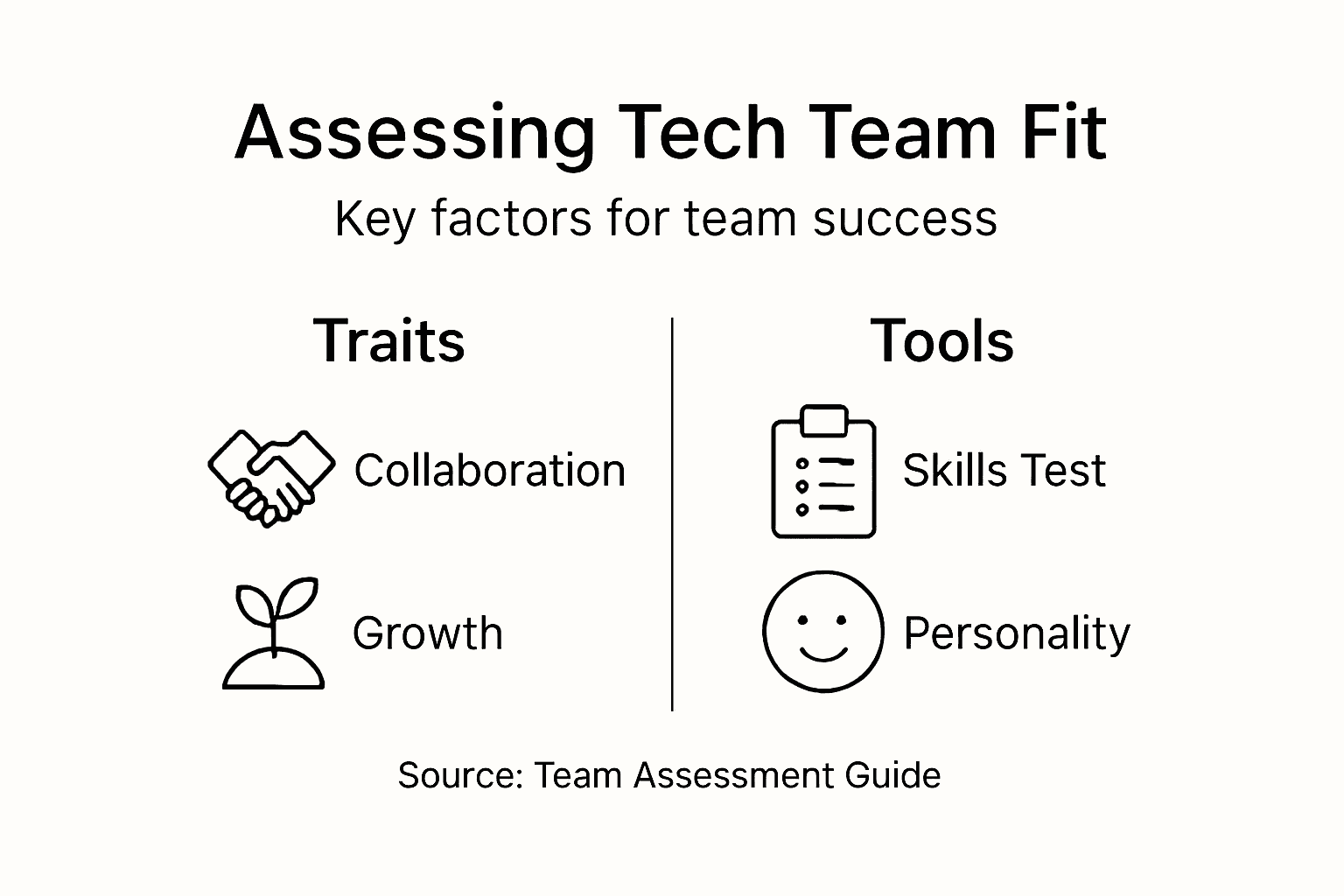
Successful tech teams require more than just technical prowess. Identifying the right personality traits becomes crucial for building high-performing groups that can adapt and innovate quickly.
When defining ideal team member characteristics, focus on fundamental soft skills that drive team performance. Cognitive flexibility and emotional intelligence emerge as critical qualities that separate good tech professionals from exceptional ones. Consider these key traits:
- Growth mindset: Eagerness to learn and continuously improve
- Empathy: Understanding team dynamics and user perspectives
- Adaptability: Comfort with changing technologies and project requirements
- Collaborative spirit: Ability to work seamlessly across different skill sets
Research consistently demonstrates that technical skills alone are insufficient. Interpersonal capabilities often determine team success more than raw technical knowledge. Teams that prioritize emotional intelligence and collaborative potential tend to solve complex problems more effectively and maintain higher morale.
Here’s a comparison of key soft skills versus technical skills in tech team success:
| Aspect | Soft Skills Impact | Technical Skills Impact |
|---|---|---|
| Problem-solving | Enhances team collaboration | Improves code quality |
| Adaptability | Drives innovation under change | Enables adoption of new tools |
| Morale | Fosters positive team culture | Less direct influence |
| Recruitment success | Supports long-term retention | Addresses immediate role needs |
Soft skills are the hidden engine driving team performance in technology sectors.
Pro tip: Develop a standardized personality assessment framework that evaluates candidates beyond their resume credentials to capture their true collaborative potential.
Step 2: Prepare multi-source assessment tools
Building a comprehensive employee assessment strategy requires blending multiple evaluation methods to capture a holistic view of potential team members. Developing robust assessment tools means going beyond traditional performance metrics to understand an individual’s true potential.
To create effective multi-source assessments, integrate diverse evaluation platforms that capture different aspects of professional capabilities. These tools should include:
- Cognitive testing: Measure problem-solving and analytical skills
- Personality assessments: Evaluate behavioral tendencies and team compatibility
- Skills evaluation: Validate technical and soft skill proficiencies
- Interactive simulations: Test real-world performance and decision-making abilities
Successful assessment strategies recognize that no single evaluation method provides a complete picture. Comprehensive candidate profiling requires synthesizing insights from multiple sources, creating a nuanced understanding of how an individual might perform within your specific team context.

The table below summarizes how different assessment tools contribute to candidate evaluation:
| Assessment Method | Main Focus | Business Benefit |
|---|---|---|
| Cognitive Testing | Analytical abilities | Identifies critical thinkers |
| Personality Assessments | Behavioral tendencies | Detects culture fit |
| Skills Evaluation | Job-specific proficiencies | Ensures technical standards |
| Interactive Simulations | Real-world decision-making | Reveals performance under pressure |
Multi-source assessments transform hiring from guesswork to data-driven decision-making.
Pro tip: Create a weighted scoring system that balances different assessment components to ensure no single metric disproportionately influences your final evaluation.
Step 3: Conduct personality-driven evaluation sessions
Personality-driven evaluation sessions transform traditional hiring processes by diving deep into candidate behavioral patterns and potential team compatibility. Creating meaningful assessment conversations requires a strategic approach that goes beyond standard interview techniques.
Personality assessment frameworks enable tech teams to understand candidates through nuanced behavioral insights. Design your evaluation sessions with these core elements:
- Structured behavioral interviews: Use scenario-based questions
- Emotional intelligence probing: Assess interpersonal skills
- Team dynamic simulations: Observe collaborative potential
- Communication style analysis: Understand interaction preferences
Successful personality evaluations require interviewers to look beyond technical skills and explore how an individual’s unique traits might complement existing team dynamics. Holistic candidate understanding means recognizing that technical proficiency represents only one dimension of potential team success.
Personality assessments reveal the human behind the resume, transforming recruitment from transactional to strategic.
Pro tip: Train your interview team to approach personality assessments as collaborative explorations, not interrogations, creating comfortable environments that reveal genuine candidate characteristics.
Step 4: Interpret insights for actionable team changes
Transforming personality assessment data into meaningful team improvements requires a strategic and nuanced approach. Translating psychological insights into concrete organizational actions demands careful analysis and thoughtful implementation.
Personality trait analysis provides powerful guidance for team optimization. Develop your interpretation strategy through these key approaches:
- Identify performance correlations: Map personality traits to team effectiveness
- Recognize individual strengths: Design roles that complement inherent characteristics
- Pinpoint potential friction points: Understand interpersonal dynamic challenges
- Create targeted development plans: Align training with personality-based insights
Successful insights interpretation goes beyond simple categorization. Strategic talent alignment means understanding how different personality dimensions interact and complement each other within your specific team context. Managers must view these insights as dynamic tools for continuous team enhancement rather than static labels.
Personality insights are not about constraining potential, but unlocking hidden team capabilities.
Pro tip: Develop a flexible interpretation framework that treats personality insights as dynamic guidelines, not rigid rules, allowing for individual growth and team evolution.
Step 5: Validate fit through ongoing performance tracking
Continuous performance validation transforms one-time hiring decisions into dynamic, evolving team optimization strategies. Tracking employee fit requires sophisticated approaches that move beyond traditional performance reviews.
AI-driven personality assessment tools enable real-time monitoring of team compatibility and individual performance trajectories. Implement a comprehensive validation framework through these strategic methods:
- Conduct regular 360-degree feedback cycles
- Monitor individual and team performance metrics
- Track behavioral alignment with team objectives
- Analyze skill development and adaptation patterns
Successful validation means treating performance tracking as a continuous improvement process. Adaptive talent management requires managers to view performance data as a living, dynamic resource that reveals insights about individual potential and team dynamics. This approach transforms traditional evaluation into a proactive team development strategy.
Performance tracking is not about judgment, but about understanding and unlocking potential.
Pro tip: Create a flexible performance tracking system that rewards growth and adaptability, not just meeting static performance targets.
Unlock True Tech Team Potential with Personality-Driven Assessment
Assessing employee fit for tech teams involves more than just evaluating skills. This article highlights the challenge of relying solely on technical capabilities while overlooking critical factors like emotional intelligence, adaptability, and team dynamics. If you aim to build high-performing groups by understanding the deeper personality traits that fuel collaboration and innovation, traditional methods fall short. Sparkly HR addresses this challenge by merging humans, AI, psychometric assessments, and Human Design to create a comprehensive, data-driven picture of each candidate’s collaborative potential and true fit.
Experience how shifting focus from just skills to personality unlocks new opportunities for team success. Discover our unique approach to employee assessment on the Uncategorized - Sparkly HR page and learn how Sparkly can revolutionize your hiring and team-building process. Don’t wait to make every team member a perfect match Visit https://sparkly.hr now to start unlocking full potential for your current and future employees.
Frequently Asked Questions
What key traits should I look for when assessing employee fit for tech teams?
Successful tech teams require a blend of soft skills and technical abilities. Focus on traits like a growth mindset, empathy, adaptability, and a collaborative spirit to ensure candidates can contribute meaningfully to the team.
How can I prepare effective multi-source assessment tools for evaluating tech candidates?
To create comprehensive assessments, blend cognitive testing, personality assessments, skills evaluations, and interactive simulations. This varied approach will give you a complete view of candidates’ abilities and compatibility with your team.
What should I include in personality-driven evaluation sessions for tech candidates?
Include structured behavioral interviews, emotional intelligence probes, team dynamic simulations, and communication style analyses. These elements will help you understand how a candidate will interact within the team beyond just their technical expertise.
How do I interpret personality assessment insights to improve team performance?
Identify performance correlations, recognize individual strengths, and pinpoint potential friction points among team members. Use these insights to create targeted development plans that leverage the unique traits of each team member for better collaboration.
How can I validate employee fit through ongoing performance tracking?
Implement regular 360-degree feedback cycles, monitor performance metrics, and analyze behavioral alignment with team goals. By continuously tracking employee performance, you can adapt your strategies to improve both individual and team dynamics over time.
Recommended
- Master the Job Fit Analysis Process for Tech Teams
- 7 Effective Talent Development Strategies for Tech Startups
- Talent Development Steps for Engaged Tech Teams
- Master Team Member Shifting Workflow for Optimal Teams
- Ruolo della tecnologia nei cantieri: spiegazione e comprensione - Sikuro
- Technical Consulting in Construction – Impact on Compliance and Risk