Workforce potential: 5 methods to boost team performance

Most HR teams believe they already know who their best people are. They look at last quarter’s numbers, recent project wins, and manager impressions. The problem? 68% of organizations misidentify high potential employees by overweighting current performance. That gap between who looks great today and who will lead your company tomorrow costs organizations millions in misplaced development budgets, failed promotions, and preventable turnover. This article walks you through the frameworks, tools, and pitfalls that matter most when you want to build a team that grows with you.
Table of Contents
- Defining workforce potential: Beyond performance
- How the 9-box grid identifies and develops talent
- Alternative assessment tools: Korn Ferry, Oracle, 360 feedback and more
- Nuances and pitfalls: Performance vs. potential, bias, and overlooked talent
- How effective potential assessment reduces turnover and boosts retention
- Take workforce potential to the next level with HR SaaS solutions
- Frequently asked questions
Key Takeaways
| Point | Details |
|---|---|
| Potential vs. performance | High potential measures future capabilities and leadership, distinct from current job performance. |
| 9-box grid and tools | The 9-box grid is the standard for ranking talent, while validated tools and feedback schemes reduce bias. |
| Avoid bias and pitfalls | Over-reliance on performance, halo effect, and gut feelings cause misidentification—combine multiple methods and review regularly. |
| Impact on retention | Systematic assessment of workforce potential can increase retention by up to 91% and cut costly turnover. |
| HR SaaS solutions | Specialized HR SaaS platforms make potential assessments easier, more data-driven, and scalable for growing businesses. |
Defining workforce potential: Beyond performance
Workforce potential is not the same as being good at your current job. Workforce potential measures employees’ capacity for future growth, leadership, and broader role success, not just current output. Think of it this way: a top-performing sales rep who consistently hits quota may lack the aspiration or learning agility to lead a team of 20. That distinction matters enormously for your talent pipeline.

Performance and potential overlap only 15 to 40% of the time. That means the majority of your current high performers are not necessarily your future leaders. Most organizations use models like Aspiration-Ability-Engagement or Learning Agility frameworks to define and measure potential more precisely. These models ask: Does this person want to grow? Can they adapt? Are they engaged enough to sustain that growth?
On average, only 16 to 17% of any workforce is classified as high potential. That is a small group, and identifying them accurately is critical. When you get it right, you protect your talent pipeline, reduce costly mis-hires into leadership roles, and improve retention across the board. Use a potential assessment checklist to make sure you are evaluating the right dimensions from the start.
Here is what separates potential from performance at a glance:
- Aspiration: Does the employee actively seek greater responsibility?
- Ability: Can they handle complexity and ambiguity beyond their current role?
- Engagement: Are they emotionally invested in the organization’s mission?
- Learning agility: Do they adapt quickly when conditions change?
Understanding the impact of potential evaluation on your team helps you move from reactive hiring to proactive talent development. 📈
How the 9-box grid identifies and develops talent
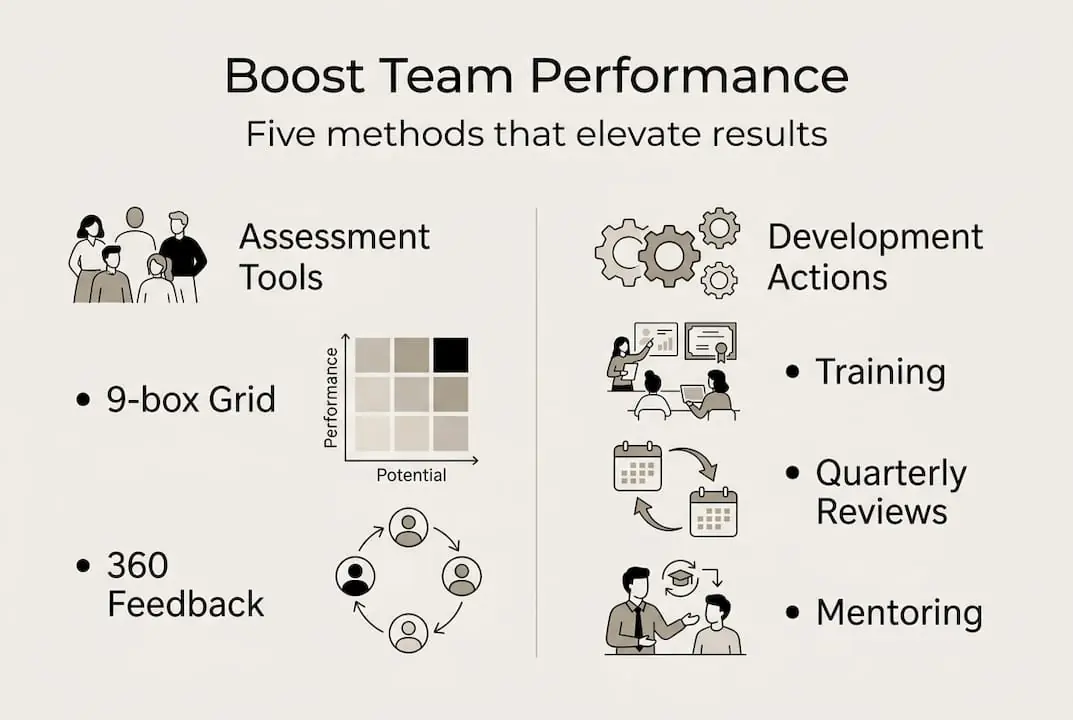
The 9-box grid is a 3x3 matrix that plots current performance against future potential, creating nine distinct talent segments. It is the primary methodology HR teams use to systematically assess and act on workforce potential. Each cell in the grid tells a different story and demands a different action.
Here is how to deploy it effectively:
- Define your criteria. Agree on what “high performance” and “high potential” mean at your organization before any ratings happen.
- Collect data. Gather performance reviews, 360 feedback, and manager assessments for each employee.
- Calibrate across managers. Hold calibration sessions so that a “high potential” rating means the same thing across departments.
- Assign actions by segment. Stars (high performance, high potential) get accelerated development. Core contributors get targeted coaching. Low performers with high potential get structured support plans.
- Review and update regularly. Potential is not static. Revisit placements at least annually, ideally quarterly.
| Grid segment | Performance | Potential | Recommended action |
|---|---|---|---|
| Stars | High | High | Accelerated development, succession planning |
| Core contributors | High | Medium | Targeted coaching, lateral growth |
| Emerging talent | Medium | High | Mentoring, stretch assignments |
| Solid performers | Medium | Medium | Engagement and retention focus |
| Underperformers | Low | Low | Performance improvement plan |
Pro Tip: The biggest mistake teams make is skipping calibration. Without it, one manager’s “high potential” is another’s “average,” and your grid becomes meaningless. Block time for cross-functional calibration sessions before finalizing any placements.
For practical assessment tips for HR teams deploying the 9-box for the first time, start with a pilot group of 30 to 50 employees before rolling out company-wide. And if reducing turnover is a priority, pair your grid with a structured candidate assessment for turnover reduction process from day one.
Alternative assessment tools: Korn Ferry, Oracle, 360 feedback and more
The 9-box is a strong starting point, but it is not enough on its own. Multi-method approaches using tools like Korn Ferry Assess, Oracle questionnaires, 360 feedback, and psychometrics reduce bias and improve identification accuracy significantly.
Here is a quick comparison of the most widely used tools:
| Tool | What it measures | Best used for |
|---|---|---|
| Korn Ferry Assess | Leadership traits, learning agility | Senior role succession |
| Oracle questionnaires | Growth capacity, role fit | Large-scale workforce reviews |
| 360 feedback | Behavioral patterns, peer perception | Triangulating manager bias |
| Psychometric assessments | Personality, cognitive style | Predicting cultural and role fit |
| Simulations | Decision-making under pressure | Leadership readiness |
Each tool has a specific strength. Simulations are particularly powerful for predicting leadership success because they put candidates in realistic scenarios rather than asking them to self-report. Questionnaires score growth capacity at scale. 360 feedback helps you triangulate what managers might miss or overrate.
“No single tool gives you the full picture. The organizations that identify high potential most accurately are the ones combining structured data from multiple sources.”
Pro Tip: Before investing in enterprise tools, run a business assessment scorecard to identify which gaps in your current process need the most attention. That way, you choose tools that solve real problems rather than adding complexity.
Exploring the full range of types of HR assessments available today will help you build a stack that fits your team size and budget. For a curated list, check out these talent optimization tools and the talent management checklist to guide your selection process. 💡
Nuances and pitfalls: Performance vs. potential, bias, and overlooked talent
Even with the right tools in place, assessment accuracy depends on how well you manage the human side of the process. 68% of organizations misidentify high potential employees by overweighting performance, and quiet contributors are the most frequently overlooked group.
The 9-box grid can be simplistic or outdated when used without calibration, and it is particularly prone to the halo effect, where one impressive trait colors all other ratings. That is a systemic problem, not a one-off mistake.
Common bias sources to watch for:
- Halo effect: One strong trait inflates all other ratings.
- Gut feel: Managers rate people they like or relate to more favorably.
- Rater influence: Senior leaders’ opinions dominate calibration sessions.
- Recency bias: Recent wins overshadow longer-term patterns.
- Visibility bias: Remote or introverted employees get underrated simply because they are less visible.
“The employees most likely to be your future leaders are sometimes the ones who never ask for the spotlight. Build your process to find them anyway.”
Potential is dynamic. Someone who was not ready 18 months ago may be your strongest candidate today. Reviewing potential quarterly rather than annually keeps your talent pipeline accurate and fair. Pair that cadence with structured talent optimization practices to surface hidden contributors before they leave for a competitor.
Pro Tip: Use a potential checklist that includes behavioral indicators, not just performance metrics. Behavioral signals like how someone responds to failure or navigates ambiguity are far more predictive of future leadership than last quarter’s numbers. For deeper context on high performance leadership development, structured programs can help you build the pipeline you need. ⚡️
How effective potential assessment reduces turnover and boosts retention
Here is where the business case becomes undeniable. Effective identification boosts retention by up to 91% and significantly cuts voluntary turnover. That is not a marginal improvement. That is a structural shift in how your organization holds onto its best people.
When employees see that potential is recognized and rewarded, they stay. When they feel invisible or misclassified, they leave. And the cost of that exit is steep: knowledge loss, productivity drops during transition, and recruiting costs that can reach 50 to 200% of an annual salary.
Here is what systematic potential assessment delivers in practice:
- Targeted development: High potentials receive the right opportunities at the right time, reducing frustration and disengagement.
- Fairer promotions: Data-driven decisions replace gut-feel promotions, which builds trust across the team.
- Proactive succession: You fill leadership gaps from within rather than scrambling to hire externally.
- Lower voluntary turnover: HiPo (high potential) programs directly reduce the rate at which your best people walk out the door.
| Action | Business impact |
|---|---|
| Quarterly potential reviews | Reduces misidentification, improves pipeline accuracy |
| HiPo development programs | Cuts voluntary turnover significantly |
| Multi-method assessment | Reduces bias, increases retention by up to 91% |
| Structured succession planning | Lowers external hiring costs by 30 to 50% |
For HR teams ready to act, start with the evaluation for team impact guide to map your current process against best practices. Then explore top talent evaluation SaaS platforms that automate tracking and reduce manual bias. If you want to strengthen your recruiting pipeline at the same time, recruit and select training programs can sharpen how you identify potential before candidates even join your team.
Take workforce potential to the next level with HR SaaS solutions
You now have the frameworks, the tools, and the pitfalls mapped out. The next step is making this process repeatable and scalable without adding hours of manual work to your team’s plate. That is exactly where HR SaaS platforms make the biggest difference.
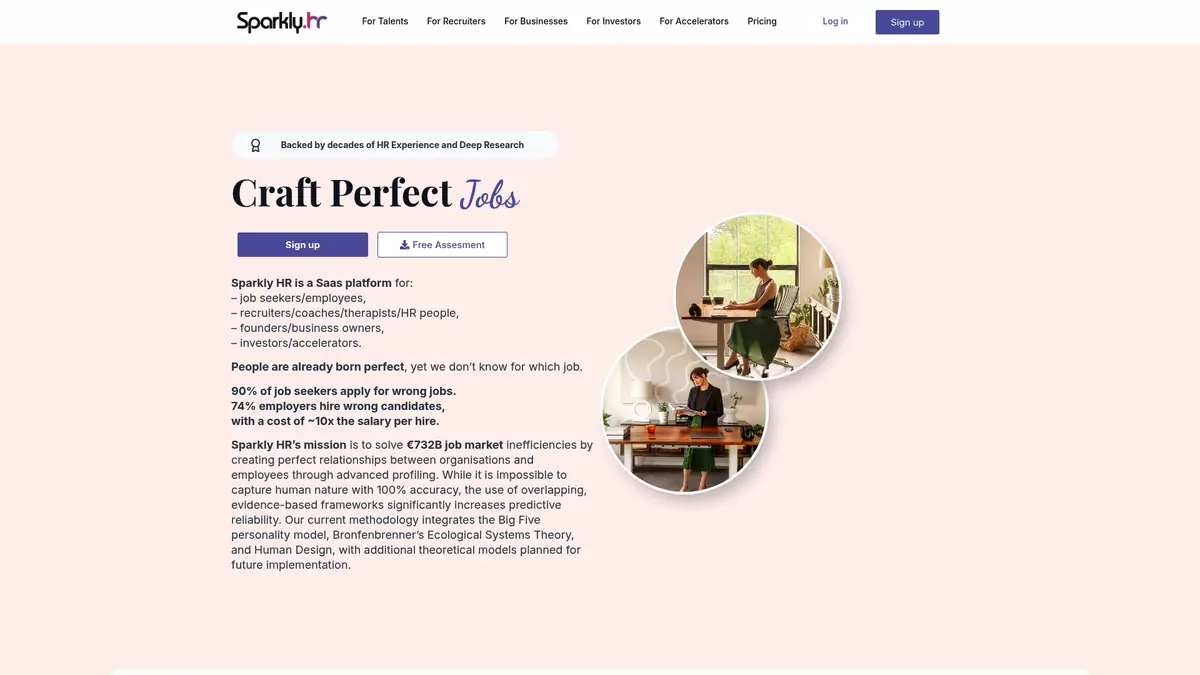
Sparkly.hr is built for HR managers and business owners who want to go beyond skills-based assessments. We merge personality data, psychometric results, AI analysis, and Human Design insights to give you higher-probability data on each employee’s real potential. The result is a clearer picture of who is ready to grow, who needs support, and how to redesign roles for maximum fit. Explore talent optimization solutions to see how data-driven potential management works in practice, understand the role of SaaS in HR strategy, and compare the best SaaS for talent evaluation to find the right fit for your organization.
Frequently asked questions
How is workforce potential different from employee performance?
Workforce potential measures future growth and leadership capacity, while performance tracks past and current results. Only 15 to 40% of high performers are high potential, so treating them as the same group leads to costly misidentification.
Which assessment methods are most accurate for identifying high potential employees?
Combining 9-box grids, validated tools like Korn Ferry, 360 feedback, and psychometrics gives the most reliable results. Multi-method approaches minimize bias and significantly improve identification accuracy compared to any single tool.
How often should workforce potential be reassessed?
Potential is dynamic and should be reviewed quarterly. Quarterly reassessment prevents misidentification from hardening into policy and keeps your talent pipeline responsive to real changes in employee growth.
What are the main causes of bias in workforce potential assessments?
Bias most often comes from the halo effect, over-reliance on performance data, gut instinct, and lack of multiple data sources. Halo effect and gut feel are the two most common culprits in calibration sessions.
How does effective workforce potential assessment impact retention?
Effective assessment can boost retention by 91% and significantly reduce voluntary turnover costs. When employees see their potential recognized and developed, they are far less likely to leave for a competitor.