Workforce optimization guide: boost performance and retention

TL;DR:
- High turnover persists due to poor person-organization fit and lack of meaningful feedback.
- Redesigning jobs with the Job Characteristics Model boosts motivation and reduces attrition.
- Personality assessments improve hiring and development by focusing on long-term engagement and team fit.
High-performing companies aren’t just lucky with hiring. They’re intentional about fit, design, and feedback. High engagement organizations see 34% less turnover and experience 14.9% less attrition when they practice continuous feedback, yet most mid-sized companies still rely on outdated performance reviews and reactive backfilling. If you’re watching good people leave and wondering why your retention strategies aren’t sticking, this guide is for you. We’ll walk through the root causes of persistent turnover, introduce proven frameworks like the Job Characteristics Model, show you how personality assessments outperform skills-only screening, and explain how to build a feedback culture that locks in the gains.
Table of Contents
- Why turnover remains high: Understanding root causes
- Applying the Job Characteristics Model for job redesign
- Leveraging personality assessments for workforce fit
- Driving engagement and feedback for lasting optimization
- A smarter approach most HR teams overlook
- How Sparkly streamlines workforce optimization
- Frequently asked questions
Key Takeaways
| Point | Details |
|---|---|
| Fit is critical | Person-organization fit and meaningful job design are proven to reduce turnover and maximize workforce potential. |
| Redesign boosts motivation | Applying the Job Characteristics Model creates roles that drive motivation and engagement. |
| Assessments outperform guesswork | Personality-focused hiring decisions result in better team dynamics and retention compared to traditional methods. |
| Feedback sustains performance | Continuous feedback and engagement strategies support long-term optimization and lower employee exits. |
Why turnover remains high: Understanding root causes
To set the stage for tackling turnover, let’s first examine why it persists despite best efforts.
Most HR teams facing high turnover reach for the usual toolkit: faster recruiting cycles, signing bonuses, exit interviews, or annual engagement surveys. These tools aren’t useless, but they’re reactive. They respond to turnover after it’s already happening rather than addressing why people disengage in the first place. The result is a “replace and repeat” cycle that drains budgets without improving retention in any meaningful, lasting way.
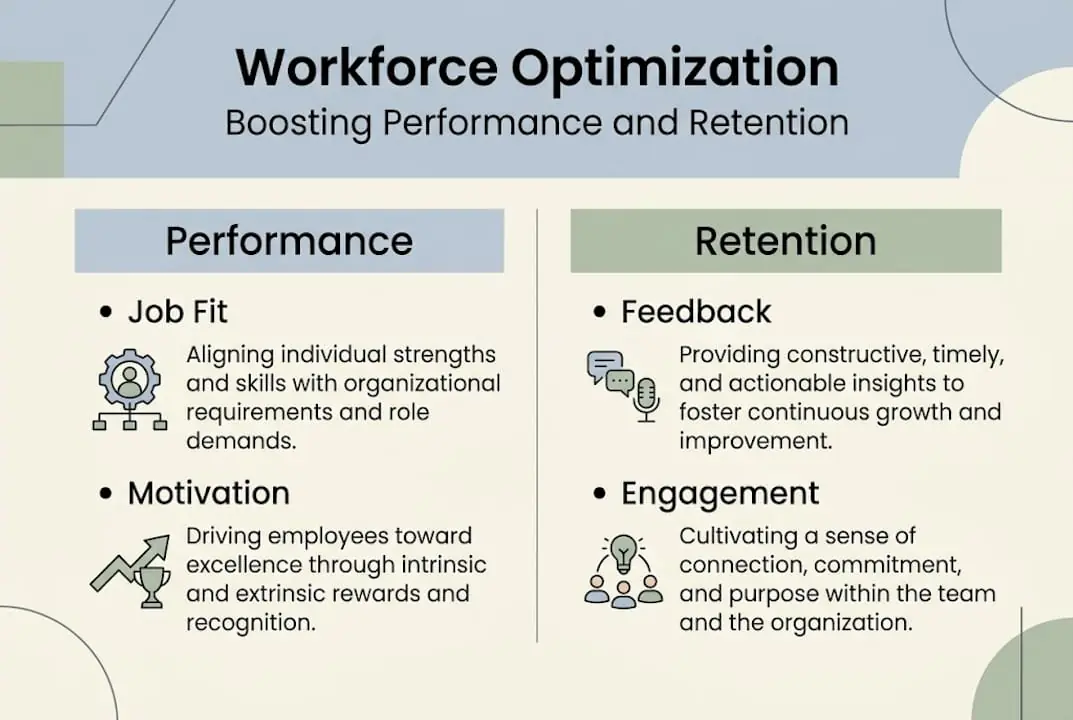
The deeper issue is that most standard approaches miss two critical levers: person-organization fit and job meaning. Person-organization fit, often called P-O fit, refers to how well an employee’s values, personality, and working style align with the culture and structure of the organization. When this alignment is weak, employees feel out of place even if they have the technical skills to do the job. They may perform adequately for a while, but they will eventually disengage and leave.
Research backs this up powerfully. P-O fit reduces turnover intention directly and also through the experience of meaning in work, with the relationship moderated by the organization’s ethical climate. In plain terms: when people feel they belong, and when they find meaning in what they do, they stay. When an organization’s ethical culture supports independence and integrity, that effect is even stronger.
“Employees don’t quit jobs. They quit environments where their values and strengths have no room to grow.”
The third overlooked root cause is feedback quality. Not annual performance reviews, but continuous, real-time feedback that helps people course-correct and feel seen. Without it, employees lose their sense of progress and value. They start looking elsewhere.
Signs you may need a new approach to workforce optimization:
- Turnover is above 15% annually in roles that aren’t naturally high-churn
- Exit interviews reveal vague dissatisfaction rather than specific grievances
- Your engagement survey scores are flat even after interventions
- Managers report that high performers feel unchallenged or misaligned in their roles
- New hires leave within the first 12 months at a higher rate than industry benchmarks
If two or more of these resonate, you’re likely dealing with fit and design problems, not just a compensation issue. Check out our employee engagement checklist to benchmark where your organization currently stands.
Understanding job fit at a deeper level, beyond skills and experience, is where the real leverage lies. Let’s look at what you can do about it structurally.
Applying the Job Characteristics Model for job redesign
Once you’ve diagnosed the causes, the next step is redesigning roles for intrinsic motivation.

The Job Characteristics Model, developed by Hackman and Oldham, is one of the most research-supported frameworks in organizational psychology. It identifies five core dimensions of a job that, when present at the right levels, produce high intrinsic motivation, job satisfaction, and lower turnover. The beauty of the JCM is that it gives you a structured way to diagnose which roles are motivationally deficient and exactly where to intervene.
The five JCM dimensions are skill variety, task identity, task significance, autonomy, and feedback from the job itself. Each dimension contributes to three psychological states in employees: experiencing the work as meaningful, feeling responsible for outcomes, and knowing the results of their efforts.
| JCM dimension | What it measures | Impact on employee |
|---|---|---|
| Skill variety | Range of skills the role requires | Reduces boredom and monotony |
| Task identity | Completing a whole, identifiable piece of work | Increases sense of ownership |
| Task significance | Perceiving the job matters to others | Deepens meaning and purpose |
| Autonomy | Freedom to decide how work gets done | Builds accountability and trust |
| Feedback | Knowing whether performance is effective | Supports growth and engagement |
You can calculate a Motivating Potential Score (MPS) using this formula: MPS = ((Skill Variety + Task Identity + Task Significance) / 3) × Autonomy × Feedback. A low MPS signals that a role is at risk for disengagement. It’s a fast way to prioritize which jobs need redesign first.
Steps to use the JCM for job redesign in your organization:
- Audit your roles using the Job Diagnostic Survey (JDS) to score each of the five dimensions for key positions
- Calculate MPS for every audited role and rank them from lowest to highest
- Identify the bottleneck dimension for each low-scoring role, since not every role has the same problem
- Redesign with targeted interventions, such as adding cross-functional project work to increase skill variety, or giving team leads more decision-making power to increase autonomy
- Reassess MPS scores after 90 days to measure whether the intervention worked
Pro Tip: Autonomy and feedback are the two fastest dimensions to improve in most mid-sized organizations. You don’t need a full structural overhaul. Simply shifting decision-making closer to the person doing the work and adding weekly one-on-ones with structured feedback can meaningfully raise MPS scores in under a quarter.
Explore how work, role, and task fit factors into role design and how job fit analysis can make the JCM more actionable for your team.
Leveraging personality assessments for workforce fit
With updated roles, it’s time to maximize how you hire and develop for optimal team fit.
Skills can be taught. Personality is the foundation that determines how someone naturally processes information, handles pressure, collaborates, and responds to ambiguity. When you hire for skills alone and ignore personality fit, you’re optimizing for short-term task completion while ignoring the long-term engagement and retention picture.
The evidence for personality-focused assessment is strong. Personality traits explain more variance in organizational citizenship behavior and counterproductive work behavior (14 to 20%) than they do in task performance (4 to 7%). This is a striking finding. It means personality is a much better predictor of whether someone will be a good organizational citizen, support teammates, follow through without supervision, and avoid harmful behaviors than it is of whether they can technically complete a task. And organizational citizenship behavior is one of the strongest predictors of team health and retention.
| Assessment approach | What it predicts well | What it misses |
|---|---|---|
| Skills-only testing | Task completion speed | Cultural fit, motivation, team behavior |
| Personality-focused assessment | Team dynamics, citizenship, engagement | Specific technical capability |
| Strengths-based approach | Natural talent and engagement | Areas needing structured development |
| Sparkly’s combined model | Personality, work style, cultural fit | Not a shortcut for skills due diligence |
Common pitfalls when using personality assessments:
- Treating a single trait score as a hiring decision on its own rather than one signal in a richer picture
- Ignoring role context, since an introvert might thrive in a deep-focus engineering role but struggle in a high-contact sales position
- Using assessments at the end of the hiring process when they’re most useful at the beginning to shape the interview conversation
- Relying on self-reported assessments without triangulating against behavioral interview data or peer feedback
Pro Tip: Use personality data to personalize onboarding, not just hiring. When you know that a new hire scores high in conscientiousness but low in openness to ambiguity, you can structure their first 90 days with clearer milestones and less unstructured time, dramatically reducing early attrition.
Our fit assessment guide walks you through how to integrate personality data across your talent lifecycle, and our hiring best practices resource will help you build a more structured, personality-informed selection process.
Driving engagement and feedback for lasting optimization
All these strategies work even better when supported by an ongoing culture of feedback and engagement.
Job redesign and personality-informed hiring create the conditions for engagement. But conditions alone don’t sustain performance. You need a continuous feedback loop that reinforces the investment you’ve made in fit and role design. Without it, even well-matched employees in well-designed roles will drift toward disengagement over time.
📈 Callout stat: Continuous feedback reduces turnover by 14.9%, and organizations with high engagement cultures experience 34% lower turnover overall. These aren’t marginal gains. For a company of 200 people with a 20% annual turnover rate, reducing exits by even 10% saves hundreds of thousands of dollars in replacement costs.
Engagement multiplies the effect of everything else you do. A great personality fit in a well-designed role will still underperform if the employee feels invisible. Feedback is the signal that tells people their effort matters, their growth is noticed, and their future at the company is real.
Steps to embed feedback and engagement into daily workflows:
- Shift from annual to continuous feedback by training managers to give brief, structured check-ins weekly rather than relying on quarterly or annual reviews
- Use stay interviews proactively with your top performers at least twice a year to understand what keeps them engaged before they start looking elsewhere
- Tie feedback to strengths and role fit, so conversations aren’t just about what went wrong but about how the employee’s natural working style is showing up in their outcomes
- Create peer recognition touchpoints through simple rituals like team shoutouts in meetings or asynchronous appreciation channels in your communication tools
- Track engagement signals in real time using pulse surveys every four to six weeks, keeping them short at three to five questions to maximize response rates
- Close the loop by sharing what you heard from pulse surveys and what changes you’re making as a result, since employees disengage fast when they see feedback disappear into a void
Explore data-driven talent management approaches that make continuous feedback sustainable at scale, and see which talent evaluation tools can help you automate the feedback cadence without overwhelming your managers.
💡 One often-missed insight: engagement doesn’t require massive investment. It requires consistency. A manager who checks in meaningfully every week, even for ten minutes, creates more retention value than a company-wide engagement initiative that happens once a year.
A smarter approach most HR teams overlook
Here’s the uncomfortable truth most workforce optimization guides won’t say out loud: broad restructuring and performance management cycles are often solutions in search of a problem. Companies spend enormous energy reorganizing org charts, redesigning competency frameworks, and rolling out new performance software, when the real lever is much simpler and much more specific.
Strengths-focused development consistently outperforms the strategy of replacing underperformers, especially when personality fit is considered within the right job context. Yet most HR teams default to the latter because it feels decisive. Firing someone and hiring someone new looks like action. Redesigning a role around a struggling employee’s strengths looks like a compromise. The data says otherwise.
We’ve seen this play out in practice. A mid-sized tech company spent 18 months cycling through customer success managers, convinced the role was attracting the wrong candidates. When they finally mapped the role’s requirements against personality profiles, they discovered the job required constant context-switching and high emotional labor, characteristics that burned out even well-matched hires quickly. A targeted redesign, splitting the role into a relationship-focused track and a technical escalation track, reduced turnover in that function by over 40% in one year. No new hires needed.
The mistake HR teams make is ignoring role context and ethical climate when assessing fit. A personality that thrives in a high-autonomy, high-trust environment may struggle in a rigid, compliance-heavy one, not because they’re a poor performer, but because the environment suppresses their natural strengths. Explore shifting workflow strategies that help you match people to contexts rather than just to roles.
Stop asking “Is this person the right fit?” and start asking “Is this role the right context for this person’s strengths?” That reframe changes everything.
How Sparkly streamlines workforce optimization
If the frameworks in this guide resonate with you, Sparkly was built to make them operational without the guesswork. ⚡️
Sparkly is an employee assessment platform that prioritizes personality over skills, because skills can be learned, but personality determines how someone leads, collaborates, and stays. We combine human insight, AI analysis, psychometric assessments, and Human Design to generate higher-probability data that HR teams can use in interviews and team decisions. Whether you’re redesigning roles using JCM principles or building a personality-informed hiring process, Sparkly gives you the tools to act on real evidence. Explore our personality-focused assessment strategies or download the employee fit guide to see how it all fits together.
Frequently asked questions
What is workforce optimization and why does it matter?
Workforce optimization means aligning roles, feedback, and selection to boost performance and retention, reducing costly turnover and increasing engagement across the organization.
How does job redesign help reduce turnover?
Redesigning jobs based on the Job Characteristics Model increases intrinsic motivation and meaning at work, which directly lowers the likelihood that employees will leave.
Which personality traits are most important for team fit?
Openness, conscientiousness, and low neuroticism best predict positive organizational fit and performance, with high neuroticism and low openness being particularly poor fits for innovative or ambiguous roles.
How does continuous feedback affect workforce optimization?
Regular feedback lowers turnover by 14.9% by increasing engagement and giving employees a measurable sense of progress, visibility, and value within the organization.
Is there a standard tool for measuring job redesign success?
The Job Diagnostic Survey is the most widely used instrument for calculating Motivating Potential Scores across the five JCM dimensions, making it the go-to benchmark for redesign effectiveness.