Why reskill employees: reduce turnover, build future talent

TL;DR:
- 94% of employees would stay longer if companies invested in their learning and development.
- Reskilling prepares employees for entirely new roles, boosting retention and reducing turnover costs.
- Effective reskilling programs rely on personality assessments, pilot testing, and continuous impact measurement.
When employees leave, most HR leaders blame compensation. But 94% of employees say they would stay longer if their company invested in their learning and development. That single number reframes the entire retention conversation. Reskilling, which means training people for entirely new roles within your organization, has become one of the most powerful tools HR leaders in medium-sized businesses can use to hold onto great people and keep their workforce ready for whatever comes next. This guide breaks down what reskilling actually means, why the business case is stronger than ever, and exactly how to put it into practice.
Table of Contents
- What reskilling really means (and why it matters now)
- The business case: How reskilling reduces turnover and costs
- Hidden risks of not reskilling: Burnout, disengagement, and lost talent
- How to implement reskilling that actually works
- HR wisdom: What most leaders get wrong about reskilling employees
- Next steps: Unlock your team’s potential with smart reskilling
- Frequently asked questions
Key Takeaways
| Point | Details |
|---|---|
| Retention boost | Reskilling leads to much lower turnover by giving employees career growth paths. |
| Prevents burnout | Matching skills to new roles stops disengagement and reduces workplace burnout. |
| Cost savings | Investing in reskilling is cheaper and more effective long-term than replacing staff. |
| Pilot for success | Start with small pilots and scale winning approaches for the best reskilling outcomes. |
What reskilling really means (and why it matters now)
Let’s clear up a common mix-up. Reskilling means preparing an employee for a completely new role or function, one that may not even look like their current job. Upskilling, on the other hand, means adding new abilities on top of what someone already does. Both matter, but they serve different purposes. When a customer service rep is trained to become a junior data analyst, that is reskilling. When that same rep learns a new CRM tool, that is upskilling.
Why does this distinction matter so much right now? Automation, artificial intelligence, and digital transformation are reshaping entire job categories at a pace most HR teams have never seen before. Roles that existed five years ago may be gone or barely recognizable today. For a company with 20 to 200 employees, losing even a handful of skilled people to redundancy or disengagement can feel like losing a load-bearing wall.
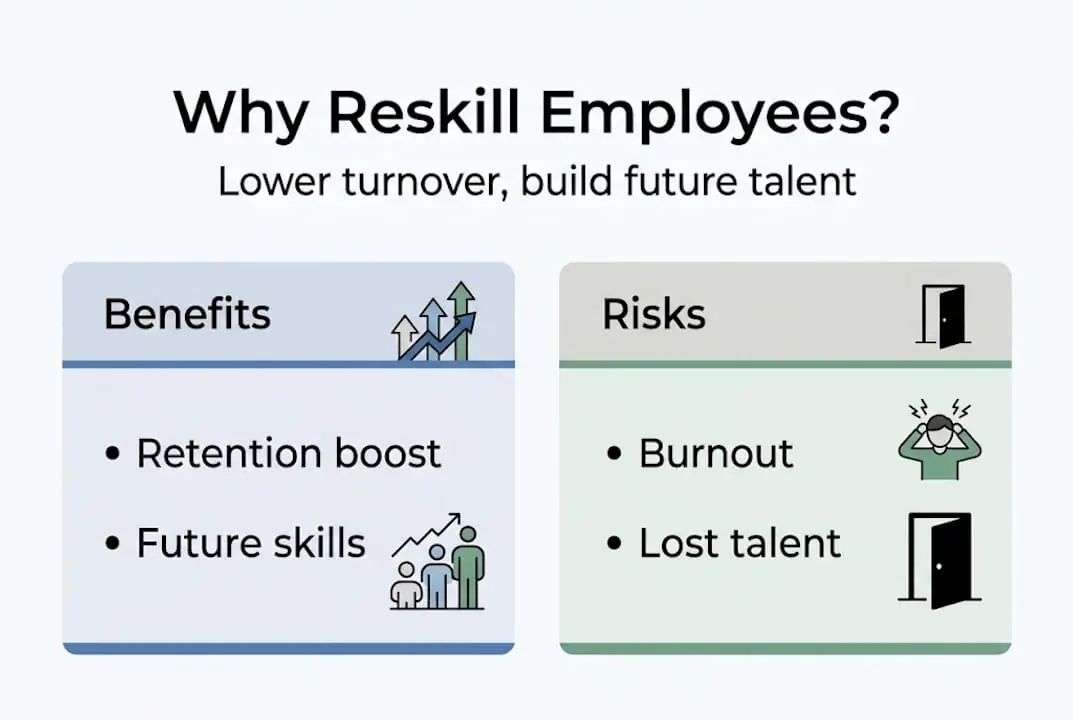
The data tells a sobering story. A longitudinal study of 7,831 employees found that skills mismatch, where employees are either over or underqualified for their role, leads to lower wellbeing, reduced job satisfaction, increased burnout, and a higher likelihood of exiting the labor market altogether. That is not just a HR problem. That is a business risk.
Here is a quick look at how reskilling compares to other common responses to skill gaps:
| Response to skill gap | Time to value | Cost | Retention impact |
|---|---|---|---|
| External hiring | 3 to 6 months | High | Neutral |
| Upskilling current staff | 1 to 3 months | Medium | Positive |
| Reskilling for new roles | 3 to 12 months | Medium | Very positive |
| Doing nothing | Immediate | Low upfront | Very negative |
The takeaway? Doing nothing is actually the most expensive option in the long run. Proactive HR leaders who use employee development tools to identify gaps early are already ahead of the curve.
Key signals that reskilling is overdue in your organization:
- ⚡️ Repeated complaints about feeling stuck or underutilized
- 📈 Rising turnover in specific departments or roles
- 💡 New technology being adopted but no training plan attached
- Roles becoming automated with no transition plan for affected employees
“Skills mismatch is not just an inconvenience. It is a direct path to burnout and workforce exit, and it is preventable.” Based on findings from a longitudinal workforce study
The business case: How reskilling reduces turnover and costs
Here is where the numbers get exciting. Companies with above-average training see 53% lower employee turnover compared to those investing less. For a mid-sized business, that kind of reduction is transformational.
Most employees do not leave for more money. They leave because they feel stuck. When there is no visible path forward, top performers start looking outward. Reskilling creates that internal path, giving people a reason to stay and grow without you having to backfill their roles.
Let’s compare the real costs:
| Scenario | Estimated cost | Retention outcome |
|---|---|---|
| Replace a mid-level employee | 50% to 200% of annual salary | Neutral, new hire risk |
| Reskill an existing employee | 10% to 30% of annual salary | High retention, faster performance |
| Reskill a team of 10 | Varies, often under $20K | Compound retention gains |
The HBR reskill vs replace case study makes a compelling argument that organizations opting to reskill consistently outperform those defaulting to replacement hiring, particularly when you factor in knowledge retention and cultural continuity.
Here is a numbered breakdown of the ROI levers reskilling activates:
- Lower recruiting costs. Fewer open roles to fill means less spent on job boards, agency fees, and interview cycles.
- Retained institutional knowledge. A reskilled employee brings years of company context into their new role.
- Faster ramp-up. Internal moves with training support outperform new hires in time-to-productivity.
- Improved morale. Reskilling signals investment, which lifts engagement across the whole team, not just the person being reskilled.
Pair reskilling with smart talent retention strategies and you start to build a compounding advantage. Employees who see a future with you become your most loyal advocates.
Pro Tip: Run exit interviews with specific questions about development. Ask departing employees: ‘Did you feel like you had room to grow here?’ The answers will reveal exactly which gaps are driving turnover, and where reskilling would have made a difference. Then connect those insights to job matching for retention data to make smarter internal moves.
Hidden risks of not reskilling: Burnout, disengagement, and lost talent
Not reskilling feels safe. It looks like the status quo. But the skills mismatch study is clear: organizations that ignore skill gaps do not avoid consequences, they just delay them.

When employees are underqualified for a role, they experience chronic stress trying to meet expectations they are not equipped for. When they are overqualified, they disengage from work that no longer challenges them. Both scenarios have the same endpoint: higher turnover and a workforce that quietly checks out before officially leaving.
For medium-sized companies, this is especially painful. You often have fewer internal advancement tracks than a large enterprise, which means top performers have even fewer options to grow without a deliberate reskilling strategy in place. Without one, your best people find growth elsewhere.
“Failing to address skill mismatches does not just cost you one employee. It can quietly reshape your entire team culture.”
Here is what that looks like in practice:
- Burnout in under-supported roles. Employees pushed into responsibilities they are not ready for face exhaustion and eventual exit.
- Disengagement among high performers. Talented people doing repetitive, under-challenging work start to coast or leave.
- Culture deterioration. A pattern of stagnation spreads. When people see no path forward, the collective energy drops.
- Loss of competitive edge. Your competitors are reskilling. You are not. The talent gap compounds fast.
Use a job shift workflow to track where skill gaps are causing pressure before they become exits. And keep an employee potential checklist handy to identify who is ready for reskilling before disengagement sets in.
Pro Tip: Schedule quarterly skill audits for each department. A 30-minute conversation between a manager and team member about role fit and growth interests can surface disengagement months before it becomes a resignation.
How to implement reskilling that actually works
Knowing you need to reskill is one thing. Actually building a program that sticks is another. Here is a practical blueprint designed for HR teams in mid-sized organizations that do not have unlimited budgets or dedicated L&D (learning and development) departments.
- Audit your current skill landscape. Survey teams and managers to map where gaps exist today and where they are likely to grow in the next 12 to 18 months.
- Map potential career pivots. Identify which employees have the personality and potential to take on new roles, not just the current skill set.
- Design a pilot program. Start with one team or department. Test a reskilling track, measure engagement and performance, and iterate before scaling.
- Blend learning formats. Mix structured courses with on-the-job projects. Real work is the fastest teacher.
- Track and adjust. Use turnover rates, engagement scores, and role performance data to measure whether your reskilling investment is working.
The reskill case study from HBR reinforces what field experience shows: both overqualification risks turnover and underqualification leads to burnout, which is why piloting before scaling is so critical. A small failed pilot costs far less than a company-wide rollout that misses the mark.
| Reskilling step | Timeline | Key tool or method |
|---|---|---|
| Skill gap audit | Month 1 | Surveys, manager interviews |
| Career path mapping | Month 1 to 2 | Personality and potential assessments |
| Pilot program launch | Month 2 to 4 | Blended learning, project work |
| Impact measurement | Month 4 to 6 | Turnover data, engagement scores |
| Full-scale rollout | Month 6 and beyond | Refined program, ongoing iteration |
The best reskilling programs use talent development best practices to guide structure and a personality-focused assessment to make sure you are placing the right people in the right new roles.
Pro Tip: Blend formal learning with real project ownership. Give reskilling employees a small, meaningful project in their new area within the first 30 days. It accelerates learning and builds confidence faster than any course alone.
HR wisdom: What most leaders get wrong about reskilling employees
Here is the uncomfortable truth we have seen play out repeatedly: most reskilling programs fail not because the training is bad, but because the match is wrong. ⚡️
HR leaders often default to a ‘train everyone’ mindset, rolling out programs based on company needs without asking whether the individual has the personality and potential to actually thrive in the new role. Skills can be taught. But personality, drive, and natural cognitive patterns? Those are much harder to shift. That is exactly why Sparkly focuses on personality assessment first, not skill inventories.
The reskilling vs. replacement debate in HBR highlights that reskilling wins on retention and cost, but only when it is paired with the right experimentation mindset. Pilot programs, honest capability assessments, and iterative learning are what separate successful initiatives from expensive ones.
The real growth from reskilling comes when new skills are aligned with actual business opportunities and an employee’s genuine strengths. Think about job matching for reskilling as the foundation, not an afterthought. When you build reskilling around who someone actually is, rather than just what the business needs, both sides win.
Next steps: Unlock your team’s potential with smart reskilling
Reskilling is not a nice-to-have in 2026. It is a core retention and growth strategy for any HR leader serious about building a team that lasts. 📈 You now have the data, the framework, and the red flags to watch for.
Sparkly HR is built specifically to help teams like yours take the guesswork out of reskilling. Our SaaS solutions for HR combine personality assessments, AI insights, psychometric data, and Human Design to help you identify who is ready to grow into what. Pair that with our fit assessment guide and you have a data-driven starting point for every reskilling decision. Stop guessing. Start matching.
Frequently asked questions
What is the difference between reskilling and upskilling?
Reskilling trains employees for entirely new roles within the organization, while upskilling adds new capabilities on top of their existing role and responsibilities.
How does reskilling help reduce employee turnover?
Reskilling gives employees a visible growth path inside the company, making them far more likely to stay. 94% of employees report they would remain with an employer that actively invests in their learning.
What are hidden risks of not reskilling employees?
Ignoring reskilling leads directly to burnout, disengagement, and labor market exit. Skills mismatch reduces wellbeing, satisfaction, and dramatically increases the chance employees leave your organization entirely.
Can small or mid-sized companies afford reskilling programs?
Absolutely. Starting with a small pilot program in one department limits risk and cost while generating real data. Pilot programs are proven to reduce failure rates before committing to full-scale rollouts.
How should HR measure the success of reskilling initiatives?
Track employee turnover rates, engagement survey scores, and role performance metrics in the months following reskilling. Comparing pre and post data gives you a clear picture of what is working and where to refine your approach.