
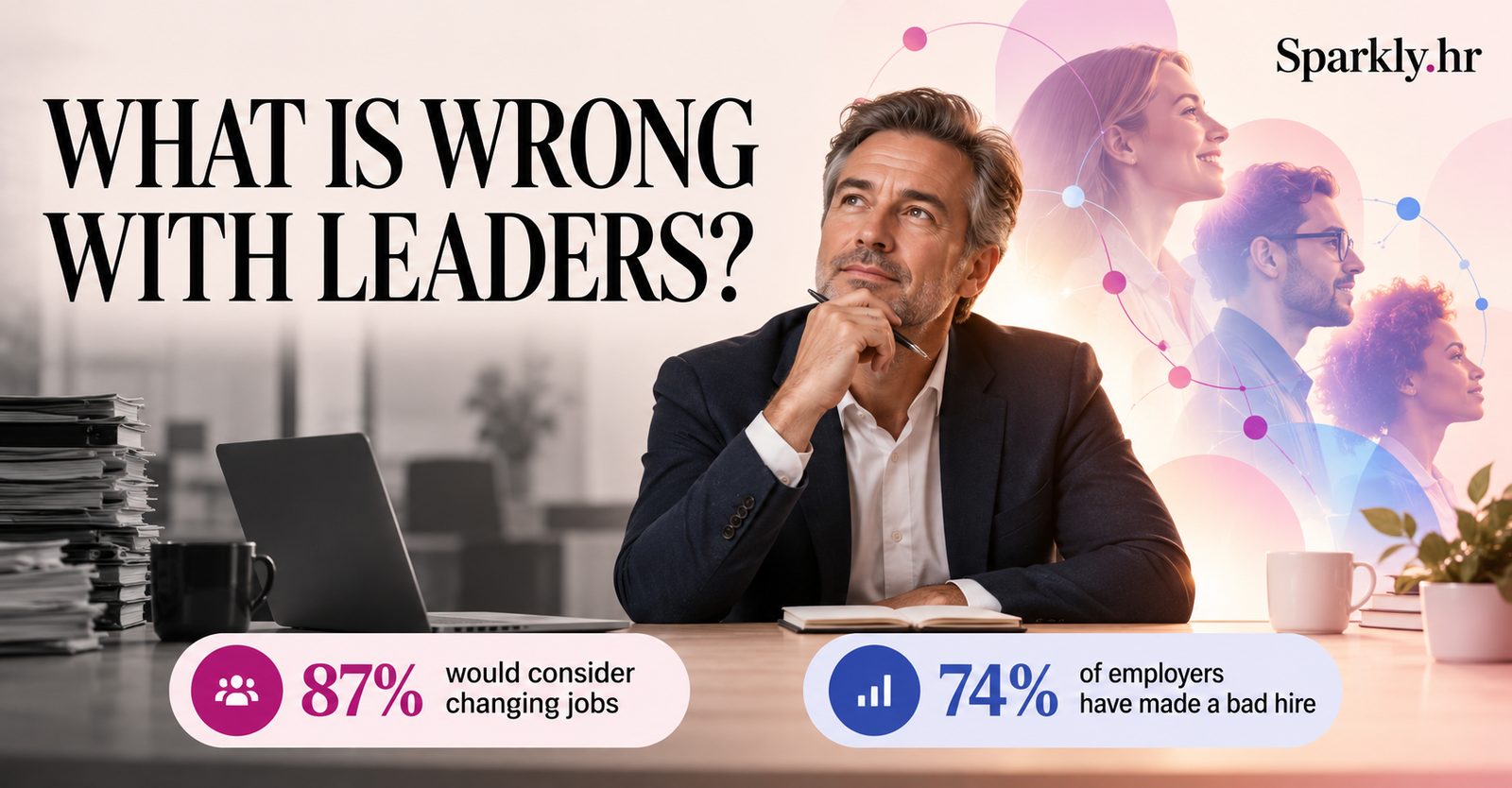
Working life statistics paint a rather uncomfortable picture: 87% of employees are not satisfied with their job and are ready to consider changing workplaces. At the same time, 74% of employers admit having hired the wrong person at least once.
Gallup uses the word engaged for this. The Estonian translation “tööga seotud” (attached to work) does not convey its real meaning. The question is whether a person is satisfied with their job, genuinely wants to contribute and sees a reason to stay. If not, they are open to considering a job change.
When not everything is fine, but nobody wants to change anything
Both sides understand that something is wrong.
The employee feels they cannot use their abilities, are in the wrong place, or do work that takes more energy than it gives back. The leader sees that results are not sufficient, the company is not growing at the expected pace, accountability is lost in the air, and too much time goes into solving problems.
Yet usually nothing changes.
When you ask a leader why they do not change the situation, the answer often sounds something like this:
- “We know our people.”
- “Actually, everything is fine with us.”
- “Yes, the company's revenue is not growing and we have challenges, but relationships between people are good.”
- “I do not want to break up the team.”
- “Now is not the right time for change.”
All of these answers sound reasonable at first. In reality, they usually describe the same thing: the leader is no longer protecting the development of the company. They are protecting the status quo.
Maintaining the status quo is not a neutral choice
Many leaders act as if leaving things unchanged costs nothing.
It does.
The real cost of a bad hire or of keeping someone in the wrong role is not limited to salary. It includes time spent recruiting, onboarding, training, coaching hours from other people, uncorrected mistakes, undone work, lost clients, postponed decisions, and the frustration of stronger employees.
Depending on the role, the real cost of one wrong person can be EUR 50,000–150,000. Sometimes more.
I have experienced this myself a couple of times. Those were very painful experiences that I still remember.
The hardest part was not even the direct financial damage. The hardest part was realizing afterwards how long I had actually already known that something was not working — and how long I had hoped the situation would improve on its own.
It did not.
When a person is in the wrong role, with the wrong responsibilities or in a team that does not fit them, time does not fix the mismatch. Time makes it more expensive.
Dissatisfaction does not mean something is missing in people
If 87% of employees are not satisfied with their job and are ready to consider changing workplaces, it does not mean that 87% of people are lazy, weak or wrong.
Much more often it means that the potential in people does not get to show itself at work.
A person can be in a company for years, completing every task they are given, without anyone ever genuinely asking:
- what they are naturally exceptionally good at;
- which tasks give them energy;
- which tasks drain them unreasonably much;
- in which environment they take ownership;
- in which team their strengths are amplified;
- in which role they would create many times more value for the company than today.
We see job titles, CVs and current results. We do not see what the result cost the person, or what they are actually capable of.
That is unrealized potential.
People bring knowledge, abilities, experience, sensitivity, systems thinking, relationship skills, creativity and resilience into the company every day, and nobody notices. The company pays for their full time but uses only a small part of their capacity.
We talk about labor shortage in a situation where a large share of the existing workforce is misapplied.
This is not only a wellbeing topic. It is a question of leadership quality, productivity and profit.
Why does the leader not change anything?
It would be easy to say that leaders are stupid.
I do not believe that.
Most often the problem is not intelligence or willingness. The problem is the leader's emotional state.
I have studied psychology, different schools of thought and theories explaining human behavior for years. The more leaders and companies I observe, the more clearly I see one pattern: many leaders are no longer in a growth mode. They are in survival mode.
In survival mode nobody asks: “How good could we become?”
There, the question is: “How do we make sure nothing gets worse?”
The leader is no longer looking for the best solution. They look for the solution with the smallest immediate threat. They avoid the hard conversation, postpone redistributing responsibility, leave the wrong person in place, and call stability a situation that is actually quietly falling apart.
Ambition does not always disappear because a person no longer wants to achieve anything. Sometimes it disappears because they no longer have the emotional space to start anything new.
When a leader's days consist of crises, helping people, fixing mistakes and filling operational holes, they eventually start believing that their job is to keep the company together.
But survival mode is not a growth strategy.
It is a death-avoidance strategy.
A pleasant atmosphere can hide a very expensive problem
“We have good relationships with our people” is an important argument. But it cannot be the reason not to look at whether the right people are in the right roles.
Getting along well does not automatically mean a good team.
A team can be friendly, calm and conflict-free, yet still hold back the development of the company. Nobody argues. Nobody demands more. Nobody questions another person's accountability. Everyone is comfortable — except the company, the client, and those strong people who have to carry the undone work of others.
Those who fight change the hardest are sometimes exactly the people who know deep down that they are not creating the value their position requires.
They hold on to their chair with ten claws. Every new metric feels like a threat. Every clarification of roles feels like distrust. Every attempt to make accountability clearer feels like “damaging relationships”.
This is how apparent peace becomes the organization's protective layer. Under it, good people go unused, strong people grow tired, and the leader keeps solving the same problems.
Respecting people does not mean we may not honestly look at their fit, accountability or results.
On the contrary. Respect also means not leaving a person for years in a role where they cannot succeed.
The owner has three options
As they say: the fish rots from the head.
The leader can decide whether to continue in survival mode or start growing again — as a leader, as a company, together with their people.
If the owner has hired a leader who is in survival mode, the owner actually has three options:
- replace the leader;
- help the leader develop and come out of that state;
- enjoy the status quo and accept its price.
There is no fourth option where nothing is changed and results start improving on their own.
Small Estonian companies are often criticized for lacking ambition. It is said that we have too many small companies. It is said that small companies do not want to grow. At the same time people say the Estonian market is so small that an ambitious company must immediately go abroad.
Perhaps the problem is not always a lack of ambition.
Perhaps beneath it is the leader's state.
When a leader has lived in crisis for a long time, they do not dream of the next market, product or growth leap. They first want today's pain to end. When the crisis briefly recedes, they often reach the so-called floating state: nothing is directly burning, people come to work, invoices get paid, and the company persists.
This feels like relief. And because it is better than crisis, it is confused with a good situation.
But “nothing is burning anymore” does not mean “we are growing”.
Bare minimum is not success. It is simply a tolerable enough state to postpone change a little longer.
A leader does not need more gut feeling. They need data under their gut feeling
Most experienced leaders have very good gut feeling about people.
The problem is not the gut feeling. The problem is that gut feeling only sees what the leader has been able to notice, what they have had time for, and what the person has shown them.
Gut feeling without data remains a one-eyed view. The big picture exists, but depth is missing.
When clear information about a person's natural working style, strengths, values, energy use, stress points, team fit and role expectations appears next to it, leadership becomes much easier.
Then the leader no longer has to guess:
- why one good person burns out in this role;
- why another does not take ownership even though their CV suggests they should;
- why two strong people working together make each other worse;
- why one person does a task in an hour and another spends a whole day on it;
- who makes sense to develop, whose role to change and which competence is genuinely needed next.
The leader does not have to give up gut feeling. They can finally put data under their gut feeling.
Solving this problem is cheaper than ignoring it
The cost of a wrong person can reach tens or hundreds of thousands of euros. The annual Sparkly profile for one person stays, depending on functionality, in the range of EUR 100–160.
That price difference is almost absurd.
Of course, Sparkly does not solve all the world's problems. No tool makes hard decisions for the leader or automatically turns a company into a great workplace.
But Sparkly gives, in minutes, an understanding of which pile of gold the company is actually sitting on.
It helps see where a person's potential goes unused. In which role the same person could create much more value. Which tasks suit them. Where overload appears. Which team helps them open up and which forces them to compress themselves every day.
This makes it possible to make changes so that a person does not have to leave simply because nobody was able to give them the right opportunity.
And it lets the leader build the foundation on which to take on the next growth challenges — with the right people, in the right roles, and with accountability they are able and willing to carry.
The question is not whether people could work better
The question is why the leader tolerates a situation where they do not.
Are leaders stupid?
No.
But an overloaded leader can make stupid decisions. A fearful leader can call stagnation stability. A leader in crisis can defend the very system that generates new crises for them every day.
Therefore the leader's first task is not always to start replacing people.
The first task is to restore clarity.
Who creates what value? Who is in the wrong role? What potential is unused? Where is the problem in the person, the task, the team, or the management system? What do we know and what do we merely assume?
When this picture becomes visible, the organization does not have to be blindly broken apart. You can make small, precise and justified changes.
A leader's life should not consist of endlessly solving stupid crises. A leader's job should be leading growth strategies.
But you cannot grow without a foundation.
And the foundation is not job titles or boxes on an org chart. The foundation consists of people who understand their accountability, use their strengths, and do work where they can genuinely succeed.
The leader can choose whether to protect today's situation or build tomorrow's company.
That choice is never free.
How can a leader help themselves?
You do not get out of survival mode by being told to “be more ambitious”. An overloaded leader does not need yet another inspiring training or a new list of things to do better.
First they need to get back clarity and decision-making capacity.
The first step is to acknowledge the situation without blaming yourself. When a leader honestly admits that they are no longer leading growth but holding a system together as it falls apart, that does not make them a bad leader. It finally gives them the chance to change something.
I would start with five very practical steps.
1. Write down the crises you keep solving repeatedly
Not all problems. The ones that come back.
Whose undone work keeps landing on your desk? Which decisions are not made without you? Around which role do the same conflicts keep appearing? Where do you have to be the translator, mediator, controller or rescuer?
A recurring crisis is no longer an isolated incident. It is information about wrongly built accountability, an unsuitable role, or missing capability.
2. Separate the person from the position
Leaders often stay stuck in the mindset that they have only two options: tolerate the situation or fire the person.
In reality there is a whole range of options in between.
Maybe the right person is in the wrong position. Maybe 70% of today's tasks suit them, but the remaining 30% eats up all their energy and results. Maybe accountability was given to a person who lacks the natural working style for it, while the same person would create much more value in another role.
Do not only ask: “Does this person fit us?”
Ask: “In which work, with which tasks and next to which people could they genuinely succeed?”
3. Ask people questions whose answers you may not want to hear
Not another satisfaction question like “Is everything fine?”. That gets answered “yes”, especially when everything is not fine.
Ask instead:
- which part of your work wastes your potential;
- which task would you happily take full ownership of;
- which work do you do only because nobody else does it;
- where is your best quality currently unused in the company;
- which problem are we only pretending to solve?
These questions do not always bring comfortable answers. But comfortable answers are often the reason nothing changes.
4. Make one small change, not a big reorganization right away
When a leader is overloaded, every change looks like a huge project. That is why it gets postponed.
Start by changing one accountability, one set of tasks, or one person's role. Agree on a 30-day experiment. Define in advance what change in results, energy use or collaboration you expect. Look a month later at what actually happened.
This way you do not have to take the whole organization apart at once. The leader can start building evidence about which changes work.
5. Do not get stuck inside your own gut feeling
A leader never sees the organization completely from the outside. They are part of the system they are trying to assess. They share history, promises, conflicts, guilt and hopes with the people.
Therefore even a very experienced leader needs an external mirror and data.
It can be a mentor, a board member, another leader, or a systematic analysis of people and roles. What matters is that someone or something helps distinguish fact from habit, appropriate tiredness from wishful thinking about potential.
Asking for help does not show that the leader cannot cope. On the contrary. A leader who understands that they no longer see the whole picture has already made the first strong leadership decision.
The goal is not to find someone to blame.
The goal is to get back the ability to choose.
When the leader sees which problem comes from the person, which from the role, which from the team and which from their own overload, they no longer have to carry everything as one big crisis. The problem becomes parts. Parts become decisions. And decisions become growth again.
Sources
- Gallup, State of the Global Workplace: In Europe, 13% of employees were engaged. In other words, 87% of employees were not satisfied with their job and were ready to consider changing workplaces. Gallup 2025 (PDF)
- CareerBuilder employer survey summary: 74% of employers said their company had made a wrong hiring decision. hrdive.com
- SHRM, The Myth of Replaceability: replacing an employee can cost roughly 50–200% of their annual salary, depending on role and level. shrm.org