
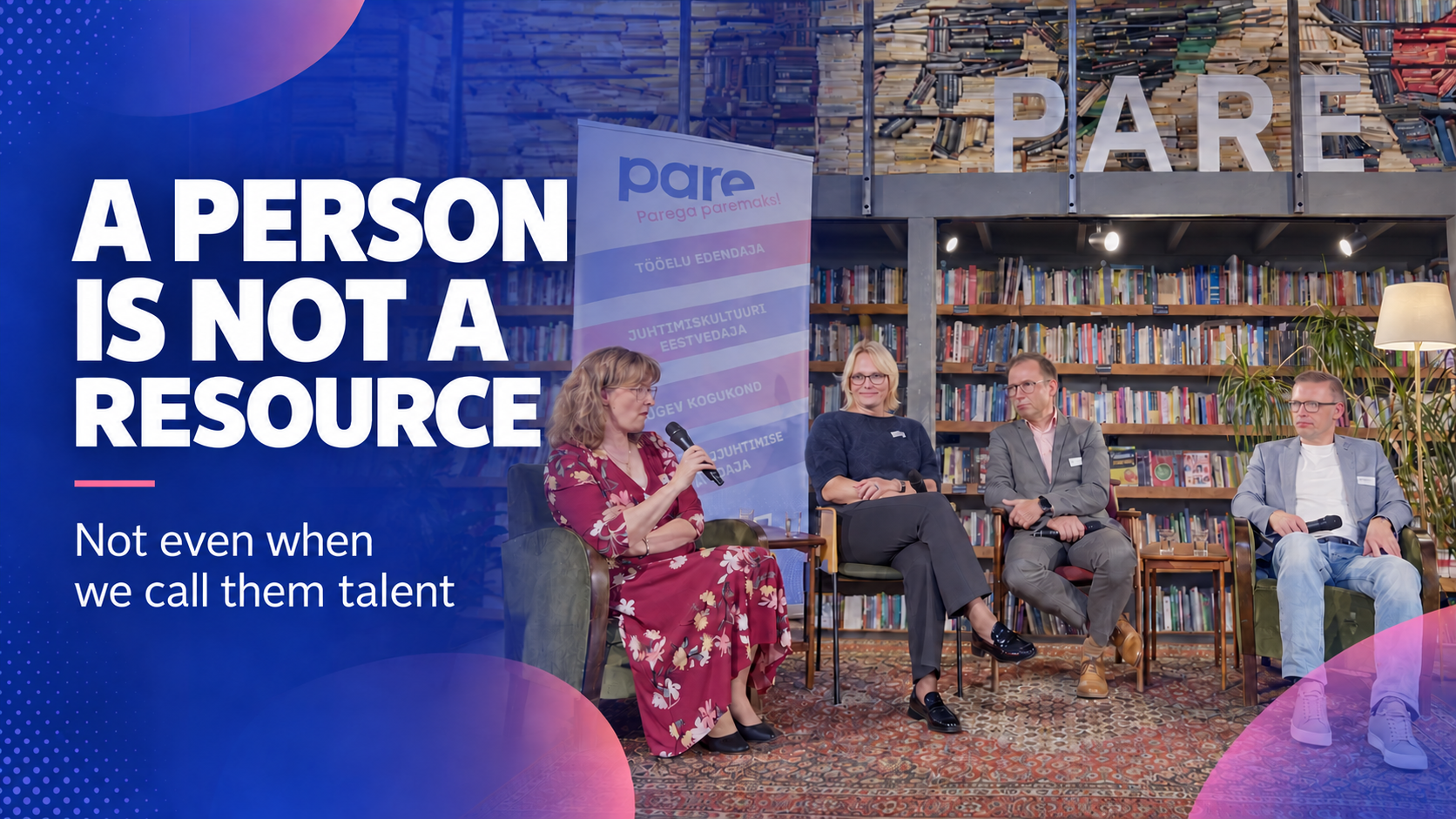
PARE opened its 2026 season by presenting a new Manifesto for Working Life and discussing its central themes. The debate was passionate, substantive and, at times, refreshingly provocative. Moderator Märt Treier introduced questions that pushed the panellists beyond safe generalities and made the discussion genuinely engaging for the audience.
PARE’s founding members, board and everyone involved in preparing the manifesto have done an excellent job. Their message to the Estonian Parliament was clear: working life in Estonia needs to change. Many solutions that were written into law with the best of intentions no longer achieve their intended purpose. In some cases, they create additional problems in the labour market. Working life has moved on, but legislation has not always kept pace.
There was a great deal of common sense in the room. On one important issue, however, I found myself disagreeing with the panellists.
The wrong question: human or AI?
Towards the end of the event, the discussion turned to the use of AI in recruitment. Unfortunately, it remained largely framed as a choice between “human or AI” and “recruitment with or without AI”.
I believe this is a false dichotomy.
People will undoubtedly remain essential in recruitment and subsequent management. The real questions are different: What information do people use to make decisions? How do we measure the quality of those decisions? How much room do stereotypes, first impressions and gut feeling still occupy?
Recruitment is rightly described as complex professional work. Much less often do we ask what its measurable professional quality actually consists of. Does good recruitment mean a positive candidate experience, a fast process, a satisfied hiring manager, successful completion of probation, or long-term compatibility between the person, the role, the manager and the team? How long must someone remain in the organisation, and what results must they create, before we can say that the hiring decision was a good one?
If we neither define nor measure quality, it is easy to call an existing process professional. It is much harder to demonstrate that the process consistently produces good decisions.
AI is neither the saviour nor the enemy here. It is one possible tool. Adding AI will not repair a bad process. At the same time, a decision does not become high-quality merely because a human made it.
We say people are not resources, yet we continue to manage them as resources
Throughout the event, we heard that age and nationality should not determine a person’s value and that what matters is the value they can offer. Yet the conversation repeatedly returned to averages, labour supply, scarcity and efficiency.
We say that a person is not a resource. Then we talk about falling birth rates, a shrinking workforce and the need to bring younger and older people into employment so that those who remain can produce more.
The language may sound caring, but the underlying management logic remains industrial: we have a certain quantity of labour from which we must extract the greatest possible output.
This is where my main disagreement lies. As long as we treat people as standardisable resources, working life will not fundamentally improve. The same problem extends into education, leadership, recruitment, organisational culture and, ultimately, family life.
When we teach everyone in the same way, we inevitably get very different results. When we manage everyone in the same way, not everyone can contribute at their best. When we place very different people in one team and expect identical behaviour from all of them, we create the disappointment, friction and conflict ourselves.
Equal treatment does not always mean identical treatment. People need different degrees of structure, autonomy, feedback, social contact, variety, uninterrupted focus and psychological safety. This does not make one person better or worse than another. It means that the fit between a person and their environment influences performance more than we are used to admitting.
The trap of becoming exceptionally average
Many people do work they have learned to perform well but which does not use their natural strengths. They are conscientious, disciplined and reliable. They achieve the results expected of them. Yet they may never reach the kind of work in which their real capability can emerge.
They have become exceptionally good at delivering an average performance.
This is not a judgement of the person. It is a judgement of a system that knows how to recognise learned skills and previous experience but is far less capable of identifying hidden potential, a person’s natural way of working, or the environment in which they could perform exceptionally well.
Discipline helps people become better at work that suits them. But discipline cannot turn an unsuitable role into the best possible use of their abilities.
Many people do not know where they are naturally stronger than others. They may go through an entire career without anyone helping them recognise it. For an organisation, that means unrealised potential. For the individual, it often means feeling that they are working at the very edge of their ability without ever arriving in the right place.
Human uniqueness is not a problem to be simplified away
One of the central conclusions from Sparkly’s development work over recent years is that finding two genuinely identical people is practically impossible. The more relevant characteristics we consider simultaneously, the clearer it becomes how different people truly are.
Our usual response to complexity is abstraction. We divide people into generations, occupations, personality types, strengths and weaknesses, young and old. These groupings can help us describe a broad picture. But when we use them to make decisions about an individual, they quickly become stereotypes.
The problem is not that a person does not fit neatly into a box. The problem is our assumption that they should.
This becomes particularly visible among leaders, entrepreneurs and top specialists. Exceptional ability in one area is often accompanied by an unusual way of thinking, heightened sensitivity, a different working pace or distinct collaboration needs. Exceptional capability may also require a different kind of management. When we try to force such a person into the model of an average employee, we begin to treat their strength as a problem.
Technology should help people see what they cannot process alone
Over several decades, psychology, management science and organisational behaviour have produced a vast range of theories and methods for understanding people. These methods are underused not necessarily because they lack value, but because applying them together is difficult and time-consuming. No single manager, teacher, recruiter or therapist can keep every relevant model in mind, calculate all the relationships between them and synthesise the whole picture for every individual.
This is where technology has a meaningful role: not as a substitute decision-maker, but as an extension of human decision-making capacity.
Sparkly’s purpose is not to place a final label on someone or tell a manager whom to hire. Its purpose is to provide more structured information for the decision: how a person prefers to work, the conditions in which their strengths emerge, where tension may arise, and what kind of leadership or role they may need.
In Sparkly’s model, the first useful analytical layer can be created from just 15 targeted questions. It is not the final truth about a person, nor is it a clinical diagnosis. It is a map that helps people ask better questions. An experienced manager, recruiter or specialist then adds context, conversation and their own ability to understand the individual.
Some parts of the synthesis still require support from AI because describing every relationship manually would become unreasonably cumbersome. Sparkly is deliberately moving towards making as much of the analysis as possible transparent, rule-based and verifiable. AI should be used where it improves the quality of a decision — not where it allows responsibility to be handed over to a machine.
We need to teach people how to understand one another much earlier — and much more widely
We often teach managers how to lead people only after they have already become managers. Even then, development programmes tend to focus on senior leaders. Yet an employee’s daily experience is affected most directly by first-line and middle managers.
Every manager should be taught to understand human differences. More than that, teachers should be able to recognise different ways of learning and functioning, while people themselves should begin learning to understand who they are as early as possible — by secondary school at the latest, and probably earlier.
This is not a soft side issue. It influences learning quality, employee wellbeing, customer experience, collaboration, leadership capability and organisational profitability. Ultimately, it also affects the sustainability of families and society.
We will never create a system in which every person receives entirely individualised teaching and management at every moment. Nor does that need to be the goal. A realistic goal is sufficient discernment: the ability to group people according to their actual needs and ways of working so that the chosen teaching or management approach is acceptable to both sides.
My main takeaway from PARE’s opening event
Estonia has many intelligent and experienced people who see the wider picture of working life and genuinely want to improve it. PARE’s opening event demonstrated that very clearly.
At the same time, even the most experienced person’s knowledge is limited by the focus of their work. For more than two years, the Sparkly team has worked intensively on a very specific challenge: synthesising models that describe the fit between a person, their work, their team and the way they are managed. This work builds on decades of leadership and entrepreneurial experience, as well as a deep interest in why some people, teams and organisations thrive while others remain stuck despite enormous effort.
That is why we see the recruitment and management challenge from a different angle.
The fundamental question is not whether a human or AI makes the decision. The question is whether we judge someone through stereotypes, averages and first impressions, or give the decision-maker enough high-quality information to see the person as a unique individual.
People will always be essential. But analytical data can significantly improve the quality of human decisions and reduce the risks created by poor hiring, placement and management choices.
If this resonates with you, get in touch. Let’s meet, and we will show you what Sparkly can make visible about a person, their work and their team — before the cost of a poor decision becomes apparent.
Key takeaways
- The fundamental question is not human or AI, but the quality of the information behind the decision.
- Equal treatment does not always mean identical management.
- Technology should extend human judgement, not take over responsibility.
Frequently asked questions
Should AI make the hiring decision?
No. AI can structure information and reveal relationships, but the final decision and accountability should remain with people.
Why should people not be managed as resources?
People need different levels of structure, autonomy, feedback and psychological safety. Standardised management leaves part of their capability unrealised.
What can Sparkly reveal with 15 targeted questions?
An initial analytical map of how a person works, where their strengths emerge, where tension may arise, and what kind of leadership or role may suit them.