What Is Workforce Planning? A Guide for Business Leaders

TL;DR:
- Workforce planning is a strategic, ongoing process that aligns talent capabilities with business goals to prevent talent crises.
- It relies on cross-functional data sharing, regular updates, and a focus on skills and behavioral fit rather than just headcount or titles.
Workforce planning is defined as the systematic process of ensuring your organization has the right people, with the right skills, in the right roles, at the right time, and at the right cost. Known formally as strategic workforce planning in HR circles, it goes far beyond counting headcount. It connects your talent strategy directly to your business goals, spanning short-term operational needs and long-term capability building across HR, Finance, and Talent functions. When done well, it is the difference between reacting to talent crises and preventing them entirely.
What is workforce planning and how does it work?
Workforce planning is a decision-making framework, not a spreadsheet exercise. IBM describes it as a process that anticipates future skill needs amid rapid technological disruption, making it far more than a simple headcount count. The goal is to align your workforce capabilities with where the business is heading, not just where it stands today.
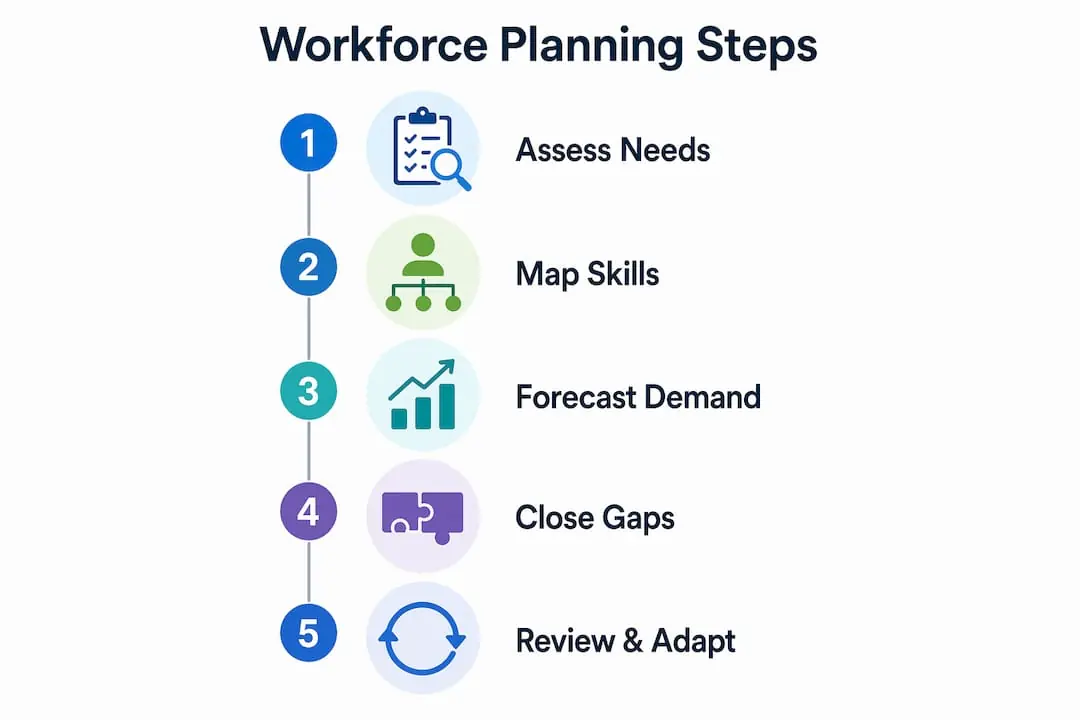
The process follows a seven-step cycle that most HR leaders and business managers can apply directly:
- Align with business strategy to define where the organization is going
- Assess supply by auditing your current workforce’s skills, roles, and capacity
- Forecast demand based on growth plans, market shifts, and technology changes
- Analyze gaps between current supply and future demand
- Plan actions using strategies like hiring, retraining, restructuring, or automation
- Execute those plans through recruiting, learning programs, and role redesign
- Review outcomes and adjust forecasts as conditions change
Alongside this cycle, the 5 R’s framework gives you a practical quality check: right person, right skills, right place, right time, right cost. Every workforce decision should pass through this filter before it moves forward.
The planning horizon matters too. Strategic workforce planning covers a 3 to 6 year window and focuses on capability building, succession, and organizational design. Operational planning covers up to one year and deals with immediate hiring needs, scheduling, and team capacity. Ignoring the long-term view carries real risk. Bain reports that labor force deceleration could create a $5.4 trillion GDP growth gap by 2030, a number that makes the cost of poor planning concrete.

Pro Tip: Start your workforce assessment by mapping skills at the role level, not the individual level. This reveals structural gaps faster and avoids the politics of evaluating specific people before you have a clear picture of what the organization actually needs.
How does workforce planning improve business outcomes?
Effective workforce planning produces measurable results across three areas: closing skills gaps, reducing turnover, and supporting strategic initiatives before they stall. When you know what capabilities you need 18 months from now, you can build them through development programs instead of paying premium rates for last-minute external hires.
The data on execution, however, is sobering. Only 42% of HR professionals believe their organization executes workforce planning effectively. That means the majority of organizations are making talent decisions based on incomplete information, gut instinct, or outdated annual plans. The gap between knowing workforce planning matters and actually doing it well is where most organizations lose competitive ground.
“Workforce planning is shifting from static exercises to dynamic, AI-powered, continuous and collaborative practices that integrate human and machine capabilities.” — Deloitte Insights
The confidence problem runs deep at the executive level too. Only 29% of chief HR officers are confident in delivering on strategic workforce planning goals. This reflects a real structural challenge: most organizations still treat workforce planning as headcount budgeting rather than capability management. The shift from “how many people do we need?” to “what skills and behaviors do we need, and where do we find or build them?” is where the real business value lives.
Organizations that make this shift see tangible improvements in time-to-fill rates, workforce engagement scores, and voluntary turnover. Data-driven talent management has been shown to cut turnover by 30%, which directly reduces the cost of unplanned exits and the productivity drag that follows them.
What are the biggest challenges in workforce planning?
The most common failure in workforce planning is not a lack of ambition. It is fragmented data and departmental silos that prevent Finance, HR, and Talent teams from working from the same picture. When each function maintains its own workforce data in separate systems, forecasts drift, decisions conflict, and planning becomes a political exercise rather than a strategic one.
Fragmented workforce data and siloed departments cause the most friction in organizations that struggle with planning. The organizations that perform best share continuous, integrated planning rhythms that align Finance, HR, and Talent on a single data view. This is not a technology problem alone. It requires deliberate process design and executive sponsorship to break down the walls between functions.
Three other challenges consistently derail workforce planning efforts:
- Treating planning as an annual event. Markets shift, business priorities change, and talent supply fluctuates. Quarterly or bi-annual forecast updates keep plans relevant. Annual cycles leave organizations reacting to changes that were visible months earlier.
- Relying on job titles instead of actual skills. A job title tells you almost nothing about what a person can do or what a role actually requires. Standardized skills assessments and gap matrices give you real data to work with.
- Trying to map every role at once. This creates data paralysis. Focusing skills inventory on high-impact roles in the top 5% of strategic importance lets you build momentum without overwhelming your HR team.
Pro Tip: Replace abstract spreadsheet data with color-coded gap matrices when presenting workforce gaps to leadership. Visual representations of red, yellow, and green skill coverage get faster buy-in and clearer decisions than rows of numbers.
Here is a simple framework for prioritizing your planning focus:
| Challenge | Root cause | Practical fix |
|---|---|---|
| Data fragmentation | Separate HR, Finance, and Talent systems | Shared real-time dashboard across functions |
| Annual-only planning | Budget cycle mindset | Quarterly reforecast cadence |
| Role title reliance | No skills taxonomy | Standardized skills library by function |
| Data paralysis | Mapping all roles at once | Start with top 5% high-impact roles |
What frameworks and tools make workforce planning work?
The Buy-Build-Borrow-Bot framework is the most practical decision tool for closing workforce gaps. When you identify a capability shortage, this framework forces a structured choice: buy talent externally through hiring, build it internally through training and development, borrow it through contractors or partnerships, or automate it using technology. Each option carries different cost, speed, and risk profiles, and the right answer depends on how critical the skill is and how quickly you need it.
Skills libraries are becoming a foundational infrastructure for this kind of planning. 38% of organizations had enterprise-wide skills libraries in 2025, up from 30% in 2023. That growth reflects a real shift toward skills-based workforce management, where capability data replaces job titles as the primary unit of analysis. Organizations with mature skills libraries can model workforce scenarios in hours instead of weeks.
Modern talent management SaaS platforms bring real-time data integration into the planning process. Rather than relying on annual surveys or static org charts, these tools pull live data on role performance, skill assessments, engagement signals, and attrition risk. This lets managers and HR leaders spot emerging gaps before they become crises. For a practical starting point on talent mapping for HR, the process of connecting individual capabilities to organizational needs is where planning becomes concrete.
Cross-functional alignment is the differentiator that separates world-class planning from average planning. Shared real-time data across Finance, HR, and Talent is the key factor in organizations that consistently execute their workforce strategies. When your recruiting team, your finance team, and your HR business partners are all looking at the same numbers, decisions happen faster and with less friction. ⚡️
The practical steps for building this alignment are straightforward:
- Establish a shared workforce data platform or dashboard accessible to all three functions
- Define a common language for roles, skills, and capacity across departments
- Set a recurring planning cadence with joint reviews at least quarterly
- Assign clear ownership for each planning component to avoid duplication and gaps
Key takeaways
Workforce planning works when it is continuous, cross-functional, and built on skills data rather than headcount assumptions.
| Point | Details |
|---|---|
| Define the right horizon | Use strategic planning for 3 to 6 year capability goals and operational planning for immediate needs within one year. |
| Close the execution gap | Only 42% of HR professionals believe their organization executes workforce planning effectively, so process discipline matters more than intent. |
| Break down silos | Align Finance, HR, and Talent on shared real-time data to prevent forecast drift and conflicting decisions. |
| Prioritize high-impact roles | Start skills mapping with the top 5% of strategic roles to build momentum and avoid data paralysis. |
| Update forecasts regularly | Quarterly or bi-annual reforecasting keeps workforce plans aligned with actual business conditions. |
Why most workforce plans fail before they start
Here is what I have observed working with organizations across different growth stages: the biggest obstacle to effective workforce planning is not the absence of data. It is the absence of a shared definition of what the workforce actually needs to do.
Most organizations begin workforce planning by asking “how many people do we need?” That question leads directly to headcount budgets, org chart debates, and annual planning cycles that are obsolete before the ink dries. The organizations that get this right start with a different question: “what capabilities does our strategy require, and do we have them?” That reframe changes everything.
The shift from headcount to capability management sounds simple. In practice, it requires breaking down the wall between Finance and HR, which are two functions that have historically operated on completely different planning cycles and success metrics. Finance thinks in budget periods. HR thinks in hiring cycles. Neither naturally thinks in skills trajectories or capability half-lives. Getting those two functions to plan together, using the same data, on the same cadence, is the hardest and most valuable thing you can do.
I also think the industry underestimates how much personality and behavioral fit matter in workforce planning. Skills can be trained. Personality shapes how someone performs under pressure, how they collaborate, and whether they will thrive in a given role or environment. When you plan your workforce without that data, you are filling seats, not building capability. That distinction is exactly why tools that go beyond skills assessments to measure personality, values, and working style produce better outcomes over time.
The organizations I respect most treat workforce planning as an ongoing operational rhythm, not a once-a-year deliverable. They reforecast quarterly, they share data across functions, and they empower managers with real insights rather than summary reports. That is the standard worth aiming for.
— Mikk
How Sparkly supports your workforce planning strategy
Workforce planning only delivers results when the people data behind it is accurate. That is where most plans break down, and where Sparkly makes a real difference.
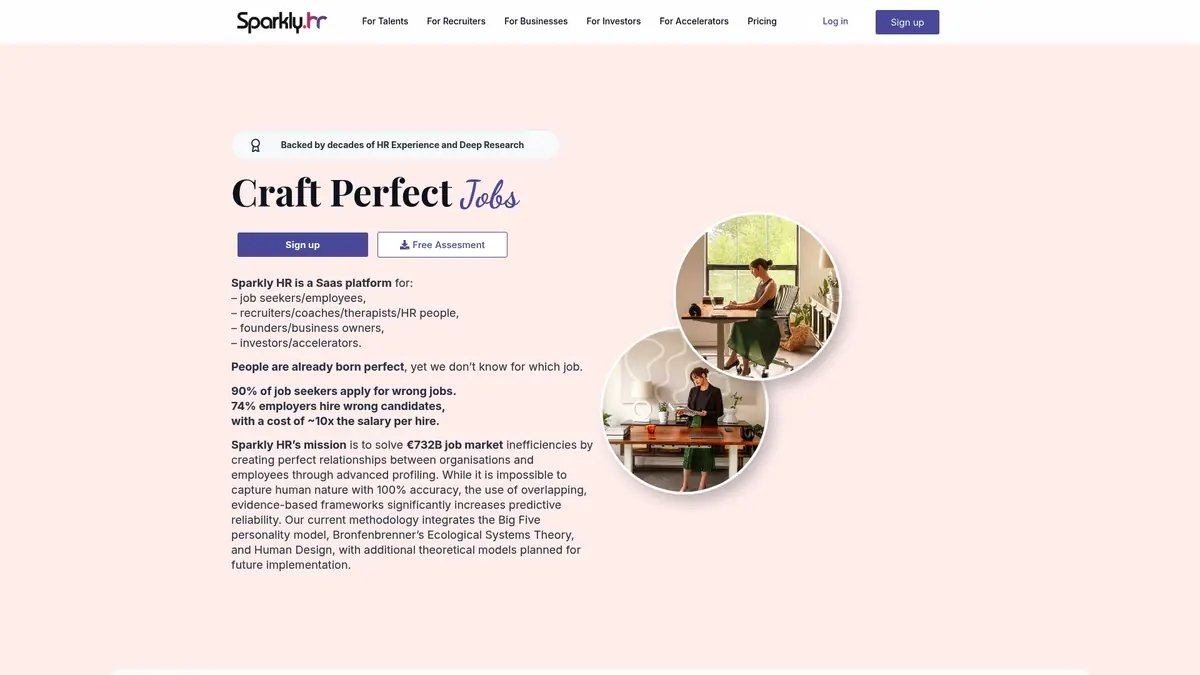
Sparkly goes beyond skills inventories by assessing personality, values, and behavioral fit alongside cognitive and team-dynamics data. It merges inputs from psychometric assessments, Human Design, AI analysis, and human observation to produce higher-probability insights about role fit, task-person alignment, and change-readiness. For HR leaders and business managers building workforce plans, this means you are not just filling roles. You are placing people where they will actually perform. Explore how SaaS in HR is transforming workforce decisions, or review the top talent evaluation tools shaping planning in 2026.
FAQ
What is the workforce planning definition in HR?
Workforce planning in HR is the process of analyzing current workforce supply, forecasting future talent demand, identifying capability gaps, and developing strategies to close those gaps in alignment with business goals. It spans both short-term operational needs and long-term strategic capability building.
What are the main benefits of workforce planning?
The core benefits include closing skills gaps before they become crises, reducing voluntary turnover through better role fit, and enabling strategic initiatives to launch with the right talent already in place. Organizations with mature workforce planning also report faster time-to-fill and stronger workforce engagement.
How often should workforce planning forecasts be updated?
Quarterly or bi-annual updates are the standard for organizations that maintain planning agility. Annual-only planning leaves too much time between adjustments, causing workforce strategies to drift out of alignment with actual business conditions.
What is the difference between strategic and operational workforce planning?
Strategic workforce planning covers a 3 to 6 year horizon and focuses on capability development, succession, and organizational design. Operational workforce planning covers up to one year and addresses immediate hiring, scheduling, and team capacity needs.
What tools support effective workforce planning?
Enterprise-wide skills libraries, talent management SaaS platforms, and shared real-time dashboards across Finance, HR, and Talent are the primary tools. Visual gap matrices and the Buy-Build-Borrow-Bot framework are practical decision tools that complement any technology stack.