
What Is Skill Mapping? A Guide for HR Leaders

TL;DR:
- Skill mapping identifies employee skills relative to current and future job needs. It helps organizations analyze skills for staffing, training, and mobility decisions. Maintaining an updated system linked to real outcomes maximizes its strategic value.
Skill mapping is defined as the systematic process of identifying, visualizing, and analyzing employee skills relative to current and future job requirements. As the University of Phoenix explains, it creates a detailed overview of available, required, and missing skills across a workforce. The industry term you will encounter most often alongside this concept is “competency mapping,” but the two are not the same thing. Skill mapping gives HR professionals and business leaders a clear, operational picture of what their teams can actually do right now. That picture is the foundation for every smart workforce decision that follows.
What is skill mapping and how does it differ from competency mapping?
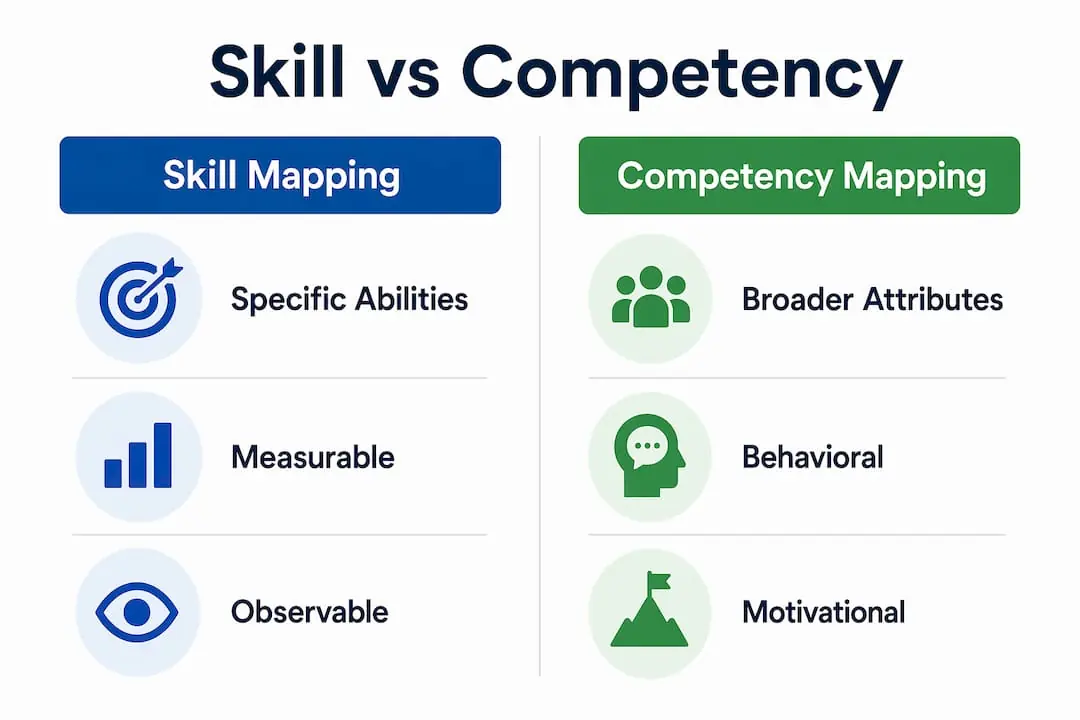
Skill mapping focuses on measurable, observable abilities. Competency mapping covers a broader set of attributes including behaviors, attitudes, and values. eLearning Industry describes skill mapping as the “what people can do” layer, making it more immediate and operational than competency frameworks.

The practical difference matters when you are making real decisions. A competency framework tells you that a project manager should demonstrate “stakeholder influence.” A skill map tells you that three people on your team can run a risk register at an advanced level and only one can do it independently. One gives you a profile. The other gives you data you can act on.
| Dimension | Skill mapping | Competency mapping |
|---|---|---|
| Focus | Specific, measurable abilities | Broader attributes including behavior |
| Output | Skills matrix with proficiency levels | Competency profiles and behavioral indicators |
| Best use | Gap analysis, staffing, L&D planning | Hiring profiles, leadership development |
| Measurability | High, tied to observable tasks | Moderate, requires behavioral observation |
| Time horizon | Immediate and near-term | Medium to long-term |
Use skill mapping when you need to answer “who can do this work today?” Use competency mapping when you are shaping what kind of people you want in your organization over the next three years.
Pro Tip: Start with skill mapping before building a competency framework. You need to know what your team can do before you define what you want them to become.
How to do skill mapping: the process and tools
The skill mapping process follows a clear sequence. Skipping steps produces a skills matrix that looks good in a spreadsheet but fails when you try to use it for real decisions.
- Define the skill taxonomy. List the specific skills relevant to each role. Keep the list focused. Smaller, focused skill taxonomies yield better insights than exhaustive inventories that nobody can maintain.
- Choose a proficiency scale. A 0–4 or 0–5 scale works well. Each level needs a behavioral descriptor, not just a label. “Advanced” means nothing without a concrete example of what advanced performance looks like.
- Collect data. Combine self-reporting with manager assessments. Self-reporting paired with manager review improves accuracy, but calibration conversations are required to reduce rating bias.
- Build the skills matrix. Plot team members against skills with proficiency scores. A skills matrix visualizes gaps, overlaps, and single points of failure at a glance.
- Analyze and act. Identify gaps between current and required proficiency. Prioritize training, hiring, or redeployment based on what the data shows.
Common tools for building a skills matrix
Spreadsheet tools like Microsoft Excel and Google Sheets work for small teams. Dedicated platforms like MuchSkills and skills management modules inside HR systems provide better visualization and update workflows for larger organizations. The right tool is the one your team will actually use and update.
Pitfalls to avoid
- Rating inflation: managers score everyone high to avoid difficult conversations
- Skill list bloat: tracking 200 skills when 30 are actually relevant to the work
- One-and-done thinking: treating the matrix as a project rather than an ongoing system
- No link to outcomes: capturing skills without connecting them to roles, projects, or business needs
Pro Tip: Run a calibration session after the first round of ratings. Bring managers together to compare scores on the same employees. Inconsistencies surface fast, and the conversation itself builds shared standards.
What are the strategic benefits of skill mapping for organizations?
Deloitte research shows that skill-to-job mapping is the most common activity organizations use to achieve workforce agility. That finding points to something most HR leaders already sense: rigid job titles slow organizations down, and skills-based thinking speeds them up.
The benefits of skill mapping show up across every major HR function.
- Gap analysis and L&D prioritization. A skills matrix makes training investment decisions defensible. You are not guessing what the team needs. You are reading it directly from the data.
- Internal mobility. Connecting skills to actual work breaks down job title barriers and enables talent to move where it is needed most.
- Succession planning. Skill maps reveal who is ready to step into a critical role and who needs development before they can.
- Risk management. Skills matrices highlight where critical knowledge sits with only one person, giving leaders time to address that vulnerability before it becomes a crisis.
- Smarter hiring. When you know exactly which skills are missing, you recruit for the gap rather than a generic job description.
“Without linking skills to work outcomes, inventories lack impact on operational decisions.” — Deloitte Insights
That quote captures the most common failure mode in skill mapping programs. Organizations build the matrix and then leave it in a folder. The value comes from connecting the data to real staffing, development, and redeployment decisions. A step-by-step talent mapping approach helps HR teams move from data collection to decisions that actually change how work gets done.
How to maintain a living skill mapping system over time
Skill mapping is a living process, not a one-time audit. Skills become outdated. Business priorities shift. New roles emerge. A skills matrix built in january and never touched again is misleading by april.
Keeping the system current requires a few deliberate practices.
- Schedule periodic reassessments. Quarterly or biannual reviews work for most organizations. High-velocity teams may need monthly updates for critical skill areas.
- Align updates with business strategy cycles. When leadership sets new priorities, the skill taxonomy should reflect them. New strategic bets require new skills.
- Use manager calibrations as a rhythm, not an event. Build calibration conversations into existing performance cycles rather than treating them as a separate initiative.
- Link skills to projects and outcomes. Skill maps that include links to outcomes enable redeployment decisions and more agile workforce shifts when demand changes.
- Build organizational buy-in early. Managers who understand how the data will be used are far more likely to provide accurate ratings and update them consistently.
The organizations that get the most value from skill mapping treat it the way they treat financial reporting: a regular, structured process with clear ownership and consequences for letting it lapse. Understanding the advantages of talent mapping helps leaders make the case internally for that level of commitment.
Pro Tip: Assign a named owner for each skill domain, not just for the overall matrix. When a specific person is responsible for keeping the data on “data analysis skills” current, it actually gets done.
Key Takeaways
Skill mapping delivers its full value only when it is treated as an ongoing, outcome-linked system rather than a static inventory exercise.
| Point | Details |
|---|---|
| Skill mapping definition | It inventories and visualizes employee skills against current and future job requirements. |
| Skill vs. competency mapping | Skill mapping measures observable abilities; competency mapping covers broader behaviors and attitudes. |
| Core process steps | Define skills, set proficiency scales, collect data, build a matrix, then analyze and act. |
| Strategic benefits | Supports gap analysis, internal mobility, succession planning, and risk management. |
| Living system requirement | Skill maps must be updated regularly and linked to real work outcomes to remain useful. |
Why skill mapping alone is not enough
I have worked with HR teams that built genuinely impressive skills matrices. Clean data, solid proficiency scales, well-calibrated managers. And then, six months later, nothing had changed. The same people were in the same roles doing the same work. The matrix sat in a shared drive.
The problem was not the skill mapping. The problem was that the organization treated skills as the whole story. Skills tell you what someone can do. They do not tell you what someone will do, how they will do it under pressure, or whether the role itself is designed in a way that lets them perform at their best. I have seen technically skilled people fail in roles that were wrong for their personality and working style. I have seen people with modest skill profiles outperform expectations because the role fit who they are.
Skill mapping is a necessary foundation. But the most effective HR leaders I know use it as one input among several. They pair it with personality data, cognitive fit, and team dynamics to get a complete picture. That is where the real decisions get made. The role of soft skills in HR is a useful starting point if you want to understand what sits alongside technical skill data in a complete people intelligence picture.
My honest advice: start with a focused skill map covering your 20–30 most critical skills. Get the process right. Then ask what the skill data alone cannot tell you, and build from there.
— Mikk
Sparkly and the next layer beyond skill mapping
Skill mapping gives you a clear view of what your team can do. Sparkly shows you who your people are and where they will thrive.
Sparkly is a people-intelligence SaaS platform that goes beyond skills by combining psychometric assessments, personality data, cognitive fit, and Human Design into computed insights HR leaders can actually use. Where a skills matrix tells you someone has advanced Python skills, Sparkly tells you whether that person is energized by deep solo work or drained by it, and whether the role you are placing them in will bring out their best or quietly burn them out. For HR professionals who want to move from SaaS-powered HR decisions to real workforce transformation, Sparkly is built for exactly that. Skills can be learned. Personality is the multiplier.
FAQ
What is the skill mapping definition in HR?
Skill mapping is the process of identifying and visualizing employee skills against the requirements of current and future roles. It produces a skills matrix that shows gaps, overlaps, and training priorities across a team or organization.
Why does skills mapping matter for workforce planning?
Skills mapping gives leaders a factual basis for staffing, training, and redeployment decisions. Deloitte research identifies skill-to-job mapping as the most common activity organizations use to achieve workforce agility.
How is skill mapping different from competency mapping?
Skill mapping focuses on measurable, observable abilities. Competency mapping covers broader attributes including behaviors and attitudes. Skill mapping is more operational and immediate; competency mapping is better suited for long-term leadership development.
How often should a skills matrix be updated?
Most organizations benefit from quarterly or biannual reviews. Skills and business priorities change, and a matrix that is not updated regularly becomes unreliable for workforce planning decisions.
What are the most common skill mapping techniques?
The most common techniques include self-assessment surveys, manager evaluations, calibration sessions, and skills matrix grids with standardized proficiency scales. Behavioral descriptors at each proficiency level are what separate reliable assessments from subjective ones.