
What is role clarity? Boost team fit and cut turnover

TL;DR:
- Role clarity involves understanding responsibilities, expectations, outcomes, decision boundaries, and organizational context.
- Clear roles improve efficiency, engagement, reduce burnout, and lower turnover costs.
- Regularly review and adapt role clarity using data, personality insights, and collaborative frameworks.
Most managers assume their team knows exactly what they’re supposed to do. But only 46% of employees can clearly describe what’s expected of them at work. That gap between assumption and reality is where engagement falls apart, performance stalls, and people quietly start looking for the door. Role clarity isn’t a soft HR concept. It’s one of the most measurable levers you have for reducing turnover and building teams that actually perform. This guide breaks down what role clarity really means, why it matters more than most leaders realize, and how to strengthen it using data, personality insights, and practical frameworks.
Table of Contents
- Defining role clarity: What it is (and isn’t)
- The real impact of role clarity: Data and business benefits
- How to create role clarity: Frameworks, job analysis, and personality fit
- Common pitfalls and advanced insights: Getting role clarity right
- Why role clarity isn’t static: A modern HR perspective
- Enhance team performance with smarter role clarity tools
- Frequently asked questions
Key Takeaways
| Point | Details |
|---|---|
| Role clarity basics | Role clarity means every team member knows their purpose, outcomes, and decision limits. |
| Business impact | Clear roles drive up to 53% higher efficiency and drastically lower turnover costs. |
| Practical steps | Use job analysis and personality assessments to define and refine roles for better team fit. |
| Common mistakes | Avoid rigidity or unchecked ambiguity—adjust clarity as your team and goals evolve. |
| Modern approach | Treat role clarity as a living process, revisiting it as your workplace changes. |
Defining role clarity: What it is (and isn’t)
Role clarity gets thrown around in HR conversations, but it’s often confused with simply having a job description. A job description tells someone their title and lists their tasks. Role clarity goes much deeper than that.
Role clarity is the clear understanding of job responsibilities, expectations, outcomes, decision boundaries, and organizational context. In other words, it’s not just what you do but why it matters, how your decisions affect others, and where your accountability begins and ends.
Here are the five core elements every employee needs to feel truly clear in their role:
- Responsibilities: The specific tasks and functions they own
- Expectations: The standards and behaviors their team and manager count on
- Outcomes: The measurable results they’re accountable for delivering
- Decision boundaries: What they can decide independently vs. what needs escalation
- Organizational context: How their role fits into the larger team and company mission
A common myth is that clarity equals rigidity. Leaders sometimes avoid defining roles tightly because they fear it will box people in or stifle innovation. But that’s a misreading of what clarity actually does. Structure doesn’t limit good people. It frees them to focus their energy where it counts most.
“Clarity is not a cage. It’s the scaffolding that lets people build something meaningful without second-guessing every move.”
The job fit analysis process matters precisely because fit isn’t just about skills. It’s about understanding how someone’s natural tendencies align with the demands of a role. And that starts with knowing what the role actually requires at a deep level. When you get that right, team alignment best practices become far easier to implement across the board.
The real impact of role clarity: Data and business benefits
Now that we know what role clarity really means, why does it matter so much for business leaders?
The numbers are striking. Teams with strong role clarity are 53% more efficient and 27% more effective than those without it. Yet despite this, fewer than half of employees feel fully clear on what’s expected of them. That’s not a minor misalignment. It’s a systemic drag on productivity.
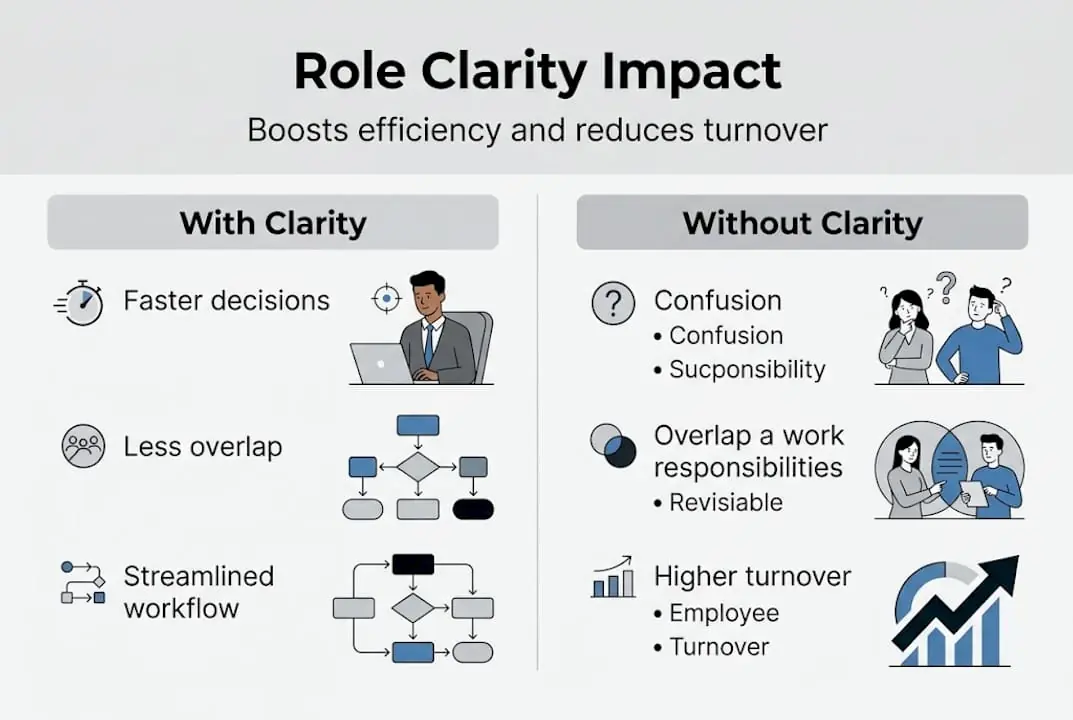
📈 Stat to remember: Role ambiguity can reduce individual performance by up to 25% and is a leading driver of workplace burnout.
When roles are unclear, people spend energy on the wrong things. They duplicate work, avoid decisions they’re unsure they’re allowed to make, and spend time managing up just to stay aligned. That friction adds up fast.

| With role clarity | Without role clarity |
|---|---|
| Faster decision-making | Decision paralysis and escalation loops |
| Higher engagement and ownership | Disengagement and blame shifting |
| Lower burnout risk | Chronic stress and confusion |
| Better performance reviews | Inconsistent output and missed targets |
Turnover is where the financial cost becomes impossible to ignore. Replacing an employee costs between 50% and 200% of their annual salary. Role ambiguity is one of the top reasons people leave. They don’t always say it in exit interviews, but when someone feels unclear on what success looks like for them, they eventually stop trying to figure it out.
The job analysis process gives you a structured way to capture what a role actually demands before ambiguity does its damage. Pair that with personality data for retention and you start making decisions based on evidence, not instinct.
Pro Tip: Ask three people on your team to write down their top three outcomes for their role, independently, without looking at any documents. If the answers don’t match, you have a role clarity problem worth fixing.
How to create role clarity: Frameworks, job analysis, and personality fit
Knowing the stakes, how do you actually engineer role clarity? Here’s a practical breakdown.
Start with a solid job analysis. Job analysis uses interviews, surveys, PAQ, O*NET, and multiple data sources to map out what a role actually requires. The Position Analysis Questionnaire (PAQ) and O*NET are structured tools that go beyond gut feel and surface the real task demands, cognitive requirements, and interpersonal dynamics of a job.
Here’s a straightforward process to follow:
- Gather input from multiple sources. Talk to current role holders, their managers, and cross-functional partners. Each group sees different aspects of the role.
- Map core tasks to outcomes. Don’t just list activities. Connect each task to a measurable result.
- Define decision boundaries explicitly. Where does this person have full authority? Where do they need to check in? Write it down.
- Layer in personality fit data. Use assessments to understand how a person’s natural tendencies align with the role’s demands.
- Review and validate with the team. Role clarity isn’t a solo exercise. It works best when built collaboratively.
Personality assessments can reduce turnover by 30% to 50% when used to match people to roles that genuinely fit how they think, communicate, and make decisions. At Sparkly, we combine psychometric assessments, Human Design, AI analysis, and human judgment to get beyond surface-level data. Skills can be learned. Personality shapes how someone shows up every single day.
| Tool | What it measures | Best use case |
|---|---|---|
| PAQ / O*NET | Task demands and cognitive load | Building baseline job profiles |
| Personality assessments | Behavioral tendencies and fit | Matching people to roles |
| HR analytics | Performance patterns over time | Optimizing team configuration |
The workflow personality assessments at Sparkly are built specifically for this kind of layered analysis. Combined with HR analytics for team potential and insights on success factors in recruitment, you get a picture that’s far more reliable than any single source alone. For teams investing in people development, performance coaching strategies can reinforce the clarity you build at the structural level.
Pro Tip: Use personality data to assess team fit, not just individual fit. A person who thrives in autonomous, creative work may struggle in a role that demands high coordination and process adherence, even if their technical skills are perfect.
Common pitfalls and advanced insights: Getting role clarity right
Practical frameworks are just the start. Mastering role clarity means navigating gray areas and potential missteps.
Not every team needs the same level of role definition. In safety-critical environments, role clarity is non-negotiable. When compliance, liability, or physical safety is on the line, ambiguity is genuinely dangerous. But in creative teams, early-stage startups, or highly adaptive knowledge work, rigid roles can actually kill the collaborative energy that drives results.
Here are the most common pitfalls HR leaders run into:
- Catchall roles: Vague titles like “Operations Generalist” or “Business Development Lead” with no defined outcomes invite confusion and resentment.
- Ambiguous decision boundaries: When it’s unclear who can approve what, decisions get stalled or duplicated at the worst possible times.
- Clarity collapse during rapid growth: Fast-scaling teams often let role definitions lag behind reality. Someone hired to do X ends up doing X, Y, and Z, with no formal acknowledgment or adjustment.
- One-time clarity efforts: Defining roles once during onboarding and never revisiting them is a recipe for drift.
“The goal isn’t to make every role a rigid box. It’s to give people a clear enough foundation that they can move with confidence, not confusion.”
Optimal team size for clarity tends to hover around 4 to 5 people. Smaller teams naturally force role overlap and communication. Larger teams without clear roles become tangled fast. During restructures, mergers, or periods of rapid hiring, role clarity should be your first priority, not an afterthought.
For accountability in coaching, clarity is the starting point. You can’t coach someone toward accountability if they’re not sure what they’re accountable for. Stay current with latest HR insights to keep your approach fresh as team dynamics shift.
Why role clarity isn’t static: A modern HR perspective
Here’s a perspective you won’t find in most HR guides. Most frameworks treat role clarity as something you define once, document, and hand off. That model is outdated.
In an era of AI-assisted work, blended teams, and rapid organizational change, the idea that a role stays stable for 12 months is increasingly unrealistic. What a customer success manager does today may look very different in six months once new tools are introduced or a product line shifts.
The smartest HR teams we see are treating role clarity as a living agreement, reviewed quarterly, built in partnership with the people doing the work. That means asking: has this role evolved? Do the outcomes still match the strategy? Does the person’s natural working style still fit?
The dynamic job fit process reflects this thinking. Fit isn’t a one-time assessment. It’s an ongoing conversation between the person, the role, and the team. When you treat it that way, role clarity becomes a retention tool and a performance accelerator, not just an onboarding checkbox. ⚡️
Enhance team performance with smarter role clarity tools
Ready to put these principles into action? Role clarity is far more achievable when you have the right tools supporting the process.
Sparkly HR is built for exactly this challenge. We help HR teams and business leaders go beyond generic job descriptions by combining personality assessments, Human Design insights, AI analysis, and psychometric data into a clear, actionable picture of job fit. Our approach focuses on personality first, because skills can be taught but natural tendencies drive how someone actually performs in a role.
Explore our personality-focused role clarity solutions to see how we support smarter hiring and team design. Or start with job fit for better retention to understand how fit-first thinking can reduce your turnover rate and build stronger teams from the inside out. 💡
Frequently asked questions
How is role clarity different from a job description?
A job description lists tasks and titles, but role clarity covers responsibilities, outcomes and organizational context, including who makes which decisions and how success is actually measured.
How can you diagnose role ambiguity in your team?
Ask team members to independently describe their key outcomes without asking others; significant variation in answers is a reliable signal that role clarity needs attention.
What’s the role of personality assessments in achieving role clarity?
Personality assessments can reduce turnover by up to 50% by matching employees to roles that align with how they naturally think, communicate, and make decisions.
Should role clarity be rigid or flexible?
Best practice is to review and adapt roles regularly. Dynamic review of role clarity is especially important in knowledge-work and AI-augmented environments where job demands shift quickly.