Unlock true potential with employee strengths analysis

Many businesses invest heavily in personality assessments yet struggle to predict which employees will thrive long term. Traditional tests like MBTI miss crucial insights into natural talents and work outcomes. Employee strengths analysis offers a fresh, evidence-backed approach to enhance retention and performance by identifying what people naturally do best. This guide covers proven methods, tangible benefits, common challenges, and practical strategies to integrate strengths-based approaches with validated personality models for optimal talent management.
Table of Contents
- Key takeaways
- Understanding employee strengths analysis methods
- Benefits and limitations of strengths-based approaches in the workplace
- Navigating challenges: overuse risks and cultural considerations in strengths analysis
- Integrating employee strengths analysis with predictive personality models for talent optimization
- Explore innovative talent evaluation solutions
- Frequently asked questions
Key Takeaways
| Point | Details |
|---|---|
| CliftonStrengths framework | The CliftonStrengths assessment identifies natural talents across 34 themes organized into four domains to guide development toward what people naturally do best. |
| Big Five over MBTI | Big Five and HEXACO provide stronger predictions of performance and retention than MBTI. |
| Balance strengths with assessments | Using strengths analysis alongside validated personality tools improves engagement and predictive accuracy for hiring and development. |
| Overuse and context matter | Excessive reliance on strengths without feedback or cultural adaptation can pose risks and reduce effectiveness. |
Understanding employee strengths analysis methods
Employee strengths analysis identifies natural talents and capabilities rather than simply measuring personality traits or fixing weaknesses. Unlike traditional tests such as MBTI, which categorize people into types without strong predictive validity, strengths-based approaches focus on what individuals naturally do best. The CliftonStrengths assessment identifies top talents from 34 themes via 177 paired statements, organizing results into four domains: executing, influencing, relationship building, and strategic thinking.
Validated personality models offer different value. The Big Five superior to MBTI-style tests, proving twice as predictive of life outcomes. Conscientiousness emerges as the strongest trait for performance and retention, while HEXACO adds honesty-humility to better predict counterproductive work behaviors. These models provide the predictive power that strengths assessments lack, making them essential for hiring and development decisions. For comprehensive strategies, explore our employee potential evaluation guide.
Key differences between approaches:
- CliftonStrengths focuses on talent identification and engagement through natural patterns
- Big Five predicts job performance, retention, and life outcomes with validated reliability
- HEXACO adds honesty-humility dimension for better counterproductive behavior prediction
- MBTI offers poor predictive validity despite widespread popularity in corporate settings
Pro Tip: Use strengths analysis to complement validated personality assessments rather than replacing them. Combining both approaches maximizes engagement while maintaining predictive accuracy for hiring and development outcomes. Review top assessment tools for recruitment agencies to find integrated solutions.
Benefits and limitations of strengths-based approaches in the workplace
Strengths-based approaches grounded in Self-Determination Theory and Job Demands-Resources model promote intrinsic motivation by aligning work with natural capabilities. When employees use their signature strengths daily, they experience enhanced self-efficacy and better role fit. These psychological frameworks explain why focusing on what people do best creates sustainable engagement rather than temporary motivation boosts.
Meta-analytic evidence demonstrates substantial correlations. Character strengths use correlates ρ=.421 with work performance and ρ=.621 with wellbeing, with no evidence suggesting overuse creates diminishing returns. These effect sizes rival or exceed many traditional interventions, making strengths-based approaches valuable for organizations prioritizing both productivity and employee satisfaction.
Character strengths use shows a correlation of .621 with wellbeing and .421 with work performance, demonstrating robust links between natural talent application and positive outcomes.
Tangible organizational benefits include:
- Increased employee engagement through alignment of tasks with natural talents
- Improved retention rates by enhancing job satisfaction and intrinsic motivation
- Higher team performance when members contribute from areas of genuine capability
- Reduced burnout risk through better role fit and resource management
However, limitations exist. Self-report bias affects accuracy since people may overestimate their strengths or answer aspirationally. Cultural bias emerges because most validation studies involve WEIRD populations (Western, Educated, Industrialized, Rich, Democratic), limiting generalizability. Psychometric concerns include weak test-retest reliability in some tools and poor replication of certain positive psychology findings. Organizations must address these limitations through multi-method validation and cultural adaptation. Explore personality-focused assessment strategies for balanced implementation approaches.

Navigating challenges: overuse risks and cultural considerations in strengths analysis
Strengths overuse turns assets into liabilities when employees push natural talents beyond appropriate contexts. High Initiative becomes rushed decision-making without proper analysis. Strong Achiever orientation leads to burnout from inability to rest. Excessive Harmony avoidance creates conflict escalation through delayed confrontation. These overdrive patterns emerge gradually, making them difficult to self-diagnose without external feedback mechanisms.
Key implementation challenges:
- Overdrive effects when strengths application lacks situational awareness or moderation
- Self-report bias inflating perceived capability levels beyond objective performance
- Neglect of weaknesses creating blind spots in development planning
- Cultural misalignment when assessment norms don’t match local workplace values
Monitor overuse via team feedback scripts and standardized peer review processes. Multi-method validation using 360 assessments provides reality checks against self-perception. Cultural adaptation requires adjusting interpretation frameworks and implementation strategies to local contexts rather than applying Western norms universally. Organizations operating globally must validate tools within each cultural setting and modify application approaches accordingly.
Pro Tip: Create standardized feedback scripts that prompt colleagues to identify both effective strengths use and potential overdrive patterns. Schedule quarterly reviews to catch overuse early before it damages relationships or performance. Cultural sensitivity training helps managers interpret results appropriately across diverse teams. Review effective personality strategies assessment for comprehensive validation approaches.
Balancing strengths awareness with recognition of potential dark sides prevents common pitfalls. Employees need clear guidance on when to dial back signature strengths and when to leverage complementary team member capabilities. This balanced approach maintains the motivational benefits while avoiding the liability risks that undermine long-term effectiveness.
Integrating employee strengths analysis with predictive personality models for talent optimization
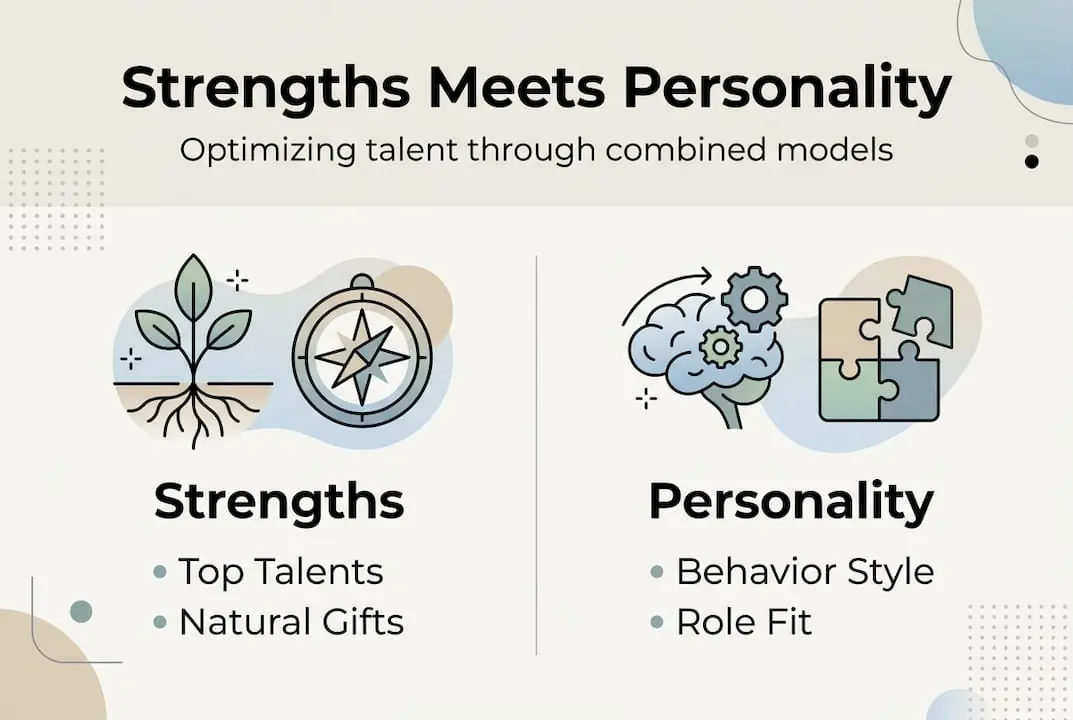
Combining strengths-based approaches with validated personality models creates comprehensive talent management systems. Strengths approaches excel for engagement and wellbeing but pair with Big Five or HEXACO for predictive hiring and retention decisions. Conscientiousness emerges as a key benchmark, with employees scoring high showing over 80% happiness and intent to stay. This integration addresses critiques of positive psychology by grounding motivation-focused tools in rigorous, multi-method assessment frameworks.
| Assessment Type | Primary Strength | Best Use Case | Predictive Validity |
|---|---|---|---|
| CliftonStrengths | Motivation and engagement | Development and role design | Moderate for performance |
| Big Five | Performance and retention prediction | Hiring and promotion decisions | High for job outcomes |
| HEXACO | Counterproductive behavior prediction | Risk assessment and culture fit | High for integrity issues |
| MBTI | Team communication preferences | Workshop facilitation only | Low for work outcomes |
Implementation process for integrated assessment:
- Screen candidates using Big Five or HEXACO to predict retention and performance potential
- Assess top candidates with strengths tools to identify natural talent patterns and engagement drivers
- Match role requirements to both personality traits and signature strengths for optimal fit
- Design development plans addressing growth areas while leveraging natural capabilities
- Monitor outcomes using multi-method feedback to validate assessment accuracy and adjust approaches
This combination delivers measurable business value through reduced turnover, optimized team dynamics, and better role fit. Organizations report faster onboarding when new hires enter positions matching both personality profiles and natural strengths. Team performance improves when members contribute from areas of genuine capability rather than forced skill development. Long-term retention increases as employees experience sustainable engagement from work aligned with their inherent patterns. Discover top talent assessment tools and learn how assessments in hiring improve quality for practical implementation guidance.
Explore innovative talent evaluation solutions
Modern HR leaders recognize that traditional assessment approaches miss critical insights into employee potential. Leveraging specialized SaaS platforms streamlines the integration of strengths analysis with validated personality models, creating comprehensive talent optimization systems. These tools automate data synthesis from multiple sources, reducing manual effort while improving accuracy.
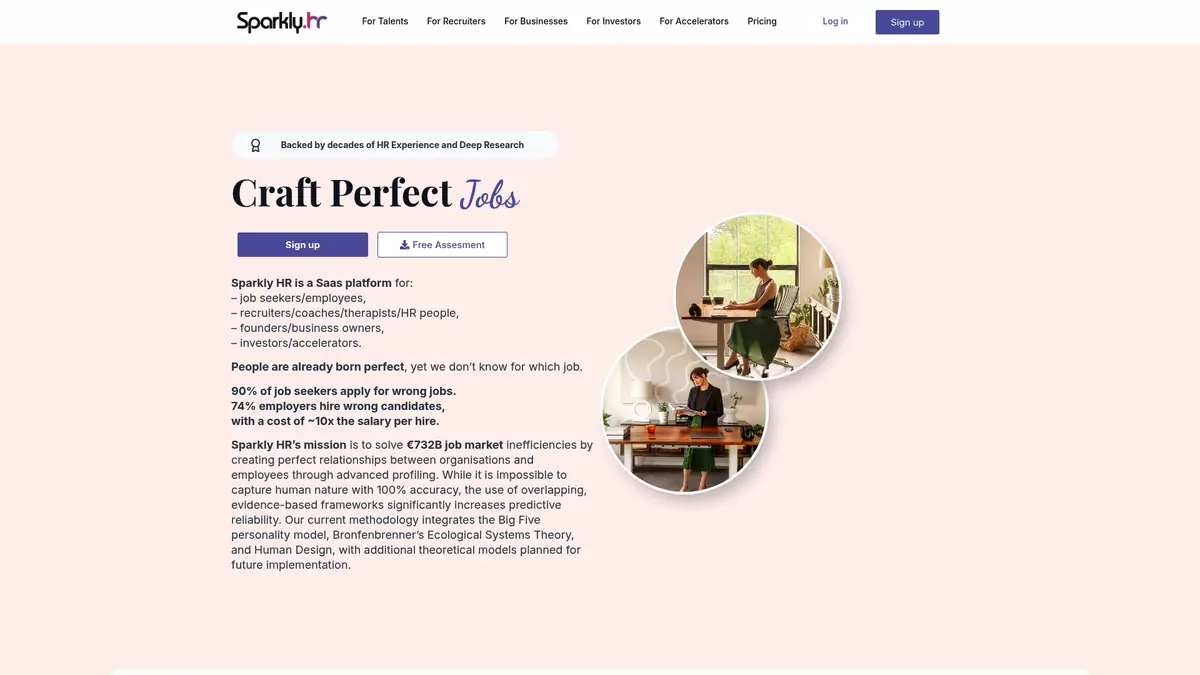
Sparkly HR leads this evolution by merging human judgment, AI analysis, psychometric assessments, and Human Design frameworks to extract higher probability insights. This multi-source approach addresses the reliability limitations of individual methods while maintaining practical usability for interview preparation and team design. Organizations using integrated platforms report faster hiring decisions, improved retention rates, and stronger alignment between employee capabilities and role requirements. Explore our SaaS in HR employee potential solutions, review top talent evaluation SaaS solutions, and discover employee personality assessment strategies to implement these advanced approaches in your organization.
Frequently asked questions
What is employee strengths analysis?
Employee strengths analysis identifies natural talents and capabilities through structured assessments like CliftonStrengths, focusing on what individuals naturally do best rather than correcting weaknesses. This approach improves engagement and role fit by aligning work responsibilities with inherent patterns of thinking, feeling, and behaving.
How does strengths-based assessment reduce employee turnover?
By enhancing intrinsic motivation and wellbeing through better role fit, strengths-based assessments create stronger job satisfaction that lowers turnover risk. Pairing strengths identification with predictive personality models amplifies retention benefits by ensuring both engagement and long-term performance capability.
What are common challenges with strengths analysis in diverse workplaces?
Overuse can backfire when strengths become liabilities without feedback mechanisms to monitor overdrive patterns. Cultural differences may impact assessment accuracy, requiring adaptation and local validation. Using 360 feedback helps overcome self-report limitations by providing objective perspectives on actual strengths application.
Why combine strengths analysis with models like Big Five or HEXACO?
Big Five and HEXACO offer stronger prediction of job performance and retention than strengths tools alone, with Conscientiousness proving especially valuable. Combining methods maximizes both employee engagement through strengths alignment and hiring accuracy through validated personality prediction, improving overall talent management effectiveness.