
Unlock employee potential: reduce turnover, build stronger teams

TL;DR:
- Focusing on employee potential improves retention and reduces turnover by 25 to 40 percent.
- Proper assessment separates high performance from high potential to build effective leadership pipelines.
- Using multiple frameworks and regular reassessment reduces bias and uncovers hidden talent.
Most mid-sized businesses are quietly losing their best people while promoting the wrong ones. It sounds harsh, but the data backs it up: HiPo programs show 91% retention for identified employees versus just 65% for their peers, and voluntary turnover drops 25 to 40% among top talent when potential is properly recognized. The real problem? Most HR teams still confuse high performance with high potential. These are not the same thing, and mixing them up costs you leadership pipelines, engagement, and retention. This article walks you through the frameworks, tools, and practical steps to shift your approach and build a team that actually grows with you.
Table of Contents
- Why focusing on employee potential beats just measuring performance
- Frameworks and tools for assessing employee potential
- Avoiding common pitfalls: Misidentification, over-inclusion, and bias
- Maximizing business impact: Best practices to unleash employee potential
- A smarter path: What most companies miss about employee potential
- Power up your strategy with innovative HR solutions
- Frequently asked questions
Key Takeaways
| Point | Details |
|---|---|
| Potential vs. performance | Focusing on potential identifies future leaders and reduces costly turnover. |
| Assessment frameworks | Use evidence-based tools like the 9-box grid for tailored employee growth. |
| Common pitfalls | Avoid program dilution by correctly identifying and continually reassessing high potentials. |
| Business impact | Transparent, personalized high-potential programs boost retention and engagement. |
Why focusing on employee potential beats just measuring performance
Performance tells you what someone has done. Potential tells you what they can do next. That distinction sounds simple, but it trips up even experienced HR teams. Research shows only 29% of top performers are truly high potential, meaning the majority of your star employees may not be the right people to promote into leadership roles.
This gap has real consequences. When you promote based on performance alone, you often lose a great individual contributor and gain a struggling manager. The team suffers, morale drops, and you are back to recruiting. High-potential identification, by contrast, builds leadership pipelines and reduces voluntary turnover by giving the right people growth opportunities that match their actual trajectory.
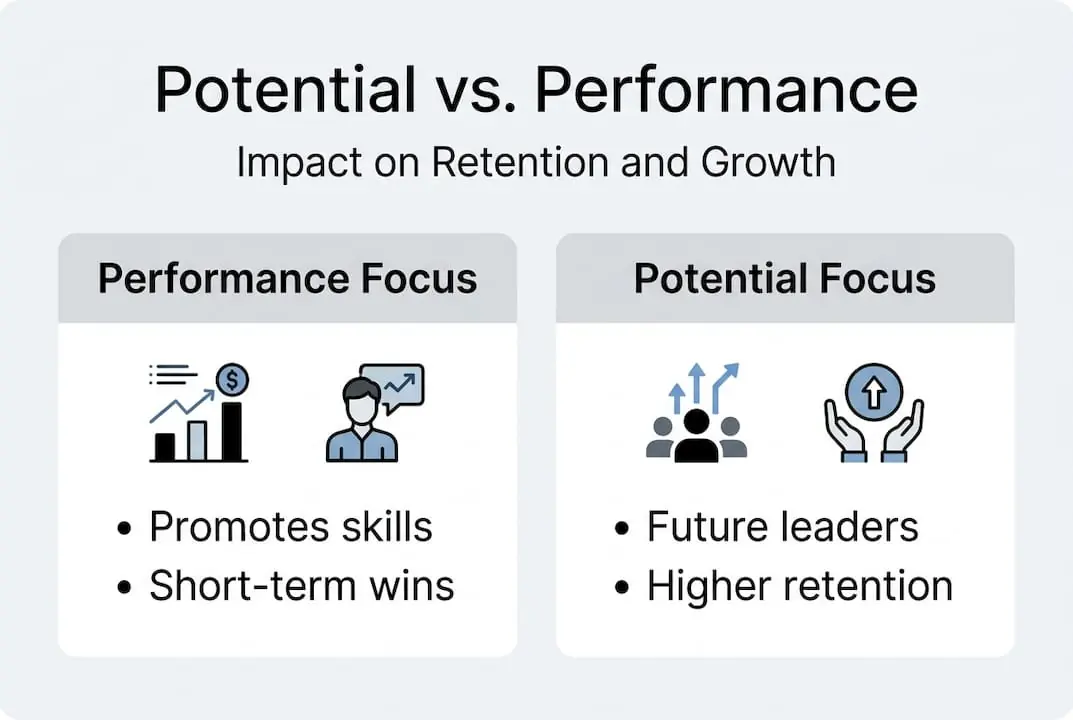
| Metric | HiPo-identified employees | General workforce |
|---|---|---|
| 1-year retention rate | 91% | 65% |
| Voluntary turnover reduction | 25 to 40% lower | Baseline |
| Promotion success rate | Significantly higher | Varies |
The numbers make a clear case. But the common pitfall is still promoting high performers into roles they are not wired for, simply because they are visible and productive. This creates resentment among peers who were overlooked and frustration in the promoted employee who now feels set up to fail.
Here is what works instead:
- Separate performance reviews from potential assessments entirely
- Use multiple data sources, not just manager ratings
- Identify aspiration, ability, and engagement as three distinct signals
- Keep your HiPo group tight, ideally 3 to 5% of your workforce
- Revisit the list quarterly, not annually
Pro Tip: Create separate development and compensation tracks for HiPos. When high performers see that growth investment is tied to potential signals rather than just output, you reduce resentment and keep both groups motivated. You can use an employee potential checklist to structure this separation cleanly.
If you want to go deeper on why this distinction matters for your talent strategy, talent optimization explained is a strong next read.
Now that we have highlighted the consequences of confusing performance with potential, let us break down the frameworks used by top HR teams.
Frameworks and tools for assessing employee potential
After understanding the why, the next question is how to actually assess potential in your teams. Three frameworks consistently show up in high-performing HR programs, and each has a different strength.
The 9-box grid maps employees on a matrix of current performance versus future potential. It is visual, easy to communicate to leadership, and helps you spot who needs development versus who is ready to move. The weakness is that it relies heavily on manager judgment, which introduces bias.

The three-dimensional framework evaluates aspiration (does this person want to grow?), ability (do they have the cognitive and emotional capacity?), and engagement (are they committed enough to follow through?). This model, along with personality assessments, adds depth that the 9-box grid alone cannot provide.
Personality assessments are where many HR teams find hidden HiPos. Skills can be learned. Personality traits like learning agility, resilience, and drive are far harder to develop and far more predictive of long-term success in new roles.
| Framework | Best for | Key limitation |
|---|---|---|
| 9-box grid | Quick visual overview | Manager bias risk |
| Three-dimensional model | Deep potential profiling | Time-intensive |
| Personality assessments | Reducing bias, surfacing hidden talent | Requires skilled interpretation |
Here is a practical sequence for rolling this out:
- Start with the 9-box grid to get a baseline view of your workforce
- Apply the three-dimensional framework to employees flagged as potential HiPos
- Layer in personality assessment data to challenge or confirm early findings
- Cross-reference results across HR, direct managers, and a neutral reviewer
- Finalize your HiPo list at no more than 3 to 5% of total headcount
Pro Tip: Personality data is especially powerful for surfacing employees who do not self-promote. Quiet, high-potential contributors often get missed in traditional reviews. Use your employee potential evaluation guide to build this into your standard process.
For a broader view of how these frameworks fit into workforce planning, talent mapping for HR walks through the full picture. And if you want a structured checklist to run personality assessments effectively, the personality assessment checklist is a practical starting point.
Avoiding common pitfalls: Misidentification, over-inclusion, and bias
With frameworks in hand, it is critical to avoid mistakes that reduce your program’s effectiveness. The most damaging one? Misidentifying who belongs in your HiPo group in the first place.
Misidentification leads to 46% failure in promotions when high performers are incorrectly labeled as high potentials. Nearly half. That is not a rounding error. That is a systemic problem that erodes trust in your HR function and wastes significant development investment.
The four most common HiPo program pitfalls are:
- Conflating performance with potential: Strong output in a current role does not predict success in a larger one
- Over-inclusion: Expanding the HiPo group beyond 3 to 5% dilutes the program and stretches resources thin
- Unconscious bias: Managers tend to nominate people who look and think like them, skewing the list toward certain demographics
- Static lists: Treating HiPo status as permanent ignores the reality that potential shifts with context, opportunity, and life circumstances
Bias is particularly tricky because it is invisible by design. Using multiple assessment methods, including personality data, helps counteract the influence of any single evaluator’s blind spots. When you triangulate across tools and reviewers, you get a more accurate picture.
“Potential is dynamic. Communicate transparently with employees about how HiPo criteria work and revisit your list regularly to avoid resentment and stagnation.”
Quarterly reassessment is not just a best practice. It is a signal to your employees that growth is an ongoing conversation, not a one-time judgment. Employees who know the criteria are open and revisited are more likely to invest in their own development.
For a deeper look at how to assess potential before someone even joins your team, the candidate potential assessment guide covers how to build this thinking into your hiring process as well.
Maximizing business impact: Best practices to unleash employee potential
Finally, let us put these lessons to work with practical steps your HR team can implement right now.
Transparency is your most underused tool. When employees understand how HiPo selection works, what the criteria are, and how they can develop toward those criteria, engagement goes up across the board. Not just among HiPos. Everyone benefits from clarity.
Here is a step-by-step approach to integrating potential assessment into your development pipeline:
- Define your HiPo criteria clearly and share them company-wide
- Run assessments using a combination of the frameworks described above
- Assign stretch assignments that challenge identified HiPos in new contexts
- Create personalized leadership pathways rather than generic development plans
- Measure program success quarterly using retention rates, promotion outcomes, and engagement scores
- Adjust the HiPo list based on new data, not just annual reviews
Personalization matters more than most companies realize. A one-size-fits-all development program signals that you have not actually paid attention to what makes each person tick. HiPos, in particular, notice this quickly and disengage. Tailor stretch assignments to each person’s aspiration and ability profile.
Limit your HiPo pool, reassess quarterly, and tailor development to sustain motivation and keep performance climbing. These three actions, done consistently, produce better outcomes than any single program or tool.
Pro Tip: Differentiate your compensation and development investment for HiPos. This does not mean ignoring everyone else. It means being intentional about where your highest-leverage investment goes. Use talent development steps to build a structured roadmap that connects assessment data to real career moves. 📈
A smarter path: What most companies miss about employee potential
Here is the part most HR playbooks skip over. Potential is not a fixed trait. It is contextual. An employee who looks average in a rigid, under-resourced role might be extraordinary in a different team structure or with a different manager. That means your assessment is always partly a reflection of the environment, not just the person.
Static HiPo lists are one of the most common ways well-intentioned programs backfire. When employees find out they are not on the list and see no path to change that, frustration builds fast. The program meant to retain your best people ends up alienating a large portion of your workforce.
The smarter move is to make HiPo criteria transparent and treat learning agility as a core organizational value, not just a checkbox on an assessment form. When everyone understands what growth looks like and sees evidence that the criteria are applied fairly, you build a culture where potential development is everyone’s business. 💡
At Sparkly, we see this play out consistently. Personality-first assessment reveals patterns that performance data alone never surfaces. And when those patterns are shared with employees in a clear, constructive way, people rise to meet them. Explore talent optimization insights to see how this thinking applies across your full workforce strategy.
Power up your strategy with innovative HR solutions
If you are ready to put these strategies to work and need the right tools, here is how Sparkly can help. Sparkly’s assessment platform combines personality data, AI, psychometric insights, and Human Design signals to give your HR team a far more accurate picture of employee potential than any single method can provide. ⚡️
Whether you are building your first HiPo program or refining an existing one, Sparkly’s resources make the process faster and more reliable. Explore SaaS in HR transformation to see how technology is changing the game, browse talent optimization tools for practical workflows, or review talent allocation methods to match the right people to the right roles with confidence.
Frequently asked questions
What is the difference between high performers and high potentials?
High performers excel in their current roles, while high potentials show the aspiration, ability, and engagement to succeed in broader, future leadership positions. Only 29% of top performers qualify as high potential.
How does focusing on employee potential reduce turnover?
When you identify and invest in high-potential employees, retention reaches 91% at the one-year mark, compared to 65% for employees who are not part of a structured HiPo program.
What assessment tools are best for identifying employee potential?
The most effective approach combines the 9-box grid, the three-dimensional framework, and personality assessments to reduce bias and surface talent that traditional reviews miss.
How often should employee potential be reassessed?
Quarterly reassessment is the best practice because potential fluctuates with changing roles, team dynamics, and personal circumstances, making annual reviews too infrequent to stay accurate.
Recommended
- Employee Potential Evaluation for HR: Maximize Team Impact
- Employee potential checklist 2026: Cut turnover 60%
- Why shift team members: Boost retention with personality fit in 2026
- Future of Job Roles: Unlocking Personality Potential
- Employee Retention Solutions, Lower Turnover | OpenElevator
- Employee-Engagement-for-HR | Artificial Intelligence