
Unlock employee potential: A guide for HR professionals

Most HR leaders believe they can spot high-potential employees just by reviewing performance metrics and resume credentials. This common misconception causes organizations to overlook hidden talent, leading to costly turnover and missed growth opportunities. Employee potential extends far beyond current job performance or listed qualifications. It encompasses motivation, adaptability, cultural fit, and untapped capabilities that traditional evaluation methods often miss. This guide provides HR professionals and business leaders with practical frameworks to identify, assess, and unleash employee potential through strategic job redesign and data-driven assessment tools that reduce turnover while optimizing team performance.
Table of Contents
- Key takeaways
- Understanding employee potential: definitions and dimensions
- How to assess employee potential effectively
- The role of job redesign in unlocking employee potential
- Using data and technology to enhance employee potential management
- Explore our tools to unlock your team’s potential
- Frequently asked questions
Key Takeaways
| Point | Details |
|---|---|
| Potential dimensions | Employee potential includes motivation, adaptability, cultural fit, and untapped capabilities beyond current performance. |
| Three assessment pillars | Assessments should cover technical skills, motivation, and cultural fit with practical tasks behavioral interviews and personality assessments. |
| Role alignment impact | Matching individual strengths to job requirements improves retention and long term performance. |
| Data driven design | Structured frameworks and data driven tools enable objective talent optimization and growth. |
Understanding employee potential: definitions and dimensions
Employee potential represents an individual’s capacity for future growth, contribution, and adaptation within an organization. Unlike performance, which measures current output, potential evaluates what someone could achieve given the right environment, resources, and role alignment. Many HR teams conflate these concepts, promoting top performers into leadership positions only to discover they lack the adaptability or interpersonal skills needed for success.
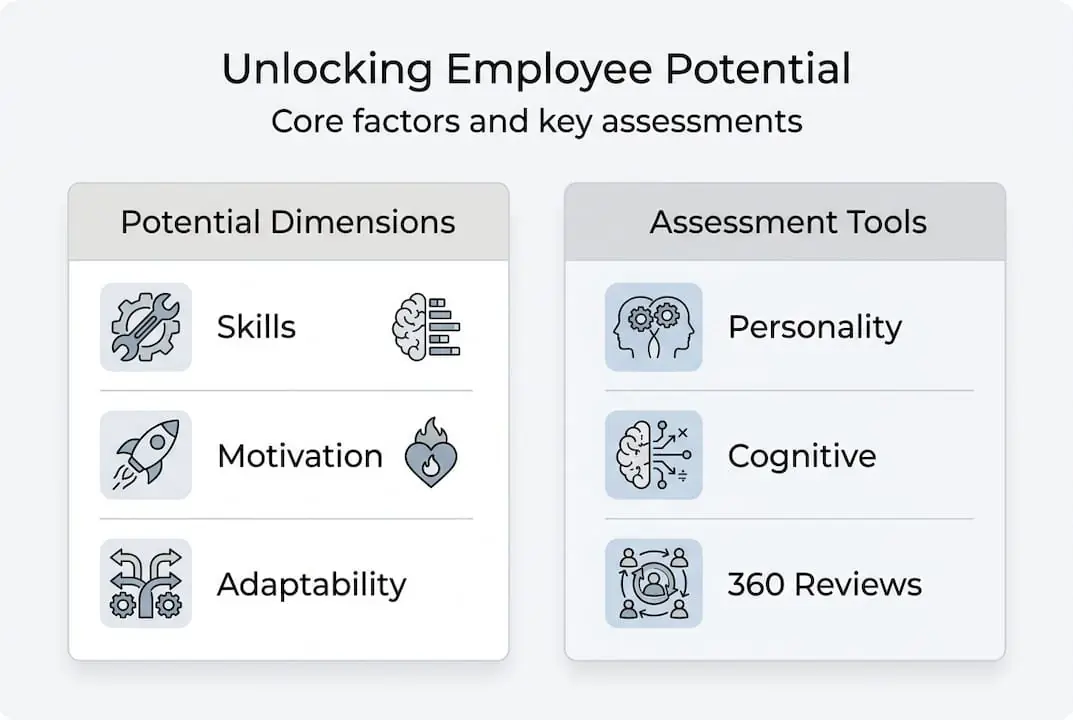
Three core dimensions define employee potential in practical HR contexts. Technical skills form the foundation, representing both current capabilities and learning agility. An employee who quickly masters new software systems demonstrates higher potential than one who resists technological change, regardless of their current proficiency level. Motivation and drive constitute the second dimension, encompassing intrinsic interest, career ambition, and resilience when facing challenges. Cultural and role fit complete the framework, measuring how well an individual’s values, work style, and personality align with organizational needs and team dynamics.
Consider two employees with identical sales numbers. The first achieves targets through established client relationships and proven scripts, showing little interest in new markets or methods. The second experiments with innovative outreach strategies, mentors junior team members, and actively seeks feedback to improve. Both perform well today, but only the second demonstrates high potential for growth into leadership or strategic roles.
Understanding these dimensions prevents costly hiring mistakes and internal mismatches. When organizations evaluate candidates or employees using only one dimension, they miss critical insights. A technically brilliant engineer with poor cultural fit will likely leave within 18 months, wasting recruitment and training investments. A moderately skilled employee with exceptional learning agility and strong team alignment often delivers greater long-term value.
Effective employee potential evaluation requires assessing all three dimensions systematically:
- Technical skills and learning agility through practical assessments and skill gap analysis
- Motivation through behavioral interviews and career aspiration discussions
- Cultural fit using personality assessments and team compatibility evaluations
- Role alignment by matching individual strengths with position requirements
- Growth trajectory by analyzing past learning curves and adaptability patterns
This comprehensive approach transforms how HR teams identify talent, moving beyond surface-level credentials to uncover genuine capability for future contribution.
How to assess employee potential effectively
Systematic assessment of employee potential requires structured frameworks that evaluate multiple dimensions objectively. Start by defining the specific potential indicators relevant to your organization’s needs. A tech startup values innovation and rapid learning differently than a healthcare provider prioritizing reliability and compliance. Clear criteria prevent subjective bias and ensure consistent evaluation across candidates and employees.
Follow this step-by-step process for comprehensive potential assessment:
- Conduct structured behavioral interviews focusing on past learning experiences, adaptation to change, and problem-solving approaches rather than just accomplishments
- Implement assessment tools for recruitment agencies that measure cognitive ability, personality traits, and situational judgment
- Use work sample tests or simulations that reveal how individuals approach unfamiliar challenges
- Gather multi-source feedback from peers, managers, and direct reports to understand interpersonal effectiveness and influence
- Analyze career trajectory patterns, noting speed of skill acquisition and scope expansion over time
- Apply personality-focused assessment strategies to evaluate fit and motivational drivers
Different assessment types serve distinct purposes in evaluating potential. Cognitive ability tests predict learning speed and complex problem-solving capacity. Personality inventories reveal work style preferences, stress tolerance, and interpersonal tendencies. Situational judgment tests measure decision-making quality in realistic scenarios. Skills assessments establish current capability baselines, while structured interviews uncover motivation and self-awareness.
Pro Tip: Combine at least three assessment types to triangulate insights and reduce the risk of false positives. A candidate who scores high on cognitive tests but low on conscientiousness may struggle with follow-through despite strong analytical abilities.
| Assessment Type | Primary Use | Potential Insights Gained |
|---|---|---|
| Cognitive ability tests | Screening for learning capacity | Processing speed, abstract reasoning, problem-solving potential |
| Personality assessments | Cultural and role fit evaluation | Work style, stress response, collaboration tendencies, motivational drivers |
| Situational judgment tests | Decision-making quality | Practical judgment, values alignment, leadership potential |
| Structured behavioral interviews | Motivation and self-awareness | Career ambitions, learning orientation, adaptability evidence |
| Work samples and simulations | Applied skill demonstration | Real-world performance under novel conditions |
The most critical mistake HR teams make is overrelying on resumes and unstructured interviews. Resumes showcase past achievements but reveal little about future capacity. Unstructured interviews amplify interviewer biases, with decisions often made in the first few minutes based on superficial rapport rather than genuine potential indicators. Data consistently shows that structured assessments outperform gut instinct by significant margins.
Another common pitfall involves assessing potential using the same criteria as performance evaluation. High performers excel at their current roles, but potential assessment must evaluate capacity for different or expanded responsibilities. The best individual contributor rarely becomes the best manager without specific leadership potential indicators like influence skills, strategic thinking, and people development interest.
The role of job redesign in unlocking employee potential
Job redesign strategically restructures roles to better align responsibilities with employee strengths, interests, and growth trajectories. Rather than forcing individuals to adapt to rigid job descriptions, progressive organizations shape positions around the unique potential their people bring. This approach increases engagement, accelerates skill development, and significantly reduces turnover by creating roles where employees naturally excel.
Effective employee fit assessment guides job redesign decisions by identifying gaps between current role demands and individual capabilities. When assessment reveals an employee’s untapped analytical skills, for example, redesigning their role to include more data-driven projects unleashes potential while filling an organizational need. The employee gains meaningful development opportunities, and the company benefits from applied talent that would otherwise remain dormant.
Several job redesign strategies unlock employee potential across different contexts:
- Task variation introduces new responsibilities that stretch capabilities without overwhelming current capacity, allowing gradual skill building
- Role enlargement expands job scope horizontally by adding related tasks at similar complexity levels, preventing boredom and stagnation
- Job enrichment adds vertical responsibilities like decision-making authority or mentorship duties, developing leadership potential
- Flexible work arrangements accommodate individual productivity patterns and life circumstances, improving focus and reducing stress
- Cross-functional projects expose employees to different business areas, building versatility and organizational understanding
- Skill-based task allocation assigns work based on individual strengths rather than rigid job boundaries
The benefits extend beyond individual satisfaction. Organizations implementing strategic job redesign report 30% higher productivity, 25% lower turnover, and measurably improved employee net promoter scores. When people work in roles designed around their potential rather than generic job templates, they invest discretionary effort and stay longer.

Implementation challenges often center on manager resistance and operational complexity. Managers accustomed to standardized roles worry about fairness and administrative burden. Address this by starting small with pilot teams, documenting positive outcomes, and providing managers with clear frameworks for making redesign decisions. Technology platforms can automate task allocation and track role modifications, reducing administrative overhead.
Pro Tip: Involve employees directly in redesign conversations. They possess unique insights into which aspects of their roles energize versus drain them, and participation increases buy-in. Schedule quarterly role review discussions where employees and managers collaboratively adjust responsibilities based on evolving skills and interests.
Common obstacles include concerns about equity when roles become more individualized. Establish clear principles ensuring that redesign serves both business needs and employee development, not just personal preferences. Document the strategic rationale for each modification, linking it to assessed potential and organizational priorities. Transparency about the criteria and process maintains trust across teams.
Using data and technology to enhance employee potential management
Modern HR analytics and SaaS platforms transform employee potential management from subjective guesswork into data-driven strategic practice. These tools aggregate assessment results, performance data, and behavioral signals to generate predictive insights about growth trajectories, retention risks, and optimal role placements. Real-time dashboards enable HR leaders to identify high-potential employees early, track development progress, and intervene before valuable talent becomes disengaged.
SaaS in HR employee potential management provides several critical capabilities. Centralized assessment administration ensures consistent evaluation across the organization, eliminating the variability inherent in manual processes. Automated scoring and benchmarking compare individual results against role requirements and peer groups, highlighting both strengths and development areas. Longitudinal tracking monitors how potential indicators evolve over time, revealing whether development initiatives actually work.
Predictive analytics represent the most powerful application of HR technology for potential management. By analyzing patterns across thousands of employees, machine learning models identify early warning signs of disengagement or flight risk among high-potential individuals. This allows proactive intervention through targeted development opportunities, role adjustments, or retention conversations before the employee starts interviewing elsewhere.
| Platform Category | Key Features | Best For |
|---|---|---|
| Integrated talent suites | End-to-end assessment, development planning, succession management | Large enterprises needing comprehensive solutions |
| Specialized assessment platforms | Deep personality and cognitive testing with advanced analytics | Organizations prioritizing assessment accuracy and insights |
| Performance management systems | Continuous feedback, goal tracking, competency evaluation | Companies focusing on ongoing development and alignment |
| People analytics tools | Predictive modeling, retention risk scoring, workforce planning | Data-driven HR teams seeking strategic insights |
| Learning management systems | Skill gap analysis, personalized development paths, progress tracking | Organizations emphasizing continuous learning culture |
Implementing technology for potential management requires thoughtful planning. Start with these practical steps:
- Define clear objectives for what insights you need and how they’ll drive decisions
- Ensure data quality by cleaning existing employee records and establishing ongoing data governance
- Integrate new tools with existing HR systems to avoid creating data silos
- Train HR team members and managers on interpreting analytics and applying insights
- Establish privacy protocols and communicate transparently about how employee data is used
- Start with pilot programs to validate ROI before full organizational rollout
HR analytics explained shows how predictive insights transform strategic workforce planning. Instead of reacting to turnover after it happens, analytics identify which high-potential employees face elevated flight risk based on engagement scores, manager relationship quality, and market opportunity signals. HR can then deploy targeted retention strategies, whether through development opportunities, compensation adjustments, or role redesign.
Data insights also reveal systemic patterns that individual assessments miss. Analytics might show that employees hired through employee referrals demonstrate 40% higher potential scores than those from traditional recruiting channels, suggesting a strategic shift in sourcing strategy. Or data could expose that high-potential employees in certain departments receive fewer development opportunities than peers elsewhere, highlighting an equity issue requiring intervention.
The key is moving from descriptive analytics that report what happened to predictive and prescriptive analytics that forecast what will happen and recommend actions. This progression requires both technology investment and analytical capability building within HR teams.
Explore our tools to unlock your team’s potential
Transforming how your organization identifies and develops employee potential requires more than good intentions. It demands specialized tools that integrate multiple assessment dimensions, generate actionable insights, and support ongoing talent optimization. Sparkly.hr offers HR professionals a comprehensive SaaS platform specifically designed to evaluate personality, fit, and potential beyond traditional skill-based assessments.
Our approach recognizes that skills can be learned, but personality, motivation, and cultural alignment drive long-term success and retention. By merging insights from human judgment, AI analysis, psychometric assessments, and Human Design, Sparkly.hr extracts higher-probability data that empowers HR teams to make confident hiring and development decisions.
Explore how SaaS in HR employee potential management transforms talent strategy, or review our curated list of top talent evaluation SaaS solutions for 2026. For comprehensive guidance on reducing turnover through better fit assessment, visit our employee fit assessment guide 2026.
Frequently asked questions
What is the difference between employee potential and performance?
Employee potential measures capacity for future growth, learning, and contribution in expanded or different roles, while performance evaluates current effectiveness in existing responsibilities. An employee might perform adequately today but possess limited potential for advancement due to fixed mindset or narrow skill interests. Conversely, a newer employee with moderate current performance might demonstrate exceptional potential through rapid learning, adaptability, and strategic thinking. Understanding this distinction prevents the common mistake of promoting top performers into roles requiring different capabilities. Use the employee potential checklist 2026 to systematically evaluate growth capacity beyond current output.
How can personality assessments improve employee potential evaluation?
Personality assessments reveal work style preferences, stress responses, collaboration tendencies, and intrinsic motivations that predict long-term fit and engagement better than skills testing alone. These insights help HR teams understand whether an employee will thrive in your specific culture and role context, reducing costly mismatches. For example, an introverted analytical thinker might possess enormous potential in research roles but struggle in client-facing positions requiring constant social interaction. Personality-focused employee assessments identify these nuances early, enabling smarter placement decisions and targeted development that aligns with natural tendencies rather than fighting against them.
What role does job redesign play in reducing employee turnover?
Job redesign reduces turnover by aligning role responsibilities with individual strengths, interests, and growth aspirations, creating positions where employees naturally excel and find meaning. When people work in roles designed around their assessed potential rather than generic job templates, they experience greater satisfaction, invest more discretionary effort, and stay longer. Strategic redesign also prevents the stagnation that drives high performers to seek external opportunities. By continuously evolving roles to match developing capabilities, organizations retain talent by providing growth without requiring job changes. Learn practical approaches in our job redesign and turnover reduction guide.
Which technology solutions best support employee potential management?
The most effective solutions integrate personality assessments, cognitive evaluations, and behavioral analytics into unified platforms that generate predictive insights about growth trajectories and retention risks. HR SaaS for employee potential management should provide real-time dashboards, automated assessment administration, and benchmarking capabilities that compare individuals against role requirements and peer groups. Look for platforms offering longitudinal tracking to monitor how potential indicators evolve over time, revealing whether development initiatives deliver results. Review our analysis of top talent evaluation SaaS 2026 solutions to identify tools matching your organization’s specific needs and technical environment.