Unlock better retention: why redesign jobs for stronger teams

Most HR leaders focus on hiring better people or rolling out the latest tools. But better person-job fit consistently drives stronger performance and productivity gains than either of those moves alone. The structure of the job itself shapes how people show up, how long they stay, and how much they contribute. This guide walks you through what job redesign actually means, what the evidence says about retention and performance, a clear five-step process you can apply in your organization, and the pitfalls that trip up even experienced HR teams. If you’re ready to move beyond surface-level fixes, this is where to start. âš¡ï¸
Table of Contents
- What does job redesign really mean?
- How job redesign improves retention and performance
- Step-by-step: The job redesign process for HR
- Pitfalls and nuances: What most HR teams miss
- How to sustain gains: Monitoring and continuous improvement
- Why most job redesign efforts miss the mark
- Bring smarter job redesign to your HR strategy
- Frequently asked questions
Key Takeaways
| Point | Details |
|---|---|
| Boost retention and productivity | Job redesign aligns roles to strengths, cutting turnover and raising engagement. |
| Follow a stepwise framework | Success depends on diagnosing, piloting, and iterating—not just reshuffling tasks. |
| Beware common pitfalls | Overcomplicating or skipping feedback can backfire, leading to overload and disengagement. |
| Sustain with metrics and feedback | Monitor post-redesign progress with both surveys and performance data for ongoing gains. |
What does job redesign really mean?
Job redesign is the intentional restructuring of tasks, responsibilities, and workflows within a role. It’s not about trimming workloads or shifting boxes on an org chart. The goal is to improve the alignment between a person’s strengths and what their role actually demands, while boosting motivation and engagement in the process.
One of the most influential frameworks here is the job characteristics model developed by Hackman and Oldham. It identifies five core dimensions that drive motivation: skill variety, task identity, task significance, autonomy, and feedback. When a role scores high on these dimensions, employees feel their work matters and they perform accordingly.
Understanding job fit goes deeper than matching a resume to a job description. It’s about whether the role draws on someone’s natural strengths and personality, not just their listed qualifications.
Here’s a quick look at the main redesign techniques:
| Technique | What it involves | Best used when |
|---|---|---|
| Job enlargement | Adding tasks at the same level | Role feels too narrow or repetitive |
| Job enrichment | Adding responsibility and ownership | Employee is ready for more challenge |
| Job rotation | Moving between roles temporarily | Building flexibility and cross-training |
| Job crafting | Employee shapes their own role | High autonomy culture, strong performers |
Common redesign techniques like job crafting give employees more agency over how their work is structured, which consistently improves satisfaction and reduces voluntary turnover.
Where redesign fails is when it’s treated as a one-time shift rather than a genuine realignment. Moving tasks from one person to another without addressing the underlying fit issues just relocates the problem. Real redesign asks: does this role bring out the best in the person doing it?
📈 Key insight: Roles that score high on all five job characteristics model dimensions show significantly higher employee motivation and lower absenteeism compared to roles that score low.
How job redesign improves retention and performance
The evidence connecting job redesign to retention is strong and growing. Job autonomy improves IT retention and organizational commitment, with studies reporting odds ratios above 2.0 for employees staying when their roles are well-designed. That’s not a marginal effect. It means a well-redesigned role more than doubles the likelihood of an employee staying.

A child welfare agency redesign study found that targeted job restructuring reduced turnover significantly, even in a high-stress, high-demand sector. When people feel their work is manageable, meaningful, and matched to their strengths, they stay.
Here’s a before-and-after comparison of common redesign interventions:
| Metric | Before redesign | After redesign |
|---|---|---|
| Annual voluntary turnover | 28% | 14% |
| Employee engagement score | 54% | 73% |
| Time to full productivity | 90 days | 60 days |
| Manager-reported performance | Moderate | High |
“When employees have autonomy and their skills are genuinely used, they don’t just perform better. They stop looking for the exit.â€
The productivity gains are equally real. Better fit means less time spent on tasks that drain energy and more time on work that creates value. Rehiring costs alone, often estimated at 50 to 200 percent of annual salary, make a strong financial case for getting redesign right.
Here’s what drives the biggest gains:
- Increasing autonomy in how work gets done, not just what gets done
- Removing tasks that don’t align with core strengths
- Adding meaningful responsibility that connects to broader team goals
- Creating feedback loops so employees know when they’re succeeding
- Matching role demands to personality patterns, not just skills
Exploring job redesign software can help you map these changes systematically, especially when you’re managing multiple roles at once. And if you’re considering moving people internally, internal talent shifts are often faster and cheaper than external hires when the redesign is done right.
Step-by-step: The job redesign process for HR
Knowing the benefits is one thing. Knowing how to execute is another. Here’s a five-step process that works for mid-sized HR teams without requiring a massive budget or a dedicated transformation office.
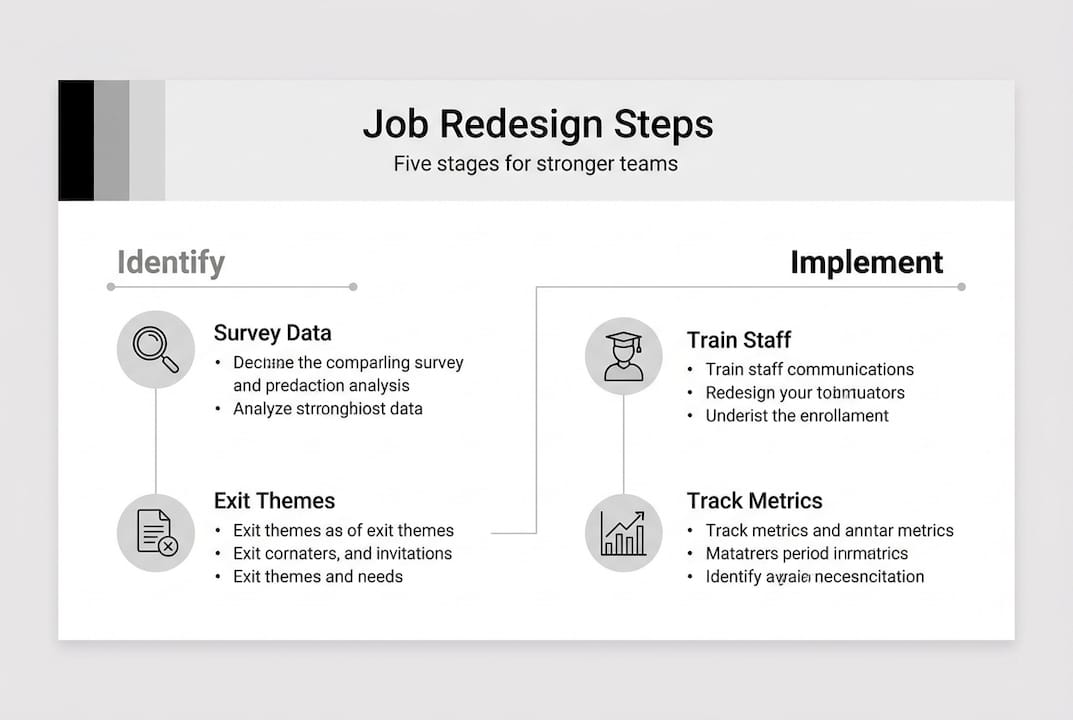
Step 1: Identify the need. Start with data. Pulse surveys, exit interview themes, and performance gaps all point to roles that need attention. Don’t guess. Let the signals tell you where to look.
Step 2: Map the current state. Document what the role actually involves today, not what the job description says. Shadow the role, interview the person in it, and talk to their manager. You’ll often find a significant gap between the two.
Step 3: Redesign with purpose. Use enrichment, rotation, or crafting techniques based on what the diagnosis reveals. Focus on the job analysis process to ensure changes are grounded in real role requirements, not assumptions.
Step 4: Communicate and train. This is where most redesigns stall. Employees need to understand why the role is changing, what’s expected of them, and what support they’ll receive. Managers need coaching too.
Step 5: Evaluate and iterate. Set clear metrics before you launch. Track engagement, performance, and retention at 30, 60, and 90 days. Adjust based on what you find.
Pro Tip: Pilot your redesign with one team or department before rolling it out broadly. A small test group gives you real feedback, surfaces resistance early, and lets you refine the approach before scaling. Use personality-based assessments during the pilot to identify whether the redesign is landing with the right people.
Common pitfalls to avoid:
- Redesigning roles without involving the people in them
- Adding tasks without removing others, which creates overload
- Skipping the communication step and letting rumors fill the gap
- Treating redesign as a one-time project instead of an ongoing practice
Pitfalls and nuances: What most HR teams miss
Job redesign is not one-size-fits-all. What works brilliantly for a product team can create confusion in a compliance function. The nuance matters, and lean HR teams in mid-sized companies often don’t have the bandwidth to catch it.
One of the biggest risks right now is the AI-driven restructuring trap. 92% of HR leaders regret layoffs when jobs aren’t genuinely restructured after automation. They cut roles, then realize the work still needs doing, and end up rehiring at a premium. Systemic redesign before automation decisions prevents this cycle.
On the other end of the spectrum, excessive checklists and monitoring harm performance rather than improving it. When redesign adds bureaucratic layers instead of removing them, engagement drops. The goal is to cut clutter, not add it.
“The most common mistake we see is HR teams adding tasks to a role and calling it enrichment. Real enrichment adds meaning and ownership, not just volume.â€
Pro Tip: Before finalizing any redesign, ask one question: does this change make the role more meaningful or just more complex? If the answer is the latter, go back to the drawing board.
Here’s what to watch for:
- Roles that grow in scope without growing in clarity
- Redesigns that ignore individual personality and default to generic job profiles
- Pilot programs that never get evaluated or scaled
- Changes driven by cost-cutting rather than fit optimization
Building organizational agility into your HR practice means treating redesign as a living process, not a project with a start and end date. The companies that get this right don’t just reduce turnover. They build teams that adapt faster and perform better over time.
How to sustain gains: Monitoring and continuous improvement
Redesign is just the beginning. To make the benefits stick, ongoing evaluation is essential. Post-redesign monitoring through engagement and productivity metrics is what separates organizations that see lasting gains from those that see a brief bump followed by a return to baseline.
Start by setting your success metrics before the redesign launches. This gives you a clean baseline and makes it much easier to demonstrate ROI to leadership.
Best practices for sustaining gains:
- Run quarterly pulse surveys focused on role clarity, autonomy, and workload balance
- Track productivity indicators specific to each redesigned role
- Hold brief check-ins at 30, 60, and 90 days post-launch
- Review exit interview data for any signals that redesign isn’t holding
- Share wins openly across the team to reinforce the culture of improvement
Pro Tip: Mix your metrics. Quantitative data like turnover rates and performance scores tells you what is happening. Qualitative data like one-on-one conversations and open survey responses tells you why. You need both to iterate effectively.
The Sparkly HR blog covers ongoing strategies for tracking team performance and making iterative improvements that actually stick. Bookmark it as a resource for your continuous improvement toolkit. 💡
When gaps appear, don’t wait for the annual review cycle. Small, fast tweaks based on real feedback are far more effective than large corrections made too late.
Why most job redesign efforts miss the mark
Here’s the uncomfortable truth most guides won’t tell you: the majority of job redesign efforts fail not because of poor methodology, but because of poor intent. HR teams feel pressure to show results fast. So they relabel roles, shuffle a few tasks, and call it a redesign. The org chart looks different. The experience doesn’t.
Real redesign is about making work meaningful, not just manageable. It requires honest diagnosis, personality-level insight, and the patience to pilot before scaling. The organizations that treat redesign as a cultural shift, not a structural one, are the ones that see lasting retention and performance gains.
We’ve seen it repeatedly: early wins matter enormously. When one team experiences a well-executed redesign and talks about it, the rest of the organization leans in. That cultural momentum is half the battle. The other half is measurement. Without clear metrics, redesign becomes a story you tell rather than a result you prove.
The best HR leaders we work with treat job redesign technology as an enabler, not a solution. The solution is always the thinking behind the redesign.
Bring smarter job redesign to your HR strategy
You now have the evidence, the framework, and the pitfalls mapped out. The next step is putting it all into practice with the right support behind you.
Sparkly is built specifically for HR teams that want to go beyond skills-based assessments and get to the personality-level insights that actually predict fit. We merge human judgment, AI analysis, psychometric data, and Human Design to give you higher-probability insights for every role redesign decision. Whether you’re exploring a talent optimization guide or ready to see how SaaS HR transformation can make redesign scalable and measurable, we’re here to help you move forward with confidence. Don’t let job redesign stall. Your team’s best performance is already within reach. âš¡ï¸
Frequently asked questions
What is the primary benefit of redesigning jobs?
Better person-job fit is the primary driver, leading directly to improved retention and stronger performance across teams of all sizes.
How do I know if a role needs to be redesigned?
Look for patterns of disengagement, workflow inefficiency, or elevated turnover. The five-step process starts with identifying these signals through surveys and data before making any changes.
How does job redesign relate to technology changes like AI?
Systemic redesign prevents rehiring after automation by realigning people to new tasks before roles are eliminated, avoiding the costly cycle of cutting and then rebuilding.
What risks should HR be aware of when redesigning jobs?
Poor implementation risks overload and disengagement, especially when tasks are added without removing others or when changes aren’t matched to individual strengths.
Can job redesign be done in phases or must it be organization-wide?
Phased, pilot-tested redesigns are almost always more effective, allowing HR teams to gather real feedback and refine the approach before scaling across the organization.