Trends in Employee Assessment 2026: HR’s New Playbook

TL;DR:
- AI-powered continuous performance intelligence is replacing annual reviews as the primary employee evaluation method in 2026. Organizations adopting real-time feedback and capability-based assessments improve retention and fairness, with tools ranging from $4 to over $20 per employee monthly. Successful implementation depends on HR upskilling, ongoing refinement, and balancing human judgment with AI insights.
The trends in employee assessment 2026 are defined by one clear shift: AI-powered continuous performance intelligence is replacing the annual review as the primary evaluation model. 94% of organizations now use talent assessments, with over 50% involving AI directly in the process. Tools like Happily.ai, Lattice, and 15Five are setting the pace, while pricing ranges from $4 to over $20 per employee per month depending on capability depth. For HR professionals and business leaders, understanding these shifts is no longer optional. The organizations that adapt their evaluation frameworks now will build more accurate, fair, and retention-focused workplaces in 2026 and beyond.
What are the key trends in employee assessment 2026?
AI integration is the single biggest force reshaping how organizations evaluate people. 91% of managers now use AI for performance assessments, a number that would have seemed extreme just three years ago. That figure signals a structural change, not a passing experiment.

The shift goes deeper than automation. AI now supports real-time data analysis, flags performance patterns before they become problems, and generates draft feedback that managers then refine and personalize. This changes the manager’s role from data collector to data interpreter. Human judgment remains central, but it operates on better information.
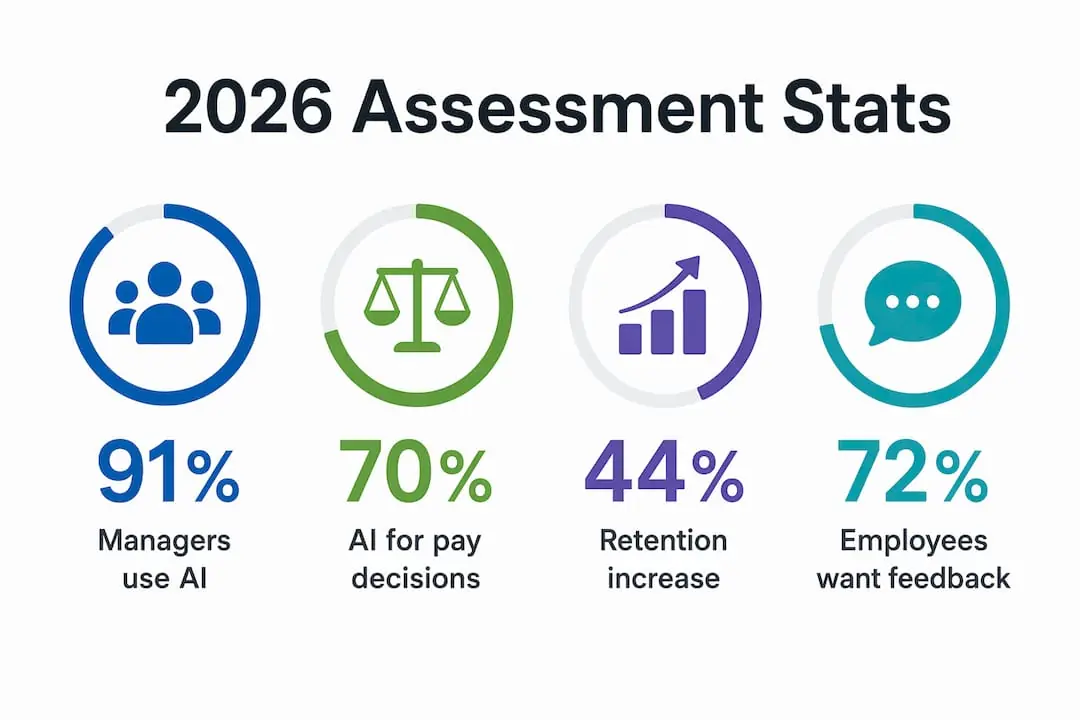
Ethical considerations are rising alongside adoption. 70% of managers use AI to help decide pay raises, promotions, layoffs, and terminations, and they report confidence in the fairness of those decisions. That confidence is meaningful, but it also raises the stakes for transparency. Employees want to know how AI influences decisions that affect their careers.
Transparency is becoming a competitive advantage in talent retention. 67% of employees favor AI in pay decisions when it guarantees competitive, market-based compensation. That finding flips the common assumption that workers distrust algorithmic management. When AI is explained clearly and tied to fair outcomes, employees accept it and often prefer it.
Key capabilities AI now brings to employee evaluation include:
- Real-time performance pattern detection across project cycles and team interactions
- Bias reduction in compensation and promotion decisions through standardized data inputs
- Draft feedback generation that managers personalize before delivery
- Predictive analytics identifying flight risk, burnout signals, and leadership potential
Pro Tip: Before deploying any AI assessment tool, document your decision logic. Employees who understand how AI influences their reviews are significantly more likely to trust the process and engage with feedback constructively.
Why are continuous feedback models replacing annual reviews?
Continuous feedback practices correlate with 44% higher employee retention compared to annual reviews. That single data point explains why HR leaders are accelerating the transition. Retention is expensive to recover once lost, and annual reviews are too slow to catch the signals that precede resignation.
The employee expectation side is equally clear. 72% of employees now expect real-time feedback on their performance. This generation of workers grew up with instant information loops. Waiting twelve months for a performance conversation feels disconnected from how work actually happens.
Continuous performance intelligence replaces episodic evaluation with real-time analysis that highlights skills trends, leadership potential, workload balance, and goal achievements. The practical result is that managers can intervene early, redirect effort, and recognize wins while they are still relevant.
Here is how leading organizations are structuring continuous evaluation in 2026:
- Quarterly structured reviews replace the single annual conversation, giving employees four meaningful checkpoints per year
- 360-degree feedback cycles run on a rolling basis, pulling input from peers, direct reports, and cross-functional collaborators
- Ongoing coaching conversations happen weekly or biweekly, focused on near-term goals rather than retrospective performance
- AI-generated performance summaries compile behavioral data between formal reviews, giving managers a factual baseline before each conversation
- Pulse surveys from platforms like Culture Amp and Qualtrics capture real-time engagement signals between formal cycles
⚡️ Stat to know: Organizations using continuous feedback models report 44% higher retention. That translates directly to reduced recruiting costs, faster team productivity, and stronger institutional knowledge retention.
The biggest implementation challenge is manager capacity. Continuous feedback requires more frequent conversations, and managers who are already stretched find this difficult to sustain. The solution is not to reduce feedback frequency but to make each conversation shorter, more structured, and AI-supported so preparation time drops significantly.
How do popular assessment tools compare in 2026?
Assessment tool pricing in 2026 ranges from $4 to over $20 per employee per month, with mid-range solutions typically landing between $6 and $12. The price difference reflects capability depth, not just feature count. Here is how the leading platforms compare across key dimensions:
| Tool | Primary Focus | Pricing Range | AI Features | Best For |
|---|---|---|---|---|
| Happily.ai | Engagement and pulse surveys | $4–$7/employee/month | Sentiment analysis, trend detection | SMBs building feedback culture |
| Lattice | Performance management | $11–$15/employee/month | Goal tracking, review automation | Mid-market HR teams |
| 15Five | Continuous feedback and OKRs | $9–$14/employee/month | AI coaching prompts, performance insights | Growth-stage companies |
| Culture Amp | Engagement and development | $5–$10/employee/month | Predictive analytics, benchmarking | Enterprise engagement programs |
| SHL | Psychometric and skills testing | Custom pricing | Behavioral profiling, role fit scoring | Structured hiring and assessment |
| Qualtrics | Experience management | Custom pricing | Advanced analytics, sentiment AI | Large enterprise HR programs |
The tool you choose should match your primary use case. Happily.ai and Culture Amp excel at engagement measurement. Lattice and 15Five are built for performance management workflows. SHL and Qualtrics serve organizations that need deep psychometric or experience data at scale.
Usage frequency matters as much as tool selection. Platforms used weekly generate richer data than those accessed only during review cycles. The right assessment tools for your team depend on how your managers actually work, not just what the feature list promises.
Pro Tip: Run a 90-day pilot with one team before rolling out any new assessment platform company-wide. Real usage data from your own organization will reveal integration gaps and adoption barriers that vendor demos never show.
What metrics will define future employee assessments?
Hiring emphasis is shifting from speed to accuracy through capability-based evaluations that measure real-world behaviors and skills less susceptible to manipulation. This is a direct response to the failure of credential-based hiring. Degrees and job titles predict past access, not future performance.
Adaptability is emerging as the most predictive performance metric for 2026. Adaptability and continuous learning are replacing retrospective annual reviews as the core performance indicators organizations track. The logic is sound: in fast-changing markets, the ability to learn new skills matters more than the skills someone currently holds.
Behavioral intelligence is the mechanism that makes this measurable. Rather than asking employees to self-report their adaptability, modern platforms analyze behavioral patterns across projects, feedback cycles, and learning activity. This produces objective signals that managers can act on. You can explore how personality-focused assessment strategies surface these behavioral patterns more reliably than skills tests alone.
The metrics that matter most in capability-based evaluation include:
- Learning velocity: How quickly an employee acquires and applies new skills in real work contexts
- Behavioral consistency: Whether performance patterns hold across different team structures and project types
- Role fit alignment: The match between a person’s natural working style and the demands of their current role
- Collaboration quality: How an individual’s presence affects team output, not just their individual contribution
- Change readiness: The degree to which someone actively seeks new challenges versus requiring external pressure to adapt
AI enables workforce analytics at a scale that makes these metrics actionable. Instead of relying on a manager’s memory of the past year, platforms now synthesize months of behavioral data into a coherent picture of where each employee is growing and where they are stalling. This is where the future of employee assessment is heading: away from point-in-time snapshots and toward continuous capability mapping.
Key takeaways
The most effective employee assessment strategy in 2026 combines AI-driven continuous feedback with capability-based metrics and consistent human oversight to improve retention, accuracy, and development outcomes.
| Point | Details |
|---|---|
| AI is now mainstream in assessments | Over 50% of organizations use AI in talent assessments, with 91% of managers applying it to performance reviews. |
| Continuous feedback drives retention | Organizations using real-time feedback models see 44% higher retention compared to annual review-only approaches. |
| Pricing reflects capability depth | Assessment tools range from $4 to over $20 per employee per month; match cost to your actual use case. |
| Capability beats credentials | Hiring accuracy improves when evaluations measure real behaviors and adaptability rather than past titles or degrees. |
| HR upskilling is urgent | Only 7% of HR leaders feel fully capable of meeting AI-driven assessment goals, making team development a priority. |
What i’ve learned from watching HR teams adopt these tools
I have watched a lot of HR teams roll out new assessment platforms with genuine excitement, only to see adoption collapse within six months. The pattern is almost always the same. The tool is solid. The data is there. But the team was never prepared to act on what the data revealed.
Only 7% of HR leaders feel fully capable of meeting AI-driven initiative goals, and 62% need urgent upskilling to leverage AI in performance management effectively. Those numbers do not surprise me. What surprises me is how rarely organizations budget for that upskilling before they buy the software.
My honest view is that the technology is the easy part. The hard part is building the human infrastructure around it. Managers need to know how to read AI-generated insights without over-relying on them. HR teams need to understand what the data cannot tell them, which is often just as important as what it can.
Treat assessment implementation as an ongoing process, refining tools with real-time data and feedback every 12–18 months to maintain quality. That advice sounds obvious, but most organizations treat tool selection as a one-time decision. They buy, deploy, and move on. The platforms that deliver lasting value are the ones that get revisited, recalibrated, and improved as the organization changes.
One more thing worth saying directly: AI supplements human judgment; it does not replace it. Human managers must validate AI analysis and write feedback to maintain employee trust and engagement. The organizations getting this right are the ones where managers see AI as a thinking partner, not a verdict machine. That mindset shift is harder to install than any software, but it is the one that actually moves the needle on performance culture.
— Mikk
How Sparkly approaches assessment differently
Most assessment platforms measure what employees have done. Sparkly measures who they are and where they will thrive.
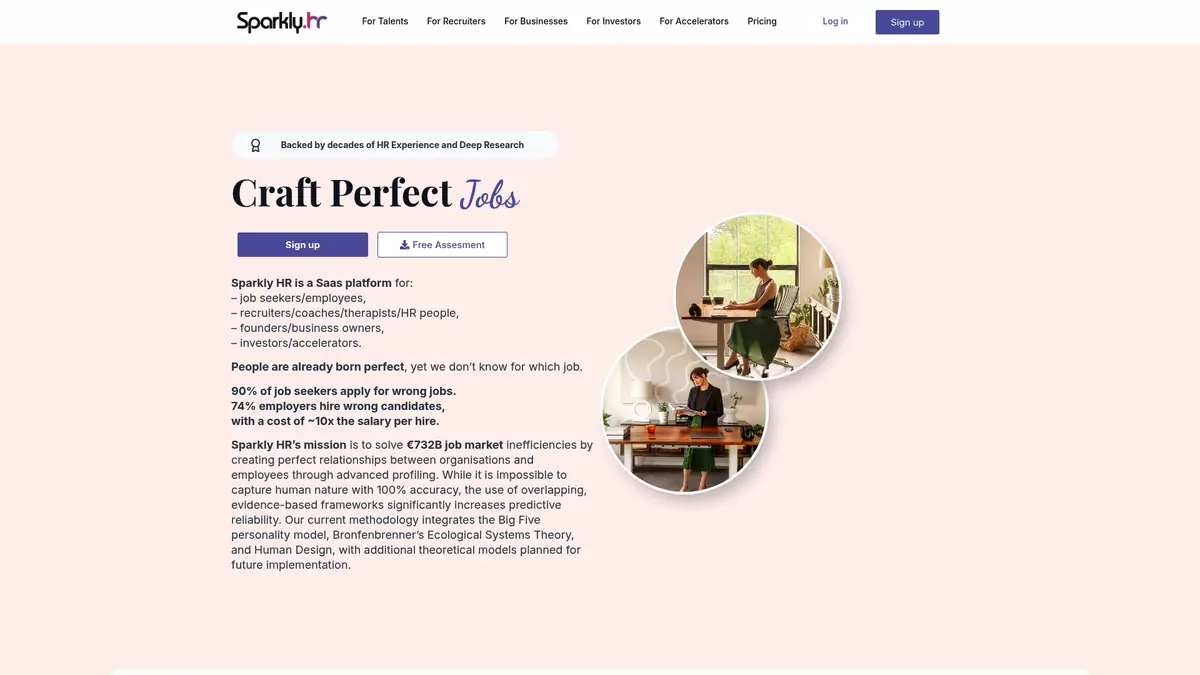
Sparkly is built on a different premise: skills can be learned, but personality is the foundation that determines whether someone will succeed in a specific role, team, or environment. Sparkly merges four data sources, including human input, AI analysis, psychometric assessments, and Human Design, to generate higher-probability insights that HR teams can actually use in interviews and placement decisions.
If you are rethinking your evaluation framework for 2026, explore how Sparkly’s talent evaluation SaaS turns personality and behavioral data into concrete role-fit decisions. You can also see how SaaS is transforming employee potential across hiring, development, and team restructuring. The result is fewer costly mismatches and more people placed where they genuinely perform.
FAQ
What are the biggest trends in employee assessment for 2026?
The leading trends are AI integration in performance reviews, continuous feedback replacing annual evaluations, and capability-based assessments measuring adaptability and real-world behaviors. Over 94% of organizations now use talent assessments, with more than half involving AI directly.
How does continuous feedback improve employee retention?
Continuous feedback correlates with 44% higher employee retention compared to annual review models. Real-time feedback keeps employees engaged, addresses performance gaps early, and meets the expectation of 72% of workers who want ongoing input on their work.
What do employee assessment tools cost in 2026?
Pricing ranges from $4 to over $20 per employee per month. Entry-level engagement tools like Happily.ai start around $4 to $7, while full performance management platforms like Lattice and 15Five typically run $9 to $15 per employee per month.
Why is capability-based evaluation replacing credential-based hiring?
Credentials measure past access, not future performance. Capability-based evaluations assess real behaviors, learning agility, and role fit, which are stronger predictors of long-term success and less susceptible to resume manipulation.
Are HR teams ready to use AI in employee assessments?
Most are not yet fully prepared. Only 7% of HR leaders feel fully capable of meeting AI-driven assessment goals, and 62% require urgent upskilling. Investing in HR team development before deploying AI tools is the most reliable path to successful adoption.