Team productivity hacks for 2026: boost output and retention

Improving team productivity while cutting turnover is no longer optional for mid-sized companies competing in 2026. HR professionals and team leaders face mounting pressure to align employees effectively, boost output, and retain top talent without inflating budgets. Recent research reveals specific, data-driven strategies that deliver measurable gains in both areas. This article explores proven productivity hacks backed by rigorous studies, from bonus incentives and leadership selection to AI integration and culture interventions, giving you actionable frameworks to transform your team’s performance and stability this year.
Table of Contents
- How To Evaluate Your Team’s Productivity Challenges
- Incentivize And Empower Leadership For Better Team Output
- Leverage AI Tools To Amplify Your Team’s Productivity
- Compare Productivity Strategies: Incentives, Leadership, AI, And Culture Programs
- Explore Sparkly HR Solutions To Maximize Team Productivity
Key takeaways
| Point | Details |
|---|---|
| Bonus incentives work | Performance improves by 0.2 to 0.4 standard deviations for non-routine analytical tasks when bonuses are offered. |
| Leadership selection matters | Teams that choose their own leaders complete tasks 25% faster and reduce delivery time by 75%. |
| AI boosts junior productivity | Generative AI increases developer output by 26%, with junior employees gaining the most benefit. |
| Management training cuts turnover | Career development programs and management training reduce turnover by 15 to 35%, saving substantial replacement costs. |
| Disruptive high performers exist | Chaos agents who deliver results but harm team dynamics must be identified and managed to preserve productivity. |
How to evaluate your team’s productivity challenges
Before implementing any productivity hack, you need a clear diagnosis of what is holding your team back. Start by calculating the tangible costs of turnover, which typically range from 50 to 200% of an employee’s salary when you factor in recruiting, onboarding, lost productivity, and cultural disruption. Management training and career development programs can cut turnover by 15 to 35%, making the investment in evaluation worthwhile.
Next, identify chaos agents within your teams. These are high performers who deliver impressive individual results but undermine collaboration, spread negativity, or create friction that drags down overall output. Their presence often goes unnoticed because their personal metrics look strong, yet they quietly erode team morale and drive others to leave. Look for patterns in exit interviews, peer feedback, and project delays that cluster around specific individuals.
Use a systematic approach to assess employee potential and team fit. Evaluate three key areas: process efficiency (are workflows optimized or riddled with bottlenecks?), execution quality (do projects consistently meet deadlines and standards?), and cultural alignment (do team members share core values and communication styles?). An employee potential evaluation framework helps you spot misalignments early, before they escalate into turnover or productivity crises.

Consider whether your current team structure supports growth. Are high-potential employees stuck in roles that do not leverage their strengths? Could strategic team member shifting unlock hidden capacity? Mid-sized companies often overlook internal mobility as a retention and productivity tool, yet reallocating talent based on personality and potential can yield immediate gains without hiring costs.
Pro Tip: Run quarterly productivity audits using a simple scorecard that tracks task completion rates, quality metrics, and employee sentiment scores. This creates a baseline for measuring the impact of any intervention you implement.
Incentivize and empower leadership for better team output
Bonus incentives remain one of the most effective levers for improving team performance, especially for non-routine analytical work. Research shows that offering bonuses improves performance by 0.2 to 0.4 standard deviations and increases demand for leadership roles within teams. The key is structuring incentives around clear, measurable goals that align with company objectives, not vague promises of future rewards.
Equally powerful is encouraging teams to select their own leaders rather than imposing hierarchy from above. When flat teams choose leaders organically, task completion increases by 25% and time to delivery drops by 75%. This approach works because team-selected leaders earn trust faster, understand ground-level challenges better, and motivate through peer influence rather than positional authority.
Flat hierarchy teams, common in tech startups and creative agencies, benefit most from structured leadership selection processes. Without formal titles, ambiguity around decision-making slows progress and creates frustration. By formalizing how leaders emerge (through voting, rotating roles, or skill-based selection), you eliminate confusion while preserving the collaborative culture that makes flat teams productive.
Combining incentives with leadership empowerment creates a multiplier effect. When team members know that stepping into leadership roles comes with both recognition and financial reward, engagement spikes. This strategy also surfaces hidden talent, as employees who might never apply for formal management positions will volunteer to lead projects when peers nominate them.
Pro Tip: Pair bonus incentives with transparent performance dashboards so everyone sees how individual and team efforts contribute to shared goals. Visibility drives accountability and makes incentives feel fair rather than arbitrary.
These tactics work best when integrated into your broader approach to boost team alignment, ensuring that productivity gains do not come at the expense of cohesion or culture.
Leverage AI tools to amplify your team’s productivity
Generative AI has moved from experimental novelty to practical productivity tool in 2026, with measurable impacts on team output. Studies show that AI increases developer productivity by 26%, with junior employees experiencing the largest gains. This is not about replacing humans but augmenting their capabilities, particularly for routine coding, drafting, research, and data analysis tasks that consume disproportionate time.
AI functions as what researchers call a cybernetic teammate, replicating some collaboration benefits by providing instant feedback, suggesting solutions, and handling repetitive work. For less experienced team members, AI acts as an always-available mentor, accelerating skill development and reducing the gap between junior and senior performance. This democratization of expertise means smaller teams can punch above their weight without hiring additional specialists.
However, AI usage comes with a trade-off. While task completion speeds up, social engagement within teams may decline as members interact more with AI tools and less with each other. This matters for mid-sized companies where culture and collaboration drive retention. If employees feel isolated or disconnected because AI handles too much of their workflow, turnover risk increases even as productivity climbs.
The solution is balanced integration. Use AI for tasks that do not require human judgment, creativity, or relationship-building. Reserve collaborative work, brainstorming sessions, and strategic planning for human-to-human interaction. Set clear guidelines on when AI assistance is appropriate versus when team discussion is necessary.
“AI tools should enhance human collaboration, not replace it. The most productive teams use AI to eliminate grunt work, freeing time for the creative and strategic thinking that only humans can provide.”
Incorporate AI responsibly by training your team on effective prompting, output validation, and ethical use. Not all AI-generated content or code is accurate, so human oversight remains essential. Establish review processes to catch errors before they cascade into larger problems.
For HR professionals, AI also offers opportunities to improve assessments that boost performance, from analyzing interview transcripts to identifying patterns in employee feedback that signal engagement risks.
Compare productivity strategies: incentives, leadership, AI, and culture programs
Choosing the right productivity strategy depends on your company’s specific challenges, budget constraints, and team dynamics. This comparison table evaluates the four main approaches discussed on key criteria relevant to mid-sized companies.
| Strategy | Productivity Impact | Implementation Cost | Ease of Adoption | Turnover Reduction |
|---|---|---|---|---|
| Bonus Incentives | 0.2 to 0.4 SD improvement | Medium (ongoing payouts) | High (clear metrics needed) | Low to Medium |
| Leadership Selection | 25% faster completion | Low (process design only) | Medium (culture shift required) | Medium |
| AI Tools | 26% output increase | Low to Medium (licensing) | Medium (training required) | Low (may reduce engagement) |
| Culture Programs | 15 to 35% turnover reduction | Medium to High (training, time) | Low (long-term commitment) | High |
Bonus incentives deliver quick wins for teams working on analytical, non-routine projects but require ongoing budget allocation and careful goal-setting to avoid gaming the system. They work best when paired with transparent performance tracking and fair distribution criteria.
Leadership selection costs almost nothing to implement yet yields dramatic efficiency gains, especially in flat or self-organizing teams. The main challenge is cultural: teams accustomed to top-down management may resist peer-selected leadership initially. Persistence pays off as trust builds.
AI tools offer the highest immediate productivity boost for the lowest upfront cost, but the risk of reduced social engagement makes them a double-edged sword. Use AI strategically to augment junior employees and automate repetitive tasks, not to replace human collaboration on complex challenges.
Culture programs, including management training and career development initiatives, have the longest implementation timeline but deliver the strongest turnover reduction. For companies where retention is the primary concern, investing in culture yields compounding returns as experienced employees stay longer and mentor newcomers.
When selecting your approach, consider these factors:
- Current turnover rate: if above industry average, prioritize culture programs and leadership selection
- Team experience level: junior-heavy teams benefit most from AI tools and mentorship
- Budget flexibility: tight budgets favor leadership selection and AI over bonuses
- Organizational readiness: established hierarchies struggle more with peer-selected leadership than flat teams
- Competitive pressure: if speed to market is critical, AI and incentives deliver fastest results
Most effective strategies combine multiple approaches. For example, use AI to free up time, then redirect that time toward leadership development and team-building activities that strengthen culture. Or pair bonus incentives with career development programs to reward performance while building long-term loyalty.
Explore talent allocation methods to ensure your productivity investments align with how you deploy people across projects and roles.
Explore Sparkly HR solutions to maximize team productivity
Implementing these productivity hacks becomes significantly easier with the right assessment and allocation tools. Sparkly HR offers a comprehensive platform designed specifically for mid-sized companies looking to unlock employee potential without the guesswork. By prioritizing personality over skills (since skills can be learned), Sparkly helps you identify optimal team fits and reduce costly misalignments before they impact output or retention.
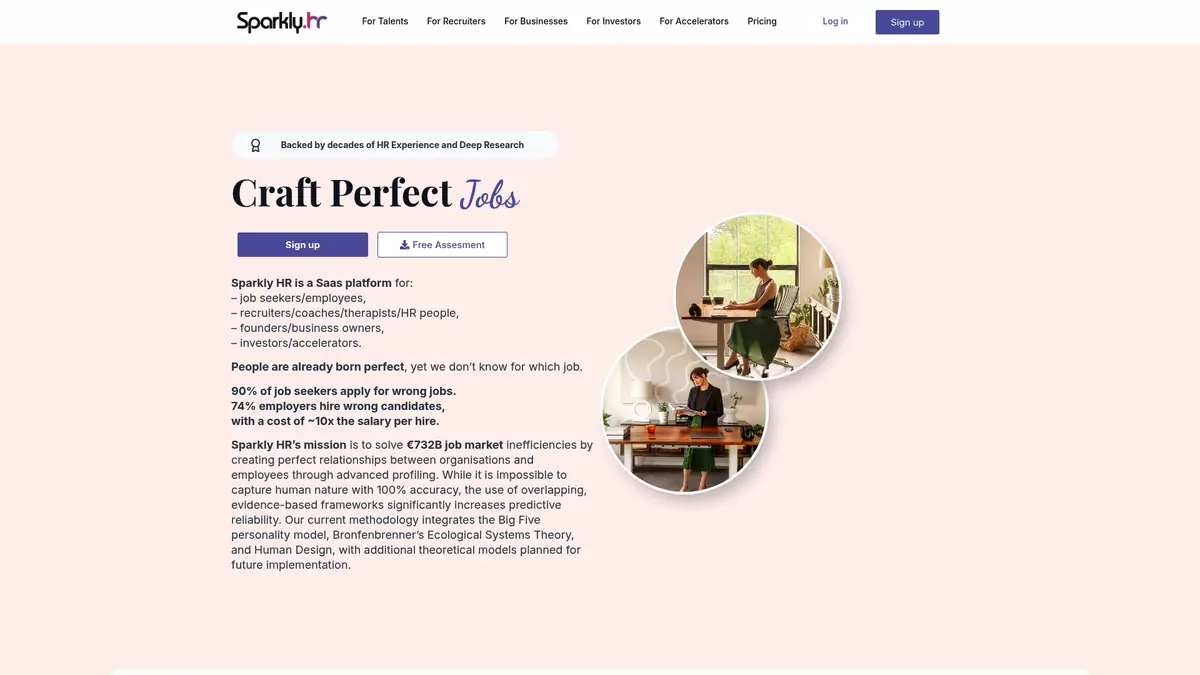
Our unique approach merges four typically unreliable data sources: human judgment, AI analysis, psychometric assessments, and Human Design principles to extract higher-probability insights. This multi-layered methodology gives HR professionals concrete, actionable data for interviews, team restructuring, and role redesign. Whether you are evaluating employee fit to cut turnover costs or applying personality strategies for team optimization, Sparkly provides the foundation for smarter decisions. Discover how SaaS solutions in HR can transform your approach to employee potential and team productivity in 2026.
FAQ
What are the most effective incentives to boost team productivity?
Bonus incentives tied to non-routine analytical tasks deliver the strongest performance improvements, with gains of 0.2 to 0.4 standard deviations in research studies. Structure bonuses around clear, measurable objectives that align with company goals rather than subjective performance reviews. Pair financial rewards with public recognition and career development opportunities to maximize motivation across different personality types.
How does leadership selection impact team efficiency?
Allowing teams to choose their own leaders increases task completion rates by 25% and reduces time to delivery by 75% compared to imposed hierarchy. Team-selected leaders earn trust faster because peers recognize their competence and communication skills firsthand. This approach works especially well in flat organizations where formal authority structures create bottlenecks, and it does not compromise creative output or originality.
Can AI replace human collaboration in teams?
AI functions as a cybernetic teammate that replicates some collaboration benefits, particularly for routine tasks and instant feedback, but it cannot replace the strategic thinking and relationship-building that human interaction provides. While AI boosts individual productivity by up to 26%, overreliance may reduce social engagement and team cohesion. Balance AI use by reserving collaborative work, brainstorming, and complex problem-solving for human-to-human interaction.
How quickly can management training reduce turnover?
Management training and career development programs typically reduce turnover by 15 to 35% within 12 to 18 months of consistent implementation. The timeline depends on program quality, leadership buy-in, and how well training addresses specific pain points identified in exit interviews and employee surveys. Quick wins appear in improved manager-employee relationships within the first quarter, while retention gains compound over subsequent years as culture strengthens.
Should mid-sized companies prioritize productivity or retention?
The most successful mid-sized companies recognize that productivity and retention are interconnected, not competing priorities. High turnover directly reduces productivity through lost institutional knowledge, recruiting costs, and onboarding time. Conversely, productivity initiatives that ignore employee well-being and development create burnout that drives turnover. Implement strategies that address both simultaneously, such as leadership selection programs that boost efficiency while building engagement, or AI tools that eliminate tedious work and free time for meaningful collaboration.
Recommended
- Employee potential checklist 2026: Cut turnover 60%
- Why shift team members: Boost retention with personality fit in 2026
- Top 5 HR Team Management Tools in 2026 for Effective Employee Engagement
- Employee engagement checklist 2026: cut 30% turnover
- 7 Keyboard Shortcuts That Actually Save Time - Daysift Blog