Team effectiveness explained: Boost performance with data

TL;DR:
- Structural factors like clear goals and roles are essential before addressing interpersonal issues.
- Personality assessments predict team fit and help reduce turnover by aligning traits with roles.
- Focusing on measurable data and role clarity improves team effectiveness more than relationship-building alone.
Most HR professionals assume team problems start with personality clashes or poor communication. The real culprits are usually misaligned goals, unclear roles, and personality mismatch that nobody measured. High turnover rates above 20% can slash productivity and innovation by nearly half and cost mid-sized companies $15,000 to $75,000 per lost employee. That is a steep price for a problem that is largely preventable. This article breaks down the proven models, personality science, and data-driven strategies that help HR teams build groups that actually perform, stay, and grow together.
Table of Contents
- Dissecting team effectiveness: The science behind success
- The role of personality and data in building effective teams
- Diagnosing and preventing turnover: Strategies for mid-sized companies
- From insight to action: Applying models and data for better HR outcomes
- Why most team effectiveness advice misses the real drivers
- Accelerate your team effectiveness journey
- Frequently asked questions
Key Takeaways
| Point | Details |
|---|---|
| Start with goals and roles | Diagnosing and aligning team goals and roles prevents most interpersonal challenges and boosts effectiveness. |
| Use personality data | Assessing Big Five personality traits helps optimize team fit and reduce costly turnover. |
| Track leading indicators | Monitor psychological safety and retention metrics for early warning signs and smarter HR interventions. |
| Leverage analytics | Data-driven tools empower HR leaders to design, measure, and iterate on high-performing teams. |
Dissecting team effectiveness: The science behind success
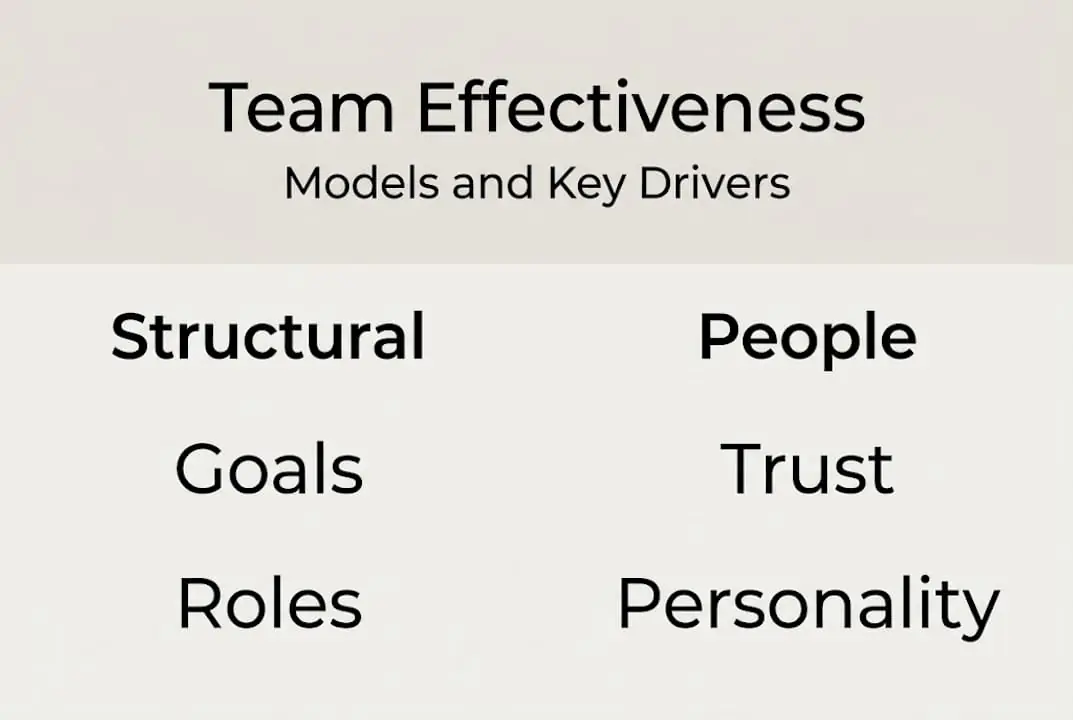
When a team underperforms, most managers jump straight to team-building exercises or conflict resolution workshops. That is almost always the wrong starting point. The GRPI model (Goals, Roles, Processes, Interpersonal) offers a more disciplined approach, and the sequence is the whole point.
The model works from the top down. You fix goals first, then roles, then processes, and only then address interpersonal dynamics. Why? Because goal and role misalignment causes most interpersonal friction in the first place. Treating the symptom without the root cause wastes everyone’s time.
“Misalignment at higher levels causes interpersonal issues.”
Google’s research on high-performing teams adds another layer. Their framework highlights five conditions: psychological safety, dependability, structure and clarity, meaning, and impact. Notice that psychological safety sits at the top, not harmony or friendship. Safety means people feel comfortable taking risks and speaking up, which only happens when goals and roles are crystal clear.
Here is a quick comparison of both frameworks:
| Framework | Primary focus | Starting point | Key insight |
|---|---|---|---|
| GRPI | Sequential diagnosis | Goal clarity | Fix structure before relationships |
| Google’s model | Conditions for performance | Psychological safety | Safety enables all other factors |
The overlap is telling. Both frameworks say the same thing in different ways: structure and clarity come before trust and harmony. HR teams that skip straight to interpersonal fixes are solving the wrong problem.
Pro Tip: When diagnosing a struggling team, start with one question: “Does everyone on this team agree on what success looks like?” If the answer is no or unclear, stop there. Goal misalignment is almost certainly driving the rest of the issues. Explore assessment tools overview to see how structured diagnostics can surface these gaps fast.
The role of personality and data in building effective teams
Once you understand the structural models, the next layer is the people side. Personality is not a soft concept here. It is measurable, predictive, and directly tied to team outcomes.

The Big Five personality model (Openness, Conscientiousness, Extraversion, Agreeableness, Neuroticism) is the most research-backed framework for predicting workplace behavior. Extraversion and conscientiousness boost team performance, while high neuroticism increases the risk of poor fit and turnover. These are not opinions. They are patterns that show up consistently across industries.
| Big Five trait | Impact on task performance | Impact on innovation | Impact on stress levels |
|---|---|---|---|
| Conscientiousness | High positive | Moderate positive | Reduces stress |
| Extraversion | Moderate positive | Positive in collaborative roles | Neutral |
| Openness | Moderate | High positive | Neutral |
| Agreeableness | Positive in teamwork | Moderate | Reduces conflict |
| Neuroticism | Negative | Negative | Increases stress |
Predictive analytics take this further. When you combine personality data with performance metrics and team composition data, you can identify mismatch before it becomes a resignation. Data-driven talent management approaches that incorporate personality assessments consistently outperform gut-feel hiring in both retention and team cohesion.
Here are key HR actions that make personality data work in practice:
- Use personality assessments during selection to predict team fit, not just job fit
- Balance team composition by mixing high openness with high conscientiousness
- Flag neuroticism clusters in team composition before they create friction
- Revisit personality data when restructuring teams or shifting roles
- Combine personality results with personality-based retention strategies to reduce early attrition
Pro Tip: Aim for a diversity of openness scores on innovation-focused teams, but set a baseline of conscientiousness across the board. Teams that lack follow-through rarely turn creative ideas into results, no matter how talented the individuals are.
Diagnosing and preventing turnover: Strategies for mid-sized companies
Turnover is not random. It follows patterns, and those patterns are measurable. The three most common drivers in mid-sized companies are role overload, poor management, and lack of career advancement. Fixing these requires more than an engagement survey.
📈 Statistic callout: Research shows that 35% of new hires at mid-sized companies leave within two years, and healthy turnover sits below 10%. Rates above 20% lead to a 33 to 45% drop in innovation and productivity. That is not a morale problem. That is a business continuity problem.
Here is a four-step process for diagnosing and addressing turnover at your company:
- Audit exit data. Collect structured exit interview data and look for patterns across departments, managers, and tenure ranges. Anecdotes are not enough.
- Map role clarity. Use a structured role-fit assessment to identify where employees feel unclear about expectations or underutilized in their strengths.
- Track psychological safety. Run regular pulse surveys with specific questions about speaking up, risk-taking, and manager responsiveness.
- Build career visibility. Create transparent advancement paths and connect individual development plans to real opportunities inside the company.
AI-powered HR analytics can surface these patterns faster than manual analysis, especially when you are managing hundreds of employees across multiple teams. Pair that with an employee potential checklist to identify who is at flight risk before they start looking elsewhere.
Pro Tip: Exit interviews are valuable, but stay interviews are more powerful. Ask high performers what would make them leave before they decide to. The answers will tell you exactly where your retention strategy has gaps.
From insight to action: Applying models and data for better HR outcomes
Knowing the models and the data is only half the job. The other half is building a repeatable process that your HR team can run consistently, not just during a crisis.
Start with the basics before adding complexity. When building or restructuring a team, follow this sequence: clarify the team’s goals in writing, define each role’s contribution to those goals, assess personality fit for each position, and then evaluate interpersonal dynamics. Skipping any of these steps usually means revisiting the whole thing six months later.
“Personality assessments and analytics can reduce turnover by 15 to 35%; tracking psychological safety is a leading indicator of team health.”
Here are five concrete actions to put this into practice:
- Pilot a team assessment on one department before rolling out company-wide to refine your approach
- Use exit and retention metrics together to identify whether your interventions are actually working
- Cultivate psychological safety through manager training focused on listening and non-defensive responses
- Schedule regular check-ins that include role clarity conversations, not just performance updates
- Align your talent strategy with data by connecting talent analytics for HR leaders to your annual workforce planning cycle
One common pitfall is overemphasizing surface harmony. A team that never disagrees is not necessarily healthy. It might just be conflict-avoidant, which is its own risk. Use analytics for team fit to go deeper than what you can see in a meeting room.
Why most team effectiveness advice misses the real drivers
Here is something most HR playbooks will not tell you: the reason team effectiveness programs fail is not a lack of effort. It is a misdiagnosis. 💡
Most organizations invest in relationship-building workshops, culture initiatives, and engagement surveys while leaving role clarity and personality fit completely unaddressed. The result is a team that feels heard but still underperforms.
The real drivers of team effectiveness are structural and measurable. Clear role alignment, tracked psychological safety, and acting on retention data are what move the needle. Harmony is a byproduct of getting those things right, not a strategy in itself.
We also see HR teams that treat personality assessments as a hiring filter rather than an ongoing management tool. Personality data is most valuable when it informs how you coach, restructure, and develop people over time. Adopt a coaching mindset that focuses on growth potential, not just performance reviews.
“Fix fit and clarity first; trust and results will follow.”
If you want personality-powered strategies that actually stick, start by measuring what matters and acting on it consistently.
Accelerate your team effectiveness journey
Ready to put these advanced team effectiveness tools to work? Sparkly gives HR professionals at mid-sized companies the personality-first assessment data they need to make smarter decisions about team fit, role design, and retention. We merge human judgment, AI, psychometric assessments, and Human Design into one reliable data stream so you stop guessing and start knowing. ⚡️
Explore our talent assessment tips to sharpen your hiring and team-building approach. Dig into our guide to master team optimization with personality-driven strategies built for 2026. And if you are ready to reduce turnover costs now, our fit assessment guide walks you through every step.
Frequently asked questions
What are the most important factors for team effectiveness?
Clear goals, defined roles, solid processes, and mutual trust are the essential factors for high-performing teams. The GRPI model shows that success starts with goal and role alignment before anything else.
How do personality assessments help reduce turnover?
Assessments match employees with teams where their traits best fit, lowering mismatch and turnover risk dramatically. Big Five assessments reduce hiring mismatch by identifying trait combinations that predict poor fit early.
What is a healthy employee turnover rate for mid-sized companies?
A healthy turnover rate is below 10%; rates above 20% lead to costly declines in productivity and innovation. High turnover rates above that threshold can slash innovation by up to 45%.
What is psychological safety, and why does it matter?
Psychological safety means team members feel safe taking risks and contributing ideas without fear of judgment. It is a leading indicator of both team success and long-term retention.