Streamline your employee assessment workflow for retention

Employee assessments are supposed to help you build stronger teams and keep your best people. But if you’re like most HR professionals, you’ve seen how bias, inconsistency, and outdated annual reviews create more problems than they solve. These flawed processes hurt retention, damage team dynamics, and waste countless hours. The good news? A structured, fair assessment workflow can turn this around. This guide walks you through practical steps to prepare, execute, and verify employee assessments that actually work, reducing turnover and strengthening your organization.
Table of Contents
- Key takeaways
- Prepare your employee assessment workflow
- Execute the employee assessment workflow step-by-step
- Verify assessment results and optimize for retention
- Enhance your employee assessments with Sparkly.hr solutions
- Frequently asked questions
Key Takeaways
| Point | Details |
|---|---|
| Bias mitigation | Address known biases with detection, structured rubrics, and evaluator training to improve accuracy and fairness. |
| Structured workflow | Create repeatable steps with clear objectives to ensure consistent, evidence based assessments. |
| Continuous feedback | Move from annual reviews to ongoing check ins and real time feedback to drive development. |
| Multi source data | Collect data from self assessments, peers, and managers to form a complete, balanced view. |
Prepare your employee assessment workflow
Before you can run effective assessments, you need to address the hidden biases that undermine accuracy. Bias detection in performance feedback systems identifies six major culprits: halo effect, recency bias, similarity bias, confirmation bias, central tendency, and visibility bias. Each one distorts your view of employee performance in different ways. The halo effect makes you rate someone highly across all areas because they excel in one. Recency bias overweights recent events while ignoring months of consistent work. Understanding these patterns is your first defense.
Structured assessment tools are your second defense. The SBI model (Situation-Behavior-Impact) gives you a framework for documenting specific examples rather than vague impressions. When you describe the situation, the behavior you observed, and the impact it had, you create evidence-based assessments that hold up under scrutiny. This approach naturally reduces bias because it forces you to cite concrete examples rather than relying on gut feelings.
Training your evaluators is non-negotiable. Even well-intentioned managers fall into bias traps without proper preparation. Your training program should cover:
- Recognition of the six major bias types and how they manifest
- Practice using structured rubrics with real scenarios
- Calibration exercises where managers compare ratings and discuss differences
- Techniques for separating personality from performance
Pro Tip: Use 7-point rating scales with detailed examples for each level. Research shows this range provides enough granularity to differentiate performance without overwhelming evaluators. Include specific behavioral examples at each level so managers know exactly what a 3 versus a 5 looks like.
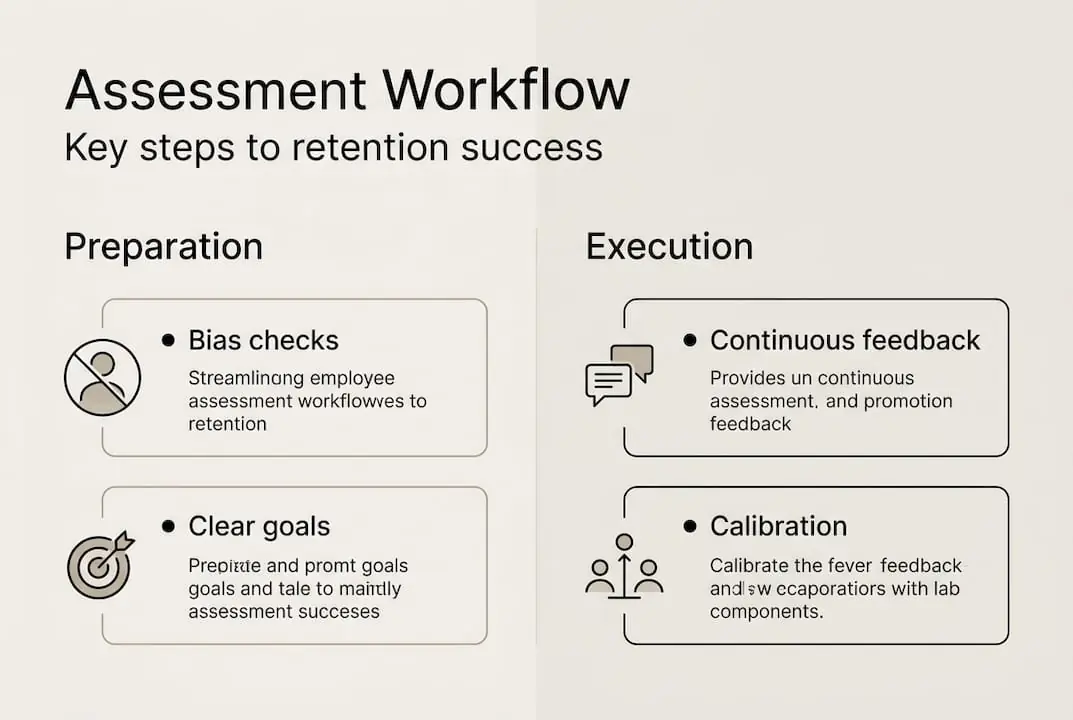
Set clear objectives before launching your workflow. Are you trying to identify high performers for promotion? Improve team dynamics? Reduce turnover in specific departments? Your goals shape everything from the questions you ask to the frequency of assessments. Link these objectives directly to business outcomes like retention rates and team performance metrics.
Finally, shift your mindset from annual events to continuous feedback. Traditional once-a-year reviews create anxiety, encourage recency bias, and arrive too late to address problems. Your personality-focused assessment strategies should include regular check-ins, real-time feedback on specific situations, and ongoing conversations about growth. Use your personality assessment checklist to ensure you’re evaluating the right dimensions consistently throughout the year.
Execute the employee assessment workflow step-by-step
Now that you’ve built your foundation, here’s how to run assessments that actually improve retention and team performance.
-
Collect data from multiple sources. Start with self-assessments where employees reflect on their own performance. Add peer feedback from colleagues who work closely with them. Include manager observations based on direct supervision. If you have access to AI tools, use them to analyze communication patterns, collaboration metrics, or project outcomes. This multi-source approach creates a complete picture and prevents any single perspective from dominating.
-
Apply structured rubrics with calibrated scales. Use your 7-point scale with specific examples for each rating level. If you’re evaluating collaboration, define what a 3 (meets basic expectations) looks like versus a 6 (consistently exceeds expectations with measurable impact). Have managers practice rating sample scenarios together to calibrate their standards. This ensures a 5 from one manager means the same thing as a 5 from another.
-
Incorporate 360-degree feedback systematically. Traditional top-down reviews miss crucial information about how employees actually work. 360-degree feedback captures insights from direct reports, peers, and cross-functional partners. Structure your questions to focus on observable behaviors rather than personality judgments. Ask about specific situations and impacts rather than general impressions.
-
Document everything with clear rationale. For each rating, include at least two specific examples using the SBI framework. Describe the situation, the behavior you observed, and the measurable impact. This documentation protects you legally, helps employees understand their ratings, and provides a baseline for tracking improvement over time. Vague comments like “needs to improve communication” are useless. Specific examples like “In the Q3 project kickoff, failed to notify the design team of timeline changes, resulting in two days of rework” give employees actionable information.
-
Deliver continuous, real-time feedback. Job performance reviews are outdated and often pointless when they happen once a year. Replace annual reviews with monthly or quarterly check-ins. Address issues within days, not months. Recognize great work immediately. This approach reduces anxiety, prevents small problems from becoming big ones, and keeps development conversations ongoing.
-
Train everyone on feedback skills. Managers need training on delivering constructive feedback without triggering defensiveness. Employees need training on receiving feedback productively and asking clarifying questions. Create safe spaces for practice and role-playing. The best assessment workflow in the world fails if people can’t have honest conversations.
Pro Tip: Compare traditional annual reviews with continuous feedback using this framework:
| Factor | Traditional annual reviews | Continuous feedback |
|---|---|---|
| Timing | Once per year | Monthly or quarterly |
| Bias risk | High (recency bias dominates) | Lower (multiple data points) |
| Employee anxiety | Very high | Moderate to low |
| Actionability | Low (too late to fix issues) | High (address problems immediately) |
| Retention impact | Minimal or negative | Positive (up to 35% improvement) |
| Manager time investment | Concentrated burden | Distributed throughout year |
Your hiring process best practices should align with your assessment workflow. The same structured, bias-aware approach that improves assessments also improves hiring decisions. When you assess personality and fit rather than just skills, you build teams that work better together. AI in recruitment can support this by identifying patterns humans miss, but it works best when combined with human judgment and structured frameworks.
Verify assessment results and optimize for retention
Running assessments is only half the battle. You need to verify that your results are fair, consistent, and actually helping you keep your best people.

Conduct calibration sessions after each assessment cycle. Bring managers together to review ratings and discuss their rationale. When Manager A rates someone a 6 and Manager B rates a similar performer a 4, you have a calibration problem. Walk through specific examples and align on standards. These sessions are uncomfortable but essential for fairness. They also help managers learn from each other and develop better evaluation skills.
Use AI tools to flag potential bias in written feedback. Natural language processing can identify gendered language, vague criticism, or patterns that suggest bias. If all your low ratings go to one demographic group, you need to investigate. If feedback for women focuses on personality while feedback for men focuses on results, you have a bias problem. AI can’t solve these issues, but it can surface them for human review.
Track your retention metrics before and after implementing your new workflow. Empirical effect of performance evaluations on turnover intentions shows that performance evaluations reduce turnover intentions for below-median wage employees by approximately 0.4 points, though they show no effect for higher-wage peers. This suggests your assessment workflow has the biggest retention impact on employees who might otherwise feel overlooked or undervalued. Monitor turnover rates by department, role, and demographic group. If turnover increases after assessments, your workflow is broken.
Understand the financial stakes. Turnover benchmarks and retention strategies reveal that high turnover costs 50 to 200% of an employee’s salary when you factor in recruiting, training, lost productivity, and institutional knowledge. Retention efforts like management training, career development programs, and optimized assessment workflows can cut turnover by 15 to 35%. For a 100-person company with 20% turnover and average salaries of $60,000, reducing turnover by 25% saves roughly $150,000 to $600,000 annually.
Compare different retention approaches:
| Retention method | Implementation cost | Turnover reduction | ROI timeline |
|---|---|---|---|
| Career development programs | Moderate | 15 to 25% | 12 to 18 months |
| Management training | Low to moderate | 10 to 20% | 6 to 12 months |
| Optimized assessment workflow | Low (mostly time) | 20 to 35% | 3 to 9 months |
| Compensation increases | High | 10 to 15% | Immediate but unsustainable |
| Enhanced benefits | Moderate to high | 5 to 15% | 6 to 12 months |
Your assessment workflow delivers the best ROI because it improves multiple factors simultaneously. It helps you identify and develop high performers, address problems before people quit, and create a culture of growth and fairness. Use your employee potential checklist 2026 to ensure you’re evaluating the dimensions that actually predict success and retention. Talent optimization explained shows how aligning people, strategy, and processes creates sustainable competitive advantage.
Regularly review and refine your workflow based on data and feedback. Survey employees about their assessment experience. Ask what’s working and what’s not. Track which managers get the best retention results and learn from their approaches. Your workflow should evolve as your organization grows and changes.
Enhance your employee assessments with Sparkly.hr solutions
Building a fair, effective assessment workflow takes time and expertise. Sparkly.hr accelerates your success with SaaS solutions designed specifically for personality-focused employee assessments. Unlike traditional tools that focus only on skills, Sparkly merges insights from human evaluators, AI analysis, psychometric assessments, and Human Design to give you higher-probability data about employee potential and team fit.
Our platform helps you detect bias, standardize evaluations, and implement continuous feedback workflows that actually reduce turnover. Whether you’re managing a 50-person team or a 500-person organization, Sparkly provides the structure and insights you need to make better decisions about your people. Explore our SaaS in HR employee potential solutions to see how we help HR leaders transform assessments from administrative burden into strategic advantage. Get started with our talent optimization explained resources and employee fit assessment guide to build workflows that strengthen your teams and protect your bottom line.
Frequently asked questions
What are the key biases affecting employee assessments?
The six major biases are halo effect (rating everything highly based on one strength), recency bias (overweighting recent events), similarity bias (favoring people like yourself), confirmation bias (seeking evidence that supports preexisting beliefs), central tendency (rating everyone as average), and visibility bias (favoring people you see more often). These biases distort assessments and hurt both high performers and those who need support. Structured rubrics, evaluator training, 360-degree feedback, and AI language analysis help mitigate these patterns by forcing evidence-based evaluations and surfacing inconsistencies.
How can I ensure fairness and accuracy in my assessment workflow?
Implement comprehensive evaluator training that covers bias recognition and structured assessment techniques like the SBI model. Use multi-rater feedback including 360-degree reviews to prevent any single perspective from dominating. Leverage AI tools to detect biased language patterns and rating inconsistencies across demographic groups. Conduct regular calibration sessions where managers review ratings together and align on standards. Document every rating with specific behavioral examples so employees understand their assessments and you have evidence to support your decisions.
What is the impact of employee assessments on turnover?
Performance evaluations reduce turnover intentions for below-median wage employees by approximately 0.4 points, though research shows no significant effect for higher-wage peers. This suggests assessments have the biggest retention impact on employees who might otherwise feel overlooked or undervalued. Effective assessments support career development conversations, help employees see a future at your organization, and address problems before they escalate to resignation. Retention efforts including optimized assessment workflows can cut turnover by 20 to 35%, saving significant costs when you consider that replacing an employee costs 50 to 200% of their salary.
What tools can help streamline the employee assessment workflow?
AI-driven SaaS platforms like those from top talent evaluation SaaS providers offer reliable bias detection, automated feedback collection, and analytics to track patterns over time. Structured assessment tools standardize evaluations across managers and departments, ensuring a rating means the same thing regardless of who assigns it. 360-feedback platforms gather input from multiple sources efficiently, while continuous review solutions replace anxiety-inducing annual reviews with ongoing conversations. AI in recruitment technologies can extend to assessment workflows, analyzing communication patterns and collaboration metrics to complement human judgment. The best tools combine AI insights with human expertise rather than trying to replace human decision-making entirely.