
Strategic mentoring: Unlock employee potential and cut turnover

TL;DR:
- Mentoring programs only become a competitive advantage when designed with high relationship quality and ongoing investment. Effective matching, clear goals, and sustained support are essential to deliver measurable improvements in performance, retention, and wellbeing. Treat mentoring as a strategic, data-driven process with continuous measurement and improvement to maximize organizational impact.
Launching a mentoring program feels like progress. You announce it, pair people up, and wait for turnover to drop. But here’s what most leaders discover too late: the program itself is not the solution. Workplace mentoring and coaching are genuinely associated with improved business performance, wellbeing, and retention, but only when the design is right. The quality of relationships, the intelligence behind matching, and the ongoing investment in each pairing determine whether your program becomes a competitive advantage or an expensive checkbox. This guide walks you through evidence-backed strategies that treat mentoring as a serious business tool, not an HR formality.
Table of Contents
- Why mentoring matters: Business outcomes and evidence
- Mentoring program design: Structure, quality, and pitfalls
- Evidence-based matching: From demographics to personality
- Sustaining mentoring relationships for long-term success
- Why most mentoring programs underperform—and what actually works
- Put mentoring impact into action with Sparkly HR
- Frequently asked questions
Key Takeaways
| Point | Details |
|---|---|
| Mentoring boosts retention | Data shows mentoring reduces turnover and supports long-term employee engagement. |
| Relationship quality matters most | Well-designed programs focusing on match quality and ongoing support deliver the best outcomes. |
| Personality-based matching works | Pairing mentors and mentees based on personality traits improves relationship quality and program results. |
| Ongoing support is crucial | Sustained mentoring efforts with feedback loops outperform one-off or checkbox programs. |
| Use metrics for success | Track measurable KPIs like retention, engagement, and match duration to assess mentoring impact. |
Why mentoring matters: Business outcomes and evidence
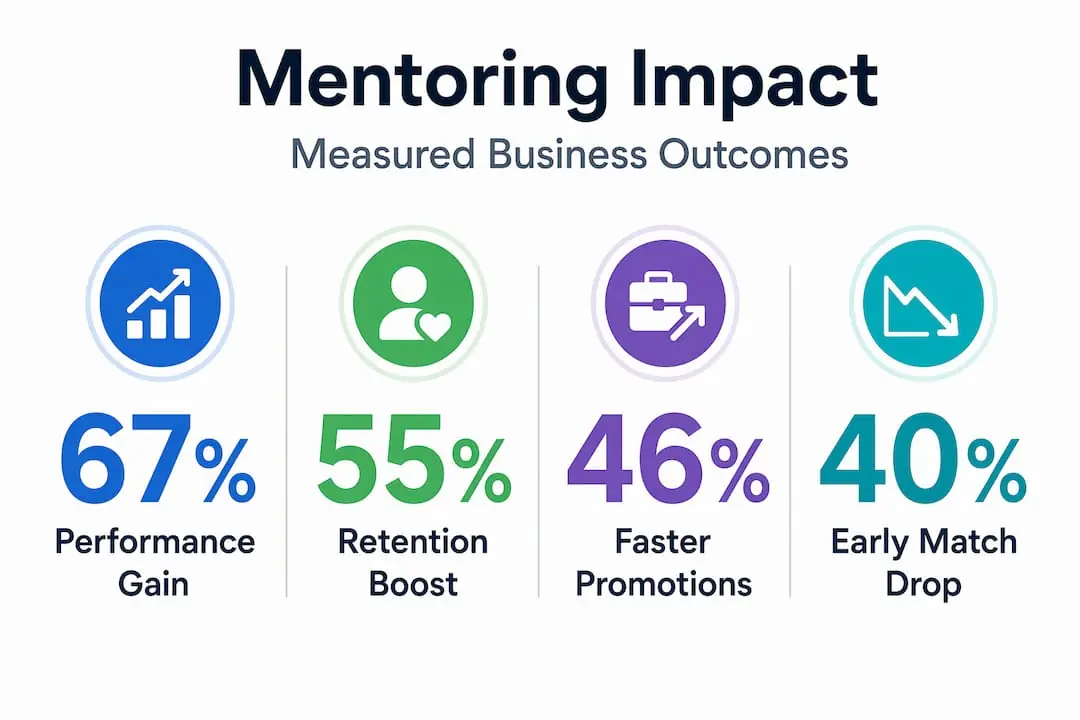
Mentoring is not a “nice to have” anymore. Forward-thinking HR leaders are measuring it the same way they measure any other performance investment. And the data is compelling. Over two-thirds of HR leaders reported positive impact on overall business performance from mentoring. That is not a marginal effect. That is a structural advantage.
Here is a snapshot of what well-run mentoring programs actually deliver:
| Outcome | Impact reported |
|---|---|
| Business performance | Positive impact in 67%+ of organizations |
| Employee retention | Measurable reduction in voluntary turnover |
| Wellbeing at work | Significant improvement in employee satisfaction |
| Talent attraction | Stronger employer brand and candidate appeal |
| Engagement | Increase in discretionary effort and motivation |
📈 Statistic spotlight: Structured mentoring programs in healthcare settings have achieved post-intervention turnover rates as low as 3.5%. Even if your industry runs higher baselines, reductions of this magnitude represent significant cost savings in recruitment, onboarding, and lost productivity.
When you pair mentoring with strong team recognition practices, the compounding effect on engagement becomes even more pronounced. Employees who feel seen AND developed are dramatically less likely to look elsewhere.
“Mentoring is not just a retention tool. It is a signal to your workforce that growth is available here, not just at your competitors.”
Building on these outcomes starts with understanding what your employees are actually capable of. Investing in structured employee potential evaluation gives you the baseline data you need to design mentoring experiences that genuinely stretch and support people, rather than simply matching them by job title or tenure.
With the need for outcomes-based mentoring clear, it is vital to move beyond surface-level programs.
Mentoring program design: Structure, quality, and pitfalls
Many organizations build mentoring programs that look good on paper and deliver very little in practice. The difference between a thriving program and a failing one almost always comes down to relationship quality and ongoing investment, not the presence of a program itself.
| Feature | High-quality mentoring | Checkbox program |
|---|---|---|
| Relationship depth | Ongoing, trust-based dialogue | Scheduled meetings with no follow-through |
| Goals | Clearly defined and revisited regularly | Vague or absent |
| Feedback | Two-way and continuous | One-directional or none |
| Match quality | Intentional and evidence-driven | Random or convenience-based |
| Organizational support | Dedicated time, resources, recognition | Program exists but is unsupported |
| Duration | Sustained over months or years | One quarter then abandoned |
Mentorship quality fully mediates the impact of mentor functions on employee outcomes. Put simply: a technically complete program with poor relationship quality will not move the needle. Relationship quality is the mechanism through which all other program benefits flow.
“Mentoring should be treated as a sustained relational process, not a one-off event.” — Evidence Based Mentoring Research
Here is a practical structure for building a program that actually works:
- Define clear goals. Before pairing anyone, document what success looks like for both the mentee and the organization. Career progression? Skill acceleration? Leadership readiness? Be specific.
- Create intentional matches. Use a structured process that goes beyond availability. Factor in personality, communication style, and development needs.
- Provide training for mentors. Not everyone who is experienced is automatically a good mentor. Train for active listening, goal-setting, and giving constructive feedback.
- Build in regular check-ins. Monthly structured touchpoints, beyond ad hoc coffee chats, keep relationships on track.
- Establish feedback loops. Collect data from both mentors and mentees at 30, 60, and 90 days to catch mismatches or disengagement early.
- Recognize mentoring effort publicly. Mentor contribution should be visible and rewarded as part of your performance culture.
Pro Tip: The most common reason mentoring programs stall is that mentors feel unsupported and unclear about their role. Build a simple resource hub with templates, conversation guides, and escalation paths. This alone reduces early dropout significantly.
Pairing the right employee development tools with your mentoring structure makes goals easier to track and progress easier to demonstrate. If you are also thinking through longer-term workforce planning, structured talent mapping for HR gives you the organizational visibility to align mentoring with your actual succession needs.

A well-crafted mentoring plan must also consider how mentors and mentees are paired.
Evidence-based matching: From demographics to personality
Here is where most programs leave enormous value on the table. Matching by department, seniority, or shared demographic background feels logical but produces inconsistent results. The quality of a mentoring relationship depends much more on how two people actually communicate, process challenges, and approach growth. That is a personality question, not an org-chart question.
Research on the Big Five personality traits (openness, conscientiousness, extraversion, agreeableness, and neuroticism) shows that trait-based matching can meaningfully improve mentoring relationship quality. Here is a breakdown of how different matching methods compare:
| Matching approach | Relationship quality | Early closure risk | Scalability |
|---|---|---|---|
| Demographic only | Low to moderate | High | Easy |
| Skill and experience | Moderate | Moderate | Moderate |
| Personality-based | High | Low | Requires tooling |
| Evidence-driven multi-factor | Highest | Lowest | High with tech support |
💡 When you match on personality, you are looking for complementary traits, not identical ones. A highly structured mentor paired with a creative, exploratory mentee can spark real growth, but only if both parties have compatible communication expectations.
Benefits of personality-informed matching include:
- Stronger rapport and trust from the first conversation
- Better alignment on how feedback should be delivered and received
- Fewer misunderstandings about pace, ambition, and relationship expectations
- Higher mentee satisfaction scores at program milestones
- Reduced early relationship closure, which is one of the most costly mentoring failures
Evidence-driven matching methods have been shown to reduce early match closure compared to manual or self-selected matching. That matters because when a mentoring relationship closes early, both the mentee and the organization lose the compounding benefits that come from sustained connection.
Pro Tip: Personality mismatches do not just produce neutral outcomes. They can actively harm the mentee’s confidence and their trust in the organization. If you invest in matching, use structured data. Gut feel is not enough here.
Technology plays a critical role in making personality-based matching scalable. Understanding job matching for retention is a natural starting point, especially if you want to align mentoring pairs with broader role fit. You can also explore hiring process best practices that embed personality insight from the very first touchpoint with a candidate. And when you are ready to build a more systematic approach, personality-based hiring tech can bring accuracy that manual processes simply cannot match.
Once matches are effective, the real benefit comes from maintaining those relationships and maximizing their long-term impact.
Sustaining mentoring relationships for long-term success
Getting a mentoring pair off to a strong start is only half the challenge. The organizations that see the best retention and performance outcomes are the ones that actively sustain mentoring relationships over time. Letting a strong pairing go dormant is one of the most wasteful things a company can do.
Mentoring outcomes depend directly on relationship maintenance and the institutional conditions that support it. Here is a practical framework for keeping programs alive and productive:
- Set a minimum relationship duration. Six to twelve months gives pairs enough time to build genuine trust and work through real challenges together. Shorter programs rarely create lasting behavior change.
- Schedule structured mid-point reviews. At the halfway point, both mentor and mentee should assess progress against goals and adjust the focus if needed. This prevents stagnation.
- Create peer cohorts. Group mentees into small peer circles so they can share experiences, normalize challenges, and hold each other accountable between mentor sessions.
- Build in escalation protocols. When a relationship is not working, there should be a clear, judgment-free path to request a rematch or additional support.
- Capture qualitative feedback. Numbers tell part of the story. Open-ended feedback from pairs reveals the nuanced reasons why relationships are thriving or stalling.
What institutional culture must provide to make this work:
- Protected time for mentoring conversations, not squeezed into lunch breaks or after hours
- Leadership that visibly participates in or champions the program
- Budget for mentor training, program administration, and recognition
- A shared understanding that mentoring is a performance priority, not a voluntary extra
- Psychological safety so mentees can bring real challenges to their mentors without fear
Pro Tip: Assign a dedicated program steward, not just a program coordinator. A steward’s job is to proactively monitor relationship health, reach out to disengaged pairs, and escalate issues before they lead to match closure. This role changes outcomes dramatically.
Connecting mentoring to your broader talent strategy makes the investment sustainable. Understanding the talent mapping advantages for HR managers helps you see where mentoring fits within your full workforce development picture, and where the highest-priority pairings should be focused.
Now let’s step back and reconsider the conventional wisdom about mentoring with a broader lens.
Why most mentoring programs underperform—and what actually works
Here is an uncomfortable truth: most mentoring programs are designed to satisfy an audit, not to change outcomes. HR teams launch a program, document participation rates, and call it successful. Meanwhile, the people inside those programs are having surface-level conversations that neither challenge nor support their actual growth. That is not mentoring. That is meeting administration.
Formal mentoring can underperform significantly without real investment in relationship quality and ongoing connection. We see this pattern repeatedly in medium-sized businesses that are scaling fast: they build programs that look comprehensive but lack the sustained support that makes relationships actually productive.
What actually works? Modular, blended mentoring. Think buddy systems for new joiners, combined with focused 1:1 mentoring for high-potential employees, supplemented by peer coaching circles for mid-level contributors. Not everyone needs the same depth of mentoring at the same time. Designing for that reality is far more effective than rolling out one blanket program and hoping it fits everyone equally well.
Data-driven, personality-sensitive matching is non-negotiable if you want retention impact. Pairing people based on shared interests or available time slots is not a strategy. It is a missed opportunity. When you match on personality, communication style, and development goals simultaneously, you create the conditions for relationships that actually stick. And it is those sustained relationships that move your turnover numbers.
Ongoing support and clear metrics turn good intentions into measurable results. Define what you are measuring before you launch: turnover rate in mentored vs. non-mentored cohorts, match duration, mentee advancement rates, and engagement scores. Without those metrics, you cannot improve what you cannot see. The organizations winning with mentoring right now are treating it like a product: iterating, measuring, and improving continuously. That mindset shift is what separates programs that genuinely reduce turnover from the ones that look good in the annual report.
Looking at employee development strategies through this lens changes how you build and sustain mentoring infrastructure. It is not about doing more. It is about doing it with more precision and more intention.
Put mentoring impact into action with Sparkly HR
You now have the research, the framework, and the perspective. The next step is building the tools to make it real. ⚡️
Sparkly HR is built specifically for this challenge. We combine psychometric assessments, AI insights, Human Design data, and human judgment to create high-probability personality profiles that HR teams can use to match mentors and mentees with real precision. Our approach goes beyond skill inventories because skills can always be learned. Personality shapes how someone learns, connects, and grows. When you get matching right, the entire mentoring program performs better. Explore how talent optimization explained can reshape your approach, or go deeper with personality-focused assessment strategies designed for exactly this purpose. If you are ready to scale, our HR SaaS for employee potential gives you the infrastructure to turn mentoring from an intention into a measurable competitive advantage.
Frequently asked questions
How does mentoring reduce turnover in medium-sized businesses?
Mentoring programs reduce turnover by building the engagement, sense of belonging, and professional growth that keep employees committed to staying, especially when paired with targeted organizational support.
Should mentoring matches be based on personality or experience?
Big Five personality traits significantly shape mentoring relationship quality, but experience context still matters. An evidence-driven approach that layers both personality and relevant experience produces the strongest, most lasting mentoring pairs.
What is the biggest mistake companies make with mentoring?
Treating mentoring as a one-off event with no investment in relationship quality or ongoing support is the most common and costly failure. Outcomes depend more on sustained relational conditions than on formal program structure alone.
How can HR teams measure mentoring program effectiveness?
Track turnover rates in mentored versus non-mentored employee cohorts, monitor match duration and early closure rates, and measure changes in engagement scores over time. Match duration and turnover rates are among the most direct and actionable indicators of program health.