
Predictive Hiring Explained: Reduce Turnover and Build Better Teams

TL;DR:
- Predictive hiring uses data and AI to forecast candidate success and reduce turnover.
- It significantly improves hiring speed, quality, retention, and cost efficiency.
- Ethical risks include bias and transparency issues, requiring careful oversight and fairness audits.
Hiring the right person has always felt like a gamble. You review resumes, conduct interviews, and trust your gut, yet turnover keeps climbing and team dynamics stay unpredictable. The real problem? Traditional hiring misses the signals that actually predict success. Predictive hiring is a data-driven recruitment strategy that uses AI, machine learning, and historical data to forecast which candidates are most likely to succeed in a role, perform well, stay longer, and fit culturally. For HR managers leading teams of 20 or more, this shift from guesswork to data-backed decisions could be the clearest path to reducing costly turnover and building teams that genuinely thrive. ⚡️
Table of Contents
- What is predictive hiring?
- How predictive hiring works: The process from data to decisions
- The business impact: Turnover, costs, and team performance
- Limitations, risks, and ethical considerations in predictive hiring
- Our take: What most guides miss about predictive hiring
- Take the next step: Tools and resources for predictive hiring
- Frequently asked questions
Key Takeaways
| Point | Details |
|---|---|
| Predictive hiring defined | It’s a data-driven approach that uses AI and past hiring data to forecast candidate success, retention, and fit. |
| Significant ROI possible | Companies can reduce turnover by up to 52% and cut costs by 30% using predictive hiring strategies. |
| Needs human oversight | To avoid bias and ensure fairness, blend predictive tools with transparent decision-making and regular audits. |
| Start with pilots | Teams new to predictive hiring should start small, using quality data and clear models before wide adoption. |
What is predictive hiring?
With the problem and promise clear, let’s demystify what predictive hiring actually is and how it contrasts with what you may be used to.
At its core, predictive hiring replaces intuition-heavy processes with structured, data-informed ones. Traditional hiring leans heavily on resume screening, gut feelings during interviews, and loosely defined culture fit criteria. These methods are inconsistent by nature. Two interviewers can walk away with completely different reads on the same candidate. Predictive hiring eliminates much of that noise.
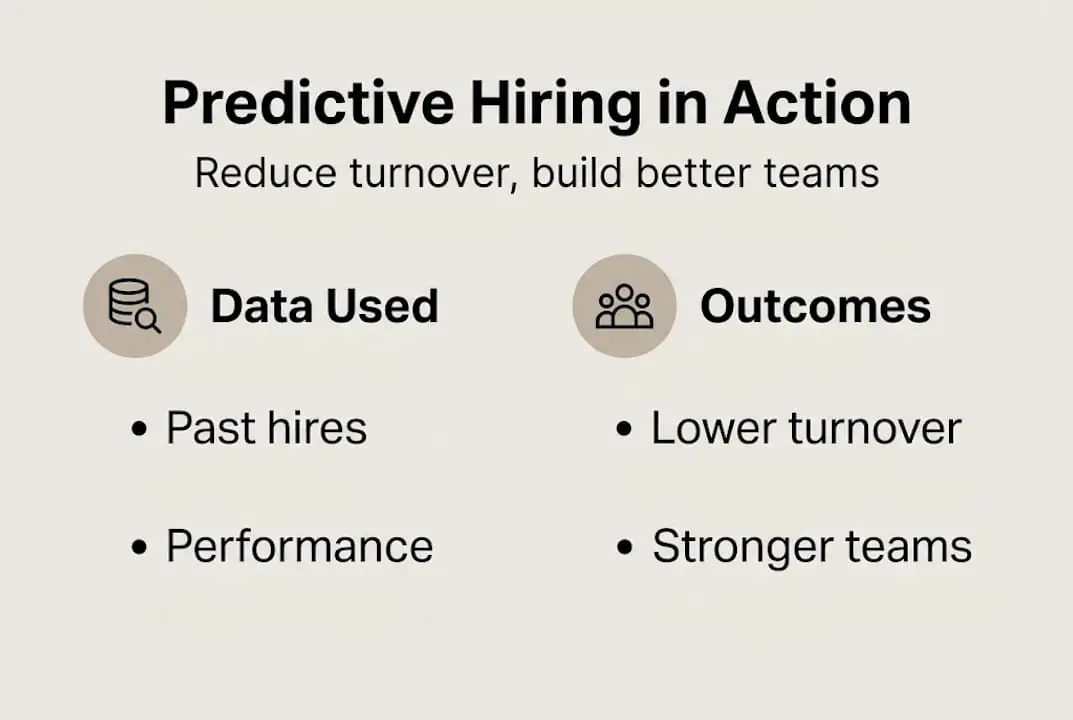
According to the predictive hiring glossary, predictive hiring uses statistical models and behavioral data to evaluate candidates against profiles built from your highest-performing employees. It’s not about finding someone who looks good on paper. It’s about finding someone whose traits, patterns, and tendencies statistically align with success in your specific environment.
Here’s how predictive hiring compares to traditional methods at a glance:
| Factor | Traditional hiring | Predictive hiring |
|---|---|---|
| Evaluation basis | Resume + interview impressions | Historical data + behavioral models |
| Culture fit assessment | Subjective judgment | Data-matched profiles |
| Bias risk | High | Reduced with proper audits |
| Speed | Often slow | Up to 86% faster in pilot cases |
| Retention prediction | Minimal | Core feature |
The benefits for medium to large organizations are real and measurable. Here’s what machine learning in HR consistently delivers when predictive hiring is implemented well:
- Stronger quality of hire because candidates are scored against success patterns, not just job descriptions
- Higher retention rates because the model identifies candidates likely to stay, not just perform short term
- Faster time-to-hire by surfacing top candidates earlier in the funnel
- More consistent decisions across hiring managers and teams
- Reduced costs tied to bad hires and repeated recruitment cycles
For HR leaders managing growing teams, predictive hiring isn’t just a tech upgrade. It’s a structural shift in how talent decisions get made. 📈
How predictive hiring works: The process from data to decisions
Now that you know what predictive hiring is, let’s dig into exactly how the process works in practice.
The mechanics are more straightforward than they sound. Predictive analytics in recruiting typically follows a clear workflow: collecting historical data on past hires’ performance and retention from your ATS or HRIS, building success profiles of top performers, then using machine learning models to score candidates on fit. Classification models, regression analysis, random forest algorithms, and gradient boosting are the most common approaches. From there, the process integrates assessments and structured interviews, keeps humans in the loop for final decisions, and refines the model continuously as new data comes in.
Here’s a practical breakdown of the full workflow:
- Gather historical data. Pull performance scores, retention records, and skills data from your ATS and HRIS systems. This is your foundation.
- Build success profiles. Identify what your top performers actually have in common. Skills matter less than you think. Personality traits and behavioral tendencies matter more.
- Train the predictive model. Feed your success profiles into an ML algorithm that learns which incoming candidate signals correlate with long-term performance.
- Score and rank candidates. The model evaluates new applicants and assigns fit scores based on how closely they match your top performer profiles.
- Integrate assessments. Layer in psychometric tools, personality assessments, or structured video interviews to add qualitative depth to the quantitative scores.
- Human review and decision. Hiring managers review the ranked candidates with model insights in hand. The algorithm informs, not replaces, judgment.
- Refine continuously. As new hires onboard and performance data accumulates, the model updates. It gets smarter over time.
The analytics in HR that power these models are only as good as the data you feed them. That’s why clean, unbiased historical records are non-negotiable before you launch. For teams managing data-driven talent management, starting with the cleanest available data produces the most reliable early results.
Pro Tip: Start with a simpler, transparent model rather than a complex black box algorithm. Logistic regression or decision trees are easier to explain to stakeholders and easier to audit for bias, which builds organizational trust faster.
The business impact: Turnover, costs, and team performance
Understanding the process sets the stage. Now, let’s back it up with concrete numbers on why predictive hiring is worth your attention.
The ROI is striking. Turnover reductions of 50 to 52% have been documented in real-world deployments, with case studies from organizations like Mindr and CareerBuilder showing 40 to 49% reductions. Cost-per-hire drops by around 30%. Time-to-hire shrinks by 25% on average, and in some implementations like ChinaMobile, hiring time fell by 86%. These aren’t projections. These are benchmarks from live programs.

| KPI | Traditional hiring | Predictive hiring |
|---|---|---|
| Turnover rate reduction | Minimal | Up to 52% |
| Cost-per-hire reduction | Baseline | Up to 30% lower |
| Time-to-hire improvement | Baseline | 25 to 86% faster |
| Quality of hire | Inconsistent | Consistently higher |
Real organizations are already seeing the shift. A few standout results worth noting:
- Mindr partnered with Cangrade and reduced turnover by over 40%, translating to significant cost savings across their hiring pipeline
- CareerBuilder applied predictive models to reduce attrition in high-volume roles with measurable results in under six months
- ChinaMobile’s pilot program cut total hiring time by 86%, freeing HR teams to focus on onboarding and development
For context, a bad hire at the manager level typically costs 1.5 to 2x annual salary when you factor in recruitment, onboarding, lost productivity, and the cascading impact on team morale. Multiply that across even a handful of poor hiring decisions per year and the financial case for predictive hiring becomes impossible to ignore.
The HR analytics explained framework behind these results isn’t magic. It’s pattern recognition applied at scale. Teams that pair predictive tools with a solid employee potential checklist see faster adoption and stronger early returns. 💡
Limitations, risks, and ethical considerations in predictive hiring
No innovation is risk-free, so before adopting, you need to understand predictive hiring’s practical and ethical boundaries.
The biggest risk? Bias amplification. If your historical hiring data reflects past discrimination, the model learns from that. It then encodes those patterns into future decisions at scale. That’s not a hypothetical concern. AI has made hiring worse in documented cases where organizations deployed models without rigorous fairness checks.
Here are the core risks every HR team needs to assess before going live:
- Biased training data that reflects historical inequities in hiring, performance scoring, or retention
- Model opacity where a black box algorithm produces scores that no one can interpret or challenge
- Compliance exposure under GDPR and CCPA, particularly around consent, data storage, and algorithmic transparency
- Small dataset limitations where teams with fewer hiring records don’t yet have enough data to build reliable models
- Over-reliance on prediction at the expense of human judgment in edge cases
The AI and hiring fairness debate is active and ongoing. Some researchers argue that even well-designed algorithms redefine fairness in ways that disadvantage certain groups. Others point out that AI talent acquisition done right consistently outperforms human decision-making on measurable fairness metrics.
“The question isn’t whether AI can improve hiring. It’s whether organizations are willing to invest in the oversight, auditing, and transparency required to make it work responsibly.”
Building organizational agility in HR means being willing to pause, test, and course-correct. That applies directly to predictive hiring rollouts.
Pro Tip: Run a bias audit before and after every major model update. Use diverse evaluation panels for your success profiles, and never treat a model score as the final word on a candidate.
Our take: What most guides miss about predictive hiring
Now that you see the landscape, let’s step back for a candid look at what actually works.
Most coverage of predictive hiring fixates on speed and cost savings. Those are real wins, but they’re not the deepest value. The real ROI lever is making culture fit measurable at scale. For years, culture fit has been the softest, most subjective criterion in hiring. Predictive models, when built with personality and behavioral data rather than just skill signals, finally give it structure.
At Sparkly, we’ve seen this firsthand. Skills can be learned. Personality patterns and behavioral tendencies are far more stable and far more predictive of how someone will actually function inside a team. That’s exactly why we combine human judgment, AI, psychometric tools, and Human Design into one framework rather than leaning on any single source.
Simple, transparent models plus consistent human oversight outperform black box complexity, especially for HR teams just getting started. And fairness audits aren’t a compliance checkbox. They’re a trust-building exercise with your own organization. Most guides understate the change management required to shift teams from gut instinct to data-informed decisions. That shift takes time, transparency, and strong internal champions who understand analytics for employee fit.
Take the next step: Tools and resources for predictive hiring
Ready to experiment with or upgrade your hiring systems? Here’s where to learn more and take action.
Sparkly is built specifically for HR teams who want to go beyond skills-based screening and get real clarity on who someone is, how they think, and how they’ll perform inside your unique team structure. We merge four data sources including human insight, AI signals, psychometric assessments, and Human Design to surface the highest-probability candidates for every role.
Explore how SaaS in HR is reshaping talent decisions for medium to large businesses. Get practical guidance through our employee fit assessment guide, or compare leading platforms with our breakdown of top talent evaluation SaaS tools. Your next great hire is a data point away.
Frequently asked questions
How does predictive hiring reduce employee turnover?
Predictive hiring identifies candidates more likely to stay by analyzing past data on performance and retention. Turnover reductions up to 52% have been documented in real organizational case studies.
Can small teams or companies use predictive hiring?
Yes, small teams can run pilots, but data quality matters most. Start with cleaner datasets and simpler models before scaling to more complex algorithms.
What data does predictive hiring need?
It relies on historical hiring records, performance scores, and retention data from ATS and HRIS systems. Past hire performance data from these platforms forms the model’s foundation.
Are there legal or ethical issues with predictive hiring?
Yes. Organizations must monitor for bias, maintain transparency, and comply with GDPR and CCPA. Fairness and compliance checks are non-negotiable to avoid reputational and legal exposure.