Master the team realignment workflow: 74% lower turnover

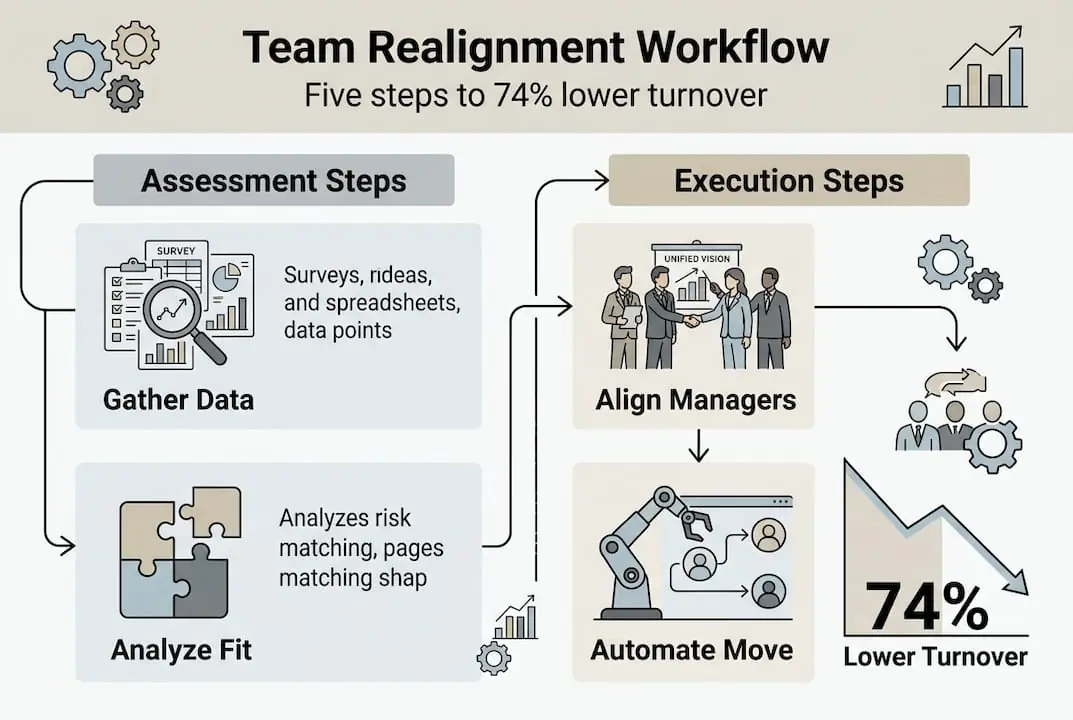
Mid-sized enterprises face mounting pressure to optimize team performance while controlling turnover costs. Traditional realignment approaches often overlook the critical role of personality fit, leading to mismatched placements and employee disengagement. This guide presents a data-driven workflow that prioritizes personality assessment over skills alone, combining multiple validation sources to identify optimal team configurations. By following this systematic approach, HR professionals can reduce turnover by up to 74% while building more resilient, high-performing teams through strategic employee shifts.
Table of Contents
- Key takeaways
- Preparing for team realignment: assessment and data gathering
- Executing the team realignment workflow step by step
- Verifying team realignment success and continuous improvement
- Optimize your team realignment with Sparkly HR solutions
- FAQ
Key Takeaways
| Point | Details |
|---|---|
| Personality alignment reduces turnover | Prioritizing personality fit over skills leads to better placements and lower turnover. |
| Automated realignment workflows | Automating the transfer process minimizes disruption and speeds up realignment. |
| Data driven realignment boosts performance | A data driven approach uses diverse sources to improve team performance and engagement. |
| Multiple validation sources improve accuracy | Using multiple validation sources increases confidence in team configurations. |
Preparing for team realignment: assessment and data gathering
Effective team realignment starts long before moving anyone. You need comprehensive personality data from multiple sources to make informed decisions. Job fit analysis includes defining roles and gathering personality data from diverse sources like ML assessments and AI communications.
Start by mapping each role’s personality requirements alongside technical skills. What communication styles work best? Does the position require high resilience under pressure or collaborative problem solving? Document these criteria in specific, measurable terms. Generic descriptions like “team player” fail to capture the nuanced personality traits that predict success.
Collect personality data through four complementary channels: structured psychometric assessments, AI analysis of communication patterns, manager observations, and self-reported preferences. Each source has inherent biases, but combining them creates higher-probability insights. Psychometric tests provide standardized baselines, while AI can detect patterns in email tone and meeting participation that humans miss. Manager input adds contextual understanding, and employee self-assessment reveals motivations and preferences.
Research shows that team resilience profiles predict turnover risk with remarkable accuracy. Teams with mid-range resilience traits experience 74.2% lower turnover compared to those at extremes. Build resilience profiles for each team member by assessing stress tolerance, adaptability, and recovery capacity. These profiles become your roadmap for identifying who thrives in high-pressure environments versus those better suited for steady-state operations.
Create an assessment toolkit covering these personality dimensions:
- Communication preference (direct vs. nuanced, verbal vs. written)
- Decision-making style (analytical vs. intuitive, independent vs. collaborative)
- Stress response patterns (energized vs. depleted, proactive vs. reactive)
- Learning orientation (structured vs. experimental, individual vs. social)
- Change tolerance (embraces novelty vs. prefers stability)
Pro Tip: Schedule assessments during normal work periods, not during crunch times or immediately after major changes. Stress skews results and gives you an inaccurate baseline for personality traits.
Organize your data in a centralized dashboard that tracks personality metrics alongside performance indicators. This visibility helps you spot patterns like high performers with mismatched team dynamics or struggling employees who might excel in different configurations.
| Assessment Type | Data Points Captured | Reliability Score |
|---|---|---|
| Psychometric tests | Standardized personality traits | 72% |
| AI communication analysis | Interaction patterns, tone | 68% |
| Manager observations | Contextual behavior, team fit | 64% |
| Self-assessment | Preferences, motivations | 61% |
| Combined multi-source | Integrated personality profile | 89% |
The job fit analysis personality focus approach emphasizes that skills can be taught, but personality traits remain relatively stable. Prioritize personality alignment in your data gathering phase to build the foundation for successful realignment decisions.
Executing the team realignment workflow step by step
With assessment data in hand, execute your realignment through a structured workflow that minimizes disruption and maximizes acceptance. Internal employee transfer workflows typically include manager alignment, compensation validation, budget checks, timing coordination, and record updates, all automated in under 5 minutes with modern tools.

Step 1: Align managers on needs and role fit. Schedule joint sessions where sending and receiving managers review personality profiles and performance data together. Discuss how the employee’s traits match the destination role’s requirements. Managers must agree on the transfer rationale and timing to prevent mixed messages that confuse the employee.
Step 2: Validate compensation and budget impact. Review whether the move requires salary adjustments based on role level, location, or market rates. Calculate budget implications across both departments and secure approvals before communicating with the employee. Compensation surprises derail otherwise smooth transitions.
Step 3: Coordinate timing and communicate transparently. Map out project commitments, knowledge transfer needs, and team capacity on both sides. Select a transition date that allows the employee to wrap current responsibilities without abandoning teammates. Communicate the change directly and early, explaining how their personality strengths align with the new role’s demands.
Step 4: Use participatory self-selection to involve employees. Reteaming best practices show that participatory self-selection and domain analysis approaches like Wardley mapping improve team flow and reduce cognitive load during realignment. Present employees with role options that match their personality profiles and let them choose their preferred path. This approach increases buy-in and reduces resistance.
Step 5: Implement workflow automation to minimize manual errors. Modern platforms handle the administrative burden of transfers, including updating HR systems, access permissions, reporting structures, and payroll allocations. Automation eliminates the delays and mistakes that plague manual processes.
| Process Aspect | Manual Approach | Automated Workflow |
|---|---|---|
| Manager alignment | Multiple email threads, 3-5 days | Integrated approval system, same day |
| Compensation validation | Spreadsheet calculations, 2-3 days | Automated rules engine, 15 minutes |
| System updates | IT tickets, 5-10 days | API integrations, instant |
| Documentation | Scattered files, incomplete | Centralized audit trail, complete |
| Total timeline | 2-3 weeks | Under 5 minutes |
The team member shifting workflow optimal teams emphasizes evolutionary reteaming over sudden big-bang reorganizations. Make incremental shifts that allow teams to adapt gradually rather than wholesale restructuring that disrupts established relationships and knowledge networks. Move one or two people at a time, observe the impact, and adjust before making additional changes.
Pro Tip: Create transition buddies by pairing the transferring employee with someone in their destination team who has complementary personality traits. This accelerates onboarding and helps the new team member navigate unwritten norms.
Integrate personality insights throughout the workflow by referencing specific traits in manager discussions and employee communications. Instead of vague statements like “you’ll be a good fit,” explain that “your analytical decision-making style and preference for structured processes align perfectly with the compliance team’s requirements.” This specificity builds confidence and demonstrates thoughtful placement.
Follow hiring process best practices boost team alignment principles during internal moves just as you would for external hires. Conduct role-specific interviews, provide realistic job previews, and set clear expectations about responsibilities and team dynamics.
Verifying team realignment success and continuous improvement
Realignment success depends on systematic measurement and ongoing refinement. Track outcomes rigorously to validate that personality-focused placements deliver the promised benefits. Monitoring turnover and team resilience post-realignment enables targeted interventions and performance optimization.
Establish baseline metrics before making changes: current turnover rates by team and role, employee engagement scores, performance ratings, and time to productivity for new team members. These benchmarks let you quantify improvement after realignment. Without pre-change data, you’re guessing about impact.
Track turnover changes against baseline metrics by monitoring departure rates in realigned teams over 6 and 12 month periods. Calculate whether personality-aligned placements reduce unwanted attrition compared to your baseline. Segment the data by voluntary versus involuntary departures and high versus low performers to understand which groups benefit most from improved fit.
Assess ongoing personality fit and team member satisfaction through quarterly pulse surveys that probe role alignment, team dynamics, and work environment preferences. Ask specific questions about whether employees feel their strengths are utilized and whether team interactions energize or drain them. Generic engagement surveys miss the personality-specific signals that predict retention.
Use resilience profiles to guide future teaming decisions by analyzing which personality combinations create stable, high-performing units. Document patterns like “teams with 2-3 members showing high adaptability plus 1-2 with strong stability preferences achieve best results under changing requirements.” These insights become decision rules for subsequent realignments.
Leverage data dashboards to visualize key realignment KPIs in real time:
- Turnover rate trends by team and role type
- Personality fit scores for current placements
- Time to full productivity after transfers
- Manager satisfaction with team composition
- Employee engagement trajectories post-move
Dashboard visibility helps you spot emerging issues before they escalate. A sudden dip in engagement scores for a realigned team signals the need for intervention, while sustained improvement validates your approach.
| Success Metric | Target | Measurement Frequency |
|---|---|---|
| Voluntary turnover reduction | 40-60% decrease | Quarterly |
| Personality fit score | 85%+ alignment | Monthly |
| Time to productivity | 30% faster onboarding | Per transfer |
| Manager satisfaction | 4.5+ out of 5 | Quarterly |
| Employee engagement | 15+ point increase | Bi-annually |
Establish feedback loops for proactive team adjustments by scheduling monthly reviews of team performance and personality dynamics. Invite managers and team members to share observations about what’s working and where friction persists. Use this qualitative input to refine personality profiles and placement criteria.
Pro Tip: Create a “realignment retrospective” template that captures lessons learned from each major team shift. Document what personality combinations worked well, which transitions faced unexpected challenges, and how you’d approach similar moves differently. This institutional knowledge compounds over time.
The role of analytics in hr extends beyond initial placement decisions to continuous optimization. Build predictive models that identify early warning signs of misalignment, such as declining communication patterns or shifting stress indicators. Proactive interventions prevent turnover before employees mentally check out.
Apply talent assessment tips for better team dynamics during verification phases by reassessing personality fit at 30, 90, and 180 day intervals post-transfer. Personalities don’t change, but how they manifest in new team contexts can surprise you. Regular reassessment catches mismatches early when course correction is still straightforward.
Compare realignment outcomes across different personality-focused approaches to identify which assessment methods and placement criteria deliver the strongest results in your specific organizational context. What works in a fast-paced startup may differ from a regulated enterprise environment. Continuous experimentation and measurement drive improvement.
Optimize your team realignment with Sparkly HR solutions
Transforming team realignment from reactive shuffling to strategic optimization requires specialized tools and expertise. Sparkly HR provides a comprehensive platform that merges psychometric assessments, AI communication analysis, Human Design insights, and manager observations into unified personality profiles with higher predictive accuracy than any single source.
Our personality strategies help you assess employees effectively by focusing on traits that truly matter for role fit and team dynamics, not just skills that can be taught. The platform automates the entire team member shifting workflow, from initial assessment through transfer execution and post-move verification, reducing administrative burden while improving placement quality.
Explore our employee fit assessment guide to discover proven frameworks for cutting turnover costs through personality-aligned placements. The guide includes assessment templates, decision matrices, and case studies from mid-sized enterprises that achieved 50-70% turnover reduction within 12 months of implementing personality-focused realignment workflows.
FAQ
How do I identify which employees need to be realigned in a team?
Use multi-source personality assessments combined with performance feedback to identify misaligned employees showing signs of disengagement or underperformance despite adequate skills. Look for patterns where personality traits clash with role requirements or team dynamics, such as highly autonomous individuals in rigidly collaborative environments. Assess employee fit by comparing current placement personality demands against individual profiles to spot mismatches. Focus realignment efforts where turnover risk is highest based on resilience profiles and engagement scores.
What tools can help automate the team realignment workflow?
Modern SaaS tools streamline process steps such as manager alignment and budget validation through integrated approval workflows and automated compliance checks. Automation tools like TeamOhana complete internal employee transfers in under 5 minutes with compliance checks. These platforms connect HR systems, payroll, access management, and documentation into unified workflows that eliminate manual data entry and reduce errors. Optimize job shift workflow solutions also incorporate personality assessment data directly into transfer recommendations and approval processes.
How does personality diversity affect turnover and team performance?
Diverse personalities improve resilience and reduce turnover risk by creating teams that handle varied challenges and perspectives more effectively than homogeneous groups. Mid-range resilience and diverse personality traits correlate with up to 74.2% lower turnover and better performance. However, personality homogenization can improve fit but risks blind spots and increased turnover when team composition becomes too uniform. Balance is essential: enough diversity to maintain adaptability without creating constant friction from incompatible working styles.
How long does it take to see results from personality-based team realignment?
Initial engagement improvements typically appear within 30-60 days as employees settle into roles that better match their natural working styles and preferences. Measurable turnover reduction becomes evident after 6-12 months, allowing enough time for the full impact of improved fit to manifest. Performance gains follow a similar timeline, with productivity increases becoming statistically significant around the 90-day mark. Set realistic expectations with leadership that personality-focused realignment is a medium-term investment, not an overnight fix, but delivers compounding returns as you refine placement criteria based on outcomes.
What are the most common mistakes in team realignment workflows?
Skipping comprehensive personality assessment and relying solely on skills or manager intuition leads to mismatched placements that recreate the problems you’re trying to solve. Rushing the process without proper manager alignment and employee communication generates resistance and rumors that undermine even well-planned moves. Failing to establish baseline metrics means you can’t demonstrate success or identify what’s working. Making too many simultaneous changes overwhelms teams and prevents you from isolating which shifts drive positive outcomes. Finally, treating realignment as a one-time event rather than an ongoing optimization process misses opportunities for continuous improvement based on feedback and results.