Job Redesign Explained: A Practical HR Guide

TL;DR:
- Job redesign involves deliberately restructuring roles to align with organizational goals and employee strengths. It enhances engagement, reduces turnover, and boosts productivity through strategies like enrichment, enlargement, rotation, and task auditing. Incorporating personality fit and AI-driven insights ensures successful, ongoing role optimization.
Job redesign is defined as the deliberate restructuring of a role’s tasks, responsibilities, and workflows to better align with both organizational goals and employee strengths. Known formally in HR practice as work redesign or job restructuring, it is one of the most direct levers managers have for improving engagement, reducing turnover, and unlocking productivity that is already sitting inside your current workforce. Resources like AIHR, Training Journal, and government programs such as the Job Redesign+ grant confirm that this is not a soft HR initiative. It is a structured, evidence-based process with measurable outcomes.
What is job redesign? core methods and strategies explained
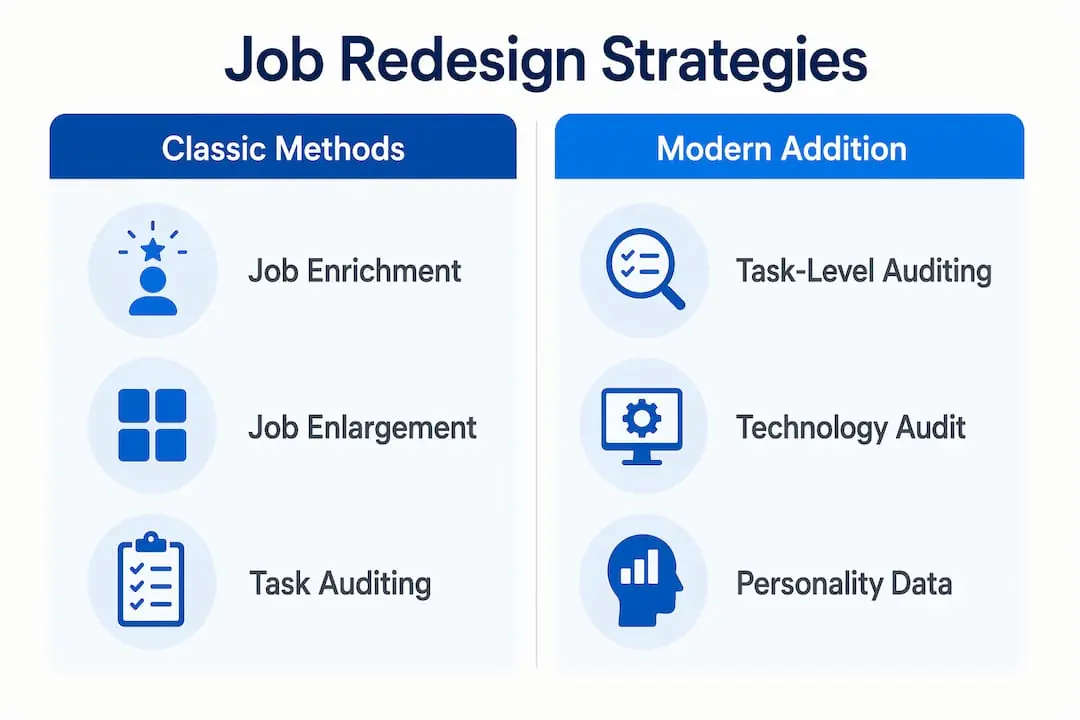
Job redesign covers three classic strategies that HR professionals have used for decades: job enrichment, job enlargement, and job rotation. Each one targets a different dimension of how work is experienced.

Job enrichment and enlargement are two major strategies that keep employees engaged and productive. Enrichment adds vertically, giving employees more challenging, meaningful tasks and greater decision-making authority. Enlargement adds horizontally, expanding the scope of work at the same level of complexity. Job rotation moves people across roles periodically to build skills and reduce monotony.
More recent thinking adds a fourth approach: task-level auditing. This means breaking a role down into its smallest components and asking which tasks add value, which can be automated, and which are simply habits from the past. This is where modern redesign gets genuinely interesting.
| Strategy | Primary Impact | Complexity | Best Use Case |
|---|---|---|---|
| Job Enrichment | Higher engagement and ownership | Medium | Experienced employees feeling under-challenged |
| Job Enlargement | Broader skill use, reduced boredom | Low | Roles with narrow, repetitive scope |
| Job Rotation | Cross-functional capability building | Medium | Teams needing flexibility and succession depth |
| Task-Level Audit | Efficiency gains, waste elimination | High | AI-driven redesign, workflow transformation |
Pro Tip: Audit for “ghost tasks” before you redesign anything. These are obsolete activities that employees still perform out of habit, with no current business justification. They are especially common in senior roles and quietly consume hours every week.
How is a structured job redesign process conducted?
A six-step redesign process moves from goal alignment through to pilot testing before any changes go live. Each step builds on the last, and skipping any one of them is where most redesign efforts break down.
- Goal alignment. Define what the redesign is meant to achieve. Design requirements vary significantly depending on whether your priority is cost reduction, cycle time improvement, quality, capacity, or strategic flexibility. Be specific.
- Evidence gathering. Use time sampling, stakeholder interviews, and direct observation to map what employees actually do versus what their job descriptions say they do. The gap is almost always larger than expected.
- Task grouping. Cluster tasks by type, skill requirement, and energy demand. This step reveals natural role boundaries and often surfaces tasks that belong in a different role entirely.
- Performance metrics. Define how you will measure success after redesign. Metrics might include output quality, time-on-task, employee satisfaction scores, or absenteeism rates.
- Documentation and payroll mapping. Update job descriptions, competency frameworks, and payroll classifications to reflect the new role structure. Misalignment here creates legal and compensation risk.
- Pilot testing. Run the redesigned role with a small group before full deployment. Collect feedback, measure against your metrics, and adjust before scaling.
Pro Tip: Involve employees directly in steps two and three. People doing the work know where the friction is. Their input also increases buy-in, which makes the transition significantly smoother.
The optimize job shift workflow approach from Sparkly adds a layer that most frameworks miss: personality data. Knowing whether an employee’s natural working style fits the redesigned role prevents you from solving a structural problem while creating a person-role mismatch.
What are the benefits and pitfalls of job redesign?
Job design, not perks, is the true foundational strategy for employee wellbeing, according to Professor Carol Atkinson. That finding reframes the entire conversation. Companies spend heavily on wellness programs, flexible benefits, and office perks, while the actual source of disengagement sits in the structure of the work itself.
The documented benefits of a well-executed redesign include:
- Improved productivity. Removing ghost tasks and clarifying responsibilities reduces wasted effort and decision fatigue.
- Higher engagement. Roles that match an employee’s strengths and interests generate intrinsic motivation that no bonus program can replicate.
- Better retention. Employees who feel their role fits their abilities and values are far less likely to leave.
- Role clarity. Redesign forces organizations to articulate what each role actually requires, which improves hiring, onboarding, and performance management.
The pitfalls are equally real, and they are worth naming directly:
- Autonomy without compensation. Giving employees autonomy without matching pay expectations can worsen satisfaction, even when the intent is enrichment. Always pair increased responsibility with a compensation review.
- Superficial changes. Renaming a role or adding a task without addressing the underlying workflow problems produces no measurable benefit and erodes trust in the process.
- Increased workload without support. Enlargement that simply piles on tasks without removing others creates burnout, not engagement.
- Ignoring personality fit. Redesigning a role around tasks alone, without considering whether the person in it has the natural disposition to thrive, is a structural fix that misses the human variable entirely.
How has AI changed the way we redesign jobs?
The traditional question in job redesign was binary: should a human do this task, or should it be automated? That question is now obsolete. AI transforms jobs from manual task execution to value orchestration, where humans and AI systems collaborate on tasks rather than compete for them.
This shift has practical consequences for how you conduct a redesign. Task-level audits now need to account for three categories: tasks that humans do best, tasks that AI does best, and tasks that require human-AI collaboration. The third category is growing fastest and is the least understood.
Between 20% and 40% of tasks in typical roles can be streamlined, automated, or reassigned through redesign. That is a significant portion of any role, and it represents real capacity that organizations can redirect toward higher-value work.
The critical warning here comes from successful AI-driven redesign research: start with task decomposition, not technology selection. Organizations that begin by choosing an AI tool and then fitting their workflows around it end up automating inefficient processes rather than improving them. The sequence matters enormously.
For HR professionals, this means your redesign process now needs to include a technology audit alongside the task audit. Which tools are already in use? Which tasks are candidates for AI assistance? And critically, which employees have the cognitive and personality profile to work effectively alongside AI systems? The role of HR technology in answering that last question is growing fast.
Key takeaways
Job redesign delivers measurable gains in engagement and retention only when it starts with honest task analysis, accounts for personality fit, and pairs any increase in responsibility with appropriate compensation.
| Point | Details |
|---|---|
| Start with task decomposition | Break roles into elemental tasks before selecting tools or making structural changes. |
| Use the six-step process | Move from goal alignment through pilot testing to reduce risk and improve outcomes. |
| Pair autonomy with pay | Increased responsibility without compensation review often worsens satisfaction. |
| Audit for ghost tasks | Eliminating obsolete activities frees senior employee time for higher-value work. |
| Match redesign to personality | Structural fixes fail when the person in the role lacks the natural fit for the new design. |
The part most job redesign guides won’t tell you
I have seen organizations run thorough redesign processes, follow every step correctly, and still end up with disengaged employees six months later. The reason is almost always the same: they redesigned the role without understanding the person in it.
The assumption built into most redesign frameworks is that if you get the task structure right, engagement follows. That is partially true. But it ignores a fundamental reality: two people with identical skills can experience the same role completely differently based on their personality, energy patterns, and working style. Job enrichment that feels motivating to one person feels overwhelming to another. Autonomy that one employee craves makes another anxious.
This is why I believe the most important shift in redesign practice right now is moving from task-centered analysis to person-task fit analysis. You need both. The task audit tells you what the role should contain. The personality assessment tells you whether the person currently in it, or the person you are about to hire, will actually thrive in that structure.
The other thing I would push back on is the tendency to treat redesign as a one-time project. Work changes continuously, especially with AI entering more workflows every quarter. The organizations getting the most value from redesign treat it as an ongoing practice, not a periodic initiative. They build the capability to audit, adjust, and realign roles as the work itself evolves.
Start with the tasks. Stay close to the people. And be honest about what your redesign is actually trying to achieve, because cost reduction and engagement improvement require very different design choices.
— Mikk
How Sparkly supports smarter job redesign ⚡️
Job redesign works best when you have reliable data about both the role and the person in it. Sparkly is built exactly for that. It combines psychometric assessments, Human Design, AI analysis, and human judgment to give HR teams a clearer picture of personality-based role fit than any single source can provide on its own.
Where most tools assess skills, Sparkly assesses personality first, because skills can be learned but natural working style cannot be easily changed. That distinction matters enormously in redesign work. When you know how a person processes information, manages energy, and responds to autonomy, you can redesign roles that actually fit, not just roles that look good on paper. Explore how Sparkly’s employee fit assessment approach helps reduce turnover and make redesign decisions that stick.
FAQ
What is job redesign in simple terms?
Job redesign is the process of changing a role’s tasks, responsibilities, or workflows to better match organizational goals and employee strengths. The goal is to improve productivity, engagement, and retention.
Why should organizations use job redesign?
Job design is the foundational driver of employee wellbeing and engagement, far more than perks or benefits programs. Redesign addresses the root cause of disengagement rather than masking it.
What are the main job redesign strategies?
The three classic strategies are job enrichment (adding challenge and authority), job enlargement (broadening scope at the same level), and job rotation (moving employees across roles). Task-level auditing is a fourth, increasingly important approach in AI-influenced workplaces.
How long does a job redesign process take?
A structured six-step process, from goal alignment through pilot testing, typically takes several weeks to a few months depending on role complexity and organizational size. Skipping the pilot phase is the most common cause of failed rollouts.
What is the biggest mistake in job redesign?
Starting redesign with technology rather than task decomposition is the most common error. Organizations that choose tools first end up automating inefficient processes instead of improving them.