
Job Enrichment Steps to Boost Engagement & Retention

TL;DR:
- Job enrichment expands roles to include autonomy, responsibility, and purpose, boosting engagement and reducing turnover.
- Successful implementation requires organizational assessment, employee involvement, clear communication, and ongoing feedback.
- Leadership buy-in, continuous practice, and personalized approaches are crucial for sustaining long-term enrichment benefits.
High turnover and disengaged teams are costing mid-sized companies far more than most HR managers realize. The good news? Job enrichment reduces turnover by 18 to 43% in engaged firms and cuts burnout by 81%. These aren’t theoretical promises. They’re measurable outcomes that forward-thinking HR leaders are achieving right now. This guide walks you through exactly what job enrichment is, how to prepare your organization for it, and how to execute it step by step. If you’re serious about building a team that stays, grows, and performs, you’re in the right place.
Table of Contents
- Understanding job enrichment and its impact
- Key prerequisites for effective job enrichment
- The step-by-step job enrichment process
- Troubleshooting and ensuring long-term success
- A practitioner’s take: Why most job enrichment fails (and how to get it right)
- Unlock your team’s potential with Sparkly HR
- Frequently asked questions
Key Takeaways
| Point | Details |
|---|---|
| Job enrichment boosts retention | Redesigning roles for more variety and responsibility helps cut turnover by up to 43%. |
| Preparation is critical | Gather feedback and analyze current roles before launching enrichment initiatives. |
| Follow step-by-step process | Involve employees, update job descriptions, and provide training for the best outcomes. |
| Overcome common pitfalls | Sustain success with regular feedback, measurement, and leadership support. |
Understanding job enrichment and its impact
Job enrichment is the practice of expanding an employee’s role to include greater variety, deeper meaning, and real autonomy over how work gets done. It goes beyond simply assigning more tasks. The goal is to make work feel purposeful and motivating at its core.
It’s worth clarifying how job enrichment differs from two related concepts:
| Concept | What it adds | Effect on motivation |
|---|---|---|
| Job enrichment | Autonomy, responsibility, variety, growth | High |
| Job enlargement | More tasks at the same level | Low to moderate |
| Job rotation | Movement between existing roles | Moderate |
Job enrichment is the only approach that targets the psychological drivers of motivation, which is why 71% of successful redesign interventions are linked to it and higher performance outcomes. Enlargement and rotation are useful supplements, but they rarely move the needle on their own.
Here’s what enriched roles typically include:
- Skill variety: Tasks that draw on different abilities and keep work interesting
- Task identity: Ownership of a complete piece of work with a visible outcome
- Task significance: A clear sense that the work matters to the team or company
- Autonomy: Freedom to decide how and when tasks are completed
- Feedback: Regular, meaningful information about performance and impact
For mid-sized companies especially, evaluating job roles against these five dimensions gives you a clear diagnostic for where enrichment is most needed. It also helps you prioritize resources rather than trying to overhaul every role at once.
The research backing for enrichment is strong. When employees feel their roles are meaningful and they have control over their work, engagement rises, satisfaction improves, and the desire to leave shrinks. Building a high-performing workforce consistently involves making this shift from transactional roles to purposeful ones. Enrichment is the structured way to get there. âš¡ï¸
Key prerequisites for effective job enrichment
Now that you know what job enrichment is, here’s how to prepare your organization for success. Jumping into enrichment without preparation is one of the most common mistakes. You need real data from the people doing the work before you change anything.
Start with a structured assessment. Use short surveys or one-on-one interviews to surface what employees actually find repetitive, frustrating, or under-stimulating. Ask directly: what parts of your job feel most meaningful? What feels like a waste of your abilities? These conversations reveal enrichment opportunities faster than any org chart review.
| Assessment method | Best used for | Time investment |
|---|---|---|
| Pulse surveys | Quick, broad data from many employees | Low |
| One-on-one interviews | Deep insights from key roles | Medium |
| Manager feedback sessions | Identifying team-level patterns | Medium |
| Job description audits | Spotting outdated or narrow role definitions | Low |
Engaged firms saw 81% less burnout after enrichment initiatives, and that kind of outcome starts here, with honest data collection before any changes are made.
Once you have feedback, review job descriptions systematically. Look for roles dominated by repetitive, low-complexity tasks with no path to growth. These are your highest-priority enrichment candidates. Flag positions where talented people are likely underutilized.

You’ll also want to loop in frontline managers early. They know where the friction lives. Using HR management tools for engagement can help you structure this collaboration and keep feedback organized across departments.
Here’s what strong preparation looks like in practice:
- Run a satisfaction and motivation pulse survey before making any changes
- Audit at least five job descriptions per department for enrichment gaps
- Hold manager briefings to align on enrichment goals
- Set measurable baselines: current turnover rates, engagement scores, absenteeism
Pro Tip: Don’t skip the personality dimension. Skills can be learned, but personality shapes how someone experiences autonomy, responsibility, and feedback. Using a personality assessment approach at this stage helps you match enrichment strategies to individual motivators, not just role requirements. 💡
The step-by-step job enrichment process
Once you’re prepared, here’s a straightforward step-by-step guide to enriching job roles effectively.
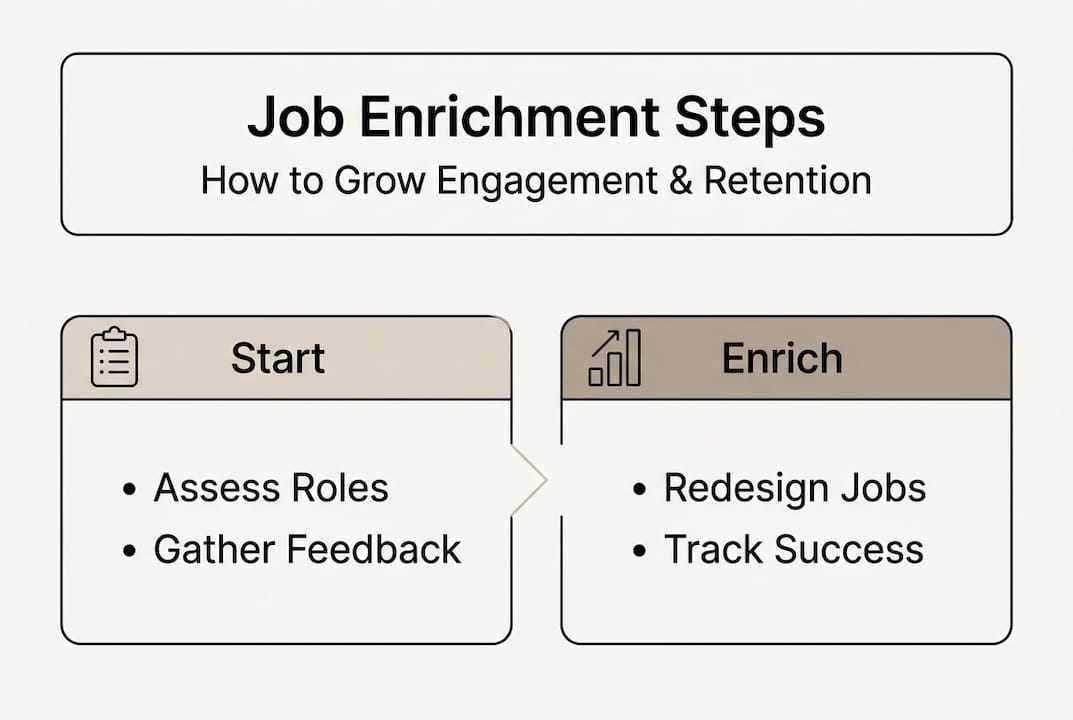
Step 1: Identify enrichment opportunities. Use your assessment data to pinpoint where roles lack variety, autonomy, or growth. Prioritize roles with the highest disengagement or turnover signals. Think about adding decision-making authority, cross-functional project involvement, or mentoring responsibilities.
Step 2: Involve employees in the redesign. This is non-negotiable. When employees co-create their enriched roles, buy-in follows naturally. Hold structured conversations or small workshops where team members suggest what they’d like more of in their work. Future-oriented job role changes always perform better when they reflect what employees actually want.
Step 3: Redraft job descriptions. Update role definitions to reflect the new scope. Be specific about added responsibilities, new decision-making latitude, and skill development opportunities. Vague language kills momentum.
Step 4: Communicate changes and provide training. Announce changes clearly and explain the why behind them. Pair new responsibilities with targeted training or coaching so employees feel supported, not overwhelmed. Job enrichment reduces turnover by 18 to 43%, but only when transitions are managed well.
Step 5: Monitor and adapt. Set a 60 to 90-day review checkpoint. Gather feedback from employees and managers. Track your baseline metrics. Adjust role definitions if something isn’t working.
“The best job enrichment programs don’t happen to employees. They happen with them. Co-creation is the difference between a policy change and a culture shift.â€
Pro Tip: When evaluating employee potential, look beyond current performance. Some of your highest-potential people are disengaged precisely because their roles don’t challenge them. Enrichment is often the reset they need.
Focusing on enhancing employee satisfaction through enrichment also pays off in recruitment. A reputation for meaningful work attracts stronger candidates without inflating your salary budget. 📈
Troubleshooting and ensuring long-term success
With your enrichment steps in place, here’s how to handle obstacles and maintain progress long-term.
The most common pitfalls aren’t strategic. They’re operational. Here’s what derails enrichment programs most often:
- Over-complicating roles: Adding too much at once overwhelms employees instead of motivating them. Start small and build.
- Skipping feedback loops: Enrichment without ongoing feedback becomes stagnant quickly. Build in regular check-ins.
- Unclear objectives: If employees don’t know what success looks like in their enriched role, confusion replaces motivation.
- No leadership alignment: Managers who don’t believe in enrichment will quietly undermine it. Get them on board early.
Overcoming resistance takes patience and transparency. Share the data behind your initiative. Show employees what’s in it for them, concretely. When people see that enrichment isn’t about more work for the same pay but about more meaningful work and real growth opportunities, resistance drops significantly.
Companies implementing enrichment see long-term drops in burnout and turnover, but these gains require consistent maintenance. Enrichment isn’t a one-time project.
Key metrics to track:
- Monthly turnover rate: Compare pre- and post-enrichment figures
- Engagement scores: Use quarterly pulse surveys
- Absenteeism rate: A reliable proxy for disengagement
- Internal promotion rate: Signals that enrichment is building real capability
Pro Tip: Build celebration into your process. Recognizing employees who’ve grown into their enriched roles, publicly and specifically, reinforces the behavior you want to scale. It also signals to others that this initiative is real and valued.
For sustained success, pair enrichment with stronger hiring process best practices. Bringing in candidates whose personalities fit the culture and role complexity from day one reduces how much enrichment you need to retrofit later. An HR strategy for hiring that accounts for long-term fit pays dividends across the entire employee lifecycle.
A practitioner’s take: Why most job enrichment fails (and how to get it right)
Let’s take a step back and look at what separates theory from day-to-day HR success.
Most job enrichment programs fail not because the concept is flawed but because leadership treats it as a one-time initiative rather than an ongoing commitment. A workshop is run, job descriptions are tweaked, and then everyone moves on. Six months later, nothing has changed.
Real enrichment demands two things that are harder than they look: genuine leadership buy-in and a structured feedback culture. When managers don’t model autonomy and growth in their own behavior, employees don’t believe the initiative is real. Words on a revised job description don’t change how work actually feels.
The companies that get this right treat rethinking job evaluation as a continuous practice. They revisit roles quarterly. They ask employees what’s working. They adjust before problems escalate into turnover. Clear objectives, measurable outcomes, and honest conversations are the infrastructure that makes enrichment stick. Treat it as a process, not a checkbox, and the results will follow.
Unlock your team’s potential with Sparkly HR
Ready to turn these proven steps into real results? Here’s how Sparkly HR can help.
Sparkly HR is built specifically for HR managers and business owners who want to stop guessing about what makes their people tick. Our platform helps you transform employee potential by combining personality assessments, Human Design insights, AI analysis, and psychometric data into one clear picture of each team member.

When you understand personality first, job enrichment stops being a generic exercise and becomes a precise strategy. You’ll know which employees thrive with more autonomy, who needs variety to stay engaged, and who is ready for more responsibility. You can also cut turnover costs by matching roles to people more accurately from the start. Explore what’s possible at Sparkly HR and see how smarter assessments lead to stronger, more engaged teams.
Frequently asked questions
What is the difference between job enrichment and job enlargement?
Job enrichment adds variety, autonomy, and responsibility to a role, making work feel more meaningful and improving engagement. Job enlargement expands the number of tasks without increasing responsibility or tapping into motivational drivers.
How do you measure the success of job enrichment initiatives?
Track turnover rates, engagement scores, absenteeism, and productivity before and after enrichment. Measurable drops in turnover and burnout are the clearest signs that your program is working.
Is job enrichment suitable for all types of employees?
Most roles benefit from enrichment, but the approach must be tailored. 71% of redesign interventions show positive links to performance, and customizing enrichment to each employee’s personality and career goals produces the strongest results.
What are the common obstacles to successful job enrichment?
Resistance to change, unclear objectives, and lack of leadership support are the top barriers. Engaged firms overcame these through consistent communication, manager alignment, and structured feedback loops built into the process from day one.