
HR Digital Transformation: Boost Engagement, Cut Turnover

TL;DR:
- HR digital transformation shifts manual processes into AI-enabled, data-driven ecosystems to reduce turnover.
- Most companies are at early stages, needing system integration and analytics for meaningful insights.
- Successful transformation requires process redesign, leadership buy-in, and focus on human judgment over technology.
One company cut turnover by 15% and saved $7 million. Another slashed its turnover rate from 35% to 28% within a year. These aren’t outliers — they’re what happens when HR leaders stop patching manual processes and start building integrated digital HR ecosystems. For medium-sized companies where every departure costs real money and morale, HR digital transformation is no longer a future priority. It’s the lever that separates high-turnover organizations from high-engagement ones. This guide breaks down exactly what transformation means, how to benchmark your progress, and what steps actually move the needle.
Table of Contents
- What HR digital transformation really means
- The 6-stage maturity model for HR digital transformation
- Real-world case studies: From high turnover to engagement wins
- Best practices for your digital HR transformation
- What most HR leaders get wrong about digital transformation
- Transform your HR strategy with trusted tools and insights
- Frequently asked questions
Key Takeaways
| Point | Details |
|---|---|
| Digital transformation impact | Real digital HR strategies reduce turnover and improve engagement measurably. |
| Six-stage maturity model | HR digital transformation progresses through six clear stages from manual to AI-driven practices. |
| Case study evidence | Firms like Kemp & Lauritzen and GlobalMart cut turnover 7-15% with proven roadmaps. |
| Start small for success | Process audits and quick onboarding wins create momentum for long-term change. |
| Human over tech | Sustainable value depends on culture and agility, not just software investment. |
What HR digital transformation really means
With that high-impact result in mind, let’s clarify what HR digital transformation truly encompasses — and what it is not.
Most HR leaders have heard the term. Fewer agree on what it means. Some think it’s buying a new applicant tracking system. Others think it’s scanning paper files into the cloud. Both are wrong — and that confusion is exactly why so many transformation efforts stall before they deliver results.
HR digital transformation involves evolving HR from manual, fragmented processes into AI-enabled, data-driven ecosystems that connect every stage of the employee lifecycle.
That’s a meaningful shift. It’s not just about speed or convenience. It’s about generating insights you couldn’t access before — insights that tell you why people leave, who is likely to disengage next month, and which roles are misaligned with the people filling them.
For medium-sized companies, this matters especially because you’re operating without the HR army that enterprise firms have. You need your people processes to work smarter, not just faster.
Here’s what HR digital transformation actually solves:
- Fragmented data: Employee information scattered across spreadsheets, email threads, and disconnected tools
- Reactive hiring: Filling seats instead of predicting and preventing gaps
- Blind-spot assessments: Evaluating candidates on skills alone, missing personality fit and long-term potential
- Manual reporting: HR teams spending hours compiling data instead of acting on it
- Engagement guesswork: Not knowing who’s disengaged until they hand in their notice
The role of analytics in HR is central here. When data flows between your recruiting, onboarding, performance, and engagement tools, patterns emerge. Those patterns become decisions. And those decisions reduce turnover.
This is also where personality-first assessment becomes a competitive advantage. Skills can be taught. Personality shapes how someone works, collaborates, and grows — and data-driven talent management that accounts for personality fit consistently outperforms skills-only screening.
The 6-stage maturity model for HR digital transformation
Understanding the overall goal, the next step is to see where your organization stands along the transformation journey.
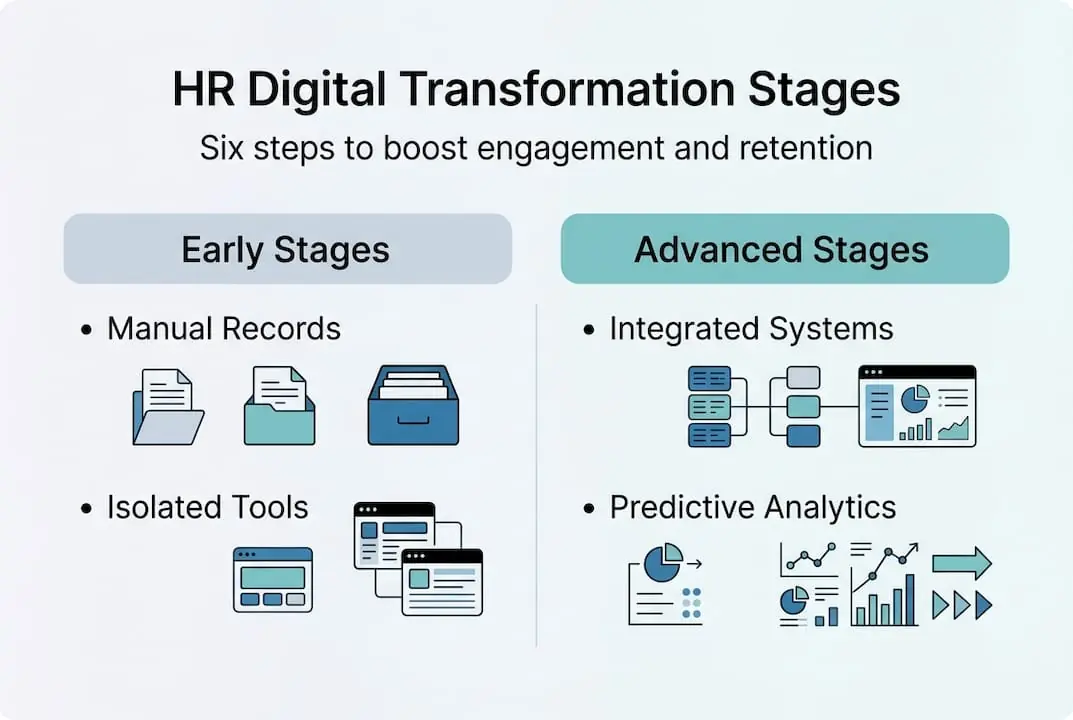
A maturity model gives you a map. Without one, you’re guessing whether you’re ready for predictive analytics or still stuck solving basic data hygiene problems. Key methodologies include a 6-stage maturity model that HR leaders can use to benchmark progress and prioritize next moves.
Here’s how the six stages break down:
- Manual: All HR processes run on paper or basic spreadsheets. No integration, no visibility.
- Digitized: Documents and records are stored digitally, but processes are still siloed.
- Integrated: Core HR systems talk to each other — payroll, ATS, and performance tools share data.
- Analytical: HR uses dashboards and reporting to track trends and make evidence-based decisions.
- Predictive: Machine learning flags flight risks, identifies high-potential employees, and forecasts hiring needs.
- Adaptive: HR continuously learns and adjusts using real-time data, AI recommendations, and agile operating models.
Most medium-sized companies sit between stages 2 and 3. They’ve digitized records but haven’t connected systems in a way that generates real insight. The jump from stage 3 to stage 4 is where HR analytics explained becomes essential reading for your team.
Moving up a stage isn’t just a technology purchase. It requires a process audit, leadership buy-in, and at least one visible quick win to build momentum. Onboarding and recruiting are usually the fastest areas to show ROI.
| Stage | Key capability | Common sign you’re here |
|---|---|---|
| Manual | Paper-based records | HR reports built in Excel weekly |
| Digitized | Digital storage | Files in Google Drive, no integration |
| Integrated | Connected systems | Payroll syncs with ATS automatically |
| Analytical | Reporting dashboards | Monthly turnover trends visible in real time |
| Predictive | ML-driven forecasting | System flags at-risk employees proactively |
| Adaptive | Continuous learning loop | HR strategy updates based on live signals |
Pro Tip: Run a quick internal audit. Ask your HR team how long it takes to pull a turnover report. If the answer is more than 30 minutes, you’re likely at stage 2 or below — and that’s your starting point.
Real-world case studies: From high turnover to engagement wins
Armed with a roadmap, it’s crucial to look at what’s possible — here are stories from the field.

Theory is useful. Numbers are better. These three cases show what happens when medium-sized and large organizations commit to real digital HR change.
Heidelberger Druckmaschinen AG partnered with Deloitte to roll out Workday across a complex global workforce. Implemented in 11 months, the project gave HR leaders a unified view of headcount, turnover, and personnel planning across regions. Before the rollout, global HR data was fragmented and slow. After, planning cycles shortened and leadership could act on workforce trends in near real time.
Kemp & Lauritzen, a Danish logistics company, implemented SAP SuccessFactors to address a serious retention problem. Turnover dropped from 35% to 28% within the first year. Onboarding satisfaction climbed to 4.0 out of 5, and 80% of employees were actively using the self-service portal within months of launch. That’s not just a tech win — it’s a culture shift.
GlobalMart used predictive analytics to identify the specific drivers behind employee departures. The result: a 15% reduction in turnover and $7 million in savings. The key wasn’t the algorithm — it was acting on what the data revealed about management quality, role fit, and compensation gaps.
📈 Stat to remember: A 7-point drop in turnover (35% to 28%) can save a 200-person company hundreds of thousands in recruiting and onboarding costs annually.
| Company | Tool used | Key result |
|---|---|---|
| Heidelberger | Workday | Unified global HR data in 11 months |
| Kemp & Lauritzen | SAP SuccessFactors | Turnover from 35% to 28%, 80% portal use |
| GlobalMart | Predictive analytics | 15% turnover cut, $7M saved |
For medium-sized firms, the lesson is clear: you don’t need enterprise scale to get enterprise results. The principles transfer. Organizational agility in HR is what lets smaller teams move fast once the right systems are in place.
Pro Tip: Before choosing a platform, map your top three turnover drivers. Your tool selection should directly address those drivers — not just automate what you already do.
Best practices for your digital HR transformation
These results don’t happen by accident — here’s how you can replicate success step by step.
Every successful HR digital transformation follows a recognizable pattern. It starts with clarity about the problem, not excitement about the technology.
- Start with a process audit: Map every HR workflow and flag the ones that eat the most time or cause the most errors. Onboarding and recruiting almost always surface first.
- Centralize employee data: Move from scattered spreadsheets to a single integrated platform. This alone unlocks reporting you’ve never had before.
- Use predictive analytics early: Even basic tools can flag engagement dips and flight risks. For medium-sized firms with high turnover, predictive analytics consistently cut turnover by 10 to 15%.
- Secure leadership sponsorship: HR transformation without executive buy-in stalls at the first budget conversation. Frame it in business terms: cost per hire, turnover cost, productivity loss.
- Avoid the tech-only trap: Tools amplify good processes. They can’t fix broken ones. Redesign how work gets done before you automate it.
Deloitte’s 2026 Global Human Capital Trends found that 70% of leaders now prioritize organizational agility, with human-machine synergy emerging as the defining capability of high-performing HR teams. That’s not a future trend. It’s the current bar.
The HR team management tools that work best in 2026 are the ones that combine data intelligence with human judgment — not replace one with the other. And the rise of SaaS in HR means even 30-person companies can access capabilities that were enterprise-only five years ago.
Pro Tip: Pick one metric to improve in your first 90 days — onboarding satisfaction, time-to-hire, or 90-day retention. A focused win builds the internal credibility you need to go further.
What most HR leaders get wrong about digital transformation
Now, let’s address the main reason HR digital transformation efforts stall or under-deliver.
The most common mistake isn’t choosing the wrong software. It’s buying software before redesigning how work actually gets done. When you automate a broken process, you get a faster broken process. That’s not transformation — it’s acceleration of the wrong thing.
The unsung heroes of every successful transformation aren’t vendors or IT teams. They’re the internal change champions who help colleagues adapt, ask the hard questions, and keep the human dimension visible when everyone else is focused on dashboards.
Gartner and Deloitte both emphasize that the human edge — judgment, empathy, cultural alignment — is what separates organizations that extract real value from digital tools versus those that collect expensive shelfware.
Tech can amplify a strong people-first culture. It cannot create one. Long-term value from digital HR requires ongoing skills development, honest feedback loops, and the willingness to adapt when the data tells you something uncomfortable. Explore team potential analytics to see how the right data surfaces those signals early.
Transform your HR strategy with trusted tools and insights
If you’re ready to take action, trusted solutions can help you bridge the gap between learning and doing.
Sparkly HR is built for exactly this moment. ⚡️ We offer assessment, engagement, and analytics SaaS tools designed for medium-sized companies that want to move beyond guesswork and start making confident, data-backed HR decisions.
What makes Sparkly different is the approach: we assess personality first, because skills can be learned but fit cannot be faked. Our platform merges human input, AI, psychometric assessments, and Human Design into one higher-probability insight layer — giving your HR team sharper data for interviews, role redesign, and team shifts. Explore our HR SaaS solutions, get practical guidance from our employee fit assessment guide, or compare options with our talent evaluation SaaS breakdown.
Frequently asked questions
How does digital HR transformation reduce employee turnover?
It uses predictive analytics and integrated tools to identify turnover causes early, personalize interventions, and streamline onboarding — delivering up to 15% reductions in turnover as shown by real-world cases like GlobalMart.
What is the first step to start HR digital transformation?
Conduct a process audit to find manual bottlenecks with the biggest impact, then target onboarding and assessment for early digital quick wins. Prioritizing predictive analytics for assessment and engagement delivers the fastest measurable ROI.
Why do HR digital transformations often fail or stall?
Most projects over-focus on buying software and under-invest in change management and culture alignment, leading to stalled ROI. Gartner and Deloitte consistently find that the human edge outperforms tools alone.
What’s the difference between HR digital transformation and simply digitizing documents?
Digitizing documents only replicates manual processes in a digital format, while HR digital transformation reimagines HR using data, AI, and connected systems to create new value. Evolving HR from manual processes to AI-enabled ecosystems is the core distinction.
How do I measure success in HR digital transformation?
Track turnover, engagement scores, onboarding satisfaction, and platform adoption as core metrics. Kemp & Lauritzen’s results — onboarding satisfaction of 4.0/5 and 80% portal usage — show exactly what meaningful progress looks like.