How to optimize workforce structure: 5 proven steps

TL;DR:
- Skills mismatches lead to significant turnover and productivity losses in growing companies.
- Regular assessment, data-driven insights, and agile adjustments are key to workforce optimization.
- Prioritizing upskilling and internal mobility reduces reliance on external hiring and fosters growth.
Workforce mismatches are quietly draining growing companies right now. A team member stuck in the wrong role, a manager stretched too thin, a department missing a critical skill — these aren’t just inconveniences. They’re expensive. 32% of organizations report skills mismatches leading to turnover and lost productivity. For companies with 20 or more employees, that translates into real dollars, real friction, and real risk. This guide walks you through five actionable steps to assess your workforce, apply innovative tools, and build a team structure that actually holds together as you grow. ⚡️
Table of Contents
- Assess your current workforce structure and identify gaps
- Leverage innovative assessments and people analytics
- Implement targeted actions to address gaps and optimize structure
- Monitor, adjust, and sustain an optimized workforce
- A new mindset for workforce structure: why agility tops perfection
- Next steps: transform your workforce strategy with cutting-edge HR solutions
- Frequently asked questions
Key Takeaways
| Point | Details |
|---|---|
| Start with data | A thorough workforce and skills inventory sets the foundation for improvement. |
| Use advanced assessments | People analytics and AI-based tools offer deeper insight than traditional reviews. |
| Act strategically | Focus on upskilling and role realignment for measurable optimization. |
| Monitor continuously | Track metrics and regularly recalibrate your structure for sustained results. |
Assess your current workforce structure and identify gaps
Before you can fix anything, you need to see clearly what you’re working with. Most HR managers and business owners skip this step or rush through it. That’s a costly mistake.
Start with a skills inventory. Ask every team member to document their core competencies, secondary skills, and areas where they feel stretched or underqualified. You’ll be surprised what surfaces. Many organizations discover hidden capabilities sitting unused, and critical gaps they assumed were covered.
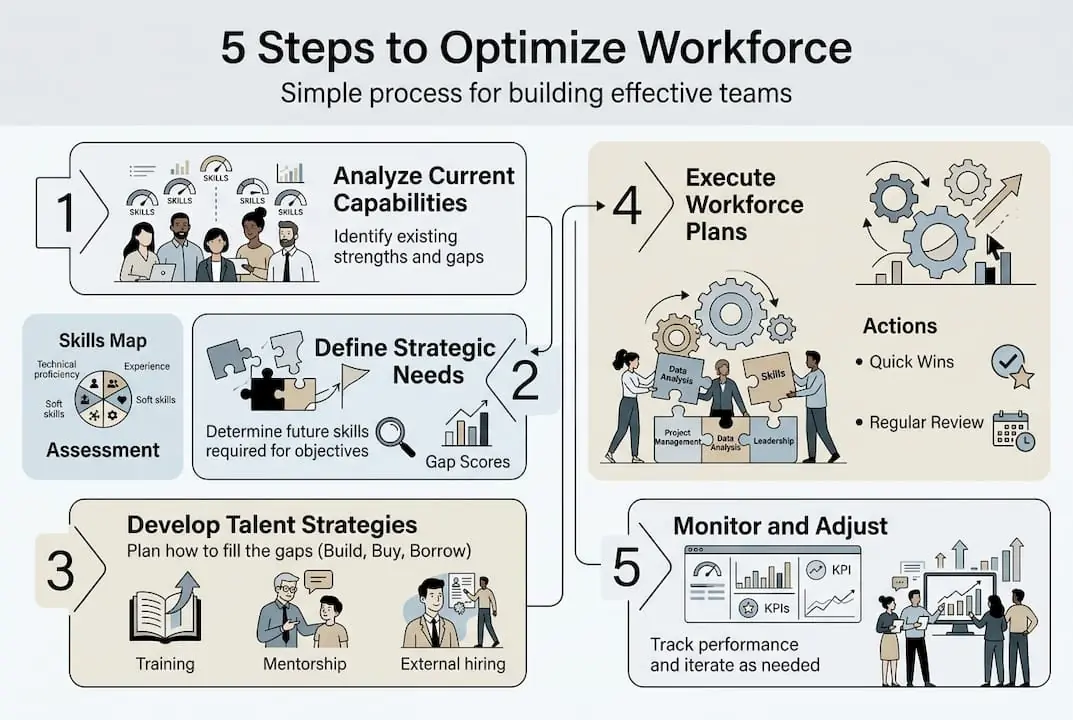
Next, map your current team structure against your actual business priorities. Not last year’s priorities — today’s. Use a simple table like this to visualize where you stand:
| Role | Current skill level | Required skill level | Gap score (1-5) |
|---|---|---|---|
| Sales lead | Intermediate | Advanced | 3 |
| Product manager | Advanced | Advanced | 0 |
| Customer success | Basic | Intermediate | 2 |
| Data analyst | Intermediate | Advanced | 3 |
This kind of visual snapshot makes it easy to prioritize where to act first. Analytics in HR can automate much of this mapping, saving you hours of manual work.
Benchmarking is your next move. Compare your internal gap scores against industry standards. Skills gap analysis benchmarks from sources like the McKinsey HR Monitor show a 32% skills mismatch across companies, meaning you’re likely not alone — but that doesn’t mean you should accept it. Use benchmarks to set realistic targets and identify which gaps are most urgent.
The job analysis process is also worth revisiting here. Many job descriptions are outdated, written for a version of the company that no longer exists. Updating them against current business needs is a fast win.
Key steps to get started:
- Conduct a skills inventory across all roles
- Map current skills against business priorities
- Score gaps and rank by business impact
- Benchmark against industry data
- Update job descriptions to reflect real needs
Pro Tip: Use anonymous surveys and data-driven talent management tools to crowdsource hidden skillsets. Employees often underreport capabilities in formal reviews but open up in low-stakes formats.
Leverage innovative assessments and people analytics
With a clear workforce map in hand, the next step is applying advanced methods that give you deeper, more actionable insights. This is where most companies leave significant value on the table. 📈
People analytics is the practice of using data about your workforce to make smarter decisions. It goes beyond headcount and turnover rates. It tracks patterns in performance, engagement, skill development, and team dynamics. People analytics and AI forecasting are now critical for high-impact workforce strategy, and companies that ignore them are flying blind.
Here’s how manual and tech-enabled assessments compare:
| Assessment type | Speed | Depth of insight | Bias risk | Scalability |
|---|---|---|---|---|
| Manual interviews | Slow | Moderate | High | Low |
| Psychometric tools | Medium | High | Medium | Medium |
| AI-powered platforms | Fast | Very high | Low | High |
| Human Design analysis | Medium | Very high | Low | Medium |
At Sparkly, we combine all four of these approaches because no single source is fully reliable on its own. Merging human judgment, AI analysis, psychometric assessments, and Human Design gives you higher-probability data — the kind that actually holds up in interviews and hiring decisions.
HR analytics explained covers how these tools work together in practice. The key is not picking one method and hoping for the best. It’s layering them.
AI and machine learning models can also predict turnover before it happens. They flag patterns — like declining engagement scores or role stagnation — that human managers often miss until it’s too late. Talent forecasting methods give you a forward-looking view, not just a snapshot of today.
How to choose and launch an assessment tool:
- Define what you’re measuring (personality, skills, engagement, or all three)
- Shortlist tools that integrate with your existing HR stack
- Pilot with one team before rolling out company-wide
- Train your HR team on interpreting results, not just collecting them
- Set a review cycle to evaluate whether insights are translating into action
Pro Tip: Track time-to-skill (how long it takes someone to reach competency in a new area) and time-to-fill (how long roles stay vacant) as your baseline metrics. These two numbers tell you more about workforce health than almost anything else. Talent optimization tools can automate this tracking.
Implement targeted actions to address gaps and optimize structure
Assessments are only valuable if they lead to action. Once your data surfaces the biggest gaps and opportunities, it’s time to move decisively. 💡

Start with quick wins. Look at your gap analysis and identify two or three changes you can make in the next 30 days. Maybe one team member has skills that are being underused in their current role. Maybe a manager is overloaded because a reporting structure hasn’t been updated in two years. These fixes are fast, visible, and build momentum.
Then tackle the bigger question: upskill or hire? Blended strategies — including recognition, clear career paths, better communication, and smart compensation — can significantly reduce turnover. Before you post a job listing, ask whether an existing employee could grow into the role with the right support. Internal mobility is faster, cheaper, and better for morale.
Key actions to prioritize:
- Identify quick structural fixes from your gap analysis
- Assess each gap: upskill, reassign, or recruit
- Build individualized development plans for high-potential employees
- Create recognition programs tied to skill growth, not just output
- Communicate changes clearly so teams understand the “why”
Here’s how to build an individualized development plan:
- Review the employee’s current skills against their role requirements
- Identify one or two growth areas that align with business needs
- Set a 90-day learning goal with specific milestones
- Assign a mentor or peer learning partner
- Schedule a check-in at 30, 60, and 90 days to track progress
Machine learning in HR can help you prioritize which employees are highest risk for disengagement, so you can direct development resources where they’ll have the most impact. The employee potential checklist is also a practical starting point for structuring these conversations.
Pro Tip: Regular communication is the most underrated retention tool. When employees understand how their development plan connects to the company’s direction, buy-in goes up and resistance drops sharply.
Monitor, adjust, and sustain an optimized workforce
Optimizing your workforce isn’t a one-time project. It’s a continuous cycle, and the companies that treat it that way are the ones that actually sustain their gains.
Start by establishing a core set of metrics you’ll track on a regular cadence. These should include:
- Turnover rate by department and role level
- Vacancy cost (the cost of a role sitting unfilled)
- Employee engagement scores from pulse surveys
- Time-to-skill and time-to-fill (as discussed earlier)
- Internal promotion rate as a signal of development program effectiveness
Review these numbers monthly, not annually. Waiting for a yearly review to spot a turnover spike is like checking your tire pressure once a year and wondering why you got a flat.
“Regular upskilling and ML-driven turnover prediction can significantly reduce external hiring needs, building a more agile and self-sustaining workforce over time.”
Continuous improvement tactics that actually work:
- Run quarterly skills reviews, not just annual performance reviews
- Create feedback loops where employees can flag role misalignment early
- Pilot structural changes with one team before scaling
- Use exit interview data to identify patterns you can prevent
- Celebrate internal promotions publicly to reinforce the culture of growth
Roadblocks are real. A common one: managers resist reassignments because they don’t want to lose a strong performer to another team. Address this by tying manager success metrics to team development, not just team output. When managers are rewarded for growing people, they stop hoarding talent.
Another roadblock is data overload. Too many metrics create paralysis. Use HR team management tools to build a simple dashboard that surfaces only the signals that require action. Keep it focused, and your team will actually use it.
A new mindset for workforce structure: why agility tops perfection
Here’s something most workforce guides won’t tell you: the obsession with building the perfect org chart is often the biggest obstacle to building a functional one. Rigid structures look great on paper but break down fast when business conditions shift — and in 2026, they shift constantly.
The companies we see succeeding aren’t the ones with the most elaborate workforce plans. They’re the ones willing to run a pilot, learn from it in 30 days, and adjust. That’s it. Agility beats perfection every time.
We encourage you to treat your workforce structure as a living system, not a fixed document. Build in regular check-ins. Give team leads the authority to flag misalignments without waiting for a formal review cycle. Talent optimization explained goes deeper on this philosophy if you want to explore it further.
Pro Tip: A 30-minute monthly team structure check-in delivers more ROI than a full annual org chart redesign. Small, frequent adjustments keep you ahead of problems instead of reacting to them.
Next steps: transform your workforce strategy with cutting-edge HR solutions
You now have a clear roadmap — from gap analysis to ongoing monitoring — to build a workforce structure that supports real growth. The next step is putting the right tools behind that roadmap.
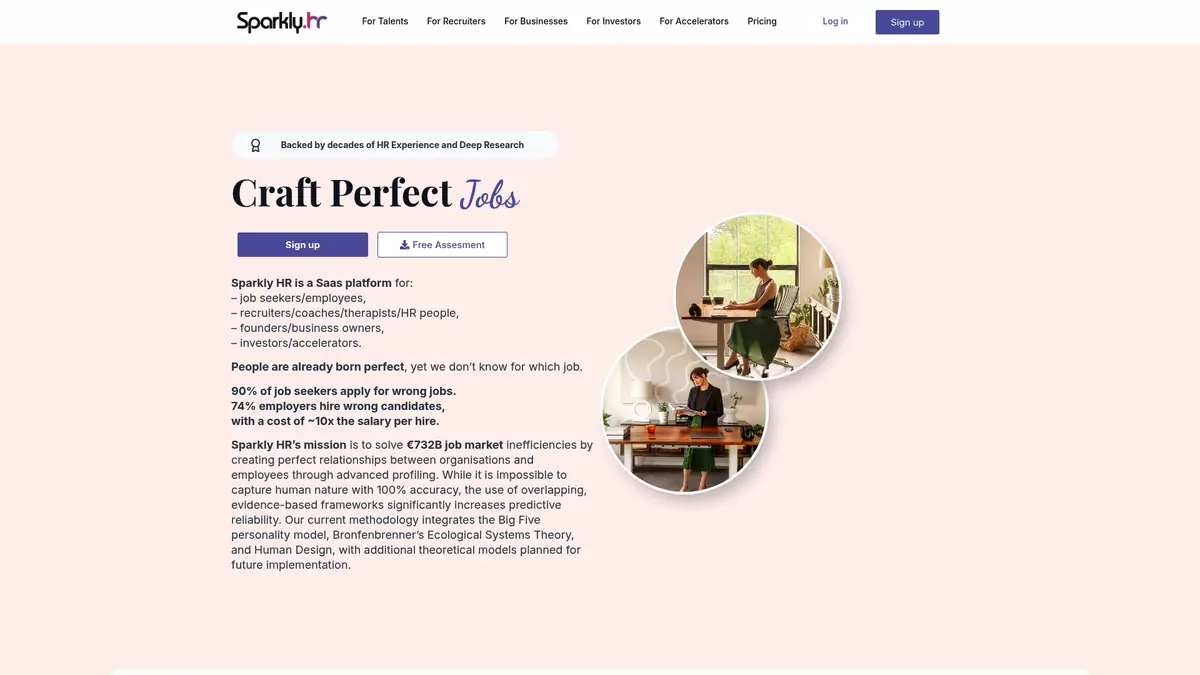
Sparkly is built specifically for this. We assess personality first, because personality drives behavior and behavior drives performance. Skills can be learned. Character is the foundation. Our platform merges human insight, AI analysis, psychometric assessments, and Human Design into one clear picture you can actually use in interviews and team decisions. Explore how SaaS in HR is changing workforce strategy, browse our talent evaluation SaaS solutions, or start with our employee fit assessment guide to see how it applies to your team today.
Frequently asked questions
What is the first step in optimizing workforce structure?
Skills gap analysis is the foundational starting point — it surfaces role mismatches and critical shortages before you invest in any fixes. Without it, you’re guessing.
How do people analytics improve workforce optimization?
People analytics help you spot engagement trends, predict turnover risk, and make smarter decisions about where to develop or redeploy talent across your organization.
Can technology help reduce employee turnover?
Yes. AI and ML models can identify turnover risk signals weeks or months before an employee resigns, giving you time to intervene with targeted support or role adjustments.
What are the most effective actions after finding a talent gap?
Prioritize upskilling or reassigning existing employees before recruiting externally. Upskilling reduces dependency on new hires and keeps institutional knowledge inside your organization where it belongs.
Recommended
- Talent Allocation Methods to Optimize Team Performance
- Talent Optimization Explained: Reducing Turnover Faster
- Top 5 Talent Optimization Tools for HR 2026
- Optimize job shift workflow with personality assessments
- How to schedule shifts efficiently: step-by-step guide
- Employee benefits checklist 2026: optimize costs and satisfaction