
How to identify high performers: proven steps for HR

TL;DR:
- High performer retention requires objective identification tools like assessments and the 9-box grid.
- Structured processes with calibration and follow-up improve the accuracy of high potential evaluations.
- Cultivating psychological safety and fair access to growth opportunities is essential for effective talent development.
Imagine your most promising team member, the one quietly delivering 40% more output than peers, has just accepted a competing offer. No counter-offer, no farewell meeting. They simply leave because nobody officially recognized their potential or created a growth path worth staying for. This scenario plays out every day at mid-sized companies, and the cost is significant. Replacing a high performer can run 1.5 to 2x their annual salary, and that does not count the momentum lost. This guide gives HR professionals a structured, practical roadmap to spot, validate, and retain the people who drive your organization forward. ⚡️
Table of Contents
- Essential tools to identify high performers
- Step-by-step: Launching your high performer identification process
- Innovative strategies to spot and develop top talent
- Validating results and refining your approach
- What most HR teams miss about high performer identification
- Take your high performer strategy further with Sparkly HR tools
- Frequently asked questions
Key Takeaways
| Point | Details |
|---|---|
| Use objective assessments | Implement tools like psychometrics and the 9-box grid to identify high performers fairly and with less bias. |
| Follow a structured process | A step-by-step, data-driven approach yields more reliable identification and development outcomes. |
| Leverage innovation | Stretch assignments, analytics, and public recognition reveal hidden talent and keep engagement high. |
| Validate and adapt | Continually measure effectiveness and adapt your approach based on results and feedback. |
| Prioritize culture and fairness | Ensure your identification strategies align with organizational culture for lasting retention and success. |
Essential tools to identify high performers
Once you recognize the importance of objective identification, the first step is understanding which tools offer the most reliable insights. Assessment’s role in HR is not simply to rank employees. It is to create a fuller picture of who a person is, how they perform under pressure, and where their growth potential actually sits.
Core methodologies for identifying high performers include performance evaluations, competency and psychometric assessments, 360-degree feedback, and the 9-box grid that plots performance versus potential. Each tool serves a different purpose, and the best programs blend several of them together.
Here is a quick overview of the most commonly used tools:
- Performance evaluations measure output against role-specific targets, useful for baseline comparisons.
- 360-degree feedback gathers input from peers, managers, and direct reports, revealing blind spots that top-down reviews miss.
- Psychometric assessments surface personality traits, cognitive patterns, and motivational drivers that predict future behavior.
- The 9-box grid visually maps where each employee sits across two axes: current performance and future potential.
- Leadership development programs create real conditions where high-potential employees (HiPos) can show initiative, resilience, and influence.
The problem most HR teams run into is over-relying on subjective tools like manager nominations. Managers naturally favor employees who are visible, vocal, and easy to work with. That is human nature. But it creates a blind spot for quieter contributors whose impact is harder to see day-to-day.
To prepare your organization for a reliable assessment initiative, you need to cover three prerequisites. First, connect your assessment tool to your HRIS so data flows without manual entry errors. Second, select tools matched to the specific roles you are evaluating. A technical lead needs different competency indicators than a client-facing project manager. Third, identify which roles are most critical to business outcomes so you prioritize your effort. For leadership hiring best practices, this scoping step is what separates programs that deliver results from ones that generate reports nobody reads.
| Tool | Strength | Best use case |
|---|---|---|
| Performance evaluation | Measures output clearly | Baseline comparison |
| 360-degree feedback | Multi-angle insight | Identifying blind spots |
| Psychometric assessment | Predicts behavior and fit | Hiring and development |
| 9-box grid | Visual, easy to calibrate | Succession planning |
| Leadership programs | Real-world performance data | HiPo development |
Understanding types of HR assessments will help you match tools to specific business goals rather than simply adopting what is popular in your industry.
Pro Tip: Start with 360-degree feedback if you are new to structured identification. It is fast to implement, creates buy-in from employees because it feels fair, and immediately surfaces insights that managers alone miss.
Step-by-step: Launching your high performer identification process
Once you have your toolkit, it is time to put a structured process in place. Many mid-sized companies make the mistake of jumping straight to tool rollout without designing the surrounding process. The result is inconsistent data, frustrated managers, and employees who feel assessed but not valued. A clear, staged launch fixes that. 📈
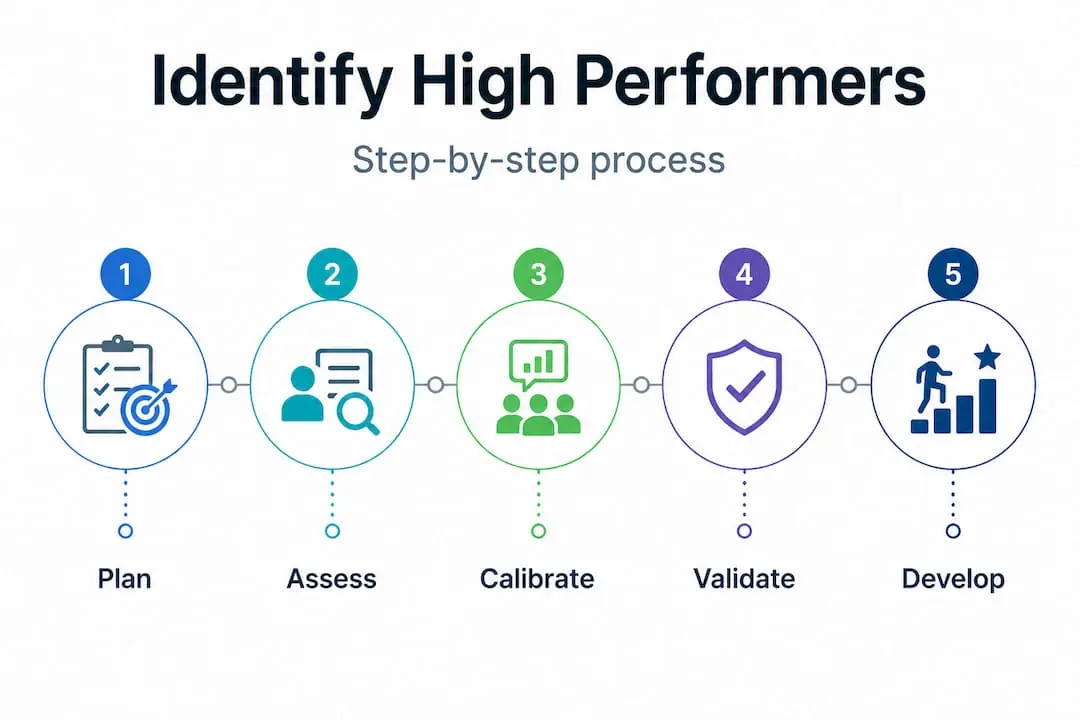
For mid-sized companies, prioritize objective tools like psychometrics and the 9-box over subjective nominations to reduce bias and integrate with HRIS for data-driven identification.
Here is a proven six-step process to get your program off the ground:
-
Plan your program scope. Define which departments and roles you will assess in the first cycle. Trying to assess everyone at once often means you assess no one well. Start with one or two critical teams and expand from there.
-
Select and configure your tools. Choose a mix of objective tools (psychometrics, 9-box) and qualitative inputs (manager reviews, 360 feedback). Configure tools to align with your competency framework or role expectations, not generic benchmarks.
-
Integrate with your HRIS. Pull in existing performance data before adding new assessment inputs. Pre-populating the 9-box with historical data saves time and gives calibration sessions real substance. Data-driven talent management at this level is what turns HR from a support function into a strategic partner.
-
Train managers and participants. Managers need to understand both how to use the tools and why bias reduction matters. Participants need context so they engage honestly rather than gaming assessments for perceived safety. Without training, even the best tools produce unreliable results.
-
Run calibration sessions. After initial data collection, bring department heads together to review results. Calibration is where individual manager bias gets corrected by peer perspective. This is your most important quality-control step.
-
Follow up with development plans. Every identified HiPo should receive a concrete next step: a stretch assignment, a development conversation, a promotion pathway, or a lateral move that expands their skills. Assessment without action destroys credibility faster than no assessment at all.
The table below shows the inputs, process owners, and expected outputs at each stage.
| Stage | Key inputs | Process owner | Expected output |
|---|---|---|---|
| Plan | Role data, business goals | HR leader | Scoped program design |
| Tool selection | Competency framework | HR + line managers | Configured tool set |
| HRIS integration | Historical performance data | HR tech team | Unified data view |
| Training | Manager and employee guides | L&D team | Consistent tool use |
| Calibration | Assessment results | Senior managers + HR | Validated HiPo list |
| Follow-up | Development goals | Individual managers | Active growth plans |
The measurable goals you should track from day one include turnover reduction among identified HiPos, engagement scores before and after implementation, and promotion rates of assessed individuals versus the general population. Employee potential evaluation at the team level helps you see patterns you would otherwise only notice after someone resigns.
Pro Tip: Combine objective data with manager calibration before sharing results broadly. When managers feel heard in the process, they champion the outcomes rather than resist them. This dramatically improves acceptance across the organization.
Innovative strategies to spot and develop top talent
After mastering the foundational process, the next leap forward is using innovative strategies for even greater precision and engagement. The tools in the previous sections give you structure. These strategies give you signal. 💡

Stretch assignments as discovery tools. Assigning high-potential employees to cross-functional projects or unfamiliar challenges reveals capabilities that do not show up in regular performance reviews. You learn who rises under pressure, who demonstrates leadership without a title, and who adapts their thinking when the rules change. Innovative strategies like stretch assignments, leadership programs, and AI-driven HRIS analytics also help with public recognition, though recognition carries its own risks for overload on top performers.
Leadership development programs serve a dual purpose. They train HiPos for future roles while simultaneously generating real-world performance data that no assessment can replicate. Watching someone facilitate a strategic planning session or manage a cross-departmental conflict tells you more about leadership potential than any standardized test.
AI and real-time analytics are changing how organizations track performance signals. Modern HRIS platforms can flag early indicators of disengagement, unusually high output, or consistent cross-functional collaboration patterns that suggest someone is outperforming their role level. The key is using these signals as starting points for human conversations, not as final verdicts.
Key innovative strategies worth building into your program:
- Stretch assignments that push employees into new domains or elevated responsibility levels
- Leadership program cohorts that mix HiPos from different departments, creating organic peer observation
- AI-assisted performance dashboards that surface trends managers are too busy to notice manually
- Personality-focused assessment strategies that reveal behavioral drivers behind performance, not just the outputs themselves
“Public recognition is a powerful motivator for high performers, but it also comes with real risk. When top performers are consistently celebrated, they often receive an outsized share of new responsibilities, additional projects, and urgent asks. Without careful management, the recognition itself can become a path to burnout.” — Insight from Forbes research on recognition and performance.
Pro Tip: Rotate stretch assignments deliberately. If the same two or three people always receive the exciting, high-visibility projects, you risk both burnout for them and resentment from peers. Build a rotation schedule that gives multiple employees access to growth opportunities.
Validating results and refining your approach
Once you have executed new strategies, confirmation and refinement guarantee the program keeps delivering results over time. A program that is never evaluated is a program that silently decays. The most common reason high performer identification loses credibility is that companies run one cycle, celebrate the results, and then let the process sit untouched for two years.
Focusing development on HiPos can significantly cut turnover, but only when the identification is accurate and the follow-through is consistent. Here is how to build validation into your cycle:
- Gather structured feedback from HiPos, their managers, and their peers six months after each program cycle. Ask direct questions: Did the development plan feel relevant? Were opportunities actually created?
- Track turnover data for assessed versus non-assessed employee groups. If your program is working, retention among identified HiPos should outperform the organizational average.
- Review promotion rates. Are the people you labeled as high potential actually advancing? If not, the issue may be in the identification criteria or in organizational barriers that need addressing separately.
- Monitor engagement scores. Employees who feel genuinely seen and invested in report higher engagement. If scores stagnate post-program, something in the experience is not landing.
- Run iterative improvement cycles. Treat each program cycle like a product launch. Gather feedback, identify what did not work, tweak one or two elements, and relaunch. Small, consistent adjustments outperform a total redesign every three years.
📈 Key stat to track: Companies that formalize HiPo development programs report up to 25% lower voluntary turnover among identified employees compared to those without structured programs.
The employee potential checklist for 2026 gives HR teams a concrete starting point for validation, including the specific personality indicators and behavioral markers that separate genuine potential from short-term high output.
What most HR teams miss about high performer identification
All technical guidance aside, let us step back and look at what truly moves the needle. Here is an uncomfortable observation: most companies spend months selecting the right tools and zero time examining whether their culture will actually let those tools work.
The best psychometric assessment in the world cannot surface high performers if employees are afraid that being identified as high potential means they will be exploited rather than developed. Psychological safety is the invisible prerequisite nobody puts on their implementation checklist. When employees trust that being visible leads to genuine opportunity and not just more work at the same pay grade, they engage authentically with every assessment. When they do not trust the process, they game it.
There is also a persistent problem with how organizations define high performance in the first place. Most systems measure output. How much did this person deliver last quarter? That is a backward-looking question. A truly effective identification system asks: given this person’s personality, motivations, and behavioral drivers, what are they capable of delivering in a role designed around their strengths? That is a different question entirely, and it is the one Sparkly was built to answer.
Favoritism is the other hidden obstacle. Even with a 9-box grid and calibration sessions, managers tend to advocate loudest for the people they like. The fix is not to remove managers from the process, but to audit the outputs regularly. If one team consistently produces more HiPos than another, ask whether that reflects genuine talent distribution or a manager who plays favorites. Challenge your systems. Discomfort in that audit process is a sign it is working.
The employee fit assessment guide addresses exactly this cultural layer, helping teams assess behavioral and personality fit alongside performance data to reduce the favoritism problem at its source.
Sustainable high performer identification requires psychological safety, honest feedback loops, and fair access to growth opportunities. Without all three, even perfect tools produce flawed lists.
Take your high performer strategy further with Sparkly HR tools
You now have a clear, actionable process for identifying high performers, from choosing objective tools to launching structured programs to refining your results over time. The next step is making that process smarter and more sustainable.

Sparkly combines personality assessment, AI, psychometric data, and Human Design into a single framework that gives HR teams higher-probability insights than any single tool can deliver alone. Instead of relying on one data point, you get a merged view that filters out the noise from individual bias and surfaces genuine potential. Explore how SaaS for high performer identification can reduce your dependence on subjective nominations, or review the full range of talent evaluation SaaS solutions built specifically for mid-sized teams. If you want to start with cultural fit before expanding to full potential evaluation, the fit assessment guide is your practical first move.
Frequently asked questions
What is the 9-box grid and how does it help identify high performers?
The 9-box grid is a framework that plots employees across two axes, current performance and future potential, enabling HR teams to visually identify high-potential, high-performance individuals and make objective succession planning decisions.
How can mid-sized companies reduce bias in their high performer identification process?
By prioritizing objective tools like psychometrics and 9-box grids over manager nominations, and integrating results with HRIS data, companies significantly reduce the subjective bias that skews identification toward visible, vocal employees.
Are public recognition programs always positive for high performers?
Recognition is motivating, but it risks overloading top performers with additional responsibilities that, without careful management, can lead to burnout rather than sustained high performance.
What are some early signs that you’ve misidentified a high performer?
Declining engagement scores, increased absenteeism, and rising voluntary turnover in your HiPo cohort are the clearest early signals. Running regular validation cycles after each program phase lets you catch and correct misidentification before it becomes a retention problem.
Recommended
- Employee Potential Evaluation for HR: Maximize Team Impact
- 6 Key Success Factors in Recruitment for HR Managers
- 7 Types of HR Assessments to Boost Team Performance
- Step by Step Recruitment Planning for Better Hiring Results
- Build an effective recruitment checklist for HR success | Testask Blog | testask