
Employee skills inventory: boost retention by 98%

Some companies achieve 98% employee retention using personality-driven skills inventories. Most mid-sized HR teams, meanwhile, are still working from outdated spreadsheets that track certifications but miss the human dynamics underneath. The gap between those two realities is not luck. It is strategy. A well-built employee skills inventory, one that goes beyond hard skills to capture personality traits and behavioral tendencies, gives you a clear map of who your people really are and where they fit best. This article walks you through exactly how to build, maintain, and use that map to improve retention and optimize your teams.
Table of Contents
- What is an employee skills inventory?
- Why mid-sized companies need an inventory beyond traditional skills matrices
- Core components: What to include in your employee skills inventory
- How to create and maintain a high-impact inventory: Step-by-step process
- Choosing and integrating personality assessment tools
- Pitfalls, limitations, and expert tips for sustainable success
- Take employee skills inventory further: Tools and next steps for HR success
- Frequently asked questions
Key Takeaways
| Point | Details |
|---|---|
| Holistic inventory drives retention | Combining skill and personality data offers significant gains in employee retention and team performance. |
| Integrate validated tools | Use proven assessments and regular updates to ensure accuracy and actionable results. |
| Start simple, scale smart | Begin with spreadsheets and expand to platforms as your team’s needs and complexity grow. |
| Avoid bias, validate entries | Counter self-assessment and manager bias with multi-method approaches and data triangulation. |
What is an employee skills inventory?
An employee skills inventory is a structured, living database that catalogs what your people know, what they can do, and how they tend to work. Think of it as a talent map for your organization. According to Eddy’s HR encyclopedia, a skills inventory involves creating structured databases or matrices cataloging employees’ hard skills, soft skills, experiences, and proficiencies. The key word there is structured. This is not a folder of old resumes.
When built correctly, a skills inventory helps you:
- Identify capability gaps before they become hiring emergencies
- Match people to projects based on actual strengths
- Make smarter promotion and succession decisions
- Reduce turnover by placing people in roles where they thrive
The real power comes when you layer in personality data. A strong employee fit assessment does not just ask what someone can do. It asks who they are. That distinction changes everything about how you use the data.
Why mid-sized companies need an inventory beyond traditional skills matrices
Traditional skills matrices were designed for a simpler era. They track technical competencies and certifications well enough. But they miss the undercurrents that actually drive team performance: how people communicate under pressure, how they respond to ambiguity, and whether their natural tendencies align with their role demands.
For mid-sized companies with 20 to 500 employees, this blind spot is costly. You do not have the budget to absorb constant turnover, and you do not have the headcount to hide misaligned talent. Every person matters. Personality integration in your inventory anticipates friction before it surfaces, tailors coaching to individual wiring, and benchmarks show retention gains ranging from 17% to 98% compared to industry averages.
Here is what personality-enhanced inventories make possible:
- Spot team dynamics issues before they escalate into conflict or resignations
- Tailor development plans to how each person actually learns and grows
- Reduce the guesswork in internal mobility decisions
- Build more cohesive teams by understanding complementary personality profiles
Exploring talent retention strategies grounded in personality data is one of the fastest ways to close the gap between where your retention numbers are and where you want them to be. And staying current on employee engagement trends helps you anticipate what your workforce will need next. For a broader look at how skills management systems are evolving, the landscape is shifting fast toward integrated, personality-aware platforms.
Core components: What to include in your employee skills inventory
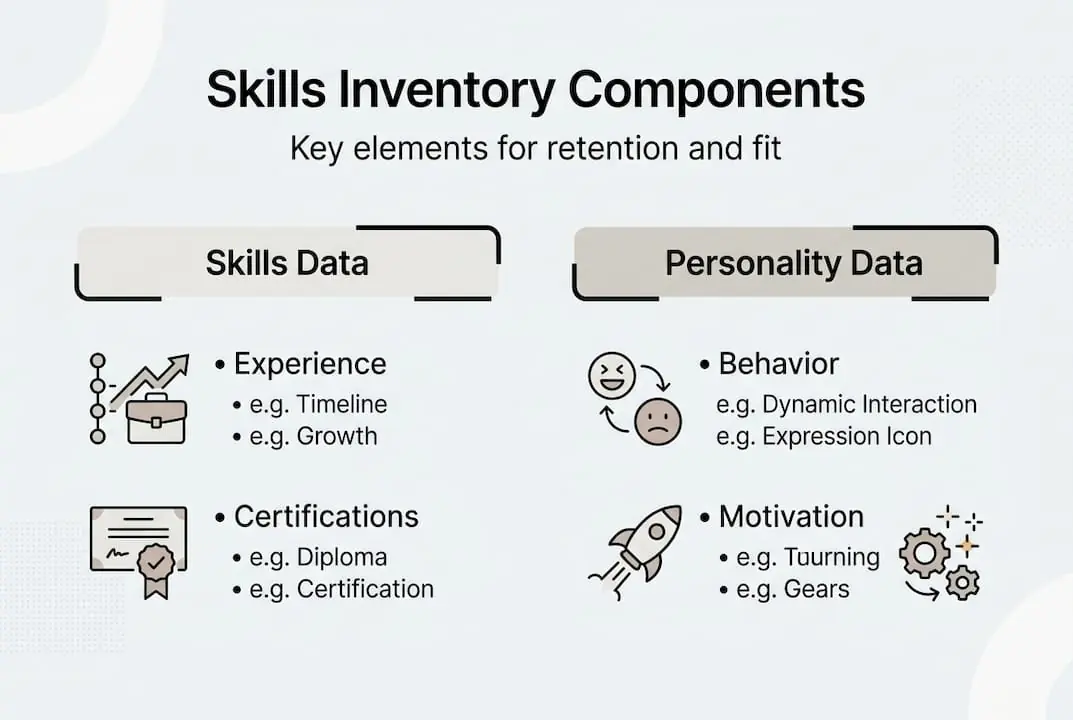
A high-impact inventory captures more than job titles and training records. The SHRM Foundation Toolkit outlines that a complete inventory should include hard skills, soft skills, experiences, and proficiencies. We recommend adding personality assessment scores to that list.
Here are the core fields every inventory should include:
- Name and current role
- Hard skills (technical competencies, software, certifications)
- Soft skills (communication style, leadership tendencies, collaboration approach)
- Key projects and achievements
- Psychometric or personality scores
- Development goals and gaps
When it comes to personality tools, leading assessments like DISC, Big Five, HPTI, PI Behavioral Assessment, MBTI, and Hogan each measure different dimensions. Here is a quick comparison:

| Tool | Primary focus | Best for |
|---|---|---|
| DISC | Behavioral style | Team communication and conflict |
| Big Five | Personality traits | Broad personality profiling |
| HPTI | High-potential traits | Leadership development |
| PI Behavioral Assessment | Drives and needs | Role fit and hiring |
| MBTI | Cognitive preferences | Team dynamics and self-awareness |
| Hogan | Personality risk factors | Executive and leadership roles |
Review skills evaluation best practices to decide which fields matter most for your organization’s size and goals. And if you want to future-proof your inventory, understanding future skills in business will help you track what competencies to prioritize next.
Pro Tip: Start simple. A spreadsheet with six to eight fields beats a complex system nobody updates. Scale up once your team is comfortable with the process.
How to create and maintain a high-impact inventory: Step-by-step process
Building a skills inventory is not a one-time project. It is an ongoing practice. Here is a proven process based on workforce assessment mechanics that HR teams use to get real results:
- Map role requirements. Start with a job analysis for each position. Use frameworks like SHRM BASK to identify the key skills and behaviors each role demands.
- Collect data from multiple sources. Use self-assessments, manager ratings, and personality assessment results together. No single source is reliable on its own.
- Build your inventory matrix. Organize data in a format your team can actually use. A shared spreadsheet or HR platform works well to start.
- Analyze gaps. Compare what your people have against what each role requires. Prioritize the gaps that carry the most business risk.
- Take action. Use your findings to drive development plans, internal moves, targeted hiring, and team restructuring.
Here is how different data sources compare in practice:
| Data source | Strength | Limitation |
|---|---|---|
| Self-assessment | High engagement | Risk of inflation or bias |
| Manager rating | Contextual insight | Potential for favoritism |
| Personality assessment | Behavioral prediction | Does not measure skills directly |
| 360-degree feedback | Holistic view | Time-intensive to collect |
“The most effective inventories treat skills data as a living asset, not a filing exercise. Review it, act on it, and update it regularly.”
Connect your inventory reviews to your talent management checklist so nothing falls through the cracks. And use job fit analysis to validate that your placements are working.
Pro Tip: Tie inventory reviews to your quarterly or annual HR cycles. A review that happens on a schedule actually happens.
Choosing and integrating personality assessment tools
Not all personality tools are created equal, and the right choice depends on what you are trying to solve. Leading tools like DISC, Big Five, HPTI, PI Behavioral Assessment, MBTI, and Hogan each bring a different lens to your inventory data.
The impact of choosing well is measurable. Companies using the PI Behavioral Assessment report 34% higher employee performance and 30% better retention of top performers. Those are not marginal gains. 📈
When selecting a tool, check these factors:
- Fit for purpose: Does it measure what actually predicts success in your roles?
- Data privacy and compliance: Is it GDPR-compliant or aligned with your local regulations?
- Staff training: Will your HR team and managers know how to interpret and apply the results?
- Integration: Can it connect to your existing HR systems or inventory platform?
- Validity and reliability: Has it been independently validated? Look for published research.
For a broader overview of personality test types used in employment contexts, there are more options than most HR teams realize. The goal is not to collect data. It is to use it. Explore how turnover reduction with personality data works in practice, and check out team assessment tips to get the most from whichever tool you choose. ⚡️
Pitfalls, limitations, and expert tips for sustainable success
Even the best-designed inventory can go sideways without the right safeguards. Here are the most common pitfalls and how to avoid them.
Self-assessment bias is the biggest culprit. People tend to rate themselves higher than reality, especially in soft skills. PI research confirms that self-assessments risk inflation and manager bias, and that skills should always be validated through multiple methods. Never make a major talent decision based on self-reported data alone.
Over-reliance on psychometrics is the flip side. Personality tools predict behavior and team fit but not performance alone. They work best when combined with structured interviews, skills tests, and real performance data.
Other pitfalls to watch for:
- Collecting data without a clear plan to act on it
- Failing to communicate to employees why data is being collected
- Ignoring data privacy obligations around psychometric results
- Letting the inventory go stale between review cycles
“Triangulation is the antidote to bias. When humans, assessments, and structured observation all point in the same direction, you can trust the signal.”
This is exactly why Sparkly merges four data sources, including human input, AI, psychometric assessments, and Human Design, to extract higher-probability insights. No single source is reliable. The combination is. Use job fit with personality data to see how this plays out in real hiring and placement decisions. For additional skills inventory assessment best practices, Avilar’s framework is a solid reference.
Pro Tip: Focus on just two or three personality or skill traits most directly linked to your key business outcomes. Depth beats breadth every time. 💡
Take employee skills inventory further: Tools and next steps for HR success
You now have a clear picture of what a high-impact skills inventory looks like and how to build one. The next step is putting it into practice without starting from scratch.
Sparkly is built for exactly this moment. We combine personality assessments, AI-driven insights, psychometric data, and Human Design into one platform so your inventory reflects who your people truly are, not just what their resume says. Our personality-focused strategies give HR teams in mid-sized companies a practical starting point for integrating personality data into every stage of the talent lifecycle. If you are exploring SaaS solutions for HR that go beyond basic skills tracking, we have built the tools to match. And if you want to see how leading platforms compare, our roundup of top SaaS talent tools is a great place to start your evaluation.
Frequently asked questions
What is the main goal of an employee skills inventory?
The primary goal is to clarify internal capabilities, surface skills gaps, and drive better retention by aligning individual strengths to business needs. A structured skills database gives HR a reliable foundation for smarter talent decisions.
How often should a skills inventory be updated?
Update your inventory at least once a year and after any significant hiring wave, promotion cycle, or team restructure. Regular validation keeps the data actionable rather than decorative.
Can personality assessments replace traditional skills inventories?
No. Personality tools predict behavior and team fit but not performance on their own. They are most powerful when layered on top of a solid skills inventory, not used as a substitute.
What tools are recommended for mid-sized companies?
Start with SHRM inventory templates to build your structure, then layer in platforms like Predictive Index or Thomas for personality insight. The combination gives you both the skills map and the behavioral context to act on it.
What is the biggest risk with self-assessment data?
The biggest risk is score inflation, where employees rate themselves higher than their actual proficiency. Cross-validating with manager ratings and objective performance data is essential to keep your inventory accurate.