Employee lifecycle: 6 stages for engagement & retention

Most HR leaders think of the employee lifecycle as bookends: you hire someone, and eventually they leave. Everything in between gets managed reactively, stage by stage, with little connection between them. That’s a costly mistake. The employee lifecycle is actually a continuous, interconnected journey that shapes performance, culture, and loyalty at every turn. When you manage it strategically, you reduce turnover, boost engagement, and build a team that genuinely wants to stay and grow. This guide breaks down each stage, shows you where most organizations lose momentum, and gives you a clear path forward.
Table of Contents
- What is the employee lifecycle and why it matters
- Breaking down the six stages of the employee lifecycle
- The secret link between holistic assessment and employee engagement
- From theory to action: Building a sustainable employee lifecycle strategy
- A fresh perspective: What most HR experts miss about the employee lifecycle
- Take lifecycle management further with Sparkly HR tools
- Frequently asked questions
Key Takeaways
| Point | Details |
|---|---|
| Lifecycle is holistic | Managing each stage of the employee lifecycle boosts engagement and reduces turnover. |
| Assessments drive results | Continuous, personalized assessments increase retention and uncover employee strengths. |
| Practical tools matter | Effective management tools and strategies turn lifecycle theory into measurable improvements. |
| Feedback is vital | Regular feedback at all stages creates a responsive and engaging workplace culture. |
What is the employee lifecycle and why it matters
The employee lifecycle is the complete journey a person takes with your organization, from the moment they first hear about you to the day they move on. It’s not just an HR concept. It’s a strategic framework that touches every part of your business.
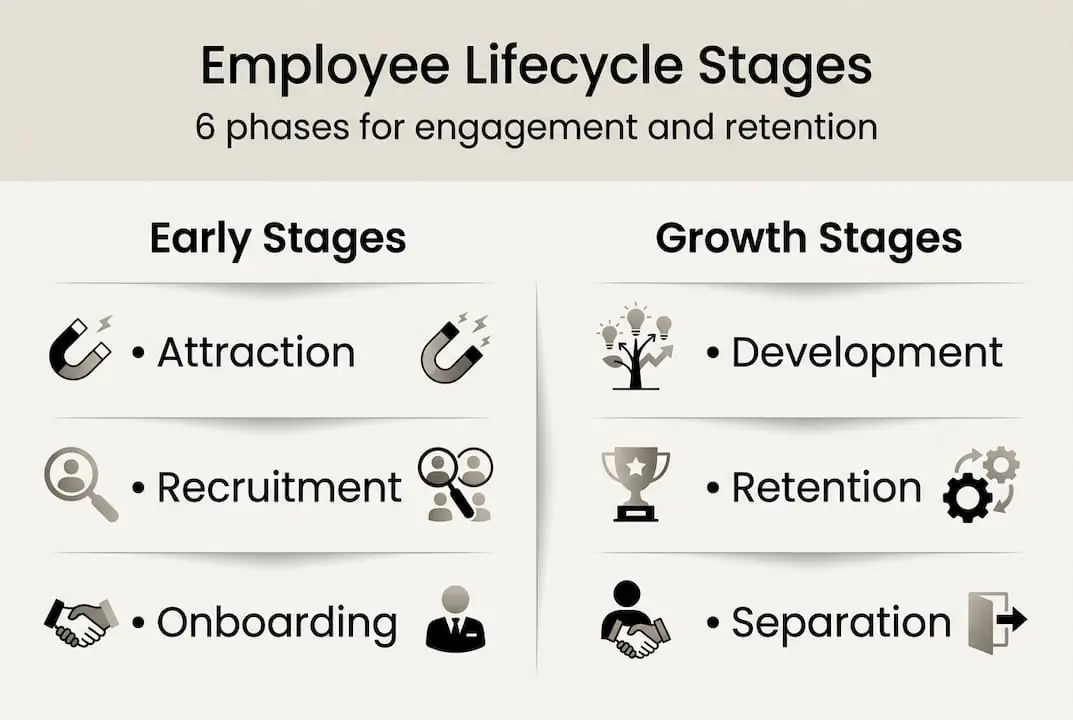
The six core stages are:
- Attraction: Building your employer brand so top talent notices you
- Recruitment: Identifying, evaluating, and selecting the right people
- Onboarding: Integrating new hires into your culture and workflows
- Development: Growing skills, capabilities, and career paths
- Retention: Keeping your best people engaged and committed
- Separation: Managing exits with care and capturing valuable feedback
Each stage directly influences the next. A weak onboarding experience, for example, undermines all the effort you put into recruitment. A poor separation process damages your employer brand and reduces future attraction. The lifecycle is a chain, and every link matters.
Here’s a quick look at how lifecycle stages connect to business outcomes:
| Lifecycle stage | Primary HR focus | Business impact |
|---|---|---|
| Attraction | Employer branding | Candidate quality |
| Recruitment | Selection accuracy | Team fit and performance |
| Onboarding | Cultural integration | 90-day retention |
| Development | Growth planning | Productivity and loyalty |
| Retention | Engagement programs | Turnover reduction |
| Separation | Exit management | Employer brand and referrals |
The data backs this up. Effective lifecycle management can significantly reduce turnover and boost engagement across your organization. Companies that treat the lifecycle as a connected system, rather than isolated HR tasks, consistently outperform those that don’t.
There’s also a dimension most HR teams overlook: security. As employees move through the lifecycle, especially during onboarding and offboarding, access to sensitive systems changes. Integrating cybersecurity best practices into your lifecycle strategy protects your organization at every transition point.
“The employee lifecycle isn’t an HR admin task. It’s one of the most powerful levers you have for organizational performance.”
When you see the lifecycle this way, it stops being a checklist and starts being a competitive advantage. 📈
Breaking down the six stages of the employee lifecycle
With the importance of the employee lifecycle clarified, let’s break down each stage for targeted action.
Every stage has its own dynamics, pitfalls, and opportunities. Here’s a comparison of what typically happens versus what best-practice organizations do differently:
| Stage | Common approach | Best-practice approach |
|---|---|---|
| Attraction | Post job ads reactively | Proactively build employer brand year-round |
| Recruitment | Screen for skills only | Assess personality and cultural fit alongside skills |
| Onboarding | One-week orientation | Structured 90-day integration plan |
| Development | Annual performance reviews | Continuous feedback and personalized growth paths |
| Retention | React when someone resigns | Proactive engagement and career conversations |
| Separation | Exit interview (if any) | Structured offboarding and alumni engagement |
Here’s a numbered action plan to optimize each stage:
- Attraction: Define your employee value proposition clearly and communicate it consistently across all channels.
- Recruitment: Use recruitment planning frameworks that go beyond skills to evaluate personality and values alignment.
- Onboarding: Follow an effective onboarding checklist to structure the first 90 days, because this phase has an outsized influence on long-term retention.
- Development: Co-create individual development plans with employees, not for them.
- Retention: Schedule regular career conversations, not just performance reviews.
- Separation: Conduct structured exit interviews and maintain positive alumni relationships.
Onboarding deserves special attention. Research consistently shows it’s the stage where organizations either cement loyalty or begin losing people. A new hire who feels confused, unsupported, or misaligned in their first 90 days is already mentally preparing to leave.

Pro Tip: Align your recruitment messaging directly with your real company culture, not an idealized version of it. Candidates who join with accurate expectations stay longer and integrate faster.
The most common pitfall? Treating each stage as a separate project managed by a different team member. When there’s no handoff between recruitment and onboarding, or between development and retention conversations, engagement drops in the gaps. ⚡️
The secret link between holistic assessment and employee engagement
Understanding the lifecycle flow, consider how assessments transform each stage and multiply engagement.
Holistic assessment means evaluating employees across multiple dimensions, not just what they can do, but who they are, how they think, and what motivates them. It’s a game-changer because it replaces guesswork with data at every stage of the lifecycle.
The most valuable assessment types include:
- Personality assessments: Reveal behavioral tendencies, communication styles, and cultural fit
- Psychometric tools: Measure cognitive patterns and decision-making approaches
- 360-degree feedback: Captures perspectives from peers, managers, and direct reports
- Human Design analysis: Identifies natural energy patterns and working styles
- Continuous check-ins: Regular pulse surveys that track engagement in real time
What makes this approach powerful is that data from these assessments feeds directly into personalized development plans. Instead of offering the same training program to everyone, you can tailor growth opportunities to each person’s actual profile. That’s how you make development feel relevant and motivating rather than mandatory.
Using employee assessment tools that focus on personality, not just skills, is especially effective. Skills can be taught. Personality drives how someone shows up every day, how they collaborate, how they handle pressure, and whether they’ll thrive in your specific environment.
Personality-focused assessment tools boost team engagement by up to 15% and cut turnover, making them one of the highest-return investments in your HR toolkit.
Well-applied assessments also help you identify at-risk talent before they disengage completely. When you spot the early signals, you can intervene with targeted support, a role adjustment, a new project, or a career conversation, before the person starts updating their resume.
Pro Tip: Build structured check-ins into every lifecycle stage, not just onboarding. A quick monthly pulse survey costs almost nothing and gives you early warning signals that save you significant replacement costs down the line.
The goal of retention strategies built on holistic data is simple: match people to roles and environments where they naturally excel. When that alignment exists, engagement follows almost automatically. 💡
From theory to action: Building a sustainable employee lifecycle strategy
Armed with assessment best practices, it’s time to translate theory into a winning strategy.
Here’s a practical step-by-step plan for rolling out a modern lifecycle strategy in your organization:
- Audit your current lifecycle touchpoints. Map every interaction employees have with HR from application to exit. Identify where you’re strong and where there are gaps or handoff failures.
- Standardize your assessment approach. Choose HR management tools that integrate personality and skills data across the lifecycle, not just at hiring.
- Build feedback loops between stages. Ensure insights from onboarding inform development plans, and development data feeds into retention conversations.
- Define your KPIs clearly. Track retention rates, engagement scores, time-to-productivity for new hires, and internal promotion rates as your core lifecycle metrics.
- Review and adapt regularly. The lifecycle strategy that works today may need adjustment for hybrid work models, team restructuring, or new business priorities.
- Integrate security into transitions. Use a cybersecurity checklist during onboarding and offboarding to manage system access responsibly.
Clear tools and strategies help HR teams turn lifecycle concepts into measurable results, which is why choosing the right platform matters as much as choosing the right strategy.
Pro Tip: Don’t skip exit interviews or rush IT offboarding. Exit conversations reveal patterns you can’t see from inside the organization. And a poorly managed offboarding process, especially around system access, creates real security and compliance risks.
You can also use the employee potential checklist to identify where current team members are underutilized. Sometimes the best retention move isn’t a raise. It’s redesigning a role to better fit the person already in it.
Adapting your lifecycle strategy to hybrid and remote work means adding digital touchpoints, virtual check-ins, and asynchronous feedback tools. The principles stay the same. The delivery channels evolve.
A fresh perspective: What most HR experts miss about the employee lifecycle
Before you implement your lifecycle plan, consider this overlooked but crucial perspective.
Most organizations treat lifecycle phases as isolated silos. Recruitment hands off to onboarding. Onboarding hands off to the manager. Development sits in L&D. Retention is HR’s problem when someone resigns. This fragmented approach is exactly why so many lifecycle programs fail to move the needle.
The real power comes from feedback loops. What you learn in development conversations should reshape how you recruit. What you hear in exit interviews should directly influence your retention programs. These stages aren’t sequential steps. They’re a continuous cycle of data and insight.
Here’s something most programs miss entirely: your former employees are an asset. Alumni networks generate referrals, provide honest market feedback, and sometimes return as stronger contributors. Engaging people post-exit is one of the highest-leverage, lowest-cost moves available to you.
The lesson we keep coming back to is this: a continuous, data-driven, and personalized approach wins today’s talent game. Following talent development steps that treat each person as an individual, not a job title, is what separates organizations that retain great people from those that constantly replace them.
Take lifecycle management further with Sparkly HR tools
To go beyond the basics and unlock powerful lifecycle results, leverage proven HR solutions.
Sparkly HR is built specifically to support every stage of the employee lifecycle, from your first candidate touchpoint to alumni engagement. What makes Sparkly different is the focus on personality over skills, because skills can be learned, but personality drives how someone actually performs and connects within your team.
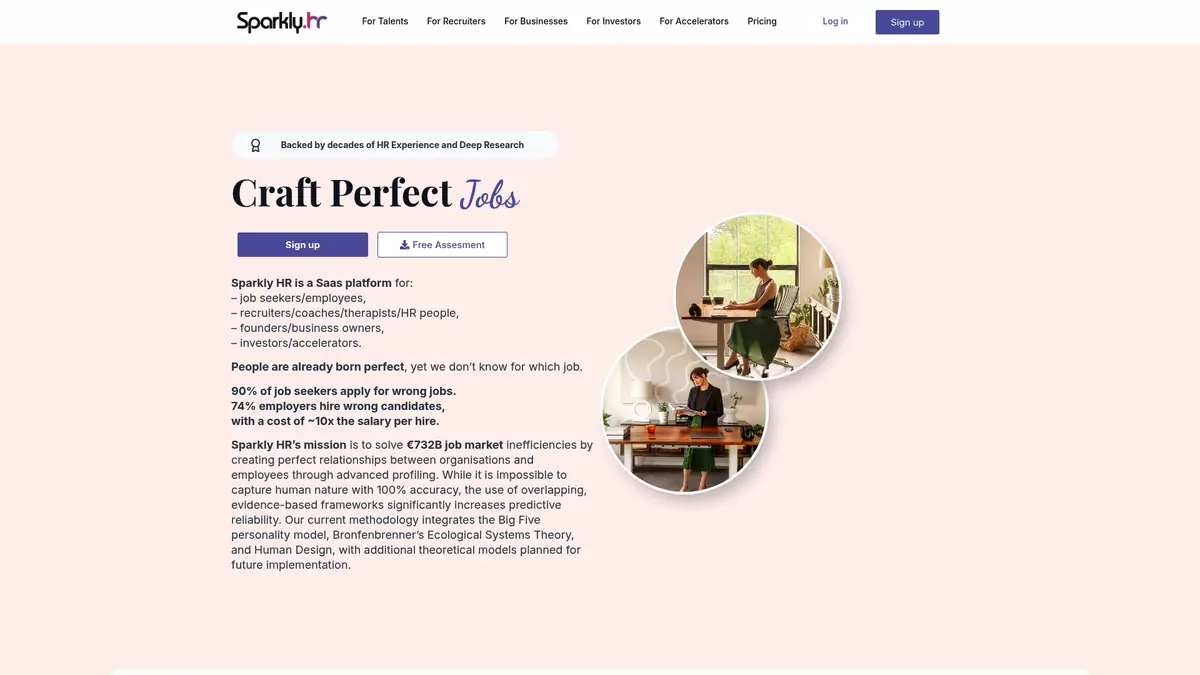
Sparkly merges four data sources, including human insight, AI, psychometric assessments, and Human Design, to give you higher-probability data for smarter decisions at every lifecycle stage. If you’re ready to see what talent optimization explained looks like in practice, or want to explore how SaaS in HR can transform your team’s potential, Sparkly has the tools to get you there. Explore our full range of talent evaluation SaaS solutions and start building a lifecycle strategy that actually sticks.
Frequently asked questions
What are the main stages of the employee lifecycle?
The employee lifecycle typically includes six defined stages: attraction, recruitment, onboarding, development, retention, and separation. Each stage connects to the next and influences overall engagement and retention outcomes.
How do assessments improve employee engagement?
Assessment tools boost engagement by up to 15% by helping you personalize development, spot disengagement early, and align roles with each person’s natural strengths and working style.
What metrics should HR track to measure lifecycle success?
Focus on retention rates, engagement scores, turnover costs, and development program effectiveness. Measuring engagement and retention gives you direct, actionable feedback on where your lifecycle strategy is working and where it needs adjustment.
Can the employee lifecycle framework adapt to remote or hybrid work?
Absolutely. HR tech platforms support lifecycle management across distributed teams by enabling digital check-ins, virtual onboarding, and asynchronous feedback tools that keep the lifecycle connected regardless of location.
Why is exit management important in the employee lifecycle?
Exit interviews are a key lifecycle stage for capturing honest feedback, identifying systemic issues, supporting positive referrals, and protecting your employer brand for future talent attraction.