Employee Capability Frameworks: Align, Engage & Retain

TL;DR:
- Clarity in role expectations through competency frameworks boosts employee retention and engagement.
- Simplified, role-specific frameworks are more effective than complex, comprehensive documents.
- Regular review and management buy-in are essential for frameworks to influence long-term performance.
Hiring great people is only half the battle. Many mid-sized companies invest heavily in recruitment, onboarding, and training, yet still watch their best employees walk out the door. The missing piece isn’t talent. It’s clarity. Without a structured model that defines what success looks like in each role, even motivated employees lose direction. Strong competency frameworks are directly linked to improved retention and engagement through clear career paths and skills development. This guide walks you through what employee capability frameworks are, why they work, how to build one, and which tools make them stick. ⚡️
Table of Contents
- What is an employee capability framework?
- Core benefits for retention and engagement
- Designing an effective framework for your business
- Innovative assessment tools and real-time alignment
- Common pitfalls and how to overcome them
- Why most capability frameworks fail (and what actually works)
- Next steps: Empower your HR strategy with smarter tools
- Frequently asked questions
Key Takeaways
| Point | Details |
|---|---|
| Strategic alignment | Capability frameworks align employee development with business objectives for better performance. |
| Retention boost | Companies with simple, actionable frameworks see measurable drops in turnover. |
| Continuous improvement | Innovative tools and regular reviews keep frameworks relevant and effective. |
| Behavior focus | Emphasizing behavioral skills in frameworks drives engagement and career growth. |
What is an employee capability framework?
Think of an employee capability framework as your organization’s shared language for performance. It’s a structured model that outlines the key competencies, behaviors, skills, and proficiency levels required for each role in your business. Instead of vague job descriptions, you get a clear map of what good looks like at every stage of a person’s career.
According to the G2 capability framework guide, capability frameworks define core skills, behaviors, knowledge, and competency levels required for roles, aligning workforce development with business goals to improve performance consistency, training, and career progression. That’s a powerful foundation for any HR team managing turnover.
A well-built framework typically includes:
- Core competencies: The skills and behaviors expected across all roles (e.g., communication, problem-solving)
- Role-specific competencies: Technical and functional skills tied to a specific job
- Proficiency levels: Clear descriptors for beginner, developing, proficient, and expert stages
- Development plans: Linked learning paths that show employees how to grow
Here’s a simple snapshot of what a framework might look like in practice:
| Component | Example |
|---|---|
| Core competency | Collaboration |
| Role-specific skill | Data analysis (for analyst roles) |
| Proficiency level | Developing: completes tasks with guidance |
| Development plan | Enroll in data visualization course by Q3 |
One thing most companies get wrong: they try to cover every possible skill. The result is a 40-page document nobody reads. Frameworks work best when they’re simple, role-aligned, and integrated directly into your HR tools and performance cycles. When you’re evaluating employee potential, a clean framework gives you real benchmarks instead of gut feelings.
📈 Key insight: Most companies don’t have unclear people. They have unclear expectations. A capability framework fixes that at the system level, not just the individual level.
Core benefits for retention and engagement
With the fundamentals defined, it’s time to examine the hard evidence showing why capability frameworks are a retention and engagement game-changer.
The numbers are hard to ignore. Internal mobility programs boost retention by as much as 35%, and companies with structured competency frameworks see measurable drops in turnover. On the flip side, 40% of employees leave their jobs because of issues with their direct manager. A framework doesn’t just clarify roles; it shapes how managers lead.

A recent meta-analysis on engagement found that transformational leadership (r=0.52), recognition (r=0.48), and development opportunities (r=0.44) are the strongest correlates of employee retention. Frameworks directly support all three by giving leaders a shared language, connecting recognition to behaviors, and mapping out visible growth paths.
Here’s how the impact typically unfolds, in order:
- Clear expectations reduce ambiguity and daily frustration
- Structured development shows employees they have a future with you
- Recognition tied to competencies feels fair and motivating
- Stronger manager behavior emerges from framework-guided conversations
| Driver | Correlation with retention | Framework impact |
|---|---|---|
| Transformational leadership | r = 0.52 | Managers use frameworks as coaching tools |
| Recognition | r = 0.48 | Recognition tied to defined behaviors |
| Development opportunities | r = 0.44 | Career paths built into the framework |
“The best retention tool isn’t a bonus. It’s showing someone they belong here and have a future.”
For HR leaders investing in employee development tools, connecting those tools to a capability framework multiplies their effectiveness. Without a framework, development feels random. With one, it feels purposeful. Explore talent retention strategies that layer personality insights on top of competency data for even sharper results.
Designing an effective framework for your business
Understanding the benefits leads naturally to the next step: building a framework that actually works in your organization.
The good news? You don’t need a consultant or a six-month project. Here’s a focused five-step process that works for medium-sized businesses:
- Define your roles clearly: Start with your highest-turnover positions. What does success actually look like in that role after 90 days? After one year?
- Identify core and role-specific competencies: Limit yourself to 5 to 7 competencies per role. Any more and adoption drops fast.
- Describe behaviors at each level: Write plain-language descriptions of what each competency looks like at beginner, developing, proficient, and expert stages.
- Map career paths: Show employees the logical next role and what they need to get there. Visibility drives motivation.
- Integrate with your HR systems: Connect the framework to performance reviews, onboarding checklists, and hiring rubrics.
Pro Tip: Before rolling out your framework, pilot it with one team or department. Their feedback will save you from costly revisions down the road.
The most common mistake? Going too broad. Companies try to build a universal framework that covers every skill across every team. The result is a document that’s technically complete but practically useless. Role-aligned frameworks, as outlined in the G2 capability guide, are especially effective for businesses with high turnover when they center on behavioral competencies and clear career paths.
Consider personality-based hiring as a complement to your framework. Skills can be learned, but behavioral tendencies are far more predictive of long-term fit. And once your framework is live, use job shift workflow optimization to match people to roles where their natural strengths align with framework expectations.
- Keep documentation to one page per role where possible
- Use plain language, not HR jargon
- Review annually at minimum, but ideally every six months
Innovative assessment tools and real-time alignment
Once you’ve established your framework, leveraging innovative assessment tools takes your approach from static to dynamic.
Static frameworks are a starting point, not a finish line. The organizations seeing the strongest retention results are those using technology to keep their frameworks alive and responsive. CIPD recommends a combination of assessment platforms, AI-driven skills passports, pulse surveys, exit interviews, and retention audits for ongoing alignment.
Here’s what a modern toolkit looks like:
- AI-driven skills passports: Used by companies like Standard Chartered, these create a living record of each employee’s capabilities and growth trajectory
- Pulse surveys: Short, frequent check-ins that flag misalignment before it becomes a resignation letter
- Real-time dashboards: Give HR teams visibility into engagement trends across teams and roles
- Exit interview analysis: Systematic tracking of departure reasons reveals framework gaps you didn’t know existed
Pro Tip: Don’t wait for exit interviews to spot problems. Use pulse surveys to capture early signals of disengagement, what some call “quiet quitting” behavior, before someone mentally checks out.
Tool selection matters. A 25-person company doesn’t need the same infrastructure as a 500-person organization. Match your tools to your HR team’s capacity to actually act on the data. The role of AI in recruitment is expanding, and the same intelligence can power smarter capability tracking. Check out talent assessment tips for practical guidance on building a stack that fits your team. You can also explore HR assessment types to find the right blend of tools for your current stage.
Common pitfalls and how to overcome them
Innovative tools can’t patch up poor design, so it’s vital to avoid the most common pitfalls many HR teams encounter.
Even well-intentioned frameworks fail. Here are the four most common reasons, and what to do instead:
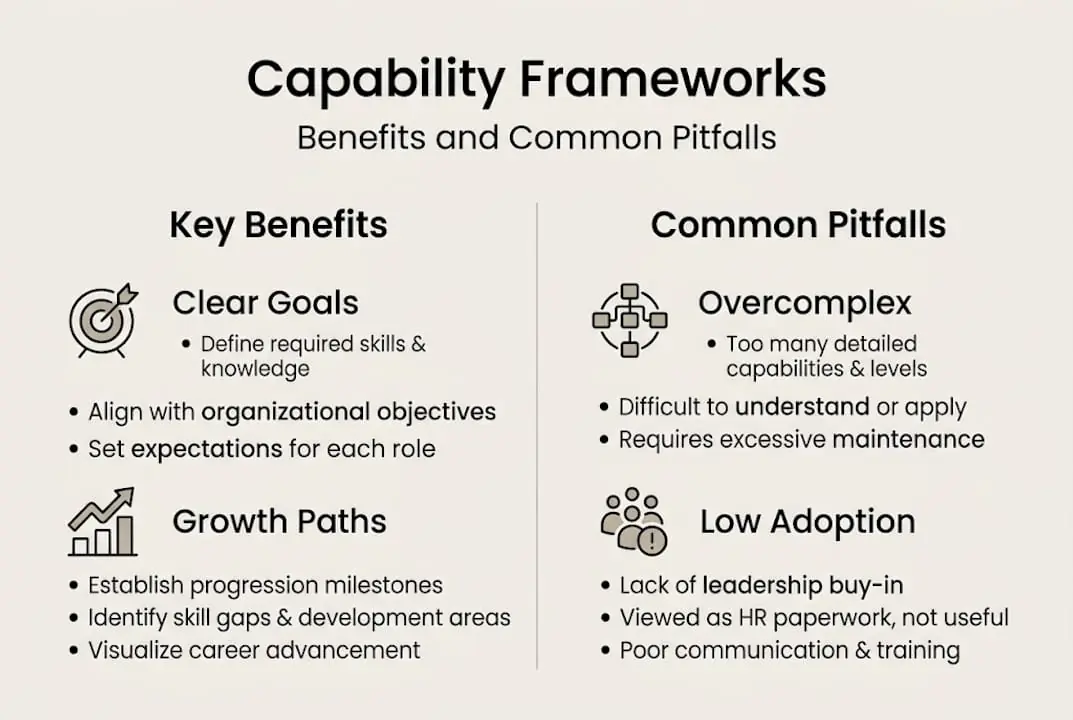
- Over-complex frameworks: Fifty competencies across twelve levels sounds thorough. In practice, nobody uses it. Simplify aggressively.
- No leadership buy-in: If managers don’t use the framework in their 1:1s and performance conversations, it dies on the intranet. Involve managers from day one, not as an afterthought.
- No follow-through: Frameworks launched with fanfare but never revisited lose credibility fast. Build review cycles into your calendar.
- Unbalanced behavioral and technical mix: Too much focus on technical skills misses the behavioral competencies that actually predict engagement and retention.
Solutions are straightforward once you know the traps:
- Keep documentation concise (one page per role as a rule of thumb)
- Train managers to use the framework as a coaching conversation tool, not a compliance checklist
- Tie framework metrics to business outcomes so leadership sees the ROI
Pro Tip: Set a firm six-month review cadence. Business priorities shift, and your framework needs to shift with them. A framework that drifts out of alignment with reality becomes a source of frustration, not clarity.
Remember, 40% of turnover is linked to manager behavior. Train your managers on how to use the framework in everyday coaching, and you address the biggest retention lever in your business. When assessing employee fit, frameworks give managers an objective lens instead of relying on instinct alone.
Why most capability frameworks fail (and what actually works)
Now that we’ve outlined implementation and pitfalls, let’s step back for a hard look at why so many frameworks fall flat and how to ensure yours makes a meaningful difference.
Here’s our honest take: most capability frameworks are built for compliance, not adoption. They’re created to satisfy an audit, check a box, or impress a board. Nobody actually uses them. The documentation is clean. The impact is zero.
What we’ve seen work is almost the opposite of what conventional HR advice suggests. Forget the polished 60-page framework. Focus instead on the everyday interactions where managers and employees actually talk about performance. That’s where frameworks live or die.
Behavioral competencies are where the real leverage is. Technical skills matter, but they can be taught. How someone navigates conflict, handles ambiguity, or builds trust with teammates? Those patterns are deeply rooted. A framework that identifies and develops behavioral strengths keeps people engaged far longer than one focused on technical checklists.
The organizations that get lasting results treat their framework as a living conversation, not a static document. They connect framework data directly to employee development tools so that growth feels tangible and immediate. Manager adoption, continuous realignment, and a genuine commitment to development are what separate frameworks that stick from frameworks that gather digital dust. 💡
Next steps: Empower your HR strategy with smarter tools
With the right strategy and tools, you’re ready to empower your business with frameworks that make a meaningful difference.
Building a capability framework is a strong start, but pairing it with the right technology is what drives lasting results. Sparkly is designed to help HR teams like yours do exactly that. We assess personality, not just skills, because skills can be learned while behavioral fit predicts long-term success. By merging human insight, AI, psychometric data, and Human Design, Sparkly surfaces higher-probability insights your team can act on immediately.
Explore SaaS solutions for HR that complement your capability framework and keep alignment sharp over time. Browse our top talent evaluation tools to find the right fit for your team size and HR maturity. And if you’re ready to reduce turnover costs now, start with our fit assessment guide for a practical roadmap. ⚡️
Frequently asked questions
How do employee capability frameworks reduce turnover?
Capability frameworks create clear expectations and visible career paths, which directly improve engagement. Strong competency frameworks are linked to retention improvements of 35% or more through structured development and role alignment.
What should be included in an effective capability framework?
At minimum, define key skills, behaviors, and competency levels for roles, and pair each with a clear development plan that shows employees how to grow within your organization.
How often should frameworks be reviewed or updated?
Review your framework every six months to keep it aligned with shifting business priorities and team needs. Annual reviews alone are too infrequent to catch meaningful drift.
Which assessment tools help with capability frameworks?
AI-driven skills passports, pulse surveys, and modern assessment platforms can automate framework tracking and flag alignment issues in real time before they become retention problems.