Employee assessment explained: what it is and why it matters

TL;DR:
- Employee assessments should be continuous, multi-source, and focus on growth rather than just past performance.
- Biases like recency, halo, and affinity can distort evaluations, especially when data is limited or biased.
- Combining human judgment, diverse data, and AI cautiously enhances fairness and talent development.
Most HR managers assume that adding more data points to an evaluation makes it fairer. Structured rating scales, productivity dashboards, and standardized forms feel reassuringly objective. But even the most carefully designed systems carry hidden assumptions that can quietly disadvantage certain employees while rewarding others. Subjectivity is inevitable even in supposedly objective assessment systems. This article breaks down what employee assessment actually is, which methods work and which fall short, where bias hides, and how you can build a process that genuinely supports growth and retention across your team. ⚡️
Table of Contents
- Understanding employee assessment: Definition and purpose
- Common methods: From annual reviews to continuous feedback
- Blind spots and biases in employee assessment
- Leveraging data and AI: Potential and pitfalls
- Making assessment work: Steps for better development and retention
- Rethinking employee assessment: What most guides miss
- Enhance your employee assessment with proven HR solutions
- Frequently asked questions
Key Takeaways
| Point | Details |
|---|---|
| Assessment is multifaceted | Effective employee assessment combines objective metrics and subjective insights for a fuller picture. |
| Bias is a real risk | Even the best-designed systems can hide bias, so regular reviews and diverse methods are critical. |
| AI isn’t automatically fair | AI can streamline evaluation but needs careful oversight to avoid replicating past biases. |
| Growth needs clear feedback | Continuous, actionable feedback supports employee development and boosts retention. |
| Adopt a blended strategy | The best results come from mixing methods and always staying open to refinement. |
Understanding employee assessment: Definition and purpose
Employee assessment is the systematic process of gathering and interpreting information about a worker’s performance, potential, and fit within an organization. It goes well beyond a once-a-year conversation about goals. Done well, it informs promotions, shapes development plans, guides team restructuring, and helps leaders retain the people they most want to keep.
Understanding the role of assessments in HR is foundational before you can improve any part of the process. Assessment is not the same as a performance review, though the two overlap. A performance review is typically a formal, periodic event. An assessment is broader: it can happen continuously, informally, and across multiple sources of input.
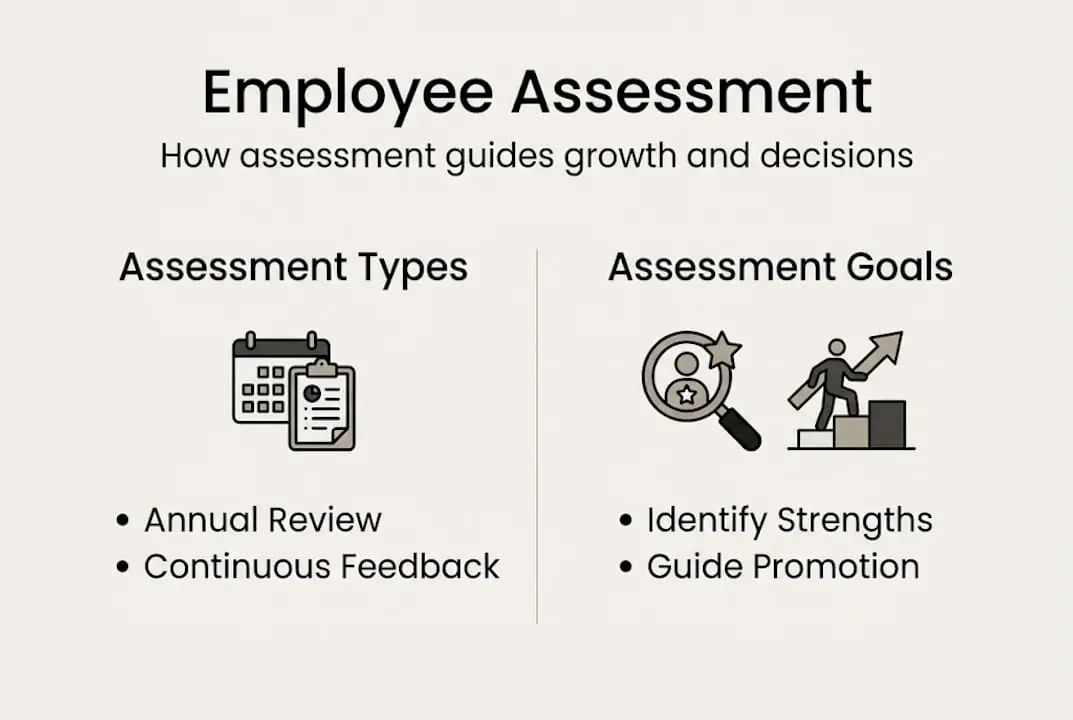
Here is a quick comparison of classic versus modern approaches:
| Dimension | Classic assessment | Modern assessment |
|---|---|---|
| Frequency | Annual or semi-annual | Continuous or on-demand |
| Primary criteria | Output and task completion | Behavior, potential, and fit |
| Feedback source | Manager only | Multi-source (peers, self, AI) |
| Focus | Past performance | Future development |
| Format | Standardized forms | Flexible, narrative, and data-driven |
The shift from classic to modern matters because the goals of assessment have changed. Organizations no longer just want to know who performed well last quarter. They want to know who can grow, who fits where, and who is at risk of leaving. That requires a richer picture than a rating scale can provide.
Key purposes of a well-designed employee assessment include:
- Identifying high-potential employees before they get overlooked or poached
- Informing development conversations with specific, actionable feedback
- Supporting fair promotion decisions by reducing reliance on gut feeling
- Flagging disengagement early so managers can act before someone resigns
- Aligning individual strengths with team and organizational needs
When assessment is treated as a checkbox exercise, it fails all of these goals. When it is treated as an ongoing conversation about people and potential, it becomes one of the most powerful tools in your HR toolkit. 📈
Common methods: From annual reviews to continuous feedback
Organizations use a wide range of methods to assess employees. Each has real strengths and real limitations. Knowing the difference helps you choose the right combination for your team.
-
Annual performance appraisals. The most traditional method. Managers rate employees on a set of criteria once or twice a year. Pros: structured and easy to compare across teams. Cons: annual appraisals are criticized for infrequency and bias, and they often reflect only the most recent weeks rather than the full year.
-
360-degree feedback. Collects input from managers, peers, direct reports, and sometimes clients. Pros: broader perspective, reduces single-source bias. Cons: time-intensive, and peer feedback can be influenced by personal relationships.
-
Self-assessment. Employees rate their own performance and development. Pros: encourages reflection and ownership. Cons: self-ratings are inconsistent across groups and can anchor manager ratings in unhelpful directions.
-
Peer reviews. Colleagues evaluate each other’s contributions. Pros: captures team dynamics that managers miss. Cons: susceptible to affinity bias and social pressure.
-
Continuous feedback systems. Real-time check-ins, pulse surveys, and ongoing coaching conversations. Pros: timely, developmental, and more accurate. Cons: requires cultural buy-in and consistent manager effort.
Pro Tip: No single method gives you the full picture. Combining continuous feedback with periodic structured reviews and at least one external data source, like personality or behavioral assessment, produces far more reliable insights than any one method alone. Explore types of HR assessments to find the right mix for your organization.
For a quick reference on how these methods compare:
| Method | Frequency | Objectivity | Cost | Best use case |
|---|---|---|---|---|
| Annual appraisal | Yearly | Low to medium | Low | Compensation decisions |
| 360-degree feedback | Periodic | Medium | Medium | Leadership development |
| Self-assessment | Flexible | Low | Very low | Reflection and goal-setting |
| Peer review | Periodic | Medium | Low | Team performance |
| Continuous feedback | Ongoing | Medium to high | Medium to high | Retention and engagement |
If you want to go deeper on personality-focused assessment strategies, those approaches add a layer that skills-based tools simply cannot replicate.
Blind spots and biases in employee assessment
Even the most well-intentioned assessment process can quietly reinforce inequity. Bias does not always look like prejudice. It often looks like consistency, pattern recognition, or simply following the data.
Common biases to watch for:
- Recency bias: Overweighting what happened in the last few weeks before the review
- Halo effect: Letting one strong trait color the entire evaluation positively
- Central tendency bias: Rating everyone as average to avoid conflict or extra documentation
- Affinity bias: Scoring people higher when they remind you of yourself
- Metric overload: Treating quantifiable outputs as the only valid measure of contribution
“Self-assessments anchor manager ratings downward for women and people of color, and an overemphasis on quantifiable metrics ignores soft skills that are often central to team success.” Harvard Gazette, 2025
This is not a fringe problem. When self-appraisals are used as a starting point, they can systematically disadvantage employees who already face structural barriers. Employees from underrepresented groups often rate themselves more conservatively, and managers unconsciously calibrate their own scores to match, pulling the final rating down.
Data-driven systems are not immune either. If your performance metrics reward visibility, like speaking up in meetings or leading high-profile projects, employees who contribute in quieter but equally valuable ways will consistently score lower. That is not objectivity. That is bias wearing a spreadsheet.
Reviewing employee fit assessment best practices can help you build a process that accounts for these blind spots rather than amplifying them. 💡
Leveraging data and AI: Potential and pitfalls
AI-powered assessment tools promise something genuinely exciting: scalable, real-time insights that no human reviewer could generate alone. They can analyze patterns across thousands of data points, flag early signs of disengagement, and reduce the inconsistency that comes from having fifty different managers apply the same rubric differently.

But AI can perpetuate data biases unless actively debiased, and that is a significant caveat. If your historical performance data reflects past inequities, your AI model will learn from those inequities and reproduce them at scale.
Specific risks to watch for:
- Historical bias in training data: Models trained on past promotions will favor profiles that match past promotees
- Penalizing non-traditional work patterns: Algorithms that reward linear career paths disadvantage caregivers and career changers
- Proxy discrimination: Metrics like communication frequency can correlate with demographic factors in ways that are hard to detect
- Opacity: Many AI tools cannot explain why they scored someone a certain way, making appeals nearly impossible
Pro Tip: Audit your AI assessment inputs and outputs at least twice a year. Look specifically at whether scores differ systematically by gender, age, or team tenure. If they do, that is a signal to investigate the model, not just the employees.
You can evaluate employee potential with AI effectively, but only when you treat AI as one input among several rather than the final word. Pair it with human judgment, qualitative feedback, and personality data. For a structured starting point, an employee potential checklist can help you build that layered approach. Learn more about the role of AI in recruitment to understand where these tools add the most value.
Making assessment work: Steps for better development and retention
Knowing the risks is only useful if you act on them. Here are five steps you can start implementing now to make your assessment process more fair, more developmental, and more effective at retaining your best people.
-
Audit your current process. Map out every touchpoint where employees are evaluated. Identify which methods you use, who provides input, and how decisions are made. Look for single points of failure where one person’s opinion carries disproportionate weight.
-
Add continuous feedback loops. Continuous or hybrid feedback models create more relevant and effective assessments than annual reviews alone. Even monthly one-on-ones with a structured format make a measurable difference.
-
Diversify your data sources. Combine manager ratings with peer input, self-reflection, and behavioral or personality data. The goal is not to eliminate subjectivity but to triangulate it across multiple perspectives.
-
Train managers on bias. Awareness alone does not change behavior, but structured training combined with calibration sessions, where managers compare and discuss their ratings, significantly reduces inconsistency.
-
Connect assessment directly to development. Every assessment conversation should end with a clear next step: a project, a learning opportunity, or a role adjustment. Assessment without action is just paperwork.
Pro Tip: Use regular team check-ins, not just individual reviews, to catch early warning signs of disengagement. When a whole team’s energy shifts, that is often a signal about the environment, not just individual performance. Explore talent assessment tips for practical ways to make this part of your regular rhythm.
Rethinking employee assessment: What most guides miss
Here is something most assessment guides will not tell you: the relentless pursuit of objectivity can actually make your process worse. When organizations treat subjectivity as the enemy, they often replace human judgment with rigid metrics that look neutral but are not. They strip out the contextual nuance that makes feedback meaningful and actionable.
The most effective assessments we have seen are not the most standardized ones. They are the ones where managers feel empowered to say, “This person is not thriving in this role, but I think they would excel in this other one.” That kind of insight does not come from a rating scale. It comes from genuine observation, trust, and flexibility.
Explicit subjectivity, when it is transparent and multi-sourced, is more honest than hidden subjectivity dressed up as data. Personality-driven approaches are one way to bring that honesty into the process systematically. The goal is not a perfect score. The goal is a clearer picture of who someone really is and where they can genuinely contribute.
Enhance your employee assessment with proven HR solutions
If this article has made you want to rethink how your organization evaluates people, you are already ahead of most. The gap between knowing assessment is broken and actually fixing it is where Sparkly HR comes in.
Sparkly’s platform combines personality data, AI insights, psychometric assessments, and Human Design to give you a layered, higher-probability picture of each employee. It is built specifically for HR managers and business owners who want to move beyond skills checklists and into genuine potential mapping. Explore talent optimization explained to see how this approach works in practice, learn how SaaS in HR transformation is reshaping team development, and browse talent evaluation SaaS solutions to find the right fit for your team.
Frequently asked questions
What is the main purpose of employee assessment?
Employee assessment aims to evaluate performance, identify strengths, and guide decisions about promotions, development, and retention. It is broader than a single review and covers potential and growth alongside past output.
How can bias be reduced during employee assessments?
Using multiple assessment methods, conducting regular audits, and building in continuous feedback all help reduce bias. Hybrid feedback models are especially effective at catching the gaps that single-source evaluations miss.
Are AI-driven assessments always fairer than human evaluation?
Not automatically. AI tools can reduce human inconsistency, but they risk perpetuating bias from historical data unless the model is actively monitored and debiased over time.
What is the difference between performance appraisal and employee assessment?
Employee assessment is broader, covering skills, growth, and potential, while appraisal usually focuses on recent job performance within a defined review period.