
Definition of Workforce Agility: HR Leaders’ Guide

TL;DR:
- Workforce agility is an organization’s ability to quickly reconfigure human resources toward value-creating work. It requires both employee-driven flexibility and adaptable organizational structures to sustain real agility. Measuring redeployment speed and quality helps organizations assess their true agility capabilities.
Workforce agility is defined as an organization’s capability to rapidly redirect its workforce toward value-creating activities, combining employee-driven flexibility with adaptable organizational structures. A 2025 systematic literature review in Management Review Quarterly classifies workforce agility as a micro-agility capability that directly supports broader organizational agility. That framing matters because it positions workforce agility not as an HR program but as a core business capability. The AIHR glossary connects this responsiveness to shifting economic conditions and technological advancement, making the definition immediately practical for HR leaders and business executives.
What is the definition of workforce agility?
Workforce agility is the ability of an organization and its people to swiftly reconfigure work systems and redirect human capital toward the activities that create the most value. A 2026 framework published in the Quantum Journal of Social Sciences and Humanities identifies four core dimensions: cognitive agility, behavioral agility, emotional agility, and learning agility. Each dimension operates at the individual level, but all four must be supported by organizational structures to produce real results. Without that structural support, individual adaptability stays trapped at the team level and never scales.

The agile workforce definition in academic literature consistently highlights two parallel tracks. The first is employee-driven flexibility, meaning people have genuine autonomy over how, when, and what work they do. The second is organizational flexibility, meaning the company has scalable workforce models, adaptable role structures, and clear redeployment mechanisms. Both tracks must run simultaneously. Research confirms that focusing on only one fails to create sustainable agility.
Pro Tip: When auditing your current workforce agility, ask two separate questions: “Can our people adapt?” and “Can our organization redeploy them?” A yes to only one of those questions means you have a gap.
Workforce agility vs. flexibility vs. resilience
| Concept | Core focus | Orientation | HR implication |
|---|---|---|---|
| Workforce agility | Redirect people to value-creating work | Proactive and anticipatory | Redesign roles, build redeployment systems |
| Workforce flexibility | Adjust schedules, contracts, and locations | Reactive and accommodating | Policy changes, remote work, flex hours |
| Workforce resilience | Recover from disruption | Reactive and restorative | Wellbeing programs, crisis response |
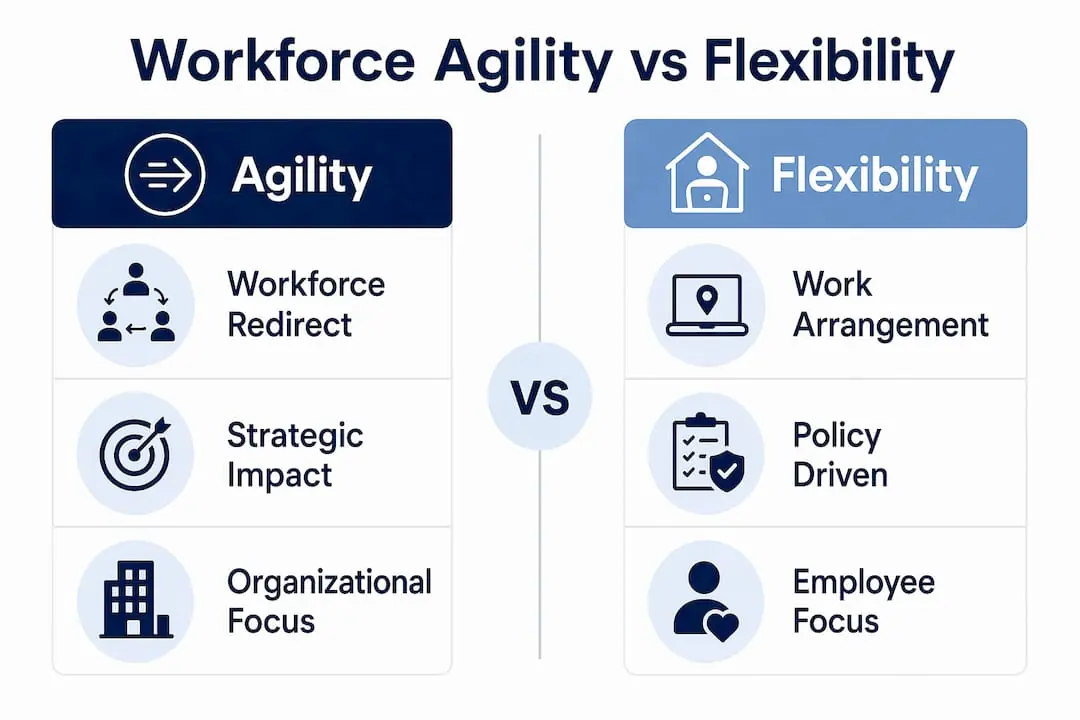
How does workforce agility differ from flexibility and resilience?
Workforce flexibility focuses on labor arrangement adaptations: schedules, locations, and contract types. It supports productivity and satisfaction, but it does not address whether the right people are working on the right problems. That distinction is the gap workforce agility fills. Flexibility asks “where and when do people work?” Agility asks “are people working on what creates the most value right now?”
Resilience is a reactive capability. It describes how well an organization recovers after a disruption, whether that disruption is a market shock, a supply chain failure, or a talent exodus. Agility, by contrast, is proactive. A 2026 Quantum Journal framework explicitly distinguishes agility from resilience by emphasizing anticipation and proactive reorganization rather than recovery. That difference guides how leaders should invest their time and budget.
Key differences HR leaders should keep in mind:
- Flexibility is a policy. Agility is a capability.
- Resilience repairs. Agility repositions.
- Flexibility improves employee satisfaction. Agility improves organizational performance under uncertainty.
- Resilience is built for known disruptions. Agility prepares for unknown ones.
- Workforce agility requires planning, skills’ visibility, and decision rights. Flexibility requires updated HR policies.
Why is workforce agility essential for organizations today?
Organizations that treat agility as a training initiative miss its strategic role entirely. Research argues that workforce agility functions as a micro-agility capability that feeds directly into organizational agility outcomes. That connection means workforce agility is not a people program. It is a competitive mechanism. Companies that build it can redirect talent to emerging opportunities faster than competitors who are still running approval chains.
The business case becomes clearest during disruption. When market conditions shift, the organizations that win are not necessarily the ones with the most skilled employees. They are the ones that can move the right people to the right work fastest. That requires visible skills data, clear decision rights, and pre-built redeployment pathways. Without those systems, even highly capable employees sit in roles that no longer create value.
⚡️ Treating workforce agility as only an HR program misses its strategic role as a micro-agility capability supporting broader organizational agility outcomes. Organizations that make this mistake invest in training and flexibility policies while leaving redeployment mechanisms completely unbuilt.
The importance of workforce agility also shows up in innovation speed. When people can move across teams and functions without bureaucratic friction, knowledge transfers faster and new ideas get tested sooner. That cross-functional movement is not accidental. It requires deliberate organizational agility in HR design, including role architecture that allows lateral moves without requiring full job changes.
How can HR leaders build and measure workforce agility?
Building workforce agility requires an integrated approach that aligns three elements: employee empowerment, continuous learning, and adaptable organizational structures. Treating any one of these in isolation produces partial results. Research confirms that HR must align empowerment and learning with adaptable structures to avoid failure in workforce agility efforts.
A practical implementation sequence for HR leaders and executives:
- Map your skills landscape. Build a real-time picture of what capabilities exist across your workforce. Static job descriptions do not capture this. You need dynamic skills data updated through project work, assessments, and manager input.
- Define redeployment pathways. Identify which roles can absorb talent from other functions and under what conditions. Pre-approved lateral moves reduce decision time from weeks to days.
- Assign decision rights. Clarify who can authorize a redeployment. Ambiguity here is the single most common reason agility initiatives stall.
- Build agile HR practices. Shift performance cycles, project assignments, and team structures to support fluid movement. Annual reviews and fixed team rosters work against agility.
- Measure redeployment speed and quality. Track how quickly people move to new roles and whether those moves produce value. Speed without quality is just churn.
The most useful metric for workforce agility is not employee satisfaction with flexibility. It is the organization’s ability to redeploy people effectively to value-creating work. Measure that, and you measure agility directly.
Pro Tip: Organizations often confuse workforce agility with flexibility policies like remote work. Real agility requires planning and skills’ visibility beyond employee adaptability. Audit your redeployment capability separately from your flexibility policies.
Using HR analytics to track skills gaps, movement patterns, and role fit data gives HR leaders the visibility they need to make redeployment decisions with confidence rather than guesswork. Personality data adds a layer that skills data alone cannot provide. Knowing that someone has a project management certification tells you what they can do. Knowing their cognitive and behavioral agility profile tells you how they will perform under the pressure of a rapid transition.
Key takeaways
Workforce agility is a strategic organizational capability, not an HR policy, and it requires both individual adaptability and organizational redeployment systems to function.
| Point | Details |
|---|---|
| Core definition | Workforce agility is the capability to redirect people to value-creating work, not just offer flexible arrangements. |
| Two required dimensions | Employee-driven flexibility and organizational flexibility must both be present for agility to work. |
| Distinct from flexibility | Flexibility adjusts where and when people work; agility determines whether people work on the right things. |
| Redeployment is the mechanism | Skills’ visibility, decision rights, and pre-built pathways are what make agility operational. |
| Measure the right thing | Track redeployment speed and quality, not just training completion or policy adoption. |
What I’ve learned about workforce agility that most frameworks miss
Most workforce agility frameworks I have encountered focus heavily on the individual. They describe cognitive agility, learning agility, and emotional agility as if building those qualities in employees is sufficient. In practice, I have seen organizations with genuinely adaptable people fail to be agile because the organizational structure would not let those people move. The bottleneck was never the employees. It was the approval process, the budget ownership, and the role architecture.
The insight that changed how I think about this: agility lives at the intersection of individual capability and organizational permission. You can hire the most adaptable people in your industry, and if your structure requires three layers of sign-off to reassign someone, you are not agile. You are just flexible on paper.
What I find most exciting right now is how personality data is reshaping this conversation. Tools like Sparkly are making it possible to assess not just what someone can do but how they are wired to respond to change, ambiguity, and rapid transitions. That data changes redeployment from a gut-feel decision to a computed one. HR leaders who combine skills’ visibility with personality fit data are making redeployment decisions that stick, rather than creating new mismatches under pressure.
The organizations I have seen build genuine workforce agility share one habit: they treat redeployment as a normal business process, not an emergency measure. They practice it before they need it. That mindset shift, from agility as crisis response to agility as operating model, is the most important one any HR leader or executive can make.
— Mikk
Sparkly and the next step in workforce agility
Building workforce agility starts with knowing your people at a deeper level than their job titles and certifications.
Sparkly combines psychometric assessments, personality profiling, and Human Design data to give HR leaders computed insights on role fit, team dynamics, and change-readiness. That means you can make redeployment decisions based on how people are actually wired, not just what their resume says. The employee fit assessment guide 2026 is a practical starting point for HR leaders who want to connect personality data to workforce agility goals. You can also explore Sparkly’s approach to talent optimization to see how personality-first assessment supports faster, smarter redeployment across your organization.
FAQ
What is the definition of workforce agility?
Workforce agility is an organization’s capability to rapidly redirect its workforce toward value-creating activities, combining employee-driven flexibility with adaptable organizational structures. A 2025 systematic literature review classifies it as a micro-agility capability supporting broader organizational agility.
How does workforce agility differ from workforce flexibility?
Workforce flexibility focuses on adjusting schedules, locations, and contracts, while workforce agility addresses whether people are working on the highest-value activities. Flexibility is a policy; agility is a dynamic organizational capability.
What are the key components of an agile workforce?
A 2026 Quantum Journal framework identifies cognitive, behavioral, emotional, and learning agility as the four core individual dimensions, supported by scalable workforce models and adaptable organizational structures at the organizational level.
Why is workforce agility important for business leaders?
Workforce agility enables organizations to move the right people to the right work faster than competitors, which drives innovation speed, sustained performance, and resilience during market disruptions.
How do you measure workforce agility in an organization?
The most direct measure is redeployment effectiveness: how quickly and successfully the organization moves people to value-creating roles. Skills’ visibility, decision rights clarity, and lateral movement frequency are the leading indicators to track.