Build stronger teams with personality-driven alignment

TL;DR:
- Team alignment links daily work directly to organizational goals to boost engagement and reduce turnover.
- Personality assessments help create shared language, improve communication, and align team strengths with roles.
- Sustaining alignment requires embedded operational systems, clear decision rights, and ongoing feedback loops.
Most leaders believe their teams are aligned because everyone nodded along in the last all-hands meeting. But agreement on high-level goals is not the same as alignment, and the gap between the two is where productivity quietly disappears. Team alignment is the degree to which people and teams are oriented toward shared strategic goals, with a clear line of sight from day-to-day work to organizational priorities. When that line of sight breaks down, you get duplicated effort, disengagement, and ultimately, turnover. This article gives HR professionals a practical roadmap to build and sustain real alignment using personality-driven assessments and smart operational systems.
Table of Contents
- What is team alignment really?
- Mechanisms that sustain team alignment âš¡ï¸
- How personality-driven assessments drive team alignment 📈
- From assessment to action: Making alignment stick 💡
- Why most team alignment initiatives fail and what actually works
- Strengthen team alignment with smarter assessment tools
- Frequently asked questions
Key Takeaways
| Point | Details |
|---|---|
| Alignment is actionable | Team alignment means connecting daily work to strategic goals, not just verbal agreement. |
| Mechanisms matter most | Sustained alignment relies on concrete systems like feedback loops and accountability structures. |
| Personality data boosts results | Personality-driven assessments reduce friction, build trust, and link strengths to retention. |
| Embed for lasting impact | Alignment only sticks when built into ongoing HR routines and regular team check-ins. |
What is team alignment really?
Alignment is not a feeling. It is not what happens when everyone leaves a strategy session nodding. Real team alignment is when every person can trace their daily tasks back to an organizational goal, and when teams across functions coordinate without constant friction or confusion.
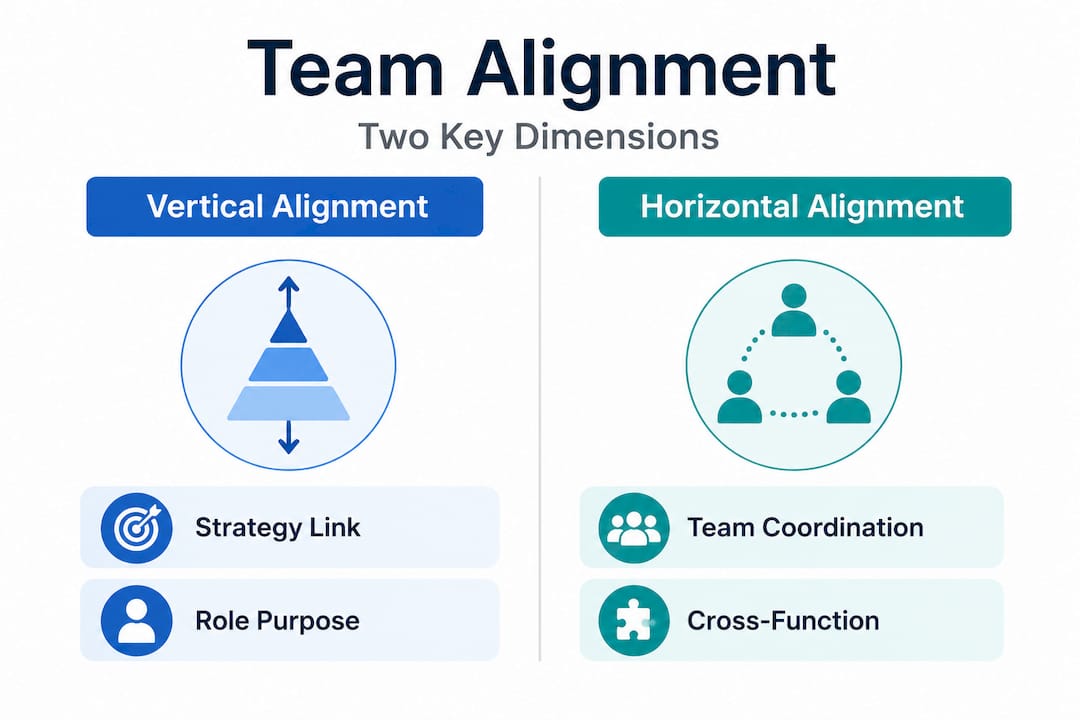
There are two dimensions worth understanding clearly. Vertical and horizontal alignment represent distinct challenges: vertical alignment connects individual roles to company-wide strategy, while horizontal alignment ensures that cross-functional teams coordinate their work without creating blind spots or redundant efforts. Most organizations invest heavily in the vertical dimension through goal-setting frameworks like OKRs or KPIs but neglect horizontal alignment entirely. The result is teams that are clear on their own priorities but have no real mechanism for coordinating with adjacent teams.
Misalignment is expensive. When team members do not see how their work connects to organizational success, engagement drops fast. Disengaged employees are less productive, more likely to seek other opportunities, and often create friction that spreads to otherwise motivated colleagues. The ripple effect is significant.
Here is a quick snapshot of what misalignment typically costs organizations across key performance indicators:
| Metric | Aligned teams | Misaligned teams |
|---|---|---|
| Employee engagement | High | Low to moderate |
| Voluntary turnover | Below industry average | Above industry average |
| Project completion rate | On time and within scope | Delayed, over budget |
| Cross-team collaboration | Smooth and proactive | Reactive and conflict-prone |
| Strategic goal achievement | Consistent | Inconsistent |
The benefits of getting alignment right are not just qualitative. Exploring high-performing workforce strategies consistently points to alignment as one of the core drivers of sustained business performance. When HR leaders take alignment seriously and build it into hiring and onboarding, the impact compounds over time.
Key signs of misalignment worth watching for in your organization:
- Employees cannot articulate how their work connects to company goals
- Teams often “rediscover†work that another department already completed
- Cross-functional meetings generate confusion rather than clarity
- Performance reviews surface surprises that should not be surprises
- High performers leave citing lack of direction or disconnection from purpose
Applying hiring process alignment tips from the start gives you a structural advantage before misalignment has a chance to take root.
Mechanisms that sustain team alignment âš¡ï¸
Knowing what alignment looks like is only the first step. The harder question is how to build the infrastructure that keeps it alive over months and years, not just weeks after a strategy retreat.
Alignment must be sustained via mechanisms that translate strategy into action across leadership layers and teams. That means goal-cascading, structured feedback loops, clear accountability frameworks, and regular cross-team forums. None of these are revolutionary ideas, but most organizations treat them as optional rather than essential.
Here is where most alignment efforts break down:
- Top-down only alignment. Leaders define strategy and cascade it down, but there is no mechanism for teams to push back, ask questions, or flag execution gaps. Information flows one way, and problems accumulate quietly.
- One-off town halls and annual retreats. These events create a surge of energy and clarity that fades within weeks. Without ongoing reinforcement, the shared understanding dissolves into individual interpretation.
- Unclear decision rights and ownership. When teams do not know who owns a decision or a deliverable, execution stalls. Everyone assumes someone else is handling it.
- Misaligned incentives. If performance reviews and bonuses reward individual achievement over team coordination, people will optimize for personal wins at the expense of shared goals.
- Absence of cross-team forums. Without a structured space for teams to share progress and coordinate dependencies, horizontal alignment collapses into siloed execution.
Contrast the two approaches side by side:
| Alignment as agreement | Alignment as operational reality |
|---|---|
| Goals are shared in meetings | Goals are cascaded with clear ownership |
| Teams “understand†the strategy | Teams can act on the strategy independently |
| Feedback is informal | Feedback loops are structured and regular |
| Accountability is assumed | Accountability is explicit and documented |
| Coordination happens ad hoc | Cross-team forums are scheduled and purposeful |
Knowing how to align HR with business strategy operationally transforms alignment from a concept into a system. This is where HR can genuinely lead, not just support.
Pro Tip: Before your next strategy rollout, define decision rights explicitly. Document who owns each initiative, who is consulted, and who is simply informed. This one step prevents more execution failures than any communication training program.
The role of assessments in HR becomes particularly powerful here because assessments help you identify not just what people know, but how they naturally approach decisions, collaboration, and accountability. That insight feeds directly into designing better mechanisms.
How personality-driven assessments drive team alignment 📈
Sustaining alignment is significantly easier when you have reliable data about how your people actually work, not just what they say they will do. This is where personality-driven assessments offer a genuine strategic advantage.

Personality-driven assessments help teams understand work-style and communication preferences, while strengths-based approaches link individual talents to strategic goals and measurably reduce turnover. The key word there is “link.†These tools are not just about self-awareness. They are about creating a shared language that makes collaboration more deliberate and less dependent on luck or chemistry.
When a team has a common framework for discussing how people work, meetings get more productive, role assignments get more intentional, and conflict gets resolved faster. A team member who scores high on analytical thinking and low on spontaneous decision-making is not a problem. They are a predictable pattern that you can design around. Personality data makes that possible.
The evidence is compelling. Organizations using strengths-based approaches see up to 23% higher engagement, 29% higher profit, and 72% lower turnover. Those numbers should get the attention of any HR leader or business decision-maker. More fascinating still, strengths awareness has twice the influence on team performance as strengths composition. In other words, knowing your team’s strengths matters more than having the “perfect†combination of strengths. Awareness drives behavior change.
Here are the direct benefits HR professionals typically see when embedding personality-driven assessments into team operations:
- Clearer communication. Team members understand why colleagues approach problems differently and adapt accordingly.
- Better role clarity. Roles get designed around actual strengths rather than generic job descriptions.
- Reduced team friction. Conflicts that stem from style differences get resolved faster because the team has shared language.
- Higher engagement. People feel seen and valued when their natural way of working is acknowledged and leveraged.
- Improved retention. Employees who fit their role and team culture are significantly less likely to leave.
- Faster onboarding. New team members integrate faster when the team already has a framework for understanding individual differences.
“Teams where people know what makes each other unique outperform teams focused solely on matching the ‘right’ strengths profile. Awareness is the competitive edge.â€
Pro Tip: Do not treat assessment results as a one-time onboarding exercise. Revisit the insights during team retrospectives, when roles shift, and when new members join. The value compounds when it becomes part of your team’s ongoing conversation.
Practical resources on talent assessment for team dynamics and personality-driven assessment strategies give HR teams structured ways to move from data to action without losing momentum between workshops and reviews.
From assessment to action: Making alignment stick 💡
The biggest risk with any assessment initiative is that the insights live in a PDF on someone’s desktop and are never applied. Real alignment requires embedding what you learn into the rhythms of how your teams actually work.
Behavioral assessment tools’ value fades unless embedded in routines through repeated check-ins and consistent attention to friction points. This is not a failure of the tools themselves. It is a failure of implementation. One-time workshops create awareness. Ongoing routines create behavior change.
Here is a practical sequence for making alignment stick after your initial assessment rollout:
- Conduct regular team check-ins. Schedule monthly conversations where team members reflect on how their work connects to organizational goals and where they feel friction. These do not need to be long, but they need to be consistent.
- Review roles against assessment data. Every six months, compare current role requirements to what the assessment data reveals about each person’s natural strengths and working style. Adjust responsibilities where there is clear mismatch.
- Create open feedback channels. Give team members a structured way to raise alignment concerns between formal reviews. Anonymous pulse surveys or structured one-on-ones work well depending on team culture.
- Revisit friction points deliberately. When conflict arises between team members or functions, go back to the assessment data before assuming it is a personality clash. Often, it is a systems problem in disguise.
- Tie alignment activities to business outcomes. Measure the impact of your alignment work. Track engagement scores, project completion rates, and retention alongside your assessment initiatives to demonstrate ROI to leadership.
A holistic HR strategy treats alignment as a continuous process rather than a quarterly event. That shift in mindset is what separates organizations that see lasting results from those that cycle through new frameworks every year with diminishing enthusiasm.
Pro Tip: Integrate assessment findings into performance reviews. When a manager can reference a team member’s personality profile and strengths data during a review conversation, the discussion becomes more objective, more constructive, and more motivating for the employee.
Using a structured talent management checklist ensures you cover every critical touchpoint without letting important steps slip through the cracks as priorities compete for attention.
Why most team alignment initiatives fail and what actually works
Here is an uncomfortable truth: most team alignment initiatives fail not because the strategy was wrong, but because the implementation treated alignment as an event rather than a system. We have seen this pattern repeatedly across mid-sized organizations that invest in offsite retreats, hire consultants, and roll out new goal frameworks, only to find six months later that nothing has really changed.
Alignment alone does not guarantee execution. It must be backed by clear decision rights and operational systems. This is the part that most alignment programs skip entirely. They focus on getting people emotionally invested in a shared vision, which is valuable, but then leave the operational mechanisms undefined. Teams leave energized and walk back into the same ambiguous environment they came from.
The true challenge with alignment is not creating it once. It is keeping it alive as the business evolves, priorities shift, and team composition changes. In a fast-moving organization, alignment has a natural half-life. Without active reinforcement, it decays. This is why focusing as much energy on feedback loops, decision clarity, and accountability systems as on the goal-setting process itself is so critical.
What actually works, based on consistent evidence, is embedding alignment into the everyday systems that govern how people make decisions, collaborate, and get recognized. When your rewards system, your performance review conversations, and your team rituals all reinforce the same priorities, alignment stops being something you achieve and starts being something you maintain organically.
The teams that succeed long-term are the ones where HR has built the infrastructure for alignment, not just the inspiration. Exploring strategies for shifting team members for better retention and personality fit shows how proactive team design, grounded in personality data, prevents the misalignment problems that cause avoidable turnover.
The conventional wisdom says alignment is a leadership communication challenge. We think that framing is too narrow. It is a systems design challenge, and HR is uniquely positioned to lead it.
Strengthen team alignment with smarter assessment tools
If the strategies in this article resonated with you, the next step is finding the right tools to put them into practice. Sparkly is built specifically for HR professionals who want to move beyond surface-level assessments and get to the personality-driven insights that actually predict how people will work, collaborate, and grow within a team.
Sparkly merges four distinct data sources, including human input, AI analysis, psychometric assessments, and Human Design, to surface higher-probability insights that make your hiring and team design decisions significantly more reliable. Because skills can be learned, but personality shapes everything from how someone handles conflict to how they respond under pressure. Explore our guide on personality-focused assessment strategies to see how this approach translates into everyday HR practice. And if you are ready to reduce turnover costs directly, our resource on how to evaluate employee fit gives you a structured, actionable framework to start with.
Frequently asked questions
How do you measure team alignment in practice?
Team alignment is measured by how well employees understand the connection between their tasks and organizational goals, often through surveys, structured check-ins, or assessment tools that track goal clarity and engagement over time.
What is the main benefit of using personality-driven assessments for teams?
Personality-driven assessments reduce friction and build trust by giving teams a shared language for communication and work-style differences, making collaboration more intentional and less reactive.
How does team alignment affect employee retention?
Aligned teams consistently see lower turnover because employees feel valued, understand their purpose, and are engaged in their work, particularly when organizations apply strengths-based approaches that can reduce turnover by up to 72%.
What is the difference between vertical and horizontal alignment?
Vertical alignment connects individual roles to company strategy, while horizontal alignment coordinates cross-functional teams to prevent silos and redundant effort across departments.
Can team alignment be achieved through communication alone?
No. While communication is essential, real alignment requires structured mechanisms that translate strategy into action across teams, including clear decision rights, accountability frameworks, and ongoing feedback loops.