Build high performing teams with personality assessments

TL;DR:
- Personality assessments significantly reduce turnover and increase engagement in teams.
- Building diverse, complementary teams enhances overall performance and collaboration.
- Ongoing integration and leadership modeling are key to sustaining personality-driven team success.
Underperformance and attrition cost mid-sized companies far more than most HR leaders realize. Even well-resourced teams with talented individuals can stall when communication styles clash, strengths go unrecognized, and roles don’t align with who people actually are. The good news? Personality assessments are a proven, underused lever that can change this fast. Strengths-based approaches yield 72% lower turnover, 23% higher engagement, and 29% higher profit. This guide walks you through exactly how to prepare, implement, and sustain high-performing teams using personality insight built for organizations like yours.
Table of Contents
- Why high performing teams start with personality insights
- Essential tools and prerequisites for team transformation
- Step-by-step: How to build and deploy high performing teams
- Verifying success: Measuring, sustaining, and scaling performance
- The reality: What most guides miss about building high performing teams
- Unlock team performance with personality-driven HR solutions ⚡️
- Frequently asked questions
Key Takeaways
| Point | Details |
|---|---|
| Personality matters | Balanced teams built on diverse strengths and personalities outperform homogeneous teams. |
| Integrate, don’t label | For best results, make personality data a continuous part of daily work instead of one-off events. |
| Measure real outcomes | Track engagement, turnover, and psychological safety to verify team-building success. |
| Start with pilots | Piloting on key teams helps work out process issues and demonstrate quick wins before a full rollout. |
Why high performing teams start with personality insights
Most traditional hiring processes focus almost entirely on skills and credentials. Can this person do the job? Do they have the right experience? These are reasonable questions, but they miss something critical. Skills can be learned. Personality, communication style, and how someone processes conflict or collaboration are far harder to shift. When teams are assembled without considering these factors, friction is almost inevitable.
The research backs this up. Teams with complementary personalities achieve a natural balance that homogeneous groups simply can’t replicate. A team of all big-picture thinkers will generate exciting ideas but struggle to execute. A team of all detail-oriented operators will deliver consistently but may resist necessary change. The magic happens when both types work alongside each other with clear roles and mutual understanding.
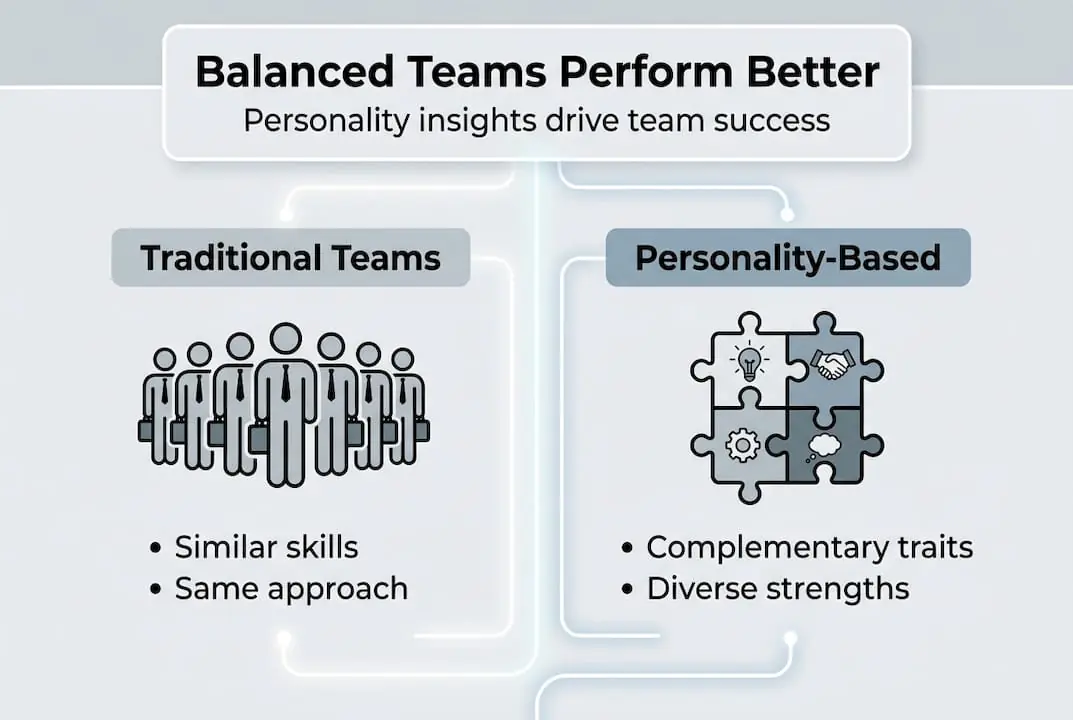
Here’s a comparison that makes the difference tangible:
| Factor | Traditional team building | Personality-driven team building |
|---|---|---|
| Selection criteria | Skills and experience | Skills plus personality fit |
| Conflict approach | Reactive | Proactive role clarity |
| Engagement | Variable | Consistently higher |
| Turnover risk | High | Significantly reduced |
| Performance trajectory | Plateaus | Sustained growth |
The HR assessment types available today go well beyond simple surveys. Tools like CliftonStrengths, DISC, MBTI, and the Big Five each reveal different dimensions of how people think, communicate, and contribute. When used together, they paint a rich picture of your team’s actual composition.
One of the most compelling findings from Gallup strengths insights is that strengths awareness doubles the performance impact compared to simply having strengths present. It’s not enough to have talented people. They need to know their strengths, and so do their teammates. That awareness creates the conditions for genuine collaboration rather than accidental friction.
For HR leaders focused on employee potential evaluation, this reframes the entire conversation. You’re not just assessing who someone is today. You’re mapping how they’ll grow, where they’ll thrive, and which teammates will bring out their best.
Essential tools and prerequisites for team transformation
Moving from theory to practice requires the right tools and a clear starting point. Rushing into assessments without preparation is one of the most common mistakes organizations make, and it leads to wasted budget and skeptical employees.

According to assessment best practices, the most effective approach is to combine standardized assessments like CliftonStrengths, DISC, or MBTI for optimal insight. Each tool has its strengths:
| Assessment | What it reveals |
|---|---|
| CliftonStrengths | Top 34 natural talent themes |
| DISC | Behavioral style and communication preferences |
| MBTI | Cognitive preferences and decision-making patterns |
| Big Five | Core personality traits across five dimensions |
Before you begin, make sure you have these in place:
- Budget approval for assessments, platform access, and facilitator time
- Leadership buy-in from at least one senior sponsor who will model the process
- Current team data including role descriptions, performance history, and existing survey results
- A chosen platform whether that’s an HRIS integration or a dedicated AI-powered SaaS tool
- A communication plan so employees understand why assessments are being used and how data will be protected
Your talent management checklist should also include a plan for how profile data flows into day-to-day decisions, not just onboarding.
One important mindset shift: personality is not destiny. Assessments reveal tendencies and preferences, not fixed limitations. A person who scores as highly introverted can still lead meetings effectively. The data helps you support them better, not box them in.
Pro Tip: Pilot the entire process with one department or a single cross-functional team before rolling it out company-wide. This gives you real data to refine the approach, builds internal advocates, and makes the business case for scaling far easier to present.
Step-by-step: How to build and deploy high performing teams
With your toolkit ready, here’s exactly how to assemble and activate high-performing teams using personality data as your guide.
- Choose your assessments. Select two to three tools that complement each other. CliftonStrengths plus DISC is a popular combination because one reveals what energizes people and the other shows how they behave under pressure.
- Evaluate your current team. Run assessments across the target group. Make participation feel safe and voluntary in spirit, even if it’s organizationally expected. Transparency about purpose drives honest responses.
- Analyze strengths and gaps. Look at the team as a whole. Where are the blind spots? Is there a shortage of strategic thinkers? Too many competing leaders? This is where patterns become actionable.
- Form teams for complementary fit. Use the data to restructure or adjust team composition. Pair people whose strengths offset each other’s gaps. Reference team build step-by-step frameworks to guide grouping decisions.
- Communicate roles clearly. Share relevant profile insights with the team, not to label people but to create shared language. When everyone understands why certain people take the lead in specific situations, trust builds faster.
- Integrate profiles into workflow tools. Add personality summaries to project management platforms or shared team wikis. Make the data visible and usable, not buried in an HR folder.
- Schedule quarterly check-ins. Teams evolve. People grow into new strengths. Roles shift. Regular reviews keep the data current and the strategy alive.
“Integrate assessments into daily workflows, make profiles accessible, create team agreements, and revisit them quarterly. That’s what separates organizations that see lasting results from those that run a one-time workshop and wonder why nothing changed.”
Review your hiring best practices to ensure new hires are assessed consistently from day one, feeding into your team optimization strategies over time.
Pro Tip: Use AI-powered tools for ongoing, dynamic application rather than static annual workshops. The best insights come from continuous data, not a snapshot taken once a year.
Verifying success: Measuring, sustaining, and scaling performance
Once your teams are running, validating impact and ensuring ongoing improvement becomes the priority. Without measurement, even the best personality-driven strategy can lose momentum and executive support.
Start by tracking these metrics before and after implementation:
- Employee engagement scores from pulse surveys or annual reviews
- Voluntary turnover rate broken down by team and department
- Role alignment scores based on manager and self-assessments
- Psychological safety survey data measuring whether people feel safe to speak up
- Team productivity indicators such as project completion rates and quality scores
- Absenteeism trends which often reflect underlying engagement issues
Track metrics including engagement, turnover, role alignment, and psychological safety both before and after implementation to build a clear before-and-after picture. This data is also your best tool for expanding the program across departments.
Consider a mid-sized logistics company that piloted personality-driven teaming in its operations department. Within six months, voluntary turnover dropped by 30% and manager-reported collaboration scores rose significantly. The key wasn’t the assessments alone. It was the ongoing team agreements and monthly check-ins that kept the insights alive.
Teams built on strengths consistently experience higher engagement and retention over time, not just in the first quarter after rollout. Sustaining that requires refreshing assessment data annually, especially after significant team changes or organizational restructuring.
To boost retention at scale, extend the approach cross-departmentally using what you learned in the pilot. Review your talent assessment tips regularly to stay current with evolving best practices. The turnover reduction impact compounds over time when the strategy is embedded into culture rather than treated as a project.
Avoid these common pitfalls in long-term rollout: using assessment results to justify limiting someone’s growth, skipping the communication phase with employees, and failing to update profiles after major life or role changes.
The reality: What most guides miss about building high performing teams
Here’s something most step-by-step guides won’t tell you: personality assessments fail far more often from poor implementation than from poor data. The tool is rarely the problem. The culture around it is.
We’ve seen organizations invest in premium assessments, run a full-day workshop, and then file the results away. Six months later, nothing has changed. Why? Because personality data only creates value when it’s woven into how your team actually operates every day. That means leaders referencing it in one-on-ones, managers using it to assign stretch projects, and teams revisiting their agreements when conflict arises.
Leader behavior is the single biggest predictor of whether this sticks. If your senior team doesn’t model curiosity about their own profiles, employees will treat the whole exercise as an HR checkbox.
Another overlooked risk is over-labeling. When someone becomes “the DISC D-type” rather than a full person, you’ve lost the point entirely. Assessments are a starting point for conversation, not a final verdict. Combine personality insight with skills data, cultural adaptability, and genuine feedback to get a complete picture.
For mid-sized firms, the fastest path to results is piloting, measuring, and iterating. Don’t overhaul everything at once. Start with one team, prove the value, and let the data do the persuading. Explore how shifting team members based on personality fit can produce faster results than restructuring entire departments.
Unlock team performance with personality-driven HR solutions ⚡️
If you’re ready to move beyond guesswork and build teams that consistently perform at their best, Sparkly is designed for exactly that. We combine personality assessments, AI, Human Design, and psychometric data to give HR leaders the clearest possible picture of each person’s potential, not just their current skills.
Explore our personality assessment solutions to see how leading mid-sized companies are using Sparkly to reduce turnover and activate hidden team strengths. Browse our top SaaS tools comparison or discover how SaaS HR transformation is reshaping what’s possible for people-first organizations. Your next high-performing team is closer than you think. 📈
Frequently asked questions
What are the best personality assessments for building high performing teams?
CliftonStrengths, DISC, MBTI, and the Big Five are widely validated tools for assembling balanced, effective teams by identifying individual strengths and communication styles.
How do personality assessments reduce employee turnover?
They improve cultural fit, role alignment, and engagement. A strengths-based approach yields 72% lower turnover and 23% higher engagement compared to traditional methods.
Is it better to have similar or diverse personalities on teams?
Teams with complementary personalities consistently outperform those with all similar types, because diverse strengths and communication styles create natural balance and fill critical gaps.
How can we keep personality assessment data actionable, not static?
Integrate personality data into daily workflows, revisit profiles quarterly, and build a culture of ongoing feedback so insights remain relevant as people and roles evolve.
What should HR track to measure the impact of personality-based teams?
Monitor engagement, turnover, role alignment, and psychological safety before and after implementation to build a clear, defensible picture of program impact.