Bias in hiring: practical guide for HR professionals

TL;DR:
- AI hiring tools often replicate gender and racial biases found in human decision-making.
- Reducing hiring bias through standardized processes and regular audits improves diversity and team performance.
- Combining human judgment with technology oversight ensures fairer, more effective hiring outcomes.
Hiring bias is not just a human problem anymore. AI hiring tools show gender bias 51.9% of the time and racial bias 85.1% of the time in resume screenings, meaning the very technology HR teams trust to be objective is often replicating the same discrimination they are trying to eliminate. If you are an HR professional or hiring manager in a medium-sized enterprise, this guide is for you. We will break down exactly where bias comes from, show you what the research says, and give you practical steps to improve your assessment process starting today.
Table of Contents
- What actually is bias in hiring?
- How bias shows up in hiring: Evidence from research
- Human vs. algorithmic bias: Key differences and pitfalls
- Practical strategies for reducing bias in your hiring process
- Why tackling hiring bias is the real competitive advantage
- Leverage smarter tools for fair hiring decisions
- Frequently asked questions
Key Takeaways
| Point | Details |
|---|---|
| Bias persists in hiring | Both human judgment and technology can introduce or amplify bias, impacting fairness and team quality. |
| AI needs oversight | Auditing and regular monitoring are essential when using AI-powered assessment tools to prevent new forms of discrimination. |
| Actionable steps matter | HR teams can implement standardization, diverse panels, and ongoing reviews to effectively reduce bias. |
| Reducing bias equals results | Companies addressing bias not only improve equity but also unlock a broader talent pool for real business advantage. |
What actually is bias in hiring?
With the stakes clear, it is essential to first clarify what bias in hiring actually means. At its core, hiring bias is any unjustified preference or prejudice that influences a recruitment decision. It does not have to be intentional to cause real harm. In fact, the most damaging biases are often the ones no one notices.
There are two main types to understand:
- Explicit (conscious) bias is when a recruiter knowingly favors or excludes a candidate based on characteristics like gender, race, age, or background. This is less common today but still exists.
- Implicit (unconscious) bias is far more widespread. It operates below the surface, shaping judgments about who “fits” a role based on deeply ingrained stereotypes. A hiring manager might unconsciously rate a resume higher because the name sounds familiar or the candidate attended a recognizable university.
Common forms of bias in hiring include gender bias, racial bias, cultural bias, affinity bias (favoring people similar to yourself), and algorithmic bias. That last one is increasingly important as AI in recruitment becomes standard practice across organizations.
“Bias in hiring is not a flaw in a few bad actors. It is a structural feature of systems built on historical data and human judgment. Recognizing it is the first step to changing it.”
AI resume screening tools show bias favoring men and white-associated names, which means the problem is embedded in the tools themselves, not just the people using them. This is why relying on technology alone is not enough. You need a smarter approach, one that treats personality data in hiring as a critical signal alongside skills and credentials. Personality, after all, shapes how someone learns, adapts, and collaborates. Skills can be taught. Character is harder to change.
Understanding the different forms bias takes is not an academic exercise. It is the foundation for building a hiring process that actually finds the best people, not just the most familiar ones.
How bias shows up in hiring: Evidence from research
Now that bias is defined, let’s examine exactly how it appears throughout modern hiring processes. The research is striking, and it covers every stage from resume review to technical interviews to platform-based freelance hiring.
Key findings from recent studies:
- Women receive 12% lower peer coding interview ratings even when code quality is equal. The work is identical. The rating is not.
- Algorithms on freelancing platforms rank women and Black women lower due to fewer prior jobs, creating a feedback loop where past disadvantage produces future disadvantage.
- LLMs score Indian interview transcripts lower than UK ones, revealing that cultural bias is now embedded in AI-driven interview evaluation tools.
These are not edge cases. They represent patterns across industries and platforms.
| Bias type | Context | Impact |
|---|---|---|
| Gender bias | Coding interviews | 12% lower ratings for women |
| Racial and gender bias | Freelance platforms | Lower algorithmic rankings |
| Cultural bias | AI interview scoring | Lower scores for non-Western accents |
| Name-based racial bias | Resume screening | Preference for white-associated names |
⚡️ Stat to remember: AI tools show racial bias in resume screening 85.1% of the time. That is not a minor glitch. That is a systemic problem.
One of the most important concepts here is intersectional bias. This is when multiple identity factors combine to produce compounded disadvantage. A Black woman, for example, may face both racial and gender bias simultaneously, resulting in outcomes worse than either group experiences alone. Recruitment technology trends in 2026 are beginning to address this, but most tools are still catching up.
The impact on team diversity is real. When bias filters out qualified candidates at scale, organizations end up with homogenous teams that miss out on the cognitive diversity that drives better decisions and stronger performance. Data-driven recruiting can help, but only if the data itself is clean and the tools are regularly tested for bias.

Human vs. algorithmic bias: Key differences and pitfalls
Seeing the scope of the problem, it is important to understand how bias differs between human judgment and technology-driven assessment.
Human bias tends to be inconsistent. One interviewer might favor extroverts. Another might unconsciously prefer candidates who share their educational background. These biases vary from person to person and are difficult to predict. Algorithmic bias, on the other hand, is consistent and scalable. When an AI model is trained on biased historical data, it applies that bias uniformly to every candidate it evaluates. That is both the power and the danger of automation.
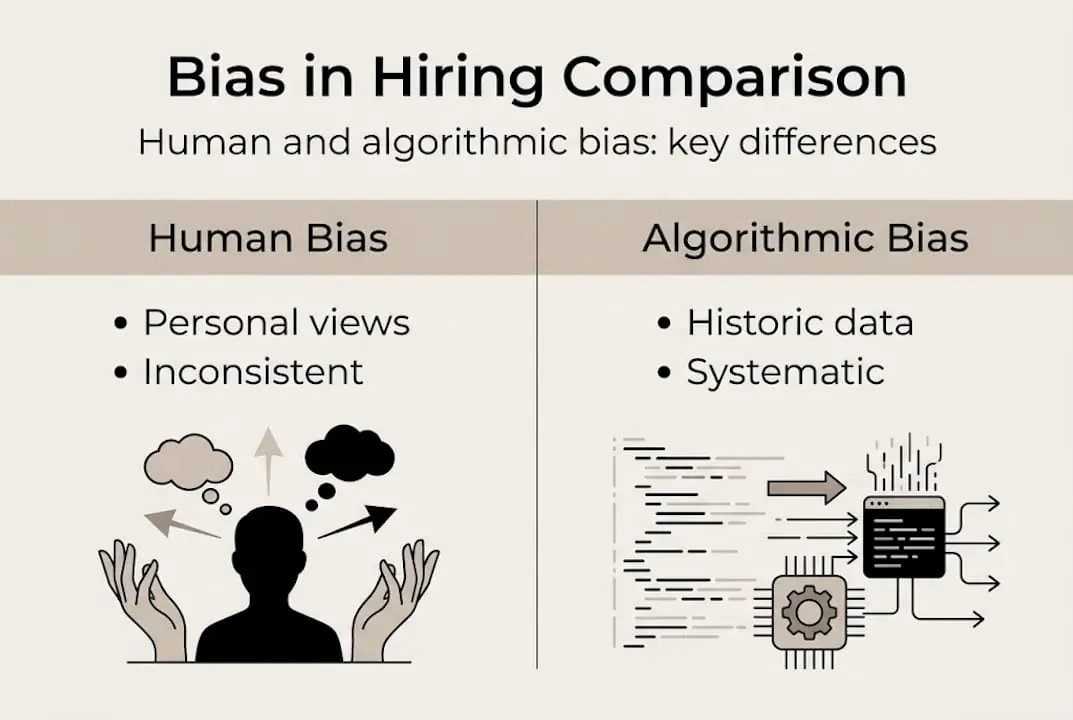
| Factor | Human bias | Algorithmic bias |
|---|---|---|
| Source | Personal experience, stereotypes | Historical training data |
| Consistency | Variable across individuals | Uniform at scale |
| Detectability | Hard to measure | Can be audited with data |
| Risk | Affects individual decisions | Amplifies bias across all decisions |
| Mitigation | Training, diverse panels | Regular auditing, model updates |
AI can outperform human interviewers at some predictive tasks, but it requires active auditing to avoid amplifying bias. This is the critical nuance. Technology is not inherently fairer. It is only as fair as the data and oversight behind it.
Key risks to watch for:
- Proxy discrimination: Algorithms use variables like zip code or job gap that correlate with protected characteristics.
- Feedback loops: AI trained on past hires replicates past patterns, including past exclusions.
- Opacity: Many commercial tools do not disclose how decisions are made, making auditing difficult.
Pro Tip: Before adopting any machine learning in HR tool, ask the vendor for a bias audit report. If they cannot provide one, that tells you something important.
The solution is not to abandon technology. It is to use it with clear eyes and consistent oversight. Understanding recruitment success factors means knowing that no single tool, human or algorithmic, should make decisions alone.
Practical strategies for reducing bias in your hiring process
Understanding the risks is only useful if you know what to do. Here’s how to detect and reduce bias in your organization today.
Bias in hiring can be mitigated with diverse teams, auditing, and well-designed tools. That is the evidence-based starting point. Here is how to put it into practice:
- Standardize your interview questions. Every candidate for the same role should be asked the same questions in the same order. This reduces the influence of personal rapport and keeps evaluations focused on relevant criteria.
- Audit your hiring outcomes regularly. Break down your hiring data by gender, race, and other demographic factors at each stage of the funnel. If certain groups consistently drop off at the same stage, that is a signal worth investigating.
- Review your algorithms. If you use AI screening tools, schedule quarterly reviews of their outputs. Look for patterns that suggest proxy discrimination or demographic skew.
- Build diverse hiring panels. A panel with varied backgrounds is less likely to share the same blind spots. Diversity in the room leads to more balanced decisions.
- Use evidence-based assessment tools. Move beyond gut feel and unstructured interviews. Tools that assess personality, cognitive style, and behavioral tendencies give you richer, more reliable data.
- Create feedback loops. After each hiring cycle, gather data on how new hires perform compared to how they were rated during the interview process. This helps you identify which assessment methods are actually predictive.
Pro Tip: Use an employee potential checklist to evaluate candidates on dimensions beyond skills. Personality fit and growth potential are often stronger predictors of long-term success than credentials alone.
If your current roles feel misaligned with your team’s actual strengths, job redesign software can help you restructure responsibilities to better match the people you already have. Reducing bias is not just about who you hire. It is about how you deploy talent once they are in the door.
Why tackling hiring bias is the real competitive advantage
After practical recommendations, it is worth thinking about the deeper reward for minimizing bias. Most organizations treat bias reduction as a compliance issue. A box to check. A risk to manage. We think that framing leaves enormous value on the table.
When you actively reduce hiring bias, you access a wider, more diverse talent pool. That is not just good ethics. It is a genuine strategic edge. Teams with diverse perspectives make better decisions, catch more errors, and generate more creative solutions. The companies that figured this out early are now pulling ahead.
Here is the uncomfortable truth: “merit-based” hiring does not automatically solve bias. Using data in recruiting shows us that what feels like merit is often familiarity. The candidate who reminds you of a past success. The resume that follows a pattern you recognize. Active mitigation, not good intentions, is what produces fairer outcomes. 📈
Prioritize bias reduction as an ongoing people strategy, not a one-time initiative. The organizations that treat it that way will build stronger teams, faster.
Leverage smarter tools for fair hiring decisions
For those committed to building fairer and more effective hiring, proven tools can accelerate your progress.
At Sparkly, we built our platform specifically to address the gaps that traditional hiring tools leave open. We assess personality first, because skills can be learned but character shapes everything. Our approach merges four data sources: human judgment, AI, psychometric assessments, and Human Design. No single source is reliable on its own. Together, they produce higher-probability insights that HR professionals can actually use in interviews. 💡
If you are ready to move beyond guesswork, explore how SaaS solutions in HR can transform your assessment process. Or take a closer look at our top talent evaluation SaaS to see exactly how Sparkly helps you find and develop the right people, with less bias and more confidence.
Frequently asked questions
What is the most common type of bias in hiring processes?
Unconscious (implicit) bias is most common, affecting decisions through cultural, gender, and racial stereotypes even in tech-led systems. AI screening tools consistently show preference for men and white-associated names, confirming that implicit bias is embedded in both human and automated decisions.
How can HR teams identify bias in candidate assessments?
Regular audits of interview ratings, algorithmic outcomes, and demographic data help reveal hidden and emerging biases in hiring. Algorithms can amplify historical discrimination, so ongoing monitoring is essential, not optional.
Can technology eliminate bias from hiring?
Technology can reduce some forms of bias but can also replicate or amplify it unless AI tools are regularly audited and improved. AI tools replicate and amplify bias without careful oversight, making human review a necessary complement to any automated system.
Why is bias in hiring a problem for business outcomes?
Bias reduces access to talent and diversity, which directly hurts innovation, team performance, and company reputation. Bias affects who is hired and shapes team composition, meaning organizations with unchecked bias are systematically missing out on their best possible hires.