
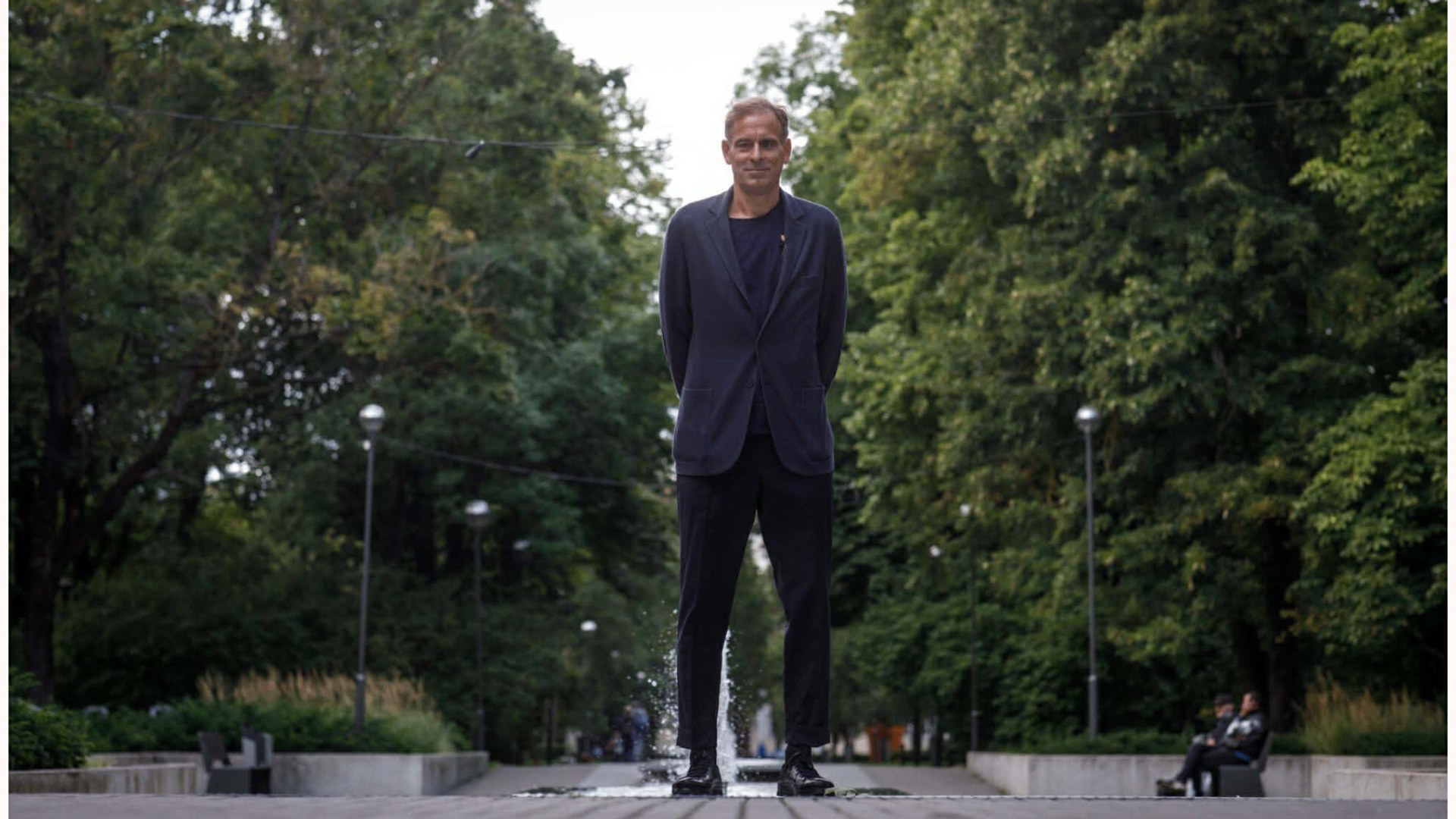
— Rain Lõhmus, majority shareholder of LHV Bank · Interview by Äripäev (Estonia's leading business daily) · Photo: Andras Kralla
Take a moment to look at the photo above. One of Estonia's most recognised owners and a shaper of its capital markets, standing quietly in a park, hands behind his back. His CV does not explain this person. His education, his previous roles, his titles — none of them tell you why this particular environment is where he performs at his best. And that is exactly the heart of the problem.
“There is little to be gained from carefully tallying up the misses of the past — that won't make you much wiser. What matters is finding the right path and starting to walk it briskly.”
Those are the words of Rain Lõhmus, the majority shareholder of LHV Bank, in an interview with Äripäev — Estonia's leading business daily. A sentence that does not fit on any CV — and precisely for that reason it matters more to a hiring manager than any previous job title.
In HR we have spent decades cultivating one habit: ask for the CV, scan previous roles, compare titles, and decide who fits the next position based on that. But honestly — how often has this method let us down? How many "perfect CVs" have turned out to be wrong hires six months later?
The CV measures the past, not the fit
A CV is a document about what someone has done. It is not a document about who they are, what energises them, or in what environment they actually thrive. Three years at a previous employer does not predict whether someone will work well with your team. A certificate does not tell you whether they enjoy the process or merely endure it.
A hiring manager who relies only on the CV makes a decision based on the past and hopes the future will repeat it. In reality, what often repeats is exactly what went wrong before — because the same profile lands in the same misaligned environment.
Energy is the most honest control question
In the human-centred Sparkly approach there is one simple but very honest question we put to every candidate and every current employee:
“At the end of the day — are you drained, or are you full of energy?”
If a person ends the day empty, irritated and depleted, that is a clear signal: the role, the tasks or the environment is not charging them. They may be competent, they may hit KPIs — but they are burning themselves down. The long-term outcome is exit, burnout or a quiet decline.
If a person is physically tired but mentally energised, they are in the right place. This distinction is the foundation of Sparkly's core focus: realise human strengths so that work adds energy rather than taking it away.
What actually works — Environment ↔ Person Fit
Hiring accuracy does not improve by adding yet another technical test. It improves through a holistic view of how a person and an environment interact. That view comes from the Environment–Person Fit family of theories — a research line that has shown for decades that performance is born from the alignment between person and context, not from the person alone.
Sparkly combines several recognised frameworks to give a hiring manager a reasonably accurate overall picture quickly. They do not replace each other — they cover different angles.
The toolbox we use
- Urie Bronfenbrenner's ecological systems theory — examines the micro, meso and macro environments in which a person actually functions.
- The Big Five — the five-factor model that provides a reliable foundation for understanding personality.
- The 16 Personality Factors test (16PF) — a finer-grained view of working style, motivation and collaboration patterns.
- Human Design — an additional angle on natural energy usage and decision-making style.
- Additional domain-specific tests — applied deliberately when the role demands it, to push accuracy further.
Why no single test is enough
Let us be honest: no personality test, no framework and no algorithm gives 100% accuracy. Anyone who promises that is lying. Each model narrows the so-called grey area — the part of a person we still cannot see — but no model removes it entirely.
That is exactly why we do not build Sparkly on a single tool. We build on the intersection of several theories. When three independent frameworks point to the same pattern, the signal is far stronger than any single test result.
A human always stays in the process
Sparkly automates the part that is repeatable and structured: data collection, applying the frameworks, comparing patterns, generating reports. But the final round is always done by a person — an experienced HR specialist or the responsible manager.
That round is where the grey area is refined, where the beliefs that matter for the organisation are explored, and where it becomes visible whether the person's inner convictions align with those of the company. This is the place where technology steps back and human judgement leads.
What a hiring manager can do tomorrow
- Stop writing role descriptions only in CV language. Describe the energy, decision style and environment the role actually requires.
- Add the energy question to your interview: "When did you last finish a workday more energised than you started it — and what caused that?"
- Do not make a hiring decision on a single signal. Look for three independent sources pointing to the same pattern.
In closing
The CV is not evil. It is simply outdated as a sole tool. The future of hiring is not reading more CVs faster — it is understanding earlier and more precisely whether the person and the environment truly fit. That is the only way a person gains energy from their work and a company gets a result that does not fall apart six months later.